

Why Nishiki Market is called Kyoto's Kitchen
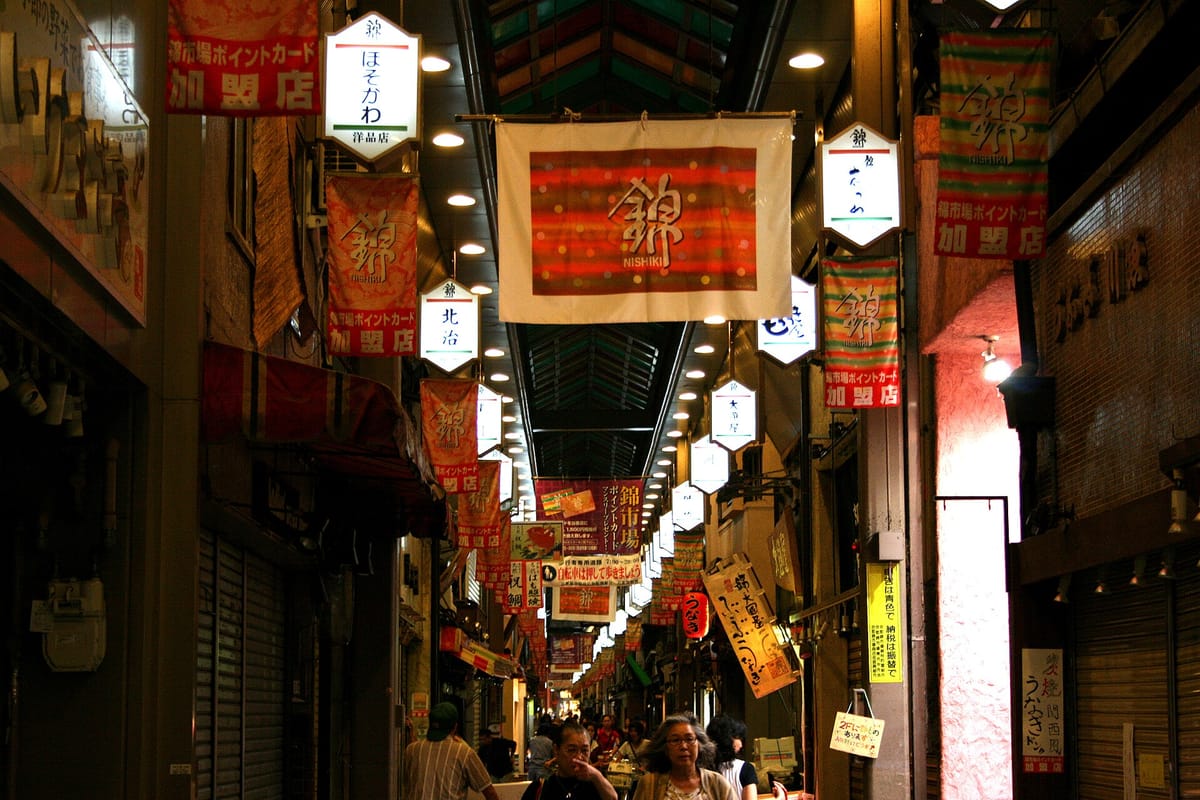
Nishiki Market began as a fish market, helped by the cold, clean groundwater under this part of the city, which was used to keep fish and other fresh food cool. Over the centuries it grew into a retail street selling everything a Kyoto kitchen needs, and the market association calls it 京の台所, Kyō no daidokoro, Kyoto's kitchen.
Walking it today, you pass shops that specialise in just one thing: one sells only pickles, the next tofu and yuba, another only dried fish or tea. Many display their goods in wooden tubs and trays at the front, with handwritten price cards, and have a counter where you can buy small portions to eat on the spot.
For a learner, the market is a vocabulary lesson in food. The kanji on the price cards and banners are the names of Kyoto ingredients, and shopkeepers are used to explaining what things are, so a simple question almost always gets a friendly answer and sometimes a taste.
Getting there: Shijō, Karasuma and Kawaramachi
The market is one block north of Shijō-dōri, Kyoto's main shopping street. For the west end, at Takakura-dōri, take the Karasuma subway line to Shijō Station or the Hankyū line to Karasuma Station, and walk a few minutes east and north. For the east end, take Hankyū to Kyoto-Kawaramachi Station, walk north along the Shinkyōgoku or Teramachi covered arcades and turn left where they meet the market.
From Kyoto Station, the subway to Shijō takes only a few minutes, making the market an easy first or last stop of the day. It is also a fifteen-minute walk from Gion across the Kamo River.
| Japanese | Romaji | Meaning |
|---|---|---|
| 錦市場へはどの出口から出ればいいですか。 | Nishiki Ichiba e wa dono deguchi kara dereba ii desu ka. | Which exit should I take for Nishiki Market? |
| 錦市場はこの通りの一本北ですか。 | Nishiki Ichiba wa kono tōri no ippon kita desu ka. | Is Nishiki Market one street north of here? |
| 寺町通りに出るにはどう行けばいいですか。 | Teramachi-dōri ni deru ni wa dō ikeba ii desu ka. | How do I get out to Teramachi-dōri? |
| 錦天満宮は市場の東の端ですか。 | Nishiki Tenmangū wa ichiba no higashi no hashi desu ka. | Is Nishiki Tenmangū at the east end of the market? |
What to taste from west to east
There is no fixed route; the market is one straight street, and the fun is stopping wherever something catches your eye. That said, a good plan is to walk the whole length once to see what is on offer, and then work your way back buying the things you want to try, eating each at the shop.
What you find depends on the season. Pickles and vegetables change month by month, and winter brings senmaizuke and hot snacks, summer cold tofu and cucumbers. The list below covers the classics to look out for.
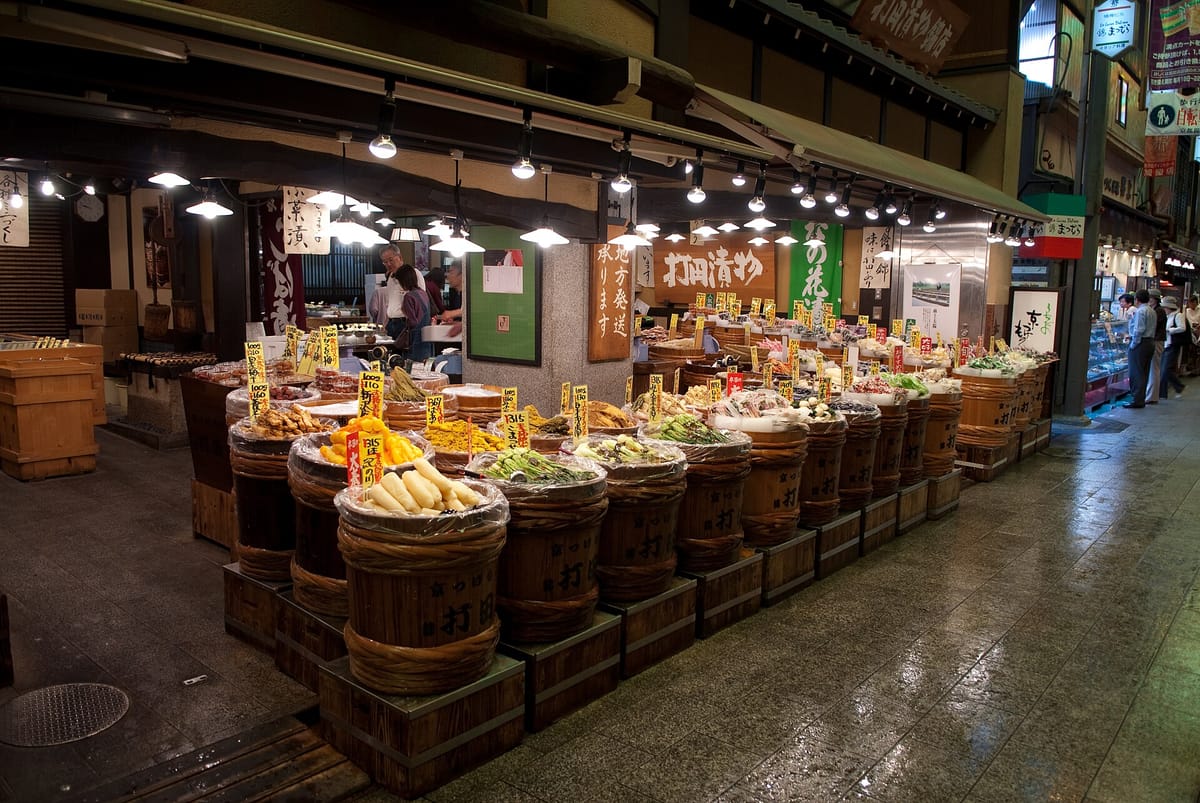
- Tsukemono: Kyoto pickles, often offered as free tastes from little dishes.
- Dashimaki tamago: a thick, juicy rolled omelette made with dashi stock.
- Yuba: the skin that forms on heated soy milk, eaten fresh with soy sauce or dried.
- Namafu: chewy wheat gluten, often grilled on skewers with miso.
- Tako tamago: a small candied octopus with a quail egg in its head, a market favourite.
- Soy milk doughnuts: small, freshly fried and sold by the bag.
- Knives and cookware: long-established shops sell kitchen knives and will often engrave your name.
- Nishiki Tenmangū: the shrine at the east end, dedicated to the god of learning, with a bronze bull to stroke.
Words on the signs and price cards
The words you most need to read at Nishiki are on the notices, not the food. 食べ歩き, eating while walking, appears on signs asking you to refrain, often with ご遠慮ください, please refrain, after it. イートイン, eat-in, and a small stool or counter show where you can eat what you buy.
On the goods themselves, 試食, free sample, is the word to look for. Price cards often show the price per piece, 一個 or 一本, or per 100 grams, and the most common kanji are the names of the foods themselves.
| Word | Reading | Meaning |
|---|---|---|
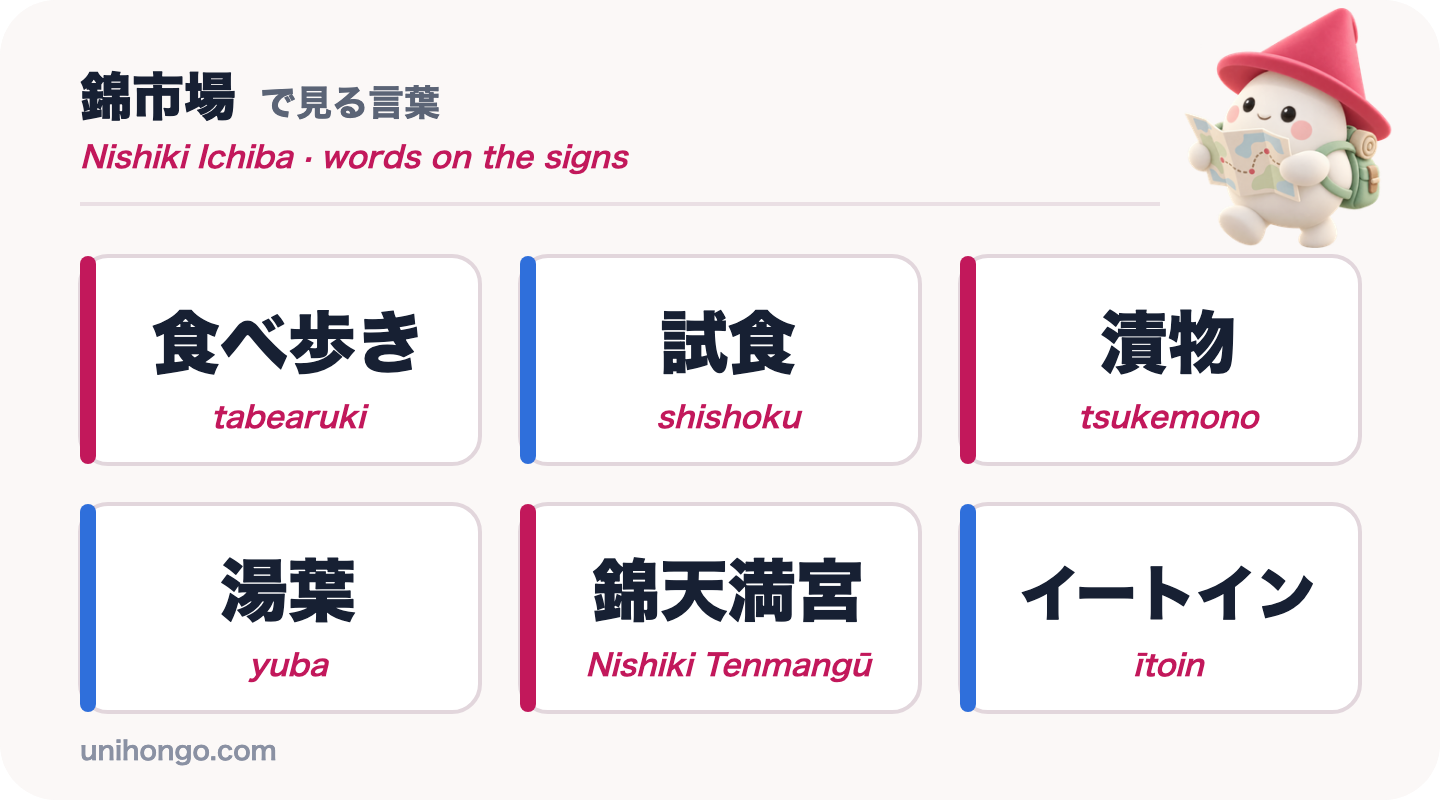
| 食べ歩き | tabearuki | Eating while walking, which the market asks you not to do |
| ご遠慮ください | go-enryo kudasai | Please refrain |
| 試食 | shishoku | Free sample to taste |
| イートイン | ītoin | Eat-in space at the shop |
| 漬物 | tsukemono | Pickles |
| 千枚漬け | senmaizuke | Thin-sliced turnip pickle, a winter speciality |
| 湯葉 | yuba | Tofu skin |
| 生麩 | namafu | Fresh wheat gluten |
| 京野菜 | kyō-yasai | Traditional Kyoto vegetables |
| 錦天満宮 | Nishiki Tenmangū | The shrine at the east end of the market |
Japanese for tasting and buying
Nishiki is a place where pointing and smiling gets you a long way, but a few set phrases turn a transaction into a conversation. Shopkeepers are used to questions about what things are and how to eat them, and asking whether you can try a pickle first is normal where sample dishes are out.
If you want to take food home, ask how long it keeps and whether it can be vacuum packed. Rules on bringing food into other countries vary, so check your own country's customs rules before you buy.
| Japanese | Romaji | Meaning |
|---|---|---|
| 試食してもいいですか。 | Shishoku shite mo ii desu ka. | May I try a sample? |
| だし巻きを一切れください。 | Dashimaki o hitokire kudasai. | One slice of rolled omelette, please. |
| これはどうやって食べるんですか。 | Kore wa dō yatte taberu n desu ka. | How do you eat this? |
| 百グラムください。 | Hyaku guramu kudasai. | One hundred grams, please. |
| 日持ちはどのくらいですか。 | Himochi wa dono kurai desu ka. | How long does it keep? |
| 真空パックにできますか。 | Shinkū pakku ni dekimasu ka. | Can you vacuum pack it? |
| 袋はいりません。 | Fukuro wa irimasen. | I do not need a bag. |
Market manners and timing
Nishiki is a working market that locals and Kyoto restaurants still shop in, and it is only a few metres wide. The market association's requests are simple.
- Eat at the shop where you bought the food, in its eat-in space or beside its counter, not while walking.
- Keep moving with the flow of people, and step to the side of the street, not the middle, when you stop.
- Ask before photographing a shop's goods or staff close up, and do not block a counter for photos.
- Do not touch food on display; ask the shopkeeper instead.
- Take your rubbish back to the shop where you bought the food if it has a bin, or carry it with you.
- Come in the late morning for the most shops open; many close in the early evening and some take a day off midweek.
Practise the pickle shop before you go
The two questions you will ask most at Nishiki are what something is and where you may eat it. Practise the four lines below until you can say them without reading, and listen for the food name in the answer, and for dōzo, please go ahead, when the shopkeeper shows you a seat.
Then practise with someone who answers back. In Unihongo, choose the Shopping topic and ask your AI Sensei to play a stallholder at Nishiki Market, or try the Convenience Store Checkout mission to practise counters, bags and paying. Speaking the lines once before you go is what makes them easy on the day.
| Japanese | Romaji | Meaning |
|---|---|---|
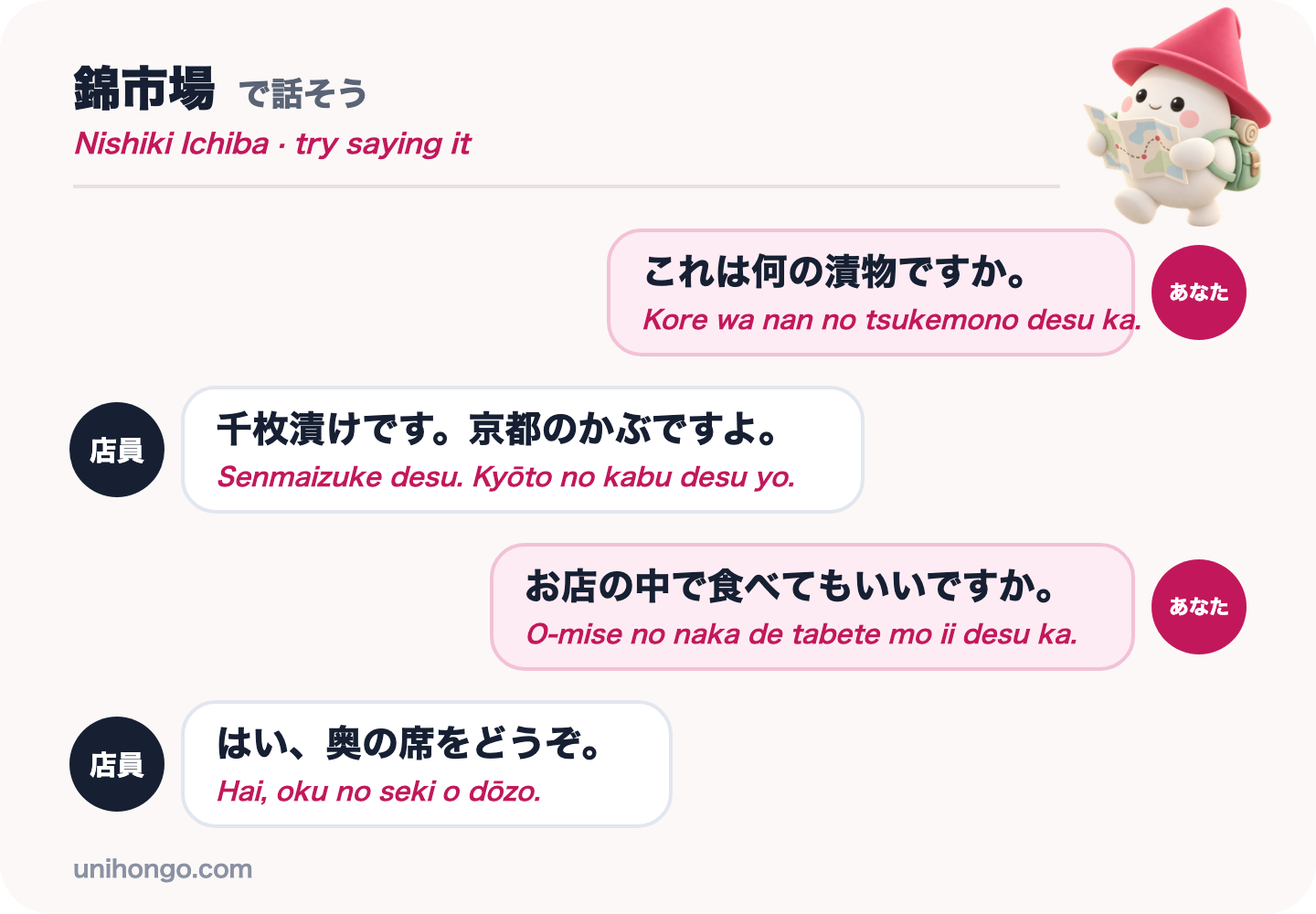
| これは何の漬物ですか。 | Kore wa nan no tsukemono desu ka. | What kind of pickle is this? |
| 千枚漬けです。京都のかぶですよ。 | Senmaizuke desu. Kyōto no kabu desu yo. | It is senmaizuke, made from Kyoto turnip. |
| お店の中で食べてもいいですか。 | O-mise no naka de tabete mo ii desu ka. | May I eat inside the shop? |
| はい、奥の席をどうぞ。 | Hai, oku no seki o dōzo. | Yes, please take a seat at the back. |
Official information
The Nishiki Market shopping street association publishes a map of shops, news and its visitor requests on its website, which has an English version.