

Why Arima Onsen is Kansai's classic hot-spring town
Arima Onsen sits in a valley on the north side of the Rokkō mountains, officially part of the city of Kobe but a world away from its harbour. It is one of the oldest hot springs in Japan, mentioned in early historical records, and is often grouped with Dōgo Onsen in Shikoku and Shirahama in Wakayama as the three ancient springs, Nihon san-kosen.
Its most famous visitor was Toyotomi Hideyoshi, who came here repeatedly to bathe and to hold tea gatherings, and who is credited with reviving the town after a period of decline. His title, Taikō, appears in Taikō no Yu, a large modern bath complex, and a statue of him stands in the town. A statue of his wife Nene stands by the bridge named after her.
What makes Arima special is the water. Few onsen towns have two such different springs: kinsen, a brown, iron-rich, salty water that stains towels orange, and ginsen, clear water with carbonic acid or radon. Trying both, and learning the words for them, is the heart of the visit.
Getting there: Arima Onsen Station, buses and the ropeway
By train from Kobe, take the Seishin-Yamate subway line from Sannomiya, which continues as the Hokushin Kyūkō line to Tanigami. There, change to the Kobe Electric Railway, Shintetsu, towards Arima-guchi and Arima Onsen; some trains need a further change at Arima-guchi. The trip takes about thirty to forty minutes, and Arima Onsen Station is a short walk from the centre of town.
Buses are simpler if you want no changes: direct buses run from Sannomiya and from Osaka, including highway buses from the Umeda area, in around half an hour to an hour depending on the route. A scenic option is to go up Mount Rokkō and ride the Rokkō-Arima Ropeway down into the valley, but check that it is running, since it closes for inspection for a period each year.
| Japanese | Romaji | Meaning |
|---|---|---|
| 有馬温泉行きのバスはどこから出ますか。 | Arima Onsen-yuki no basu wa doko kara demasu ka. | Where does the bus to Arima Onsen leave from? |
| 谷上で乗り換えですか。 | Tanigami de norikae desu ka. | Do I change at Tanigami? |
| 有馬口でも乗り換えが必要ですか。 | Arima-guchi demo norikae ga hitsuyō desu ka. | Do I also need to change at Arima-guchi? |
| ロープウェーは今日動いていますか。 | Rōpuwē wa kyō ugoite imasu ka. | Is the ropeway running today? |
| 金の湯まで歩いて何分ですか。 | Kin no Yu made aruite nanpun desu ka. | How many minutes' walk is it to Kin no Yu? |
What to see and taste in Arima
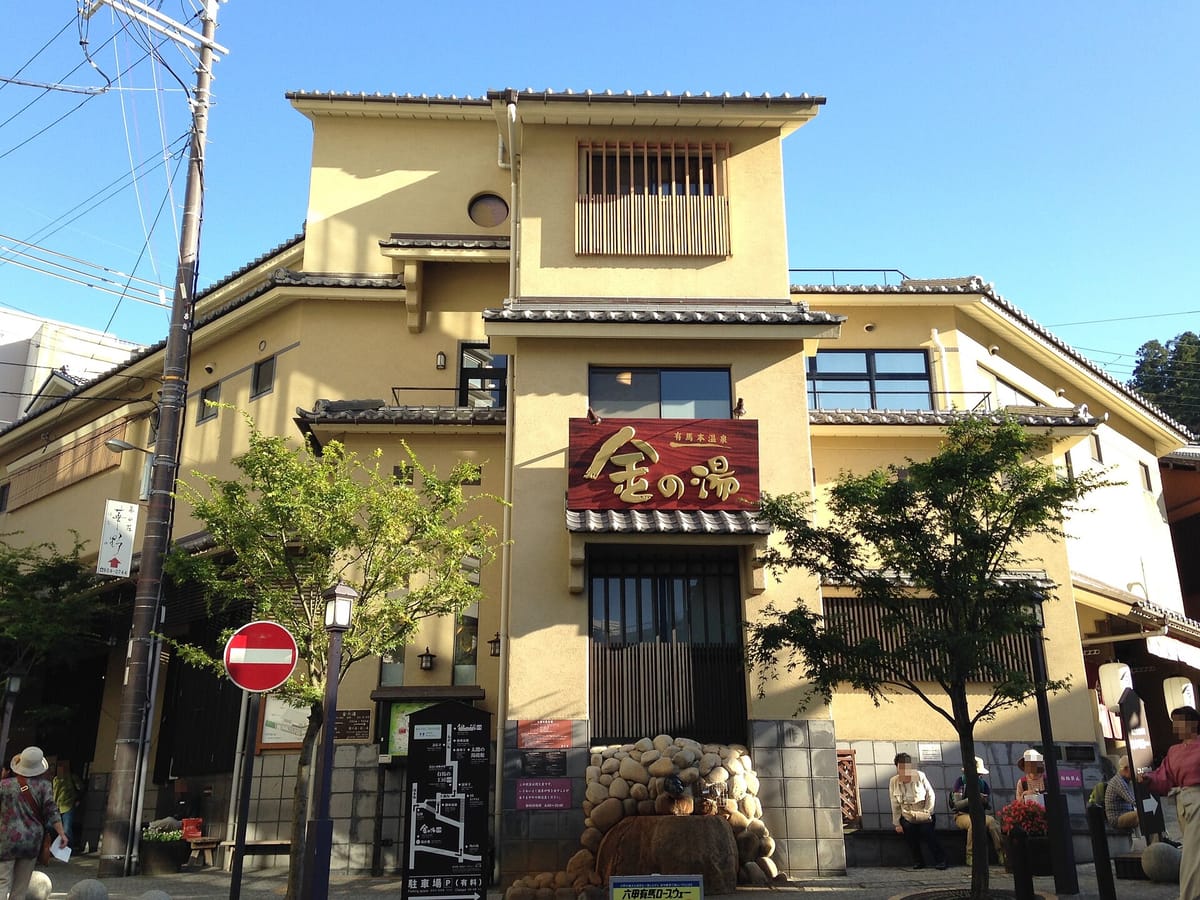
Arima is small enough to walk in an hour, but its lanes are steep and winding. Start at Kin no Yu in the centre, where a small footbath outside lets you dip your feet in the brown water for free. Climb the old lanes behind it to Onsen-ji temple and to the springs themselves: several source springs are fenced and marked around town, including a carbonated spring where the water bubbles up and a hot spring at the source steaming behind a gate.
Arima's snack is tansan senbei, thin crisp wafers made with the town's carbonated spring water and baked in front of you at some shops. You will also see Arima's traditional crafts, such as brushes and baskets, and cider made with the carbonated water.
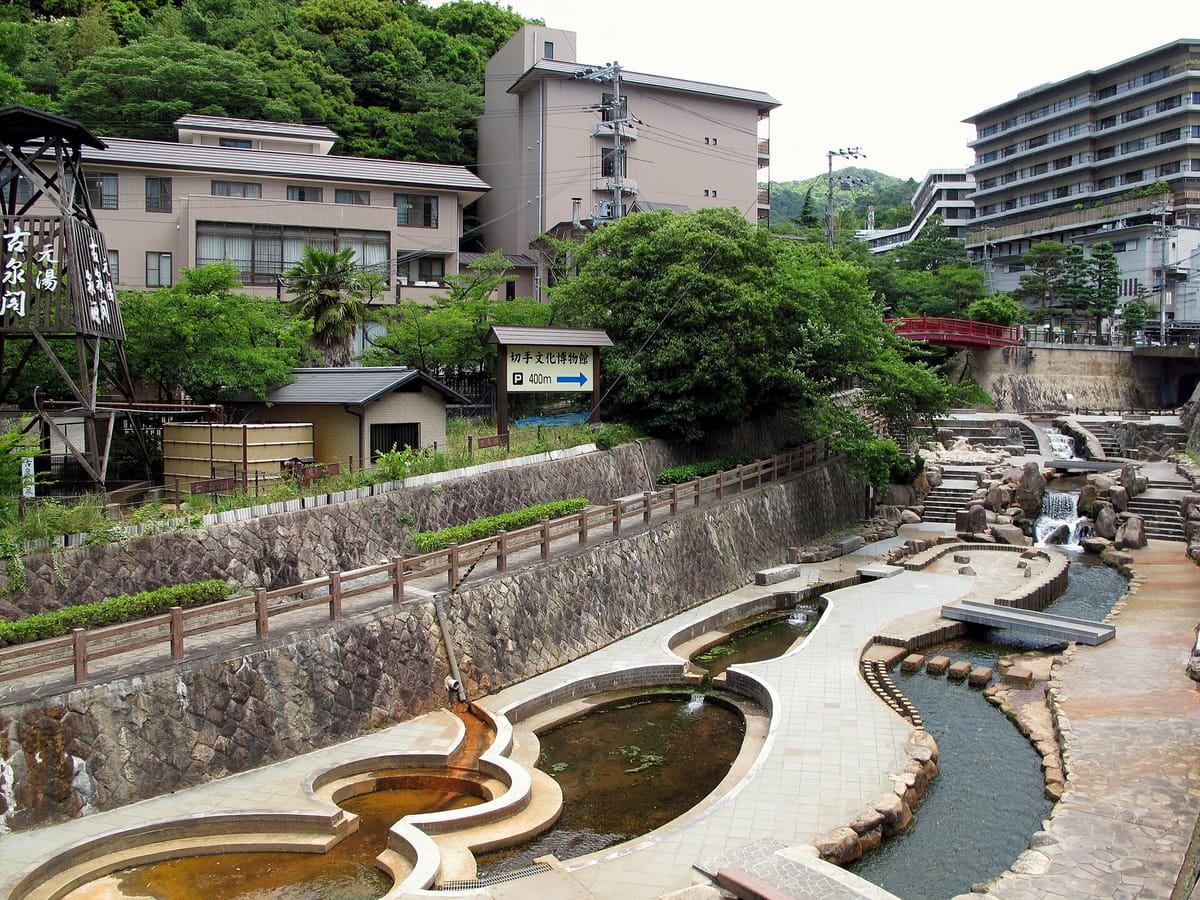
- Kin no Yu: the public bath with kinsen water, and a free footbath outside.
- Gin no Yu: the public bath with ginsen water, a short walk uphill.
- Taikō no Yu: a large bath complex with many kinds of baths, for a longer, pricier visit.
- Tansan Gensen: the carbonated spring source in a small park.
- Onsen-ji and the temples above the town centre.
- The Nene statue and Nenebashi bridge by the Arima River.
- Tansan senbei: carbonated-water wafers, the classic souvenir.
Words on the onsen signs
The single most important sign at any onsen is on the curtain, the noren, that hangs over each bath entrance. 男, otoko, means man and 女, onna, means woman, and at many baths they are also colour-coded, often blue for men and red for women. Many baths swap the men's and women's sides on a schedule, so read the curtain every time, even at a bath you have used before.
湯, yu, means hot water and appears everywhere: 金の湯, Kin no Yu, the gold bath; 男湯, otokoyu, the men's bath. 泉, sen, is spring, as in 金泉 and 銀泉.
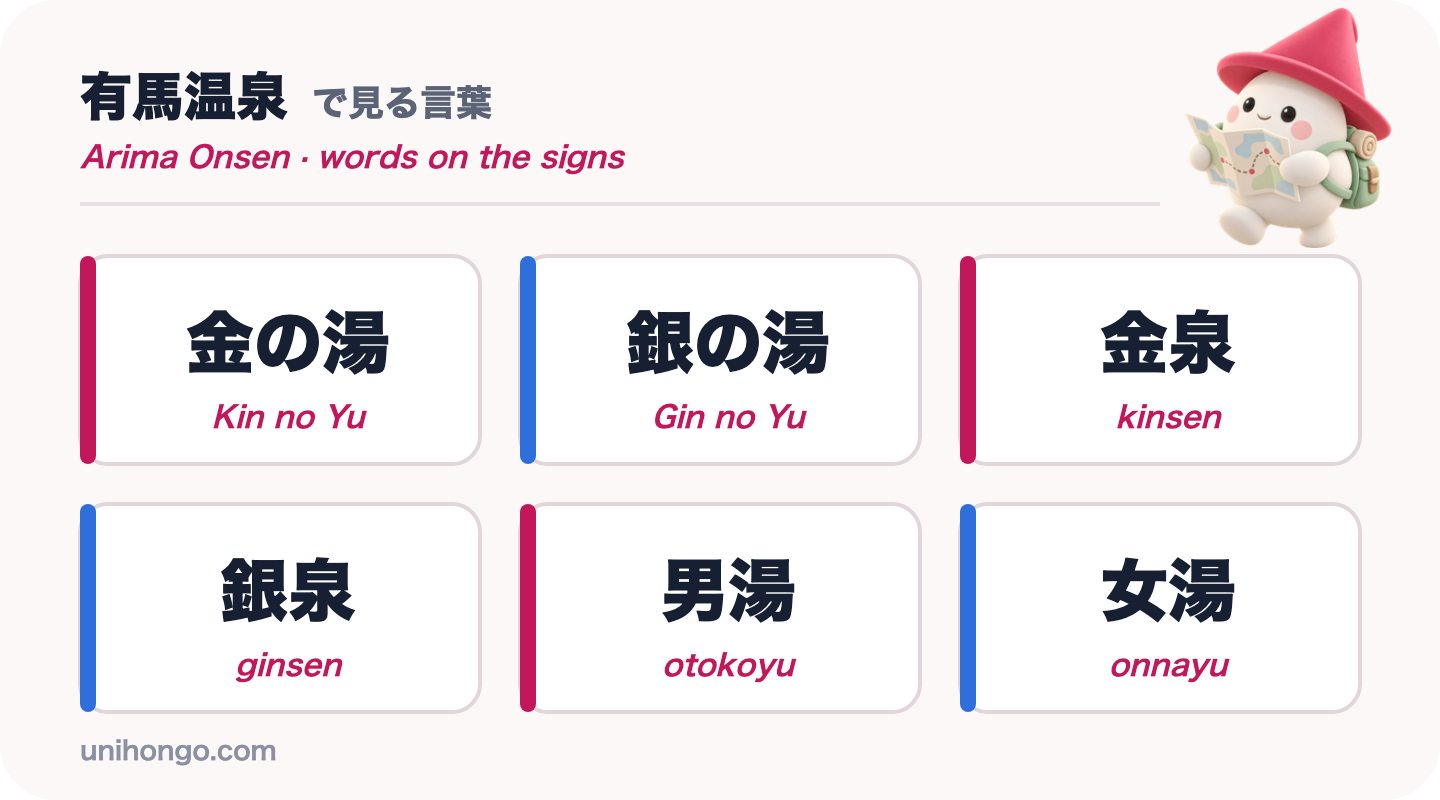
| Word | Reading | Meaning |
|---|---|---|
| 金の湯 | Kin no Yu | The gold-water public bath |
| 銀の湯 | Gin no Yu | The silver-water public bath |
| 金泉 | kinsen | Gold spring, the brown iron-rich water |
| 銀泉 | ginsen | Silver spring, the clear carbonated or radon water |
| 男湯 | otokoyu | Men's bath |
| 女湯 | onnayu | Women's bath |
| 足湯 | ashiyu | Footbath |
| 脱衣所 | datsuijo | Changing room |
| 源泉 | gensen | Source spring |
Japanese for the public bath: paying, towels and the rules
At Kin no Yu and Gin no Yu you pay at a ticket machine or counter at the entrance, then go to the changing room for your side. Towels are not always included, so bring your own or ask whether they sell or rent them. In the changing room you put your clothes in a locker or basket, take only a small towel into the bath, and wash thoroughly at the shower seats before you get into the water.
The phrases below cover what you will need to ask. Staff at the baths are used to first-timers, and a short question in Japanese goes a long way.
| Japanese | Romaji | Meaning |
|---|---|---|
| 大人一人お願いします。 | Otona hitori onegai shimasu. | One adult, please. |
| タオルは売っていますか。 | Taoru wa utte imasu ka. | Do you sell towels? |
| ロッカーの鍵はどうすればいいですか。 | Rokkā no kagi wa dō sureba ii desu ka. | What should I do with the locker key? |
| 男湯はどちらですか。 | Otokoyu wa dochira desu ka. | Which way is the men's bath? |
| タトゥーがあるんですが、入れますか。 | Tatū ga aru n desu ga, hairemasu ka. | I have a tattoo. Can I go in? |
| 金の湯と銀の湯のセット券はありますか。 | Kin no Yu to Gin no Yu no setto-ken wa arimasu ka. | Is there a combined ticket for Kin no Yu and Gin no Yu? |
Onsen etiquette, timing and practical tips
Onsen rules are the same across Japan, and following them makes you welcome everywhere.
- Wash and rinse your whole body at the shower seats before you enter the bath.
- Do not put your small towel in the water; fold it on your head or leave it at the side.
- Tie up long hair so it does not touch the water.
- No swimming, splashing or loud talking, and no photos in the bath or changing room.
- Drink water before and after, and keep your first soak short: kinsen is hot and strong.
- Each public bath has its own closing days and hours, and Kin no Yu closed for renovation in early 2026; check the official site before you go.
Practise the onsen conversation before you go
This exchange is the one you will have with your ryokan host or a shopkeeper. Dochira ga osusume desu ka, which do you recommend?, works whenever you are choosing between two things. Listen for the reply: hajimete nara means if it is your first time, and saka o orite sugu means just down the slope.
Then practise aloud with a partner. In Unihongo, choose the Onsen topic and ask your AI Sensei to play a bath attendant or a ryokan host in Arima, or the Ryokan Stay topic if you are staying the night. Rehearsing the rules and questions once before you go makes your first onsen calm rather than confusing.
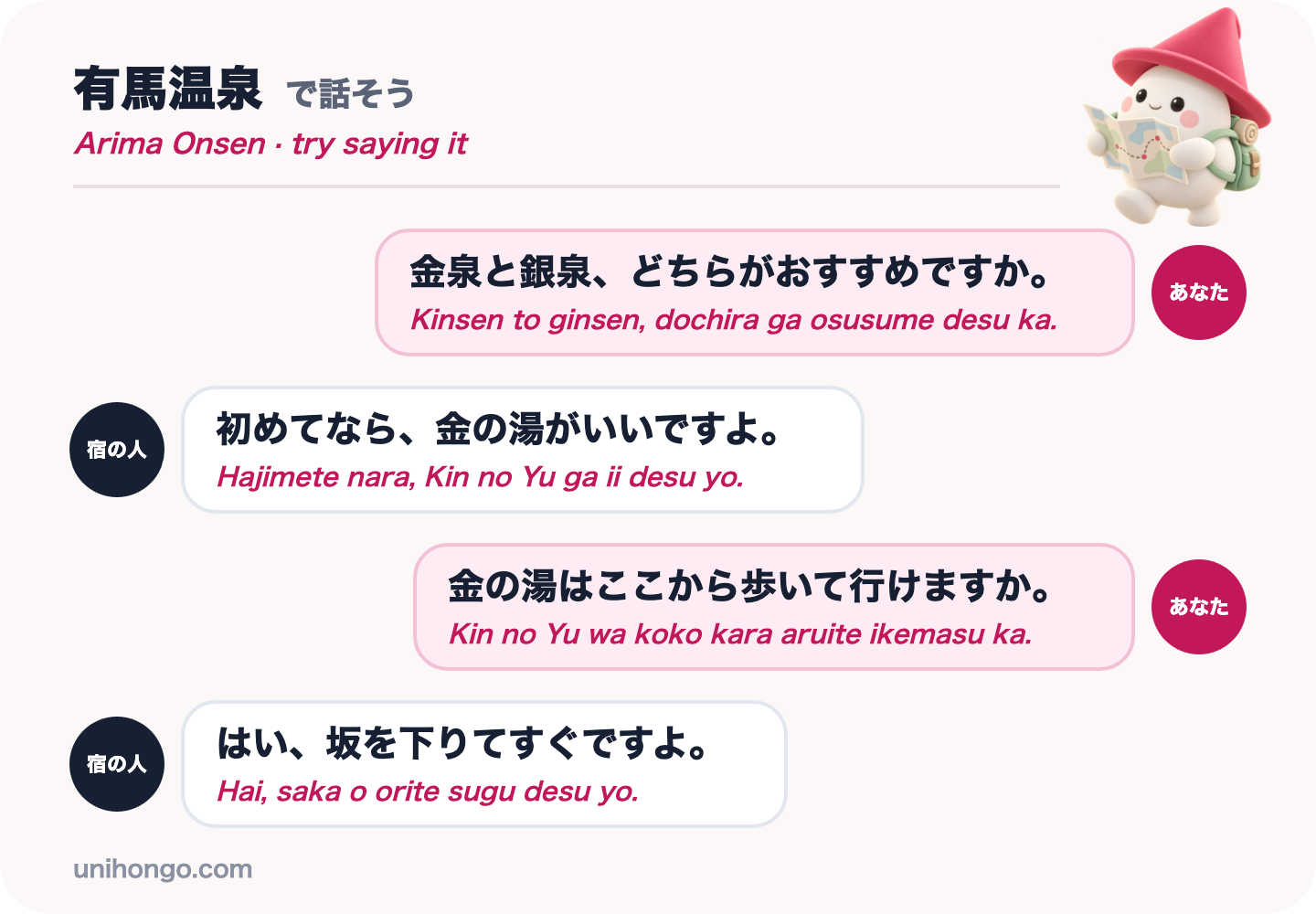
| Japanese | Romaji | Meaning |
|---|---|---|
| 金泉と銀泉、どちらがおすすめですか。 | Kinsen to ginsen, dochira ga osusume desu ka. | Gold spring or silver spring, which do you recommend? |
| 初めてなら、金の湯がいいですよ。 | Hajimete nara, Kin no Yu ga ii desu yo. | If it's your first time, Kin no Yu is a good choice. |
| 金の湯はここから歩いて行けますか。 | Kin no Yu wa koko kara aruite ikemasu ka. | Can I walk to Kin no Yu from here? |
| はい、坂を下りてすぐですよ。 | Hai, saka o orite sugu desu yo. | Yes, it's just down the slope. |
Official information
Arima's tourism association lists the town's baths, sights and access, and the public baths have their own site with current hours, closing days and notices. Check both before you go, especially for closures and the tattoo policy.