

Why Kurama and Kibune are worth the trip north
Most of Kyoto's famous sights sit on the flat valley floor or the hills just around it. Kurama and Kibune feel like a different place: steep, green and quiet, with the sound of water almost everywhere. They are close enough for a half day, and they add something the city cannot, a proper mountain walk through old cedars on a path that pilgrims have used for more than a thousand years.
Kurama-dera covers the mountain above Kurama village. Its main hall, the Honden Kondō, looks out over the northern hills, and the forest paths behind it are tied to legends of the tengu, the long-nosed mountain spirits, and of Ushiwakamaru, the boy who grew up to be the general Minamoto no Yoshitsune and is said to have trained here in swordsmanship. On the far side of the ridge, Kibune is a single road following a stream, lined with inns and restaurants and ending at Kifune Shrine, dedicated to Takaokami, a god of water and rain.
For a learner, the day mixes two vocabularies: temple words on the Kurama side and shrine and restaurant words in Kibune. The signs are clear and not too many, and the people you meet on the trail, walkers, temple staff, restaurant hosts, are used to simple questions about the way and the time.
Getting there: the Eizan Railway from Demachiyanagi
The Eizan Railway, known as Eiden, starts at Demachiyanagi Station, the end of the Keihan Main Line in north-east Kyoto. Take a train on the Kurama Line: Kibuneguchi Station is the stop for Kibune and Kurama Station is the end of the line, about half an hour from Demachiyanagi. Trains are small and run every fifteen to twenty minutes or so. From Kyoto Station, the simplest route is the JR Nara Line one stop to Tōfukuji and then the Keihan line north to Demachiyanagi.
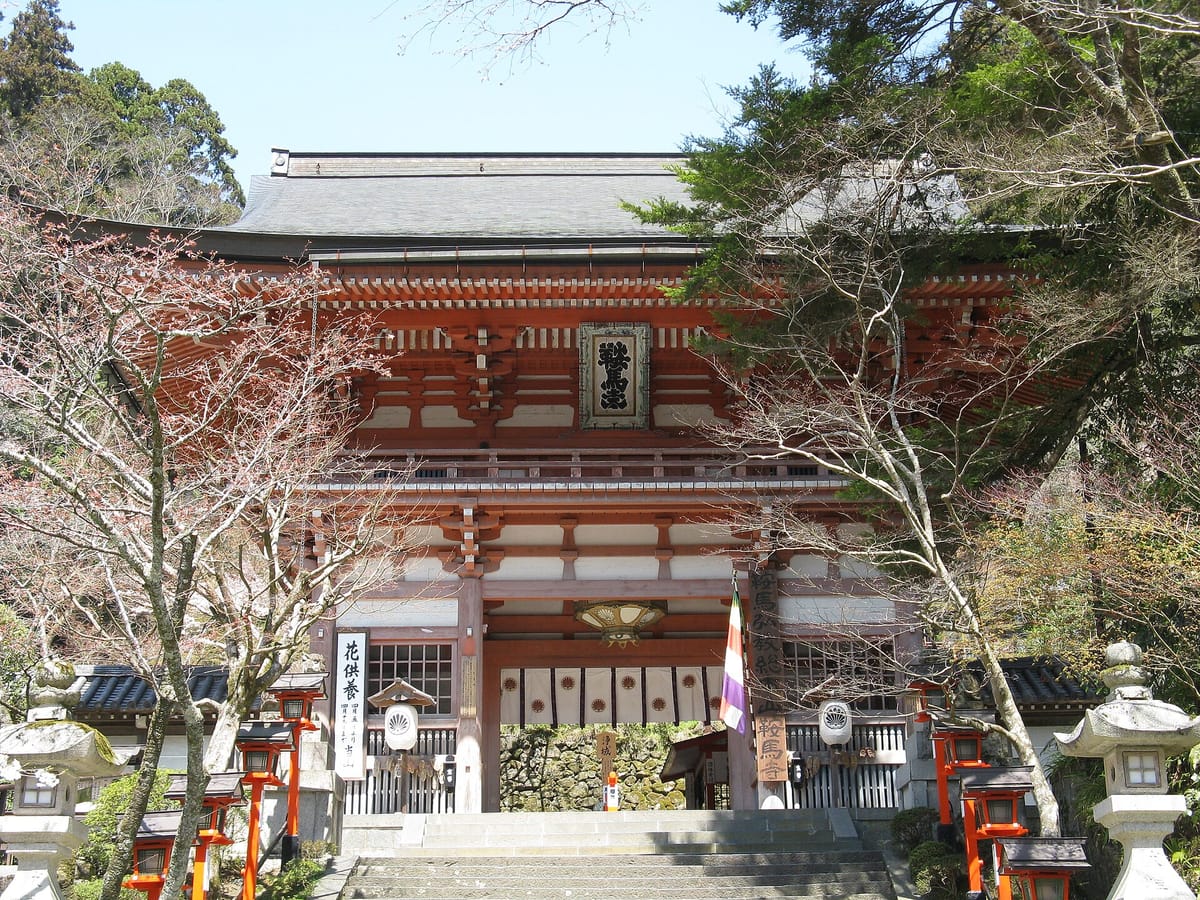
From Kurama Station, the Niōmon gate of Kurama-dera is about three minutes' walk. From Kibuneguchi Station, Kyoto Bus runs up the valley to the Kibune stop, timed roughly to the trains, or you can walk the road in twenty to thirty minutes. Kurama can also be reached by Kyoto Bus from Kokusaikaikan Station on the Karasuma subway line. The shrine asks visitors to come by public transport: parking is very limited and the valley road has traffic controls on summer weekends.
| Japanese | Romaji | Meaning |
|---|---|---|
| 鞍馬行きは何番線から出ますか。 | Kurama-yuki wa nanbansen kara demasu ka. | Which platform does the train for Kurama leave from? |
| 貴船口で降りればいいですか。 | Kibuneguchi de orireba ii desu ka. | Should I get off at Kibuneguchi? |
| 貴船行きのバス乗り場はどこですか。 | Kibune-yuki no basu noriba wa doko desu ka. | Where is the bus stop for Kibune? |
| 鞍馬寺の入口はこの先ですか。 | Kurama-dera no iriguchi wa kono saki desu ka. | Is the entrance to Kurama-dera up ahead? |
| ケーブルカーは今日動いていますか。 | Kēburukā wa kyō ugoite imasu ka. | Is the cable car running today? |
Over the mountain: from the Niōmon to Kifune Shrine
Buy your entry at the Niōmon, where Kurama-dera asks for a small upkeep fee, the aizanhi, that pays for the paths and the forest. From here you have a choice. The cable car, run by the temple itself, climbs to the Tahōtō station in two minutes for a small donation per ride, leaving a ten-minute walk to the main hall. The alternative is the Tsuzura-ori path, a winding stone and earth trail past Yuki Jinja, a shrine with a giant sacred cedar, which reaches the main hall in about half an hour.
Beyond the main hall the walk becomes a mountain trail. The path climbs through cedars to the Ki no ne michi, where the roots of the trees spread across the surface because the rock beneath is too hard for them to grow down. It then passes the Yoshitsune-dō and reaches the Maōden, a small hall in the deep forest honouring Maōson, the temple's guardian spirit. From there it drops steeply to the west gate and the red bridge over the Kibune stream. Turn left along the road and Kifune Shrine is a few minutes' walk upstream.
- Niōmon: the vermilion main gate at the foot of the mountain, where you pay the entry fee.
- Yuki Jinja: a shrine on the Tsuzura-ori path with a great cedar, home of the Kurama Fire Festival in October.
- Honden Kondō: the main hall, with a view over the hills and the patterned stone kongōshō in front of it.
- Reihōden: the temple museum near the main hall; closed on Tuesdays and through the winter months.
- Ki no ne michi: the path of tree roots on the ridge.
- Maōden: the hall of the guardian spirit Maōson, deep in the forest near the Kibune side.
- Kifune Shrine: the Honmiya with its lantern-lined steps, the Yuinoyashiro for matchmaking, and the Okumiya upstream, the original site.
Words on the signs from Kurama to Kibune
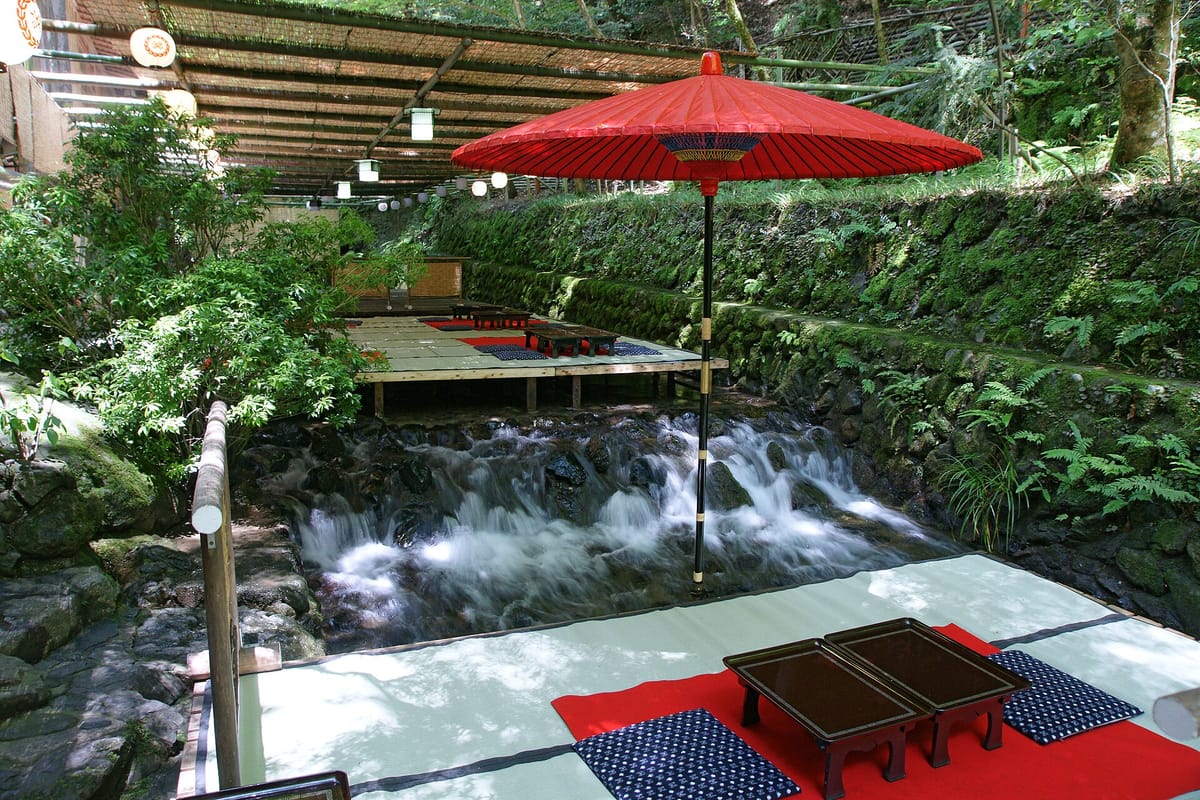
Trail signs on Kurama's mountain give the next building and a time in minutes, 分, so reading 魔王殿 and a number is enough to know where you are. In Kibune, the words change to the shrine and to food: 本宮, 奥宮 and 川床, the platforms over the stream.
Kifune Shrine is famous for its water fortune. You take a blank paper slip from the shrine, lay it on the water flowing from the stone wall before the main shrine, and the characters of your fortune appear. The shrine counts the Honmiya, the Yuinoyashiro and the Okumiya as a set, and visiting all three is called sansha-mairi. It is also the head shrine of some two thousand water-god shrines across Japan.
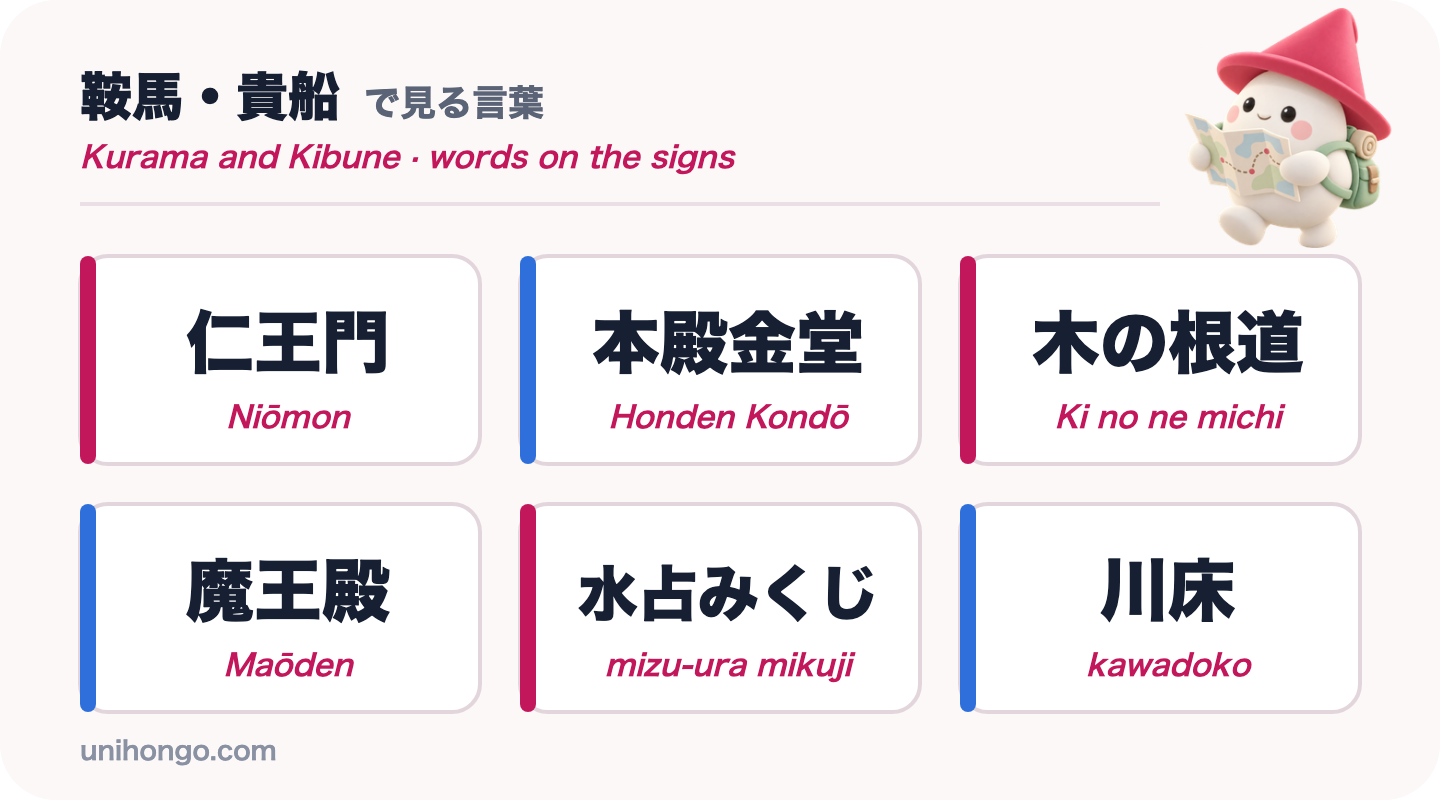
| Word | Reading | Meaning |
|---|---|---|
| 仁王門 | Niōmon | Gate of the two guardian kings, Kurama-dera's entrance |
| 本殿金堂 | Honden Kondō | Kurama-dera's main hall |
| 木の根道 | Ki no ne michi | The path over the exposed tree roots |
| 魔王殿 | Maōden | Hall of the guardian spirit Maōson |
| 西門 | Nishimon | The west gate, Kurama-dera's exit to Kibune |
| 水占みくじ | mizu-ura mikuji | Fortune slip that appears when floated on water |
| 本宮 | Honmiya | The main shrine of Kifune Shrine |
| 奥宮 | Okumiya | The inner shrine upstream, the original site |
| 川床 | kawadoko | Dining platforms built over the stream |
| 愛山費 | aizanhi | Kurama-dera's mountain upkeep fee |
Japanese for a kawadoko meal and the water fortune
A kawadoko meal is the highlight of a summer visit. Most restaurants serve set courses, often based on river fish, tofu or seasonal vegetables, and some offer nagashi sōmen, thin noodles sent down a bamboo channel for you to catch with chopsticks. Book ahead for weekends and evenings, either through the restaurant or by asking your hotel to call.
At the shrine, the Japanese you need is short: ask for the water fortune, ask where to float it and ask how to read it. The paper tells you your luck in general and then gives short lines on topics such as travel, health or waiting for someone, so a few key words go a long way.
| Japanese | Romaji | Meaning |
|---|---|---|
| 川床で昼ごはんを食べたいんですが、予約できますか。 | Kawadoko de hirugohan o tabetai n desu ga, yoyaku dekimasu ka. | I would like lunch on the kawadoko. Can I make a reservation? |
| コースには何が入っていますか。 | Kōsu ni wa nani ga haitte imasu ka. | What does the course include? |
| 雨の日はどうなりますか。 | Ame no hi wa dō narimasu ka. | What happens on a rainy day? |
| 流しそうめんはどこで食べられますか。 | Nagashi sōmen wa doko de taberaremasu ka. | Where can I eat nagashi sōmen? |
| 水占みくじを一つお願いします。 | Mizu-ura mikuji o hitotsu onegai shimasu. | One water fortune, please. |
| どこで水に浮かべればいいですか。 | Doko de mizu ni ukabereba ii desu ka. | Where should I float it on the water? |
| この字は何と読みますか。 | Kono ji wa nan to yomimasu ka. | How do you read this character? |
Shoes, seasons and timing
The walk over the mountain is short, but it is a real trail, not a garden path. A little preparation makes the day comfortable.
- Wear shoes with grip. The Ki no ne michi and the descent to the west gate are uneven and slippery after rain.
- Start in the morning. The cable car and the temple halls close in the late afternoon, and the forest gets dark early in winter.
- Carry water and a small towel; there are few shops between the main hall and Kibune.
- Book kawadoko on summer weekends and evenings; walk-ins are easiest on weekday lunchtimes.
- Expect cooler air than in the city, welcome in summer and cold in winter, when snow sometimes falls on the mountain.
- Check the Kurama-dera notices before you go: the cable car stops for maintenance on some mornings and occasionally for repairs.
- The Kurama Fire Festival at Yuki Jinja on the night of 22 October draws huge crowds and strict crowd control; plan around it unless you have come for it.
Practise the mountain path before you go
Signs on the mountain are good, but there are side paths, and it is reassuring to check with another walker that you are on the way to Kibune. The answer will usually mention the west gate, Nishimon, and a time in minutes. Practise the four lines until you can say them from memory, and listen for the landmark and the number in the reply.
Then practise with a partner who answers back. In Unihongo, choose the Directions topic and ask your AI Sensei to play a local on the trail, or choose Restaurant to rehearse booking a kawadoko table. A question you have spoken aloud once is much easier to ask on a steep path with a map in one hand.
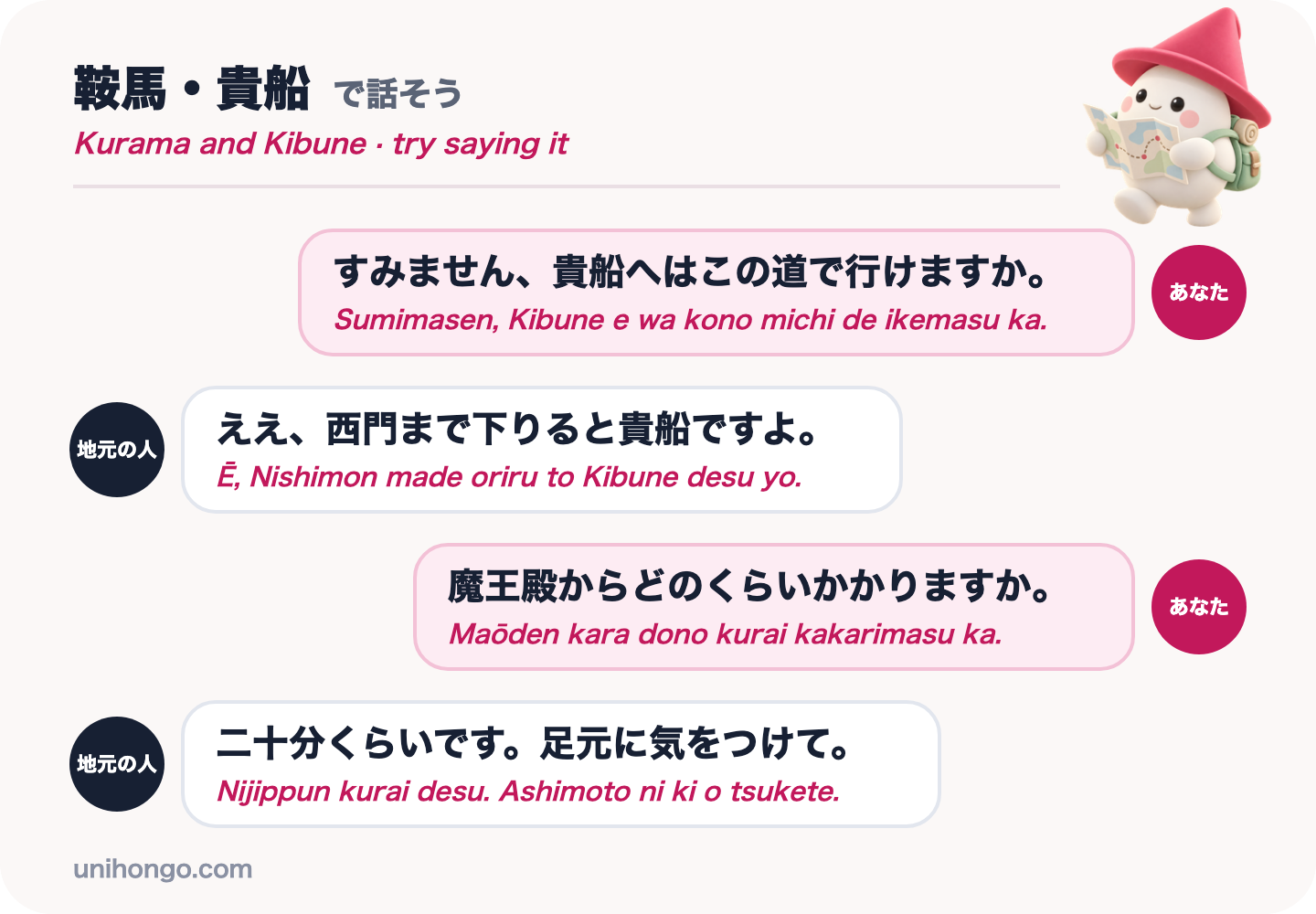
| Japanese | Romaji | Meaning |
|---|---|---|
| すみません、貴船へはこの道で行けますか。 | Sumimasen, Kibune e wa kono michi de ikemasu ka. | Excuse me, can I get to Kibune on this path? |
| ええ、西門まで下りると貴船ですよ。 | Ē, Nishimon made oriru to Kibune desu yo. | Yes, go down to the west gate and you are in Kibune. |
| 魔王殿からどのくらいかかりますか。 | Maōden kara dono kurai kakarimasu ka. | How long does it take from the Maōden? |
| 二十分くらいです。足元に気をつけて。 | Nijippun kurai desu. Ashimoto ni ki o tsukete. | About twenty minutes. Mind your step. |
Official information
Kurama-dera publishes its cable car timetable, maintenance closures and route times on its website, and Kifune Shrine lists its hours, the summer light-up and road restrictions on its own site. Both are in Japanese; check them before you go, especially for the cable car and in August.