
The four lines that find anything
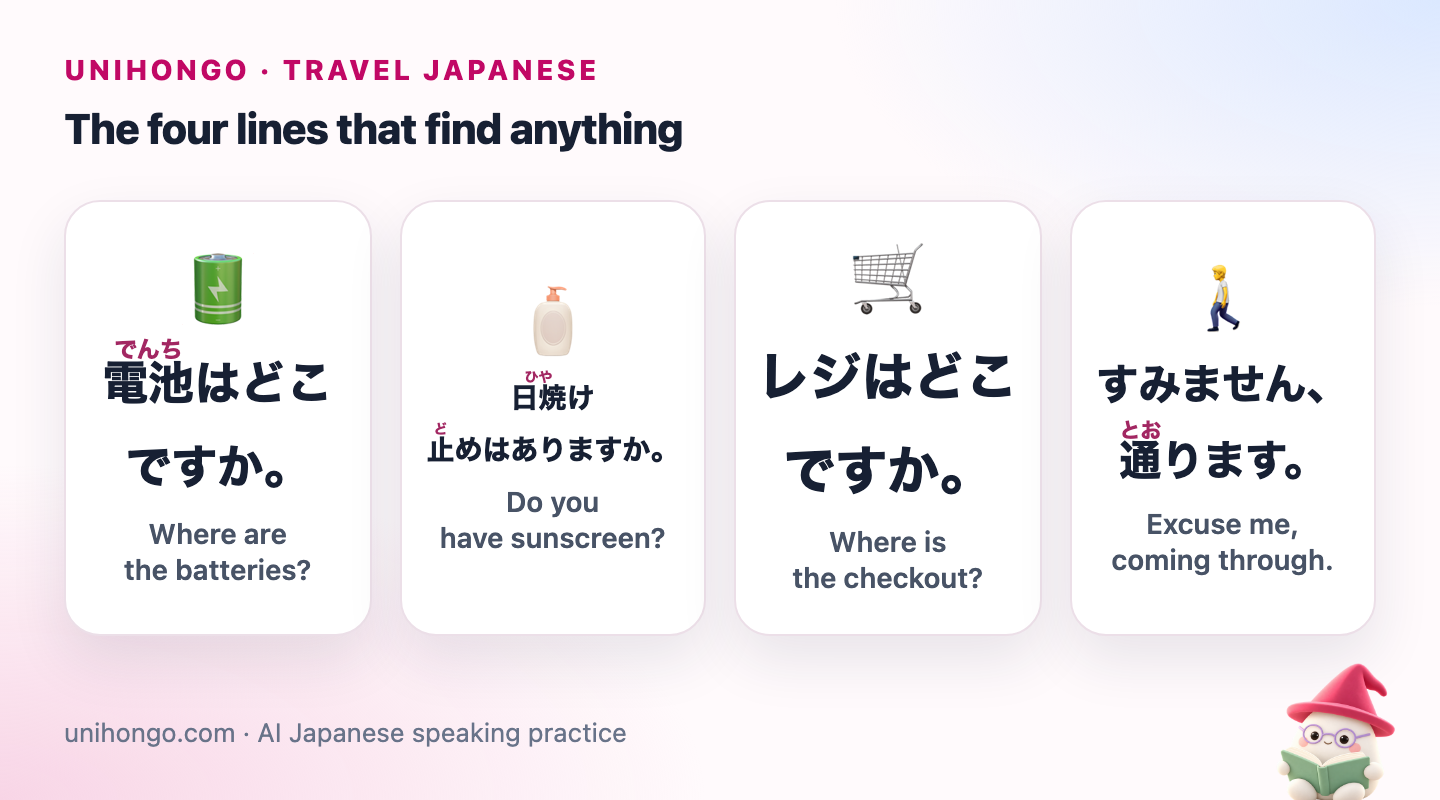
Big discount stores are built like mazes on purpose: shelves are tall, aisles are narrow and products are grouped in ways that surprise first-time visitors. The fastest way to find something is to ask. Start with sumimasen to catch a clerk's attention, then name the item and add wa doko desu ka. If you do not even know whether the shop sells it, use wa arimasu ka.
These four lines cover nearly every exchange you will have on the shop floor. They are all polite desu and masu forms, which is exactly right for talking to staff.
| Japanese | Romaji | Meaning |
|---|---|---|
| 電池はどこですか。 | Denchi wa doko desu ka. | Where are the batteries? |
| 日焼け止めはありますか。 | Hiyakedome wa arimasu ka. | Do you have sunscreen? |
| レジはどこですか。 | Reji wa doko desu ka. | Where is the checkout? |
| すみません、通ります。 | Sumimasen, tōrimasu. | Excuse me, coming through. |
| これと同じものはありますか。 | Kore to onaji mono wa arimasu ka. | Do you have the same thing as this? |
| ほかの色はありますか。 | Hoka no iro wa arimasu ka. | Do you have other colours? |
Understanding the answers: floors, corners and the back
Asking is the easy half. The answer usually comes fast, with a pointing hand and a few location words. Listen for the floor number (ikkai, nikai, sangai; the basement is chika), and for words like oku (the back), mukō (over there, beyond) and tonari (next to). Many clerks will simply say kochira desu (this way) and lead you there, which is a common courtesy in Japanese stores.
| Japanese | Romaji | Meaning |
|---|---|---|
| 二階の奥です。 | Nikai no oku desu. | Clerk: It's at the back of the second floor. |
| あちらの棚にございます。 | Achira no tana ni gozaimasu. | Clerk: It's on that shelf over there (very polite). |
| ご案内します。 | Go-annai shimasu. | Clerk: I'll show you the way. |
| こちらです。 | Kochira desu. | Clerk: This way, please. |
| 申し訳ございません、品切れです。 | Mōshiwake gozaimasen, shinagire desu. | Clerk: I'm very sorry, it's sold out. |
| ありがとうございます、助かりました。 | Arigatō gozaimasu, tasukarimashita. | You: Thank you, that really helped. |
Notice that clerks use gozaimasu, the very polite form of arimasu. You do not need to copy it. As a customer, plain desu and masu is the natural level, and copying the staff's formal service speech can sound odd.
A mini dialogue on the shop floor
Here is a typical exchange. The traveller is looking for a phone charger in a crowded store in the evening. Read it aloud in both roles; the clerk's lines are faster and more formal than yours, and that is normal.
| Japanese | Romaji | Meaning |
|---|---|---|
| すみません、スマホの充電器はどこですか。 | Sumimasen, sumaho no jūdenki wa doko desu ka. | Traveller: Excuse me, where are the phone chargers? |
| 充電器ですね。三階の家電コーナーにございます。 | Jūdenki desu ne. Sangai no kaden kōnā ni gozaimasu. | Clerk: Chargers? They're in the electronics corner on the third floor. |
| 三階ですね。エレベーターはありますか。 | Sangai desu ne. Erebētā wa arimasu ka. | Traveller: The third floor. Is there a lift? |
| はい、あちらの奥にございます。 | Hai, achira no oku ni gozaimasu. | Clerk: Yes, it's at the back over there. |
| わかりました。ありがとうございます。 | Wakarimashita. Arigatō gozaimasu. | Traveller: Got it. Thank you. |
In the aisles: crowds, announcements and the theme tune
City-centre branches can get very busy, especially in the evening, and the aisles are narrow. Japanese shoppers rarely push; they say a short word and wait for a gap. Keep large bags in front of you, keep your basket close to your body, and step aside when someone says sumimasen to you.
You will also hear a lot of sound: a cheerful jingle that plays over and over, and recorded or live announcements. Most announcements follow the same pattern. Honjitsu mo go-raiten itadaki arigatō gozaimasu means thank you for visiting today. Lines about tokka (special prices) or osusume (recommendations) are promotions, and you can ignore them. The ones worth catching are about closing time or about lost children and lost items; if in doubt, ask a clerk ima no anaunsu wa nan desu ka.
| Japanese | Romaji | Meaning |
|---|---|---|
| 本日もご来店いただきありがとうございます。 | Honjitsu mo go-raiten itadaki arigatō gozaimasu. | Announcement: Thank you for visiting us today. |
| お先にどうぞ。 | Osaki ni dōzo. | Please, go ahead. |
| すみません、ちょっと通してください。 | Sumimasen, chotto tōshite kudasai. | Excuse me, could you let me through? |
| 今のアナウンスは何ですか。 | Ima no anaunsu wa nan desu ka. | What was that announcement just now? |
At the checkout: bags, points and paying
Checkout questions in Japan are predictable, which makes them easy to learn. The clerk will usually ask whether you need a bag (plastic bags are charged for in Japan, so the question is real), whether you have the store's points card or app, and how you want to pay. You can answer each one in two or three words.
| Japanese | Romaji | Meaning |
|---|---|---|
| 袋はご利用ですか。 | Fukuro wa go-riyō desu ka. | Clerk: Would you like a bag? |
| 大丈夫です。 | Daijōbu desu. | I'm fine (no bag, thanks). |
| 一枚お願いします。 | Ichimai onegai shimasu. | One bag, please. |
| ポイントカードはお持ちですか。 | Pointo kādo wa omochi desu ka. | Clerk: Do you have a points card? |
| ありません。 | Arimasen. | No, I don't. |
| カードでお願いします。 | Kādo de onegai shimasu. | By card, please. |
| 別々に包んでもらえますか。 | Betsubetsu ni tsutsunde moraemasu ka. | Could you wrap these separately? |
Daijōbu desu is the everyday way to decline anything politely at a till. It literally means it is fine, so say it with a small wave of the hand. Iranai (I don't need it) is too blunt for a customer to say to a clerk.
Choosing and comparing: souvenirs, cosmetics and snacks
Discount stores are popular for souvenirs, cosmetics and snacks, and the choice can be overwhelming. Staff will happily point you to popular items. Osusume (recommendation) and ninki (popularity) are the two words that unlock their advice, and dō chigaimasu ka (how are they different?) helps you compare two products that look almost the same.
If you are buying snacks to share at work or with friends back home, ask for kobetsu hōsō or kohōsō (個包装), individually wrapped sweets. In Japan, sweets for sharing are usually packed this way, so the word is well known.
| Japanese | Romaji | Meaning |
|---|---|---|
| おすすめはどれですか。 | Osusume wa dore desu ka. | Which one do you recommend? |
| 人気があるのはどれですか。 | Ninki ga aru no wa dore desu ka. | Which one is popular? |
| これとこれはどう違いますか。 | Kore to kore wa dō chigaimasu ka. | How are this one and this one different? |
| 試してもいいですか。 | Tameshite mo ii desu ka. | May I try it? (a tester) |
| 個包装のお菓子はありますか。 | Kohōsō no okashi wa arimasu ka. | Do you have individually wrapped sweets? |
Asking about tax-free shopping
Many large stores in tourist areas offer tax-free purchases to visitors from abroad, often at a dedicated counter. The details, such as minimum amounts, which goods qualify and how the paperwork works, depend on the store and on the national rules in force when you visit. Japan has announced a move to a refund-style system from November 2026, in which tax is refunded when you leave the country, so check the current procedure rather than relying on an old guide. The questions below work under any system.
| Japanese | Romaji | Meaning |
|---|---|---|
| 免税はできますか。 | Menzei wa dekimasu ka. | Can I buy this tax-free? |
| 免税カウンターはどこですか。 | Menzei kauntā wa doko desu ka. | Where is the tax-free counter? |
| パスポートをお持ちですか。 | Pasupōto o omochi desu ka. | Clerk: Do you have your passport? |
| はい、これです。 | Hai, kore desu. | Yes, here it is. |
| 手続きはどうすればいいですか。 | Tetsuzuki wa dō sureba ii desu ka. | What do I need to do for the procedure? |
Common mistakes to avoid
- Saying doko desu ka with no item. Start with the thing you want: item + wa doko desu ka.
- Using kudasai to ask for directions. Kudasai means please give me, so denchi kudasai sounds like you want the clerk to hand you batteries, not tell you where they are.
- Answering iranai at the till. Use daijōbu desu or kekkō desu instead.
- Using the clerk's omochi desu ka about yourself. That is an honorific form for the customer; you answer with plain polite forms like arimasu and motte imasu.
- Asking for a discount. Big chain stores do not bargain, so asking puts the clerk in an awkward spot.