

Why Ritsurin Garden is worth a special trip
Ritsurin Garden began as a private garden in the late sixteenth century, and the South Pond, Nanko, was dug around 1625 when Ikoma Takatoshi ruled the province of Sanuki, today's Kagawa. From 1642 the Matsudaira lords of Takamatsu took it over and kept improving it for 228 years and eleven generations. By 1745 its sixty named scenic spots were complete, and in 1875 it opened to the public as a prefectural park.
It is a kaiyūshiki teien, a strolling garden, designed to be walked through so that each turn of the path reveals a new composed view. It is often summed up as ippo ikkei, one step, one view. Mount Shiun, the wooded hill behind it, is used as shakkei, borrowed scenery, so the garden seems to run straight into the mountain. The garden has three stars in the Michelin Green Guide Japan, and its pines, shaped over centuries into living bonsai, are its signature.
For a Japanese learner, Ritsurin is a calm place to practise. There is no rush, the staff are used to visitors, and the words on the signs are the classic vocabulary of Japanese gardens: 池, pond, 橋, bridge, 亭, pavilion, 松, pine. Learn them here and you can read the signposts in almost any garden in Japan.
Getting there: from Takamatsu Station by train or bus
Takamatsu Station, the terminal of the JR Seto-Ōhashi Line from Okayama and of the ferries from Naoshima, is about two kilometres north of the garden. The quickest link is the JR Kōtoku Line to Ritsurin-Kōen-Kitaguchi Station, a few minutes by local train, from where the North Gate, Kitamon, is three minutes' walk. Only local trains stop there, so check before you board.
Alternatively, take the private Kotoden railway from Kawaramachi or Kotoden Takamatsu-Chikkō Station to Ritsurin-Kōen Station, about ten minutes' walk from the East Gate, or a city bus from stops 4 or 5 at the Takamatsu Station bus terminal to the Ritsurin Kōen-mae stop, right outside the East Gate, Higashimon. The East Gate is the main entrance and the best place to start, since it leads straight into the southern Japanese garden.
| Japanese | Romaji | Meaning |
|---|---|---|
| 栗林公園北口駅に止まりますか。 | Ritsurin Kōen Kitaguchi-eki ni tomarimasu ka. | Does this stop at Ritsurin-Kōen-Kitaguchi Station? |
| 栗林公園前まで行くバスはどれですか。 | Ritsurin Kōen-mae made iku basu wa dore desu ka. | Which bus goes to Ritsurin Kōen-mae? |
| 東門はどちらですか。 | Higashimon wa dochira desu ka. | Which way is the East Gate? |
| 大人一枚お願いします。 | Otona ichimai onegai shimasu. | One adult, please. |
| 英語の地図はありますか。 | Eigo no chizu wa arimasu ka. | Do you have a map in English? |
From the East Gate to Hiraihō: what you will see
The garden has two halves. The southern half is the traditional daimyo garden, dense with ponds, bridges, pines and tea houses. The northern half is more open and park-like, with lawns, ponds and the Commerce and Industry Promotion Hall, built in 1899 as the prefectural museum. Spend most of your time in the south.
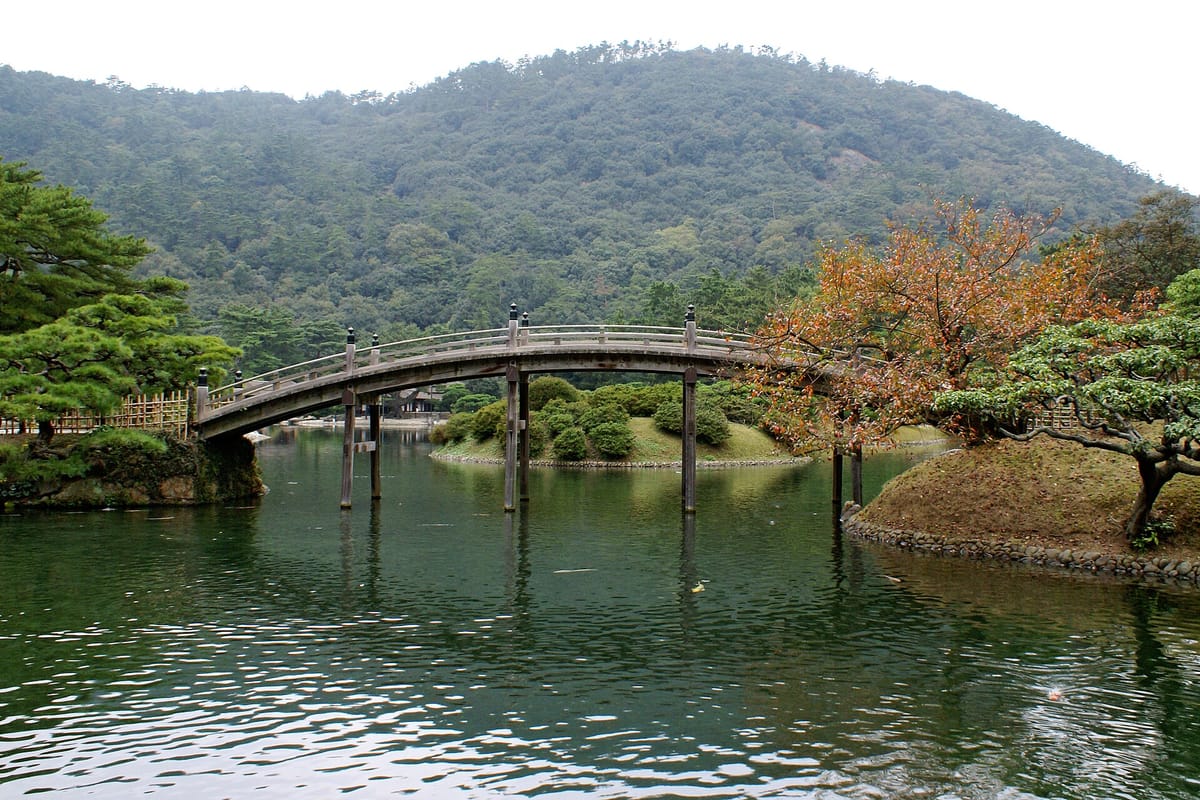
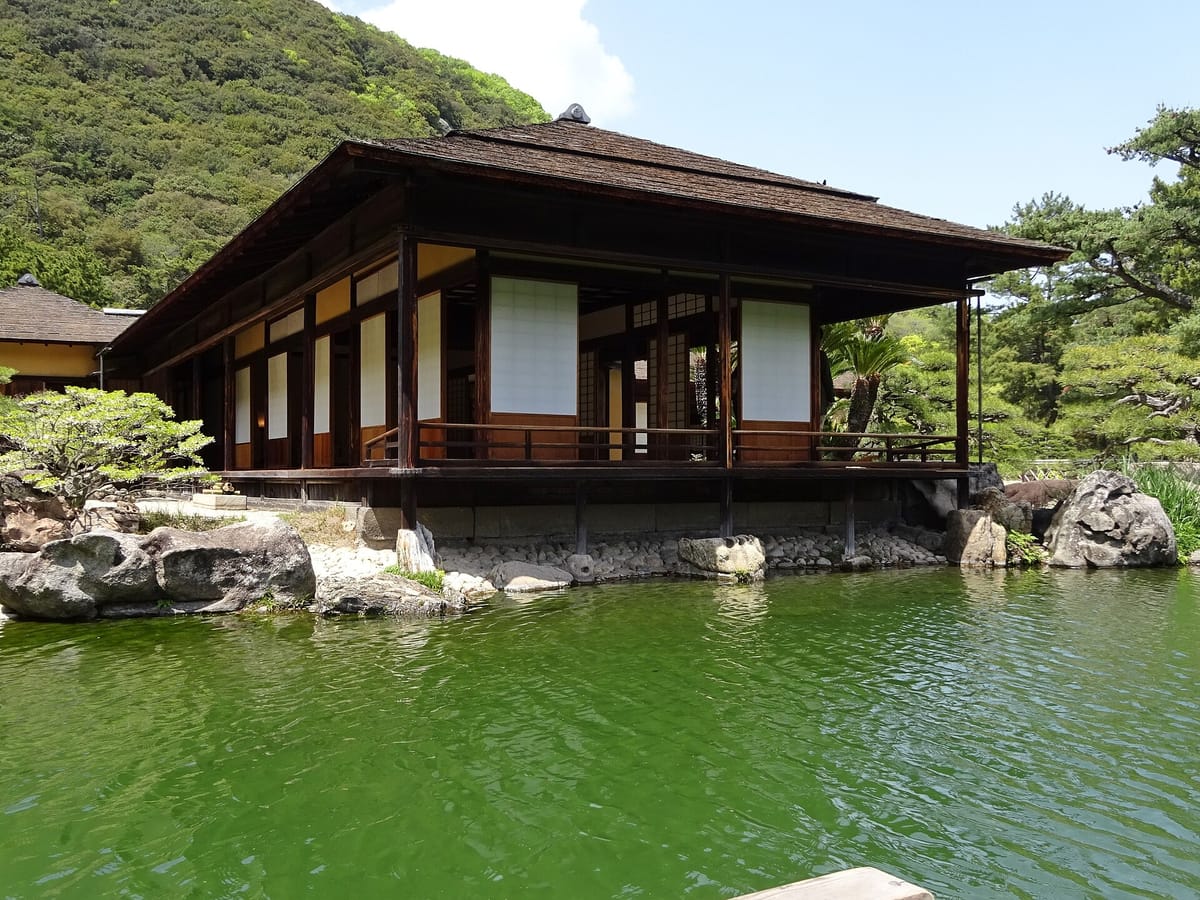
The single best viewpoint is Hiraihō, a landscaped hill said to be modelled on Mount Fuji. From the top you look across Nanko to the arched Engetsu-kyō bridge and the Kikugetsu-tei tea house, with Mount Shiun behind. It is the view on the garden's posters, and it is worth seeing at different times of day.
- Hiraihō (飛来峰): the Fuji-shaped hill with the classic view over Nanko.
- Nanko (南湖): the South Pond, the heart of the garden and the route of the boat ride.
- Engetsu-kyō (偃月橋): the arched bridge across Nanko, whose name refers to a crescent moon.
- Kikugetsu-tei (掬月亭): the lords' tea house, named after a Tang poem about scooping up water and holding the moon in your hands; matcha is served here.
- Neagari Goyō-matsu (根上り五葉松): a Japanese white pine with raised roots, grown from a bonsai presented by the eleventh Tokugawa shogun in 1833.
- Kyū Higurashi-tei (旧日暮亭): a small daimyo-style tea house originally built around 1700.
- Sanuki Mingei-kan (讃岐民芸館): the Sanuki Folk Craft Museum, with local lacquerware, ceramics and papier-mâché dolls.
Words on the signs: gates, ponds and pavilions
Signposts at Ritsurin are wooden boards pointing to the named spots, usually with an English line underneath. The Japanese names are short and built from a small set of kanji, and you will quickly start to recognise them before you reach the English.
Look out for the suffixes. 門, mon, is a gate, 亭, tei, is a pavilion or tea house, 橋, kyō or hashi, is a bridge, and 湖 or 池 is a pond or lake. Put those together with directions, 東 east, 西 west, 南 south, 北 north, and you can read most of the garden map.
| Word | Reading | Meaning |
|---|---|---|
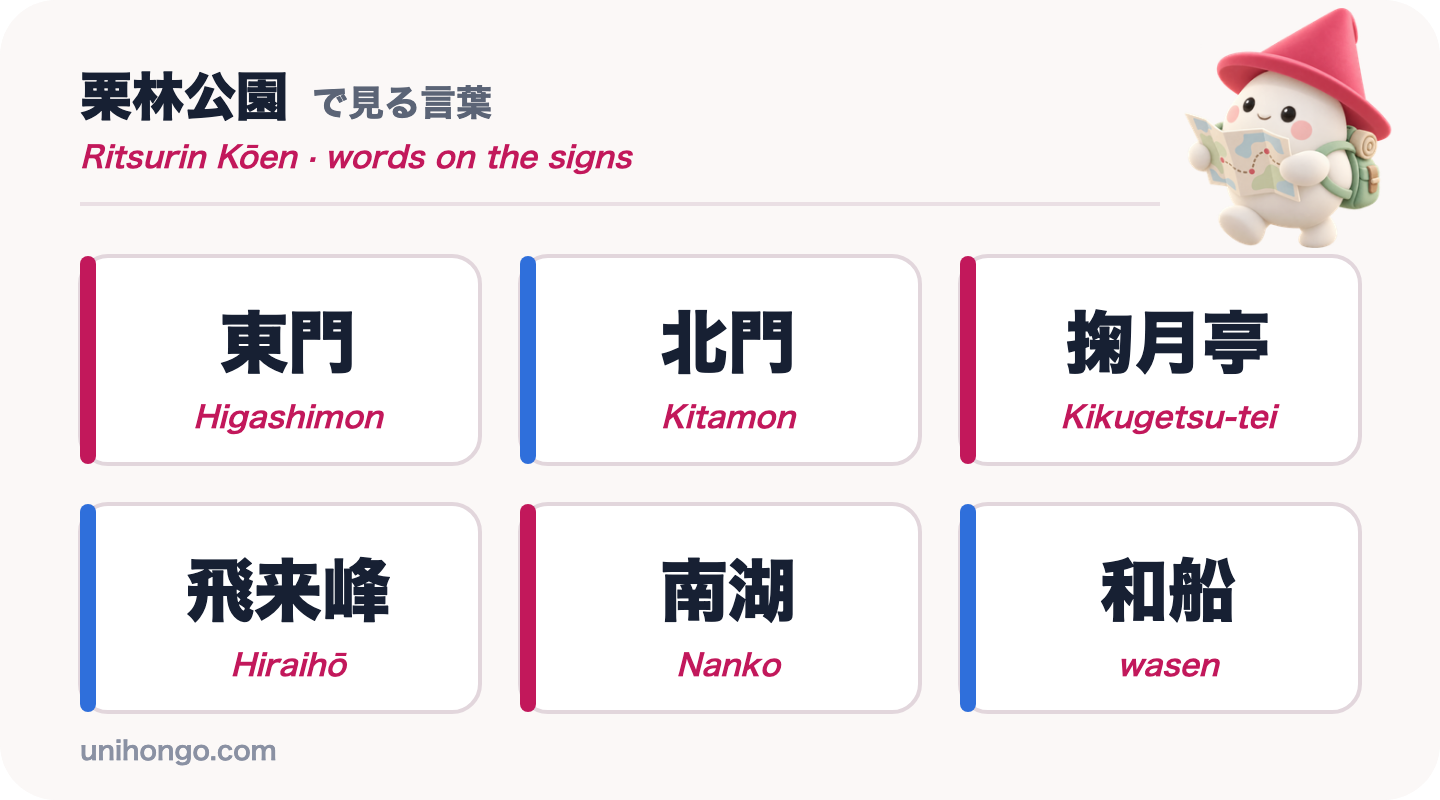
| 東門 | Higashimon | East Gate, the main entrance |
| 北門 | Kitamon | North Gate, near the JR station |
| 掬月亭 | Kikugetsu-tei | The lords' tea house on Nanko |
| 飛来峰 | Hiraihō | The Fuji-shaped viewing hill |
| 南湖 | Nanko | South Pond |
| 偃月橋 | Engetsu-kyō | Arched bridge over Nanko |
| 和船 | wasen | Traditional wooden boat |
| 松 | matsu | Pine tree |
| 特別名勝 | tokubetsu meishō | Special Place of Scenic Beauty |
Japanese for the boat ride and the tea house
The two activities that need a little Japanese are the wasen boat ride and tea at Kikugetsu-tei. For the boat, you ask about the next departure, give the number of people and perhaps your name. For tea, you choose your set, take off your shoes and sit where the staff indicate.
When your matcha arrives, a small bow and itadakimasu are enough. The traditional steps of turning the bowl before drinking are appreciated but not expected, and staff will usually explain them if you ask.
| Japanese | Romaji | Meaning |
|---|---|---|
| 次の船は何時ですか。 | Tsugi no fune wa nanji desu ka. | What time is the next boat? |
| 船はどのくらい乗りますか。 | Fune wa dono kurai norimasu ka. | How long is the boat ride? |
| 予約は必要ですか。 | Yoyaku wa hitsuyō desu ka. | Do I need a reservation? |
| お抹茶を二つお願いします。 | O-matcha o futatsu onegai shimasu. | Two matcha, please. |
| 靴はここで脱げばいいですか。 | Kutsu wa koko de nugeba ii desu ka. | Should I take my shoes off here? |
| お茶碗はどう回せばいいですか。 | O-chawan wa dō mawaseba ii desu ka. | How should I turn the tea bowl? |
| 飛来峰にはどう行けばいいですか。 | Hiraihō ni wa dō ikeba ii desu ka. | How do I get to Hiraihō? |
Etiquette, timing and practical tips
Ritsurin is a cultural property as well as a park, and it is kept in extraordinary condition. A few habits help keep it that way.
- Stay on the paths and do not step onto moss, lawns or the stone edges of the ponds.
- Do not touch or pull the pine branches; each one is shaped by hand.
- Do not feed the carp unless there is an official food dispenser, and use only that food.
- Go early: the garden opens early in the morning, and the first hours are the quietest and coolest.
- Plum, cherry, azaleas and autumn leaves draw crowds in their seasons; winter pines under a clear sky are beautiful and quiet.
- Coin lockers are available at both the North and East gates, and free volunteer guides can show you around.
- Opening hours change month by month and seasonal evening openings are held at some times of year; check the official site.
- Pair the garden with a bowl of Sanuki udon, the thick wheat noodles for which Kagawa is famous.
Practise the boat booking before you go
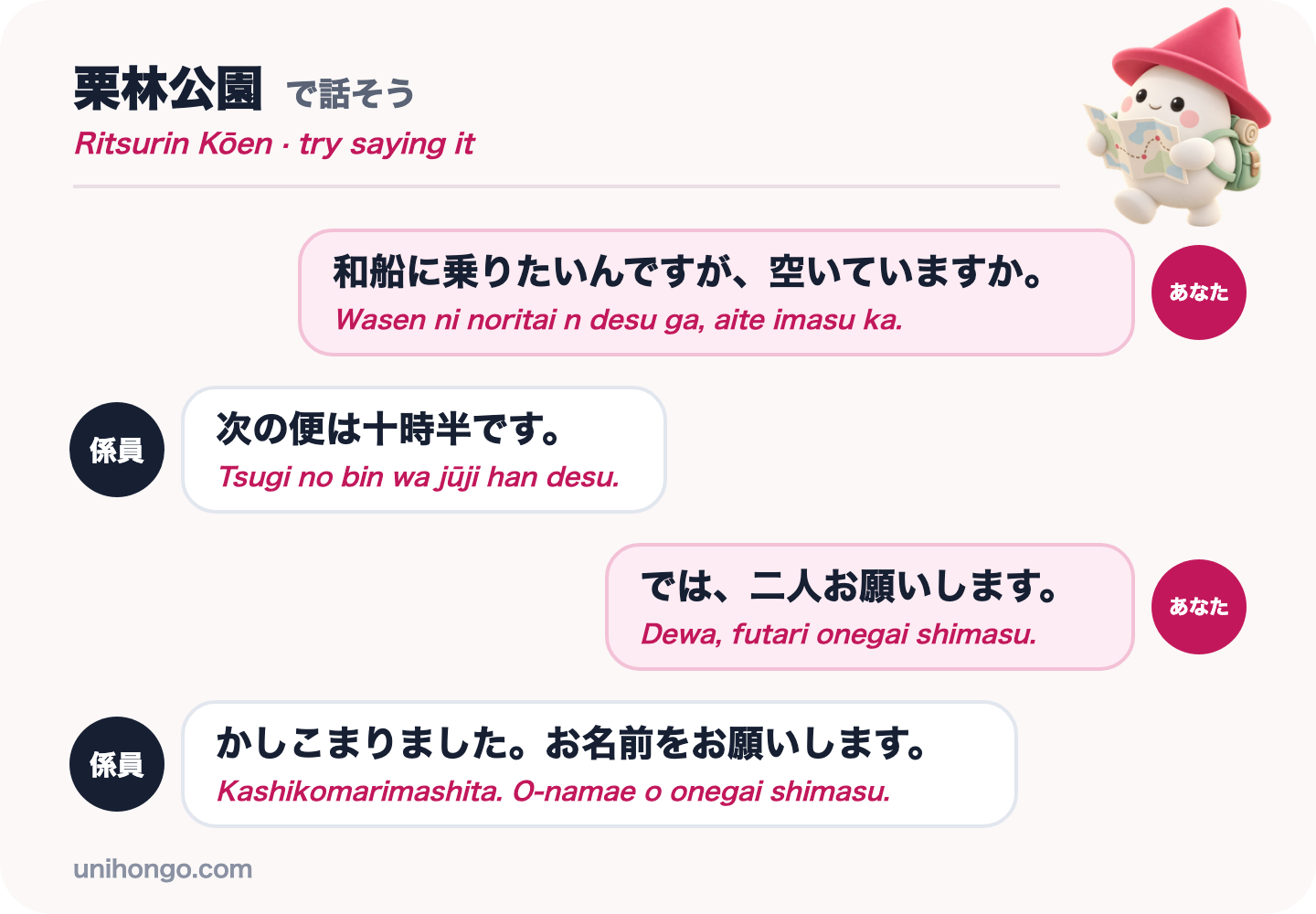
The one real conversation most visitors have at Ritsurin is at the boat counter. You ask whether there is room, the attendant gives a time, and you book. The attendant's kashikomarimashita, certainly, is the standard polite acknowledgment you will hear in shops, hotels and restaurants throughout Japan.
Say the four lines aloud until they feel natural. Then open Unihongo, choose the Sightseeing topic and ask your AI Sensei to play the boat attendant, with a twist such as the next two departures being full. Follow up with the Tea Ceremony topic to rehearse your bowl of matcha at Kikugetsu-tei.
| Japanese | Romaji | Meaning |
|---|---|---|
| 和船に乗りたいんですが、空いていますか。 | Wasen ni noritai n desu ga, aite imasu ka. | I'd like to ride the boat. Are there places free? |
| 次の便は十時半です。 | Tsugi no bin wa jūji han desu. | The next one is at half past ten. |
| では、二人お願いします。 | Dewa, futari onegai shimasu. | Then two people, please. |
| かしこまりました。お名前をお願いします。 | Kashikomarimashita. O-namae o onegai shimasu. | Certainly. May I have your name? |
Official information
Monthly opening hours, the boat ride, tea house service and seasonal events are published on the Kagawa Prefecture tourism site's Ritsurin Garden pages. Check them before you go.