

Why Kurokawa is Kyushu's favourite hidden onsen
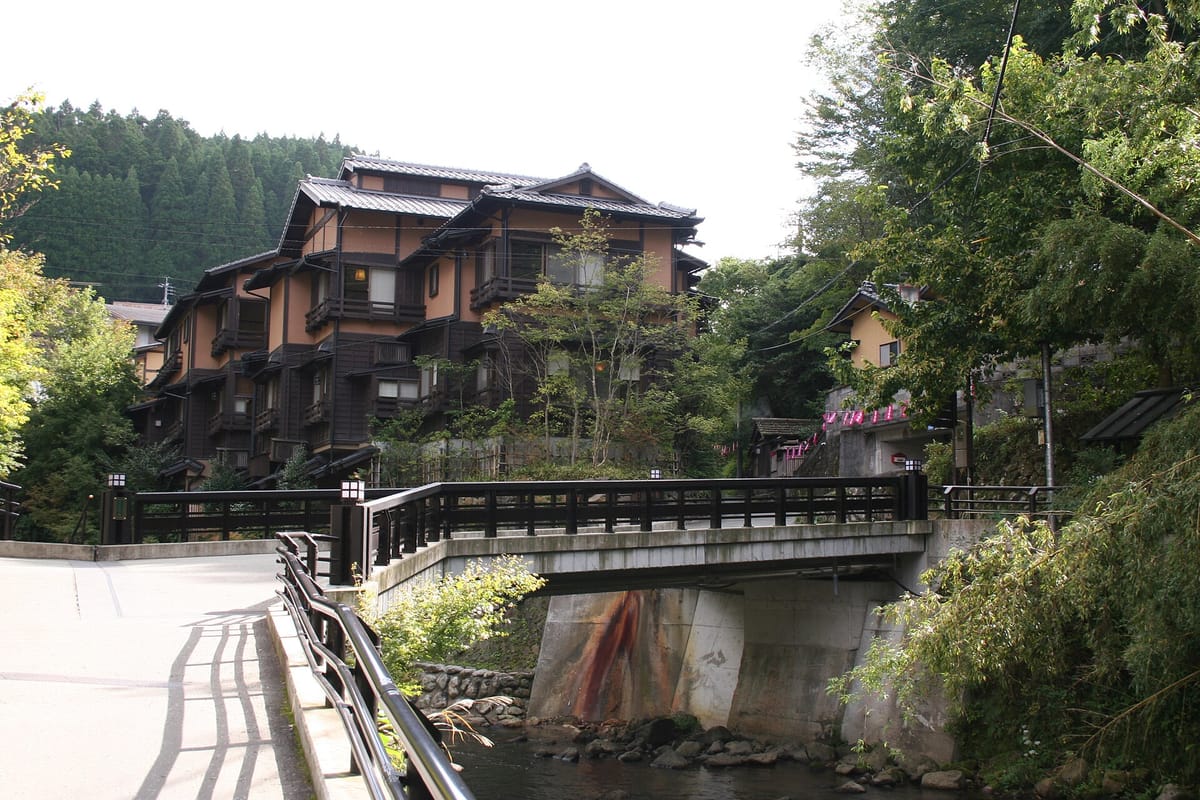
Kurokawa's spring has been known as a place of healing since the Edo period, but the village you see today was shaped from the 1960s onwards, when a small group of innkeepers decided to compete not with big hotels but with nature. They dug open-air baths into the hillsides, planted trees along the lanes, and agreed on muted signs and dark wood so that no single building would stand out. The ryokan association says the village did not even appear by name on the prefecture's tourist map until the year 2000.
The idea that holds it together is Kurokawa Onsen as one ryokan: the lanes are the corridors, the trees are the garden, and each inn is a separate room. That is why the ryokan share their open-air baths with each other's guests and with day visitors through the bath pass, which the association says began when two inns without space for a bath of their own were included rather than left out.
For a Japanese learner, Kurokawa is perfect practice. Every bath visit starts with a short exchange at a front desk, the signs are few and consistent, and the words you learn, from rotenburo to kon'yoku, apply to every onsen you will visit in Japan.
Getting there: buses from Fukuoka, Kumamoto and Yufuin
Kurokawa has no railway station, so you arrive by bus or car. Highway buses run from Hakata in Fukuoka in about three hours. The Kyushu Ōdan Bus, a cross-Kyushu route, links Kurokawa with Kumamoto in one direction and with Yufuin in the other; from Yufuin the ride is a little over an hour and a half. The ryokan association advises that buses must be booked in advance, by the day before at the latest, by phone or online, and some buses fill up at weekends.
On 28 July 2026 a magnitude 7.1 earthquake struck the Kumamoto area, with its centre in the Kumamoto region of the prefecture. Kurokawa, in the far north-east, recorded shaking of shindo 4 and reported no major damage; the village has been open as normal since the next day, with some facilities closed. Roads around Kumamoto city were more seriously affected, and the association's advice at the time was that routes from Fukuoka via Hita and from Oita were open, while the approach from Kumamoto needed checking. Conditions change as repairs continue, so read the latest access notice before you set off.
If you drive, the main routes are National Route 212 from Hita, the Yamanami Highway from Yufuin, and Route 442. Parking in the village is limited and the lanes are narrow, so use the large Kurokawa car park on Route 442 and walk in. There is no ATM in the village; bring enough cash.
| Japanese | Romaji | Meaning |
|---|---|---|
| 黒川温泉行きのバスを予約したいです。 | Kurokawa Onsen-yuki no basu o yoyaku shitai desu. | I would like to reserve a bus to Kurokawa Onsen. |
| 明日の朝の便はありますか。 | Ashita no asa no bin wa arimasu ka. | Is there a morning service tomorrow? |
| 黒川温泉までの道は通れますか。 | Kurokawa Onsen made no michi wa tōremasu ka. | Is the road to Kurokawa Onsen open? |
| 駐車場はどこですか。 | Chūshajō wa doko desu ka. | Where is the car park? |
| この近くにATMはありますか。 | Kono chikaku ni ATM wa arimasu ka. | Is there an ATM near here? |
How the wooden bath pass works
The nyūtō tegata is a slice of local timber, cut into a disc and hung on a cord. According to the ryokan association, one pass covers three baths chosen from around two dozen open-air baths at participating inns, is valid for six months, and is for one person only. The pass celebrated its fortieth anniversary in 2026.
The routine is the same at every inn. Walk to the front desk, show the pass, and staff stamp it and point you to the bath. Day bathing generally runs from the morning to the evening, but each ryokan sets its own hours and closes for cleaning, and busy times can mean a wait. The association publishes a live bathing status page each morning showing which baths are open and how crowded they are.
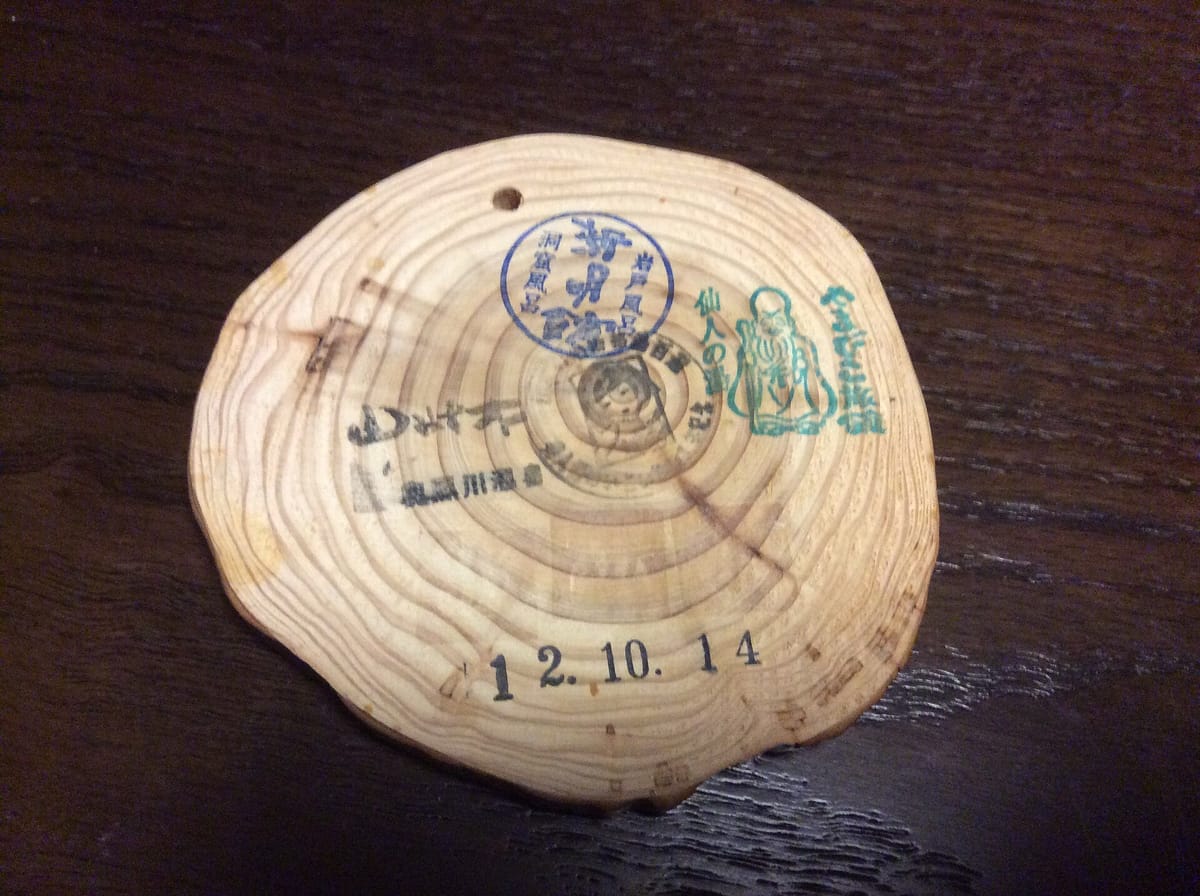
- Buy the pass at Kaze no Ya, the association's information centre in the middle of the village, or at a participating ryokan; Kaze no Ya is the surest place.
- Choose three baths: try a mix, such as a riverside bath, a cave bath and one in the forest.
- One of the three uses can be swapped for a souvenir or a snack at participating shops.
- You can also pay for a single bath at a ryokan's front desk without the pass.
- When the pass is full, keep it, or hang it at the Jizō hall, the small shrine in the village, as many visitors do.
- Photography is not allowed in the baths, so leave your phone in the locker.
Words on the signs in the onsen village
The village keeps its signs small and wooden, but they are consistent. At each ryokan entrance a board says whether day bathing, higaeri nyūyoku, is available today, and inside, the bath entrances are marked by gender. Some open-air baths at Kurokawa are kon'yoku, mixed, and some inns offer bathing wraps for these; if you would rather not use a mixed bath, check the signs or ask first.
The Jizō hall at the heart of the village has its own story. The ryokan association tells a legend of a Jizō statue that lost its head saving a young man, and that asked to be left here; hot water is said to have sprung up soon afterwards, marking the start of Kurokawa Onsen.
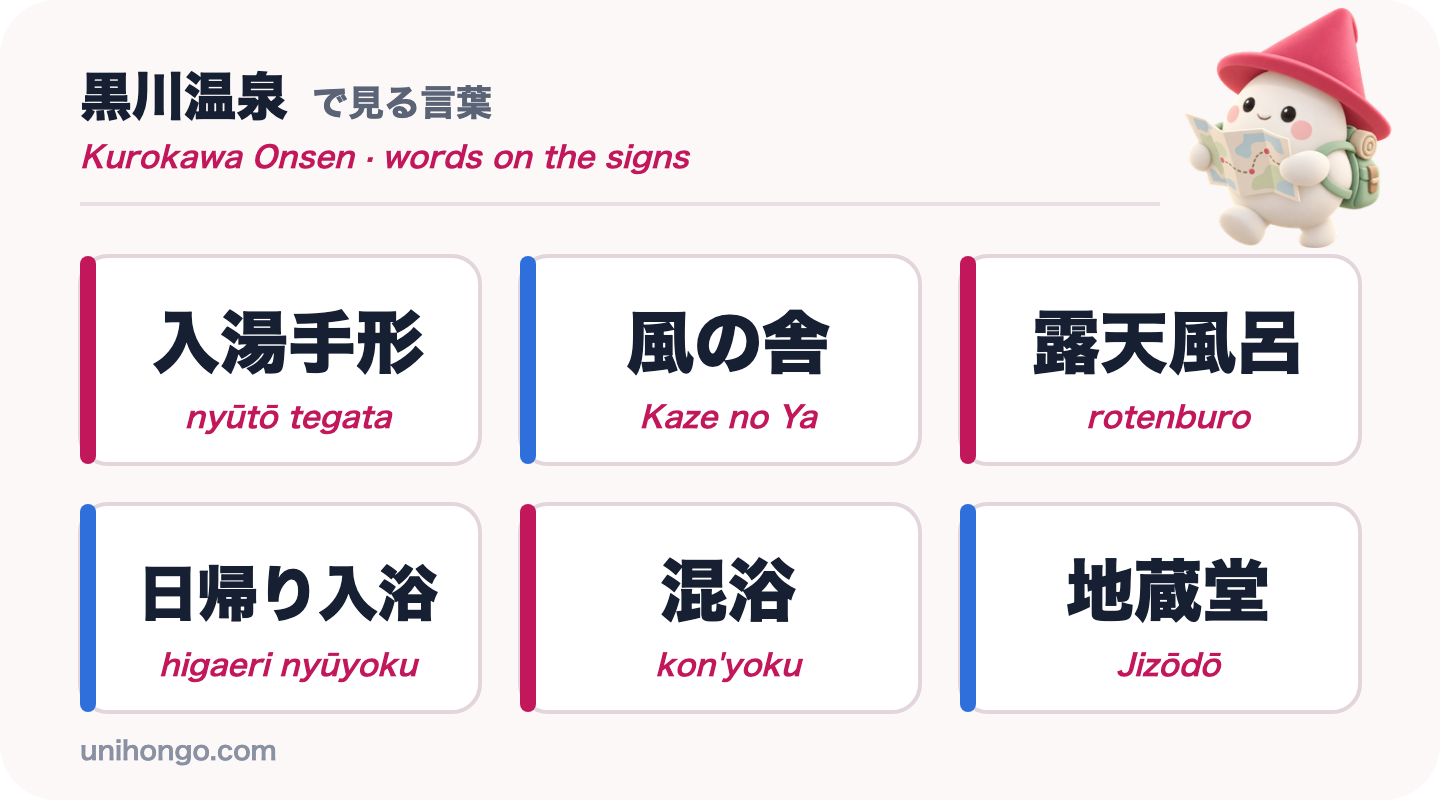
| Word | Reading | Meaning |
|---|---|---|
| 入湯手形 | nyūtō tegata | The wooden bath pass |
| 風の舎 | Kaze no Ya | The ryokan association's information centre |
| 露天風呂 | rotenburo | Open-air bath |
| 日帰り入浴 | higaeri nyūyoku | Day bathing for visitors not staying overnight |
| 混浴 | kon'yoku | Mixed bath for men and women |
| 地蔵堂 | Jizōdō | The small hall of the Jizō statue |
| 男湯 | otokoyu | Men's bath |
| 女湯 | onnayu | Women's bath |
| 清掃中 | seisōchū | Being cleaned, closed for now |
Japanese at the ryokan front desk
The front desk is where every bath begins, whether you are staying or visiting for the day. Staff are used to visitors, and the conversation is short: show the pass, ask where the bath is, and perhaps ask whether it is separate for men and women or whether a towel is included. Bring your own towel, since not every inn provides one for day visitors; ask at the desk if you need to buy one.
If you are staying overnight, the ryokan will also ask about dinner time and breakfast. The association's rental of yukata for walking in the village was suspended in 2026, but ryokan provide yukata for their own overnight guests as usual.
| Japanese | Romaji | Meaning |
|---|---|---|
| 入湯手形を一つください。 | Nyūtō tegata o hitotsu kudasai. | One bath pass, please. |
| 日帰り入浴はできますか。 | Higaeri nyūyoku wa dekimasu ka. | Is day bathing available? |
| 露天風呂はどちらですか。 | Rotenburo wa dochira desu ka. | Which way is the open-air bath? |
| タオルは売っていますか。 | Taoru wa utte imasu ka. | Do you sell towels? |
| 今、混んでいますか。 | Ima, konde imasu ka. | Is it crowded now? |
| 夕食は何時からですか。 | Yūshoku wa nanji kara desu ka. | What time is dinner from? |
| ありがとうございました。いいお湯でした。 | Arigatō gozaimashita. Ii o-yu deshita. | Thank you. That was a lovely bath. |
Onsen manners and practical tips
Bathing in someone else's ryokan as a day guest makes good manners especially important. The rules are the same as at any onsen in Japan.
- Wash and rinse your body at the washing area before getting into the bath; some riverside baths have only a simple rinse, so pour water over yourself before you get in.
- Keep your small towel out of the water; fold it on your head or leave it at the side.
- Do not swim, splash or talk loudly, and tie up long hair.
- No photos in or around the baths, and no food or drink in the bathing areas.
- Ask about tattoo rules at each inn before paying; policies differ between ryokan.
- Carry enough cash: there is no ATM in the village, and some small inns and shops do not take cards.
- Check the live bathing status page on the morning of your visit to see which baths are open.
Practise the front-desk conversation before you go
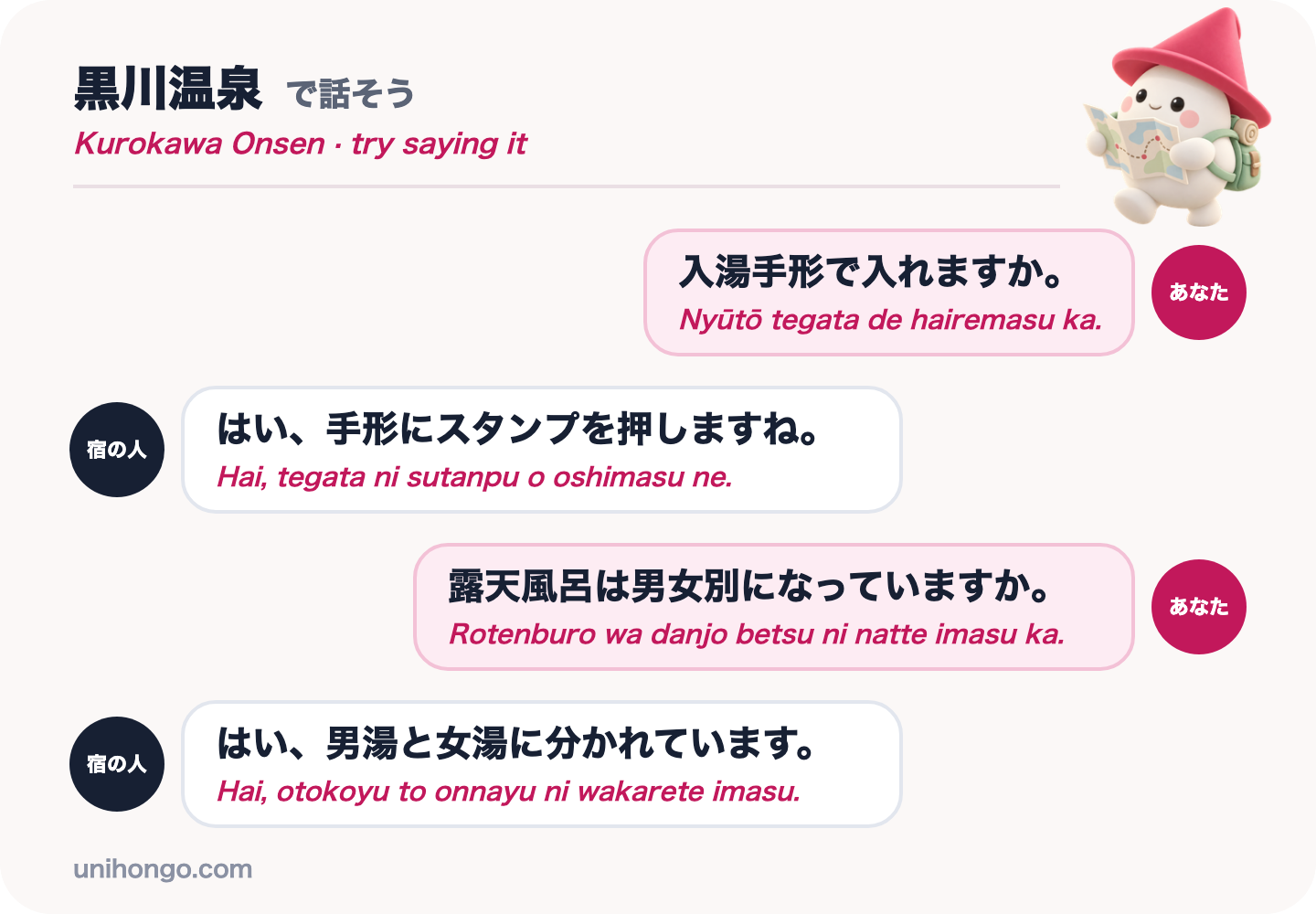
You will have this exchange three times in an afternoon, once at each inn, so it is worth having ready. Practise the four lines below until you can say them without reading, and listen in the reply for the word sutanpu, stamp, and for the kanji words you already know from the signs: otokoyu and onnayu.
Then practise with someone who answers back. In Unihongo, choose the Onsen topic and ask your AI Sensei to play the front desk at a Kurokawa ryokan, or pick Ryokan Stay to rehearse checking in for the night. Saying the lines once before you arrive is what makes them come out at the first front desk.
| Japanese | Romaji | Meaning |
|---|---|---|
| 入湯手形で入れますか。 | Nyūtō tegata de hairemasu ka. | Can I get in with the bath pass? |
| はい、手形にスタンプを押しますね。 | Hai, tegata ni sutanpu o oshimasu ne. | Yes, I will stamp your pass. |
| 露天風呂は男女別になっていますか。 | Rotenburo wa danjo betsu ni natte imasu ka. | Is the open-air bath separate for men and women? |
| はい、男湯と女湯に分かれています。 | Hai, otokoyu to onnayu ni wakarete imasu. | Yes, it is divided into men's and women's baths. |
Official information
The Kurokawa Onsen ryokan association publishes the bath pass details, access information, live bathing status and notices about the 2026 earthquake and road conditions. Check them before you book a bus and again on the morning of your visit.