

Why Eihei-ji is unlike any other temple visit
Eihei-ji was founded in 1244 by Dōgen, the monk who brought the Sōtō school of Zen from China to Japan, on land offered by a devoted samurai follower, Hatano Yoshishige. Today it is one of the two head temples, daihonzan, of Sōtō Zen, together with Sōji-ji in Yokohama. Its English site says that more than one hundred monks still train here, devoting themselves to shikantaza, just sitting, and to doing every task of daily life, from cooking to cleaning, as practice.
That is what makes a visit here different. You are walking through a monastery where people live by a strict schedule, and you may see young monks polishing the corridors, walking in silence or hurrying to a ceremony. The temple asks visitors to dress neatly, stay quiet, keep to the left and not photograph the monks. In return, you get a rare look at Zen as a way of life, not an exhibit.
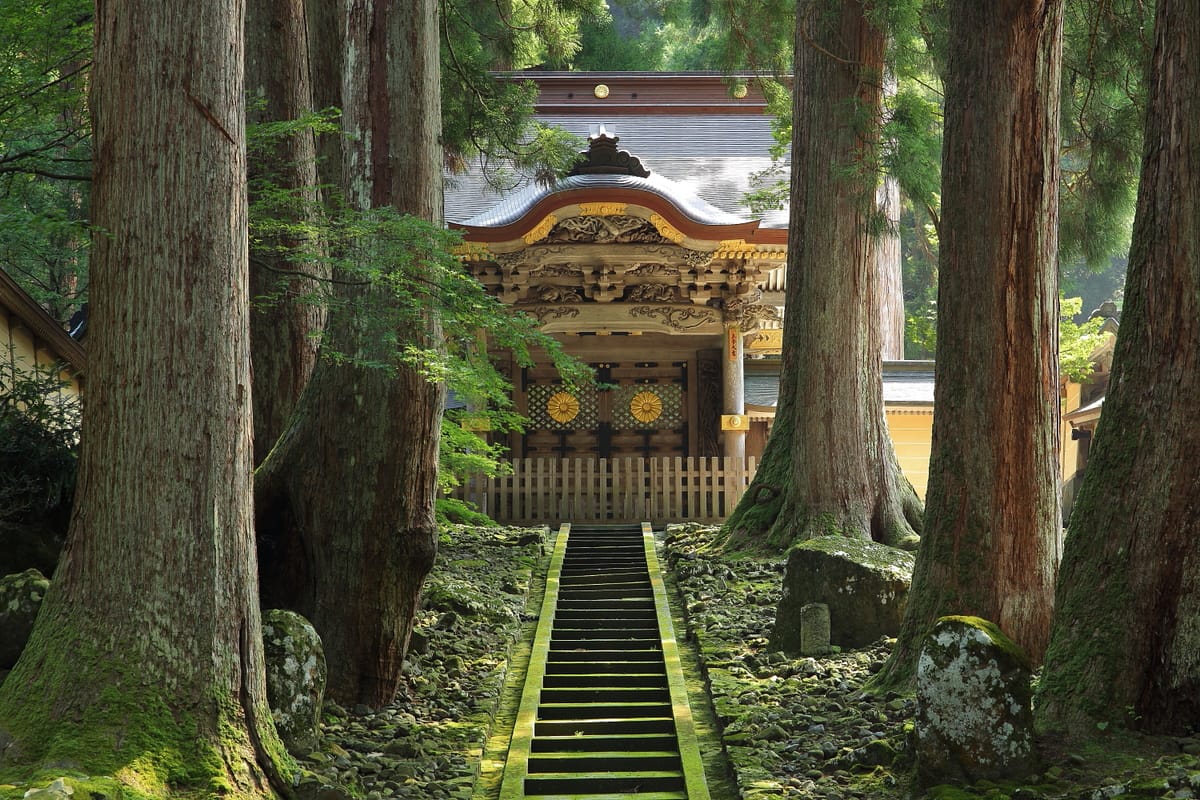
The setting helps. The halls climb a wooded slope, linked by covered stairways and corridors, and ancient cedars tower over the approach. For a Japanese learner, the signs are a small lesson in Buddhist vocabulary, and the reception desk is a good place to practise the most polite Japanese you know.
Getting there: from Fukui Station by bus or Echizen Railway
Since 2024 the Hokuriku Shinkansen has run to Fukui, which puts Eihei-ji within easy reach of Kanazawa and Tokyo. From Fukui Station, the simplest option is the Eiheiji Liner, a direct Keifuku express bus to Eiheiji Monzen, the stop by the temple gate; the temple gives the ride as about thirty minutes. Keifuku also runs a sightseeing bus that combines the temple with the Ichijōdani Asakura family ruins.
The other option is the local Echizen Railway Katsuyama Eiheiji Line, best reached from the East Exit of JR Fukui Station. Get off at Eiheiji-guchi and change to a Keifuku bus bound for Eiheiji or Eiheiji Monzen, about thirteen minutes to the last stop, then walk about five minutes. If you drive, the temple has no visitor car park; use the paid parking in the village near the Hanshaku-bashi bridge.
| Japanese | Romaji | Meaning |
|---|---|---|
| 永平寺行きのバス乗り場はどこですか。 | Eihei-ji yuki no basu noriba wa doko desu ka. | Where is the bus stop for Eihei-ji? |
| 永平寺ライナーは何時に出ますか。 | Eiheiji Rainā wa nanji ni demasu ka. | What time does the Eiheiji Liner leave? |
| えちぜん鉄道の乗り場はどちらですか。 | Echizen Tetsudō no noriba wa dochira desu ka. | Which way is the Echizen Railway platform? |
| 永平寺口でバスに乗り換えますか。 | Eiheiji-guchi de basu ni norikaemasu ka. | Do I change to a bus at Eiheiji-guchi? |
| 終点まで行けばいいですか。 | Shūten made ikeba ii desu ka. | Should I go to the last stop? |
What you will see: the seven halls and the corridors
The visit starts at the reception, where you pay the entry fee and take off your shoes as the staff direct. From there, the route follows covered corridors and steep wooden stairs up the hillside. A Zen monastery is traditionally built around seven key buildings, the shichidō garan, and at Eihei-ji they are all linked, so you can move between them without going outside, even in rain or snow.
The temple's FAQ says a quick look takes about an hour, but it warns that the grounds are on a slope with many stairs, so allow time to rest. Remember that the monks are living and training in these halls: some rooms may be closed for ceremonies, and the schedule can change for religious reasons.
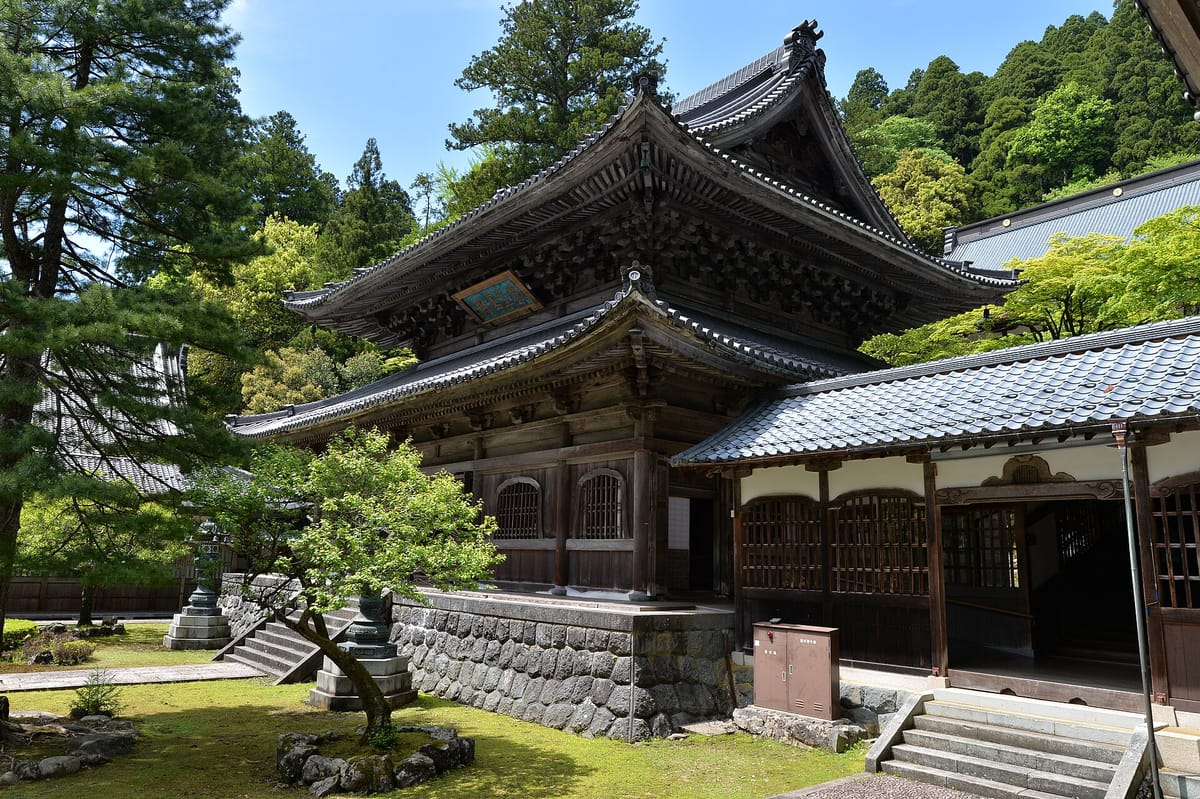
- Sanmon: the main gate, the oldest building in the temple, which trainee monks pass through when they arrive and when they finish their training.
- Butsuden: the Buddha hall, at the centre of the complex.
- Hattō: the Dharma hall at the top of the slope, used for lectures and major ceremonies.
- Sōdō: the monks' hall, where the trainees sit zazen, eat and sleep; you view it from outside.
- Kuin: the kitchen and administrative building, where the monastery's meals are prepared.
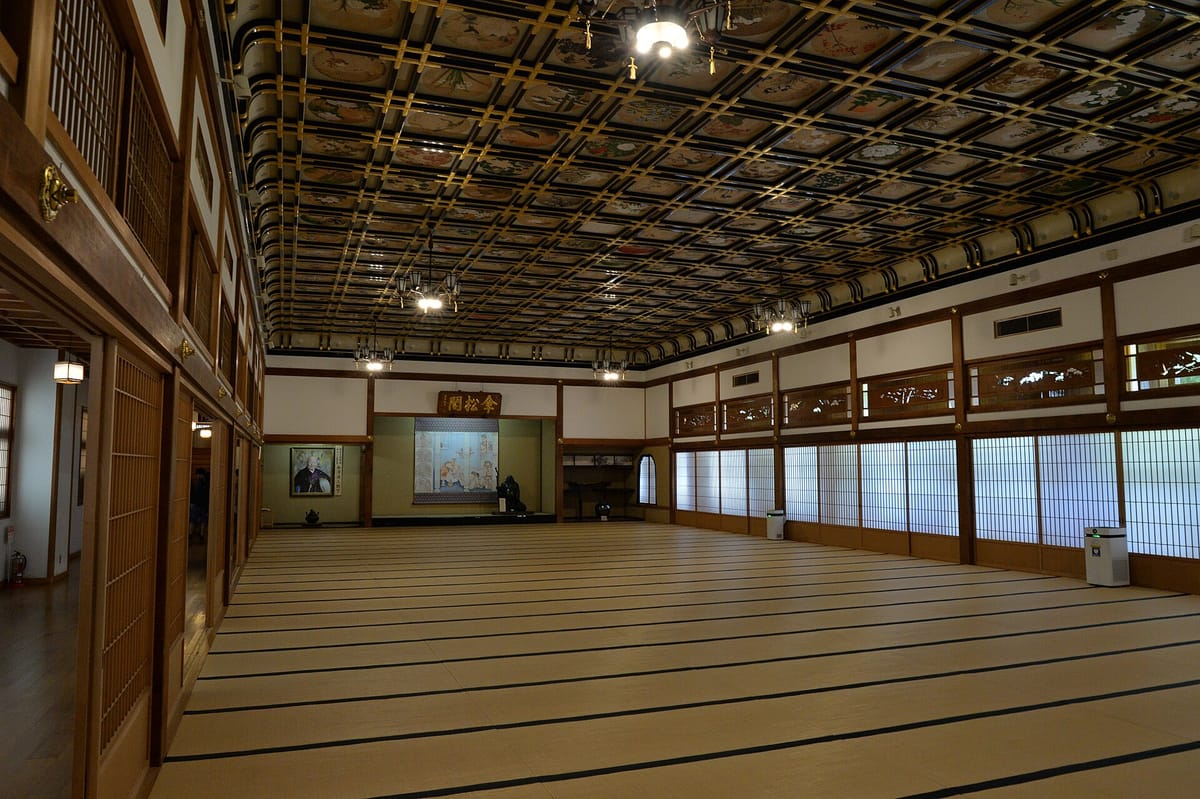
- Sanshōkaku: a large tatami hall whose ceiling is covered with painted panels of flowers and birds.
- Chokushimon: the ornate imperial messengers' gate, seen from the cedar-lined approach.
Words on the temple signs
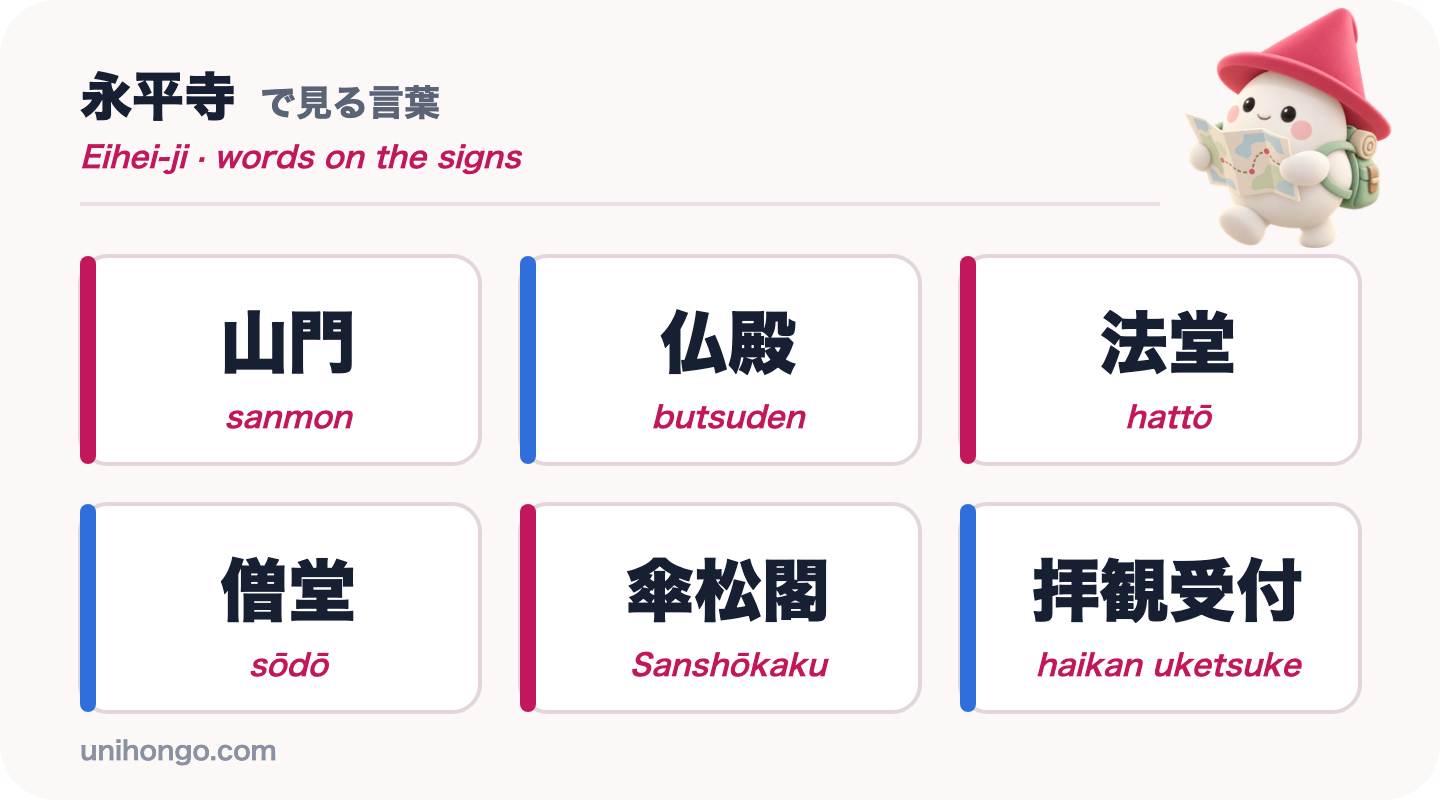
Temple words have their own readings. 堂, dō, means hall, so 僧堂 is the monks' hall; but 法堂, the Dharma hall, is read hattō, not hōdō, in Zen temples. 殿, den, is also a hall, in 仏殿, the Buddha hall. 門, mon, is a gate, and 山門 uses 山, mountain, because temples are traditionally named as mountains.
At the reception you will see 拝観, haikan, respectful viewing, the word for visiting a temple as a sightseer, and 受付, uketsuke, reception. 拝観料 is the entry fee. Near the monks' areas look for 立入禁止, no entry, and respect it.
| Word | Reading | Meaning |
|---|---|---|
| 山門 | sanmon | Main gate of a temple |
| 仏殿 | butsuden | Buddha hall |
| 法堂 | hattō | Dharma hall for lectures and ceremonies |
| 僧堂 | sōdō | Monks' hall for zazen, meals and sleep |
| 傘松閣 | Sanshōkaku | Hall with the painted ceiling |
| 拝観受付 | haikan uketsuke | Visitor reception |
| 拝観料 | haikanryō | Entry fee for a temple |
| 坐禅 | zazen | Seated meditation |
| 大本山 | daihonzan | Head temple of a Buddhist school |
Japanese at the reception and in the halls
At the reception, the key facts are simple: pay the fee in cash, take off your shoes and follow the route. The temple's Japanese site also mentions a zazen experience for day visitors, for a separate offering, while sutra copying is suspended; ask at the reception whether it is available on the day. Inside, stay on the wooden corridors and do not step into the gardens.
Temples use a formal, humble register. You will hear go-enryo kudasai, please refrain, which is the polite way of saying do not, and o-negai itashimasu, a humbler form of onegai shimasu. You do not need to copy it, but understanding it helps you follow instructions without awkwardness.
| Japanese | Romaji | Meaning |
|---|---|---|
| 大人一人お願いします。 | Otona hitori onegai shimasu. | One adult, please. |
| 靴はどこに置けばいいですか。 | Kutsu wa doko ni okeba ii desu ka. | Where should I put my shoes? |
| 今日は坐禅の体験はできますか。 | Kyō wa zazen no taiken wa dekimasu ka. | Can I try zazen today? |
| この先は入ってもいいですか。 | Kono saki wa haitte mo ii desu ka. | May I go in beyond here? |
| 法堂はどちらですか。 | Hattō wa dochira desu ka. | Which way is the Dharma hall? |
| 建物の中で写真を撮ってもいいですか。 | Tatemono no naka de shashin o totte mo ii desu ka. | May I take photos inside the buildings? |
| 御朱印はいただけますか。 | Goshuin wa itadakemasu ka. | Could I receive a goshuin? |
Temple rules, timing and practical tips
The temple's English site lists its rules for visitors, and they are worth reading before you go, because the monks' training depends on them.
- Wear neat, modest clothes suitable for a place of religious practice.
- Be quiet at all times, especially near the zazen, lecture and ceremony halls.
- Keep to the left when walking, indoors and outdoors.
- Do not photograph the priests and monks, and do not touch bells, drums or altar furnishings.
- Do not step into the gardens; stay on the wooden corridors. Smoking is allowed only in designated areas.
- Bring cash for the entry fee; the temple does not accept credit cards.
- Wear socks: floors are wooden and cold in winter, when this valley often has deep snow.
- Arrive well before the reception closes in the late afternoon, and check the temple's site for this season's hours.
Practise the visit before you go
The questions most visitors ask at Eihei-ji are about money and photos. The answers use two very polite forms: nomi de onegai shimasu, only in this way, please, and mōshiwake arimasen ga, go-enryo kudasai, I am sorry, but please refrain. Practise the four lines until you can say them without reading, and notice how politely a no can be said.
Then practise with someone who answers back. In Unihongo, choose the Cultural Etiquette topic and ask your AI Sensei to play a member of temple staff, or choose Directions to rehearse finding the bus back to Fukui. Speaking the lines once before you go makes the real exchange calm and easy.
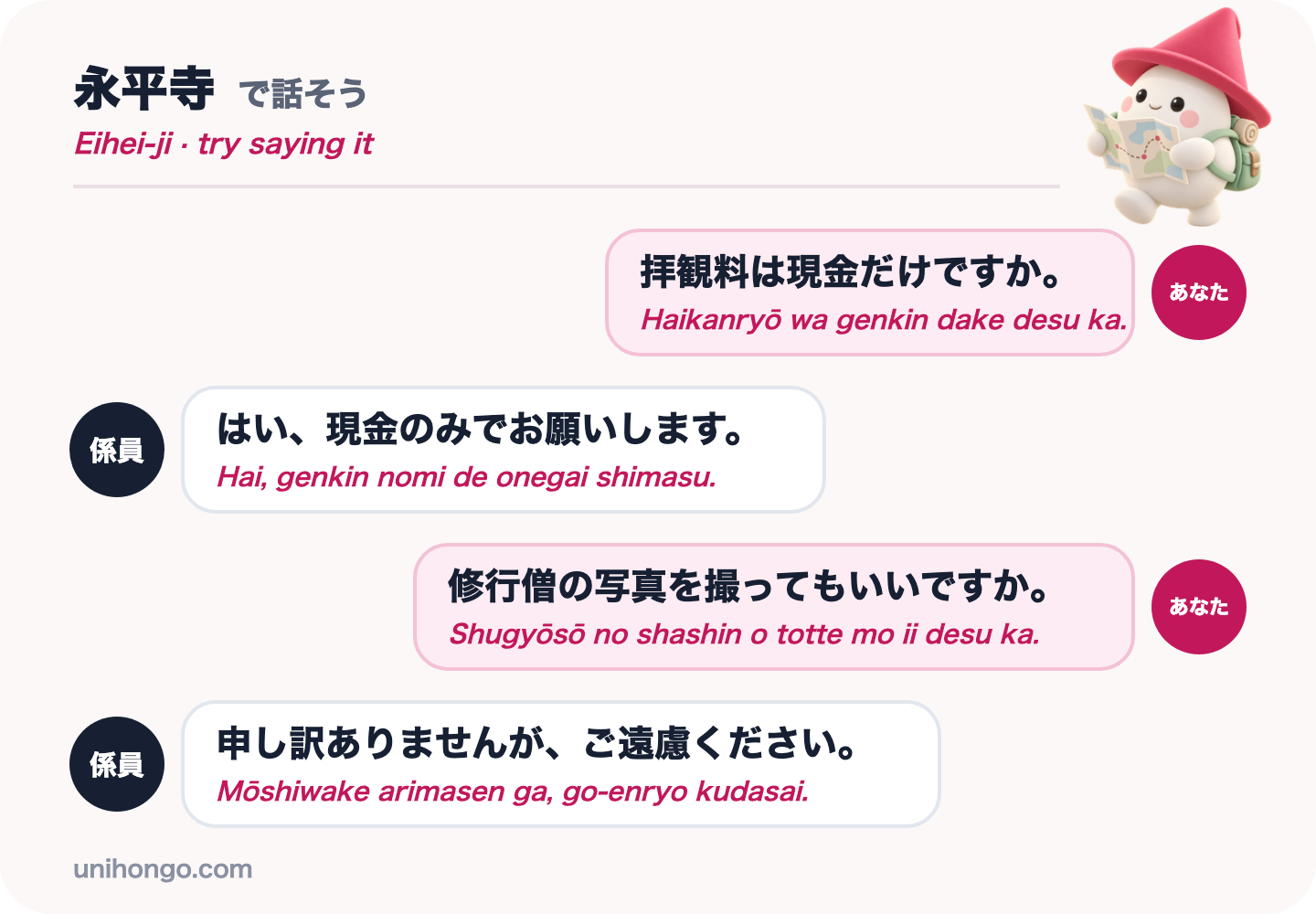
| Japanese | Romaji | Meaning |
|---|---|---|
| 拝観料は現金だけですか。 | Haikanryō wa genkin dake desu ka. | Is the entry fee cash only? |
| はい、現金のみでお願いします。 | Hai, genkin nomi de onegai shimasu. | Yes, cash only, please. |
| 修行僧の写真を撮ってもいいですか。 | Shugyōsō no shashin o totte mo ii desu ka. | May I take photos of the trainee monks? |
| 申し訳ありませんが、ご遠慮ください。 | Mōshiwake arimasen ga, go-enryo kudasai. | I am sorry, but please refrain. |
Official information
Visiting hours, the entry fee, access, visitor rules and the status of zazen and overnight programmes are published on the temple's official site. Check it before you go, especially for ceremony days and for any update on the Sanzen programme.