

Why Tōfuku-ji is worth the short trip south
Tōfuku-ji was founded in 1236 by the regent Kujō Michiie, who invited the monk Enni, recently back from studying Zen in China, to be its first abbot. Building took about twenty years. The name borrows one character each from Tōdai-ji and Kōfuku-ji in Nara, and the ambition matched: it became one of the Kyoto Gozan, the five great Zen temples of the city, and is still the head temple of the Tōfuku-ji branch of the Rinzai school. The complex was larger in the past, and fires and the upheavals of the Meiji era cut it down, but it remains a huge walled campus of halls, gates and sub-temples.
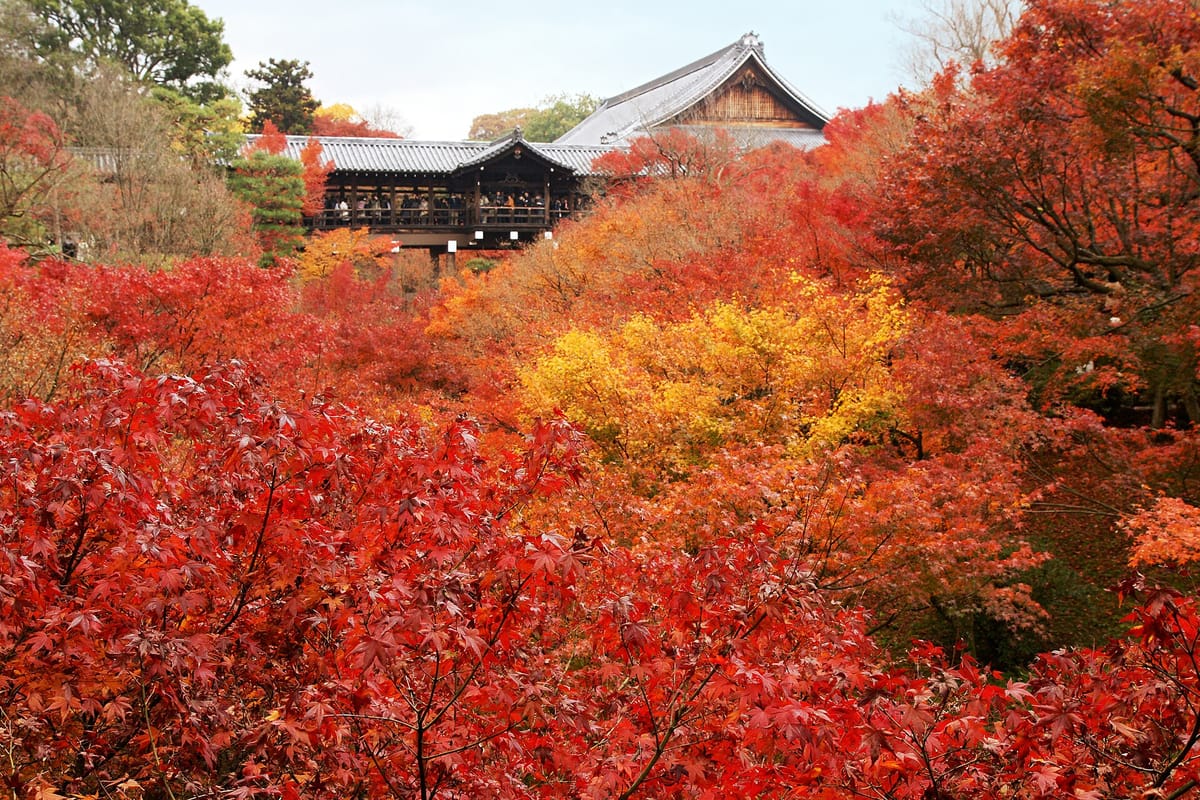
What makes it special for a visitor is contrast. On one side you have medieval Zen architecture at full scale: a vast two-storey gate, stone paths wide enough for processions, long monks' buildings. On the other you have a narrow ravine, the Sengyokukan, crossed by three bridges and filled with maples, and a set of gardens from the 1930s that look startlingly modern. In autumn the valley is one of the most famous leaf views in Japan; in spring and early summer the same trees make a green tunnel and the crowds disappear.
For a Japanese learner, Tōfuku-ji is a clean introduction to temple vocabulary. The signs repeat a few essential words, 門, gate, 橋, bridge, 堂, hall, 庭園, garden, and the ticket system makes you read and ask about which area is which. Get the difference between the free grounds and the paid areas clear and you can handle almost any large temple in Kyoto.
Getting there: Tōfukuji Station on JR and Keihan
The easiest route is the JR Nara Line from Kyoto Station to Tōfukuji Station, Tōfukuji-eki, the first stop, a few minutes out. Local and rapid trains on the Nara Line both stop there, so you can take whichever comes first. The same station is shared with the Keihan Main Line, so it is just as easy from Gion-Shijō or the Kamo River side of the city. From the station, walk south-east along the road; the temple's side gates are about ten minutes away, and signs in Japanese and English point the way.
Kyoto city buses also stop at Tōfukuji, a short walk from the north gate, and the ride from Kyoto Station takes about a quarter of an hour. Tōfukuji Station is one stop north of Inari on the JR line, and Keihan's Fushimi-Inari is also a stop away, so the natural pairing is the torii tunnel in the early morning and the Zen gardens after, or the other way round. Both are busy on autumn weekends, so plan the order around the crowds rather than the map.
| Japanese | Romaji | Meaning |
|---|---|---|
| この電車は東福寺駅に止まりますか。 | Kono densha wa Tōfukuji-eki ni tomarimasu ka. | Does this train stop at Tōfukuji Station? |
| 東福寺へはこの道をまっすぐですか。 | Tōfuku-ji e wa kono michi o massugu desu ka. | Is Tōfuku-ji straight along this road? |
| 通天橋の入口はどこですか。 | Tsūtenkyō no iriguchi wa doko desu ka. | Where is the entrance to the Tsūtenkyō? |
| 伏見稲荷へは一駅ですよね。 | Fushimi Inari e wa hitoeki desu yo ne. | Fushimi Inari is one stop away, isn't it? |
| 京都駅に戻るにはどちらのホームですか。 | Kyōto-eki ni modoru ni wa dochira no hōmu desu ka. | Which platform do I use to go back to Kyoto Station? |
The grounds, the bridges and the Hōjō gardens
Think of Tōfuku-ji as three zones. The open grounds are free: you can walk under the Sanmon, look at the main hall and the old service buildings, and cross the Gaunkyō, the downstream bridge, from where you get the famous side view of the Tsūtenkyō over the maples. The first paid zone is the Tsūtenkyō itself, which leads across the ravine to the Kaisandō, the founder's hall, with its own small garden. The second paid zone is the Hōjō, the abbot's quarters, surrounded on all four sides by gardens.
The Hōjō gardens are the work of Shigemori Mirei, who redesigned them in 1939 using only materials from the temple. Together they are called the Hassō no niwa, the garden of eight views. The south garden sets tall rocks in raked gravel to suggest islands of the immortals. The east garden uses old foundation stones as the seven stars of the Big Dipper. The west and north gardens play with checkerboards, one of clipped azaleas and gravel, the other of square paving stones fading into moss. Sit on the veranda, go slowly round all four sides, and notice how each one changes the rules of the last.
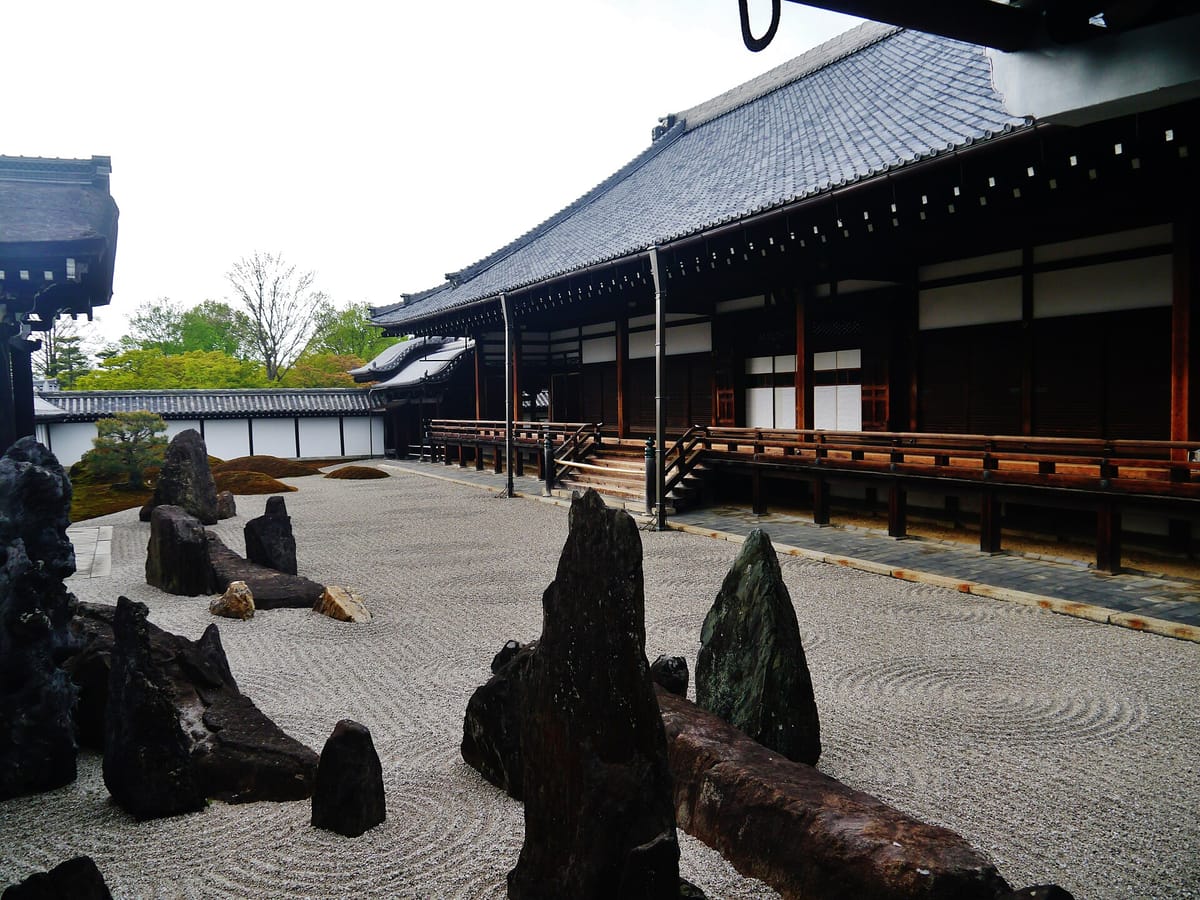
- Sanmon: the great two-storey main gate, from 1425, the oldest surviving Zen gate of its kind and a National Treasure.
- Tōsu: the monks' communal toilet from the Muromachi period, the oldest in Japan, seen from outside.
- Gaunkyō: the free bridge downstream, with the classic view of the Tsūtenkyō.
- Tsūtenkyō: the long covered bridge over the Sengyokukan ravine, ticketed.
- Kaisandō: the hall for the founder Enni across the ravine, with a raked garden before it.
- Hōjō gardens: four Shigemori Mirei gardens around the abbot's quarters, ticketed separately.
- Engetsukyō: the third, quieter bridge upstream, leading towards the sub-temple Ryōgin-an.
Words on the signs at Tōfuku-ji
Temple signs name each building by its function, and once you know a few endings you can guess the rest. 門 is a gate, 堂 a hall, 橋 a bridge and 庭園 a garden. 拝観, haikan, is the respectful word for visiting a temple, and it appears on every ticket window: 拝観受付, the reception where you pay, 拝観料, the entry fee, and 拝観券, the ticket.
In autumn look out for 撮影, satsuei, photography. You will see it on boards and hear it from staff as part of a polite request, and 共通, kyōtsū, shared, on the price board tells you which ticket covers both paid areas.
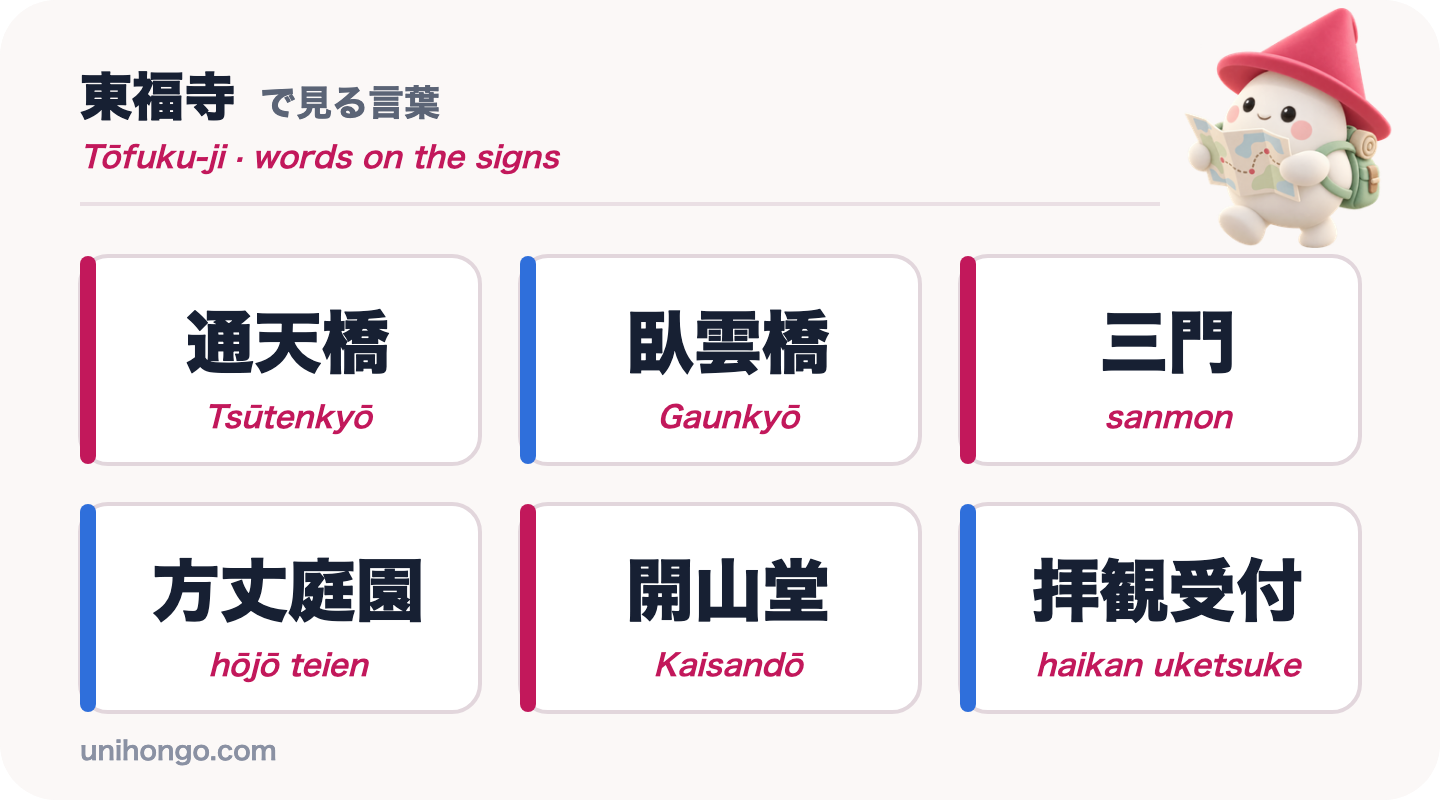
| Word | Reading | Meaning |
|---|---|---|
| 通天橋 | Tsūtenkyō | The covered bridge over the maple valley, literally bridge to heaven |
| 臥雲橋 | Gaunkyō | The free bridge downstream with the classic view |
| 三門 | sanmon | The great main gate of a Zen temple |
| 方丈庭園 | hōjō teien | Gardens around the abbot's quarters |
| 開山堂 | Kaisandō | Hall honouring the temple's founder |
| 拝観受付 | haikan uketsuke | Ticket desk for visitors |
| 共通拝観券 | kyōtsū haikanken | Combined ticket for more than one area |
| 東司 | tōsu | The old monks' toilet hall |
| 撮影禁止 | satsuei kinshi | No photography |
Japanese at the ticket desk and on the bridge
Because Tōfuku-ji has two separate paid areas, the ticket desk is where most conversations happen. Attendants deal with long autumn queues and appreciate a quick, clear request: how many tickets, which area. The word for sheets of paper, mai, is the counter for tickets, so two tickets is nimai and one is ichimai.
On the bridge and in the Hōjō the Japanese you need is about moving and photographing politely. Staff requests use go-enryo kudasai, please refrain, which is softer than a bare no but means the same thing. Answering hai, wakarimashita, yes, understood, is all that is needed.
| Japanese | Romaji | Meaning |
|---|---|---|
| 共通券を一枚お願いします。 | Kyōtsūken o ichimai onegai shimasu. | One combined ticket, please. |
| 方丈だけのチケットはありますか。 | Hōjō dake no chiketto wa arimasu ka. | Is there a ticket for the Hōjō only? |
| この券で開山堂にも入れますか。 | Kono ken de Kaisandō ni mo hairemasu ka. | Does this ticket also let me into the Kaisandō? |
| 方丈の入口はどちらですか。 | Hōjō no iriguchi wa dochira desu ka. | Which way is the entrance to the Hōjō? |
| ここで写真を撮ってもいいですか。 | Koko de shashin o totte mo ii desu ka. | May I take photos here? |
| 紅葉の見頃はいつごろですか。 | Kōyō no migoro wa itsu goro desu ka. | Around when are the autumn leaves at their best? |
| はい、わかりました。 | Hai, wakarimashita. | Yes, understood. |
Etiquette, crowds and timing
Tōfuku-ji is an active Zen monastery, and in autumn it also carries some of the heaviest crowds in Kyoto. A little planning keeps the visit pleasant for you and the monks.
- Go early in autumn. Queues for the Tsūtenkyō build fast on November weekends, and the bridge becomes a slow-moving line.
- Keep walking on the bridges when asked. In the special autumn period the temple may ask visitors not to stop and take photos on the Tsūtenkyō or the Gaunkyō.
- Tripods are not allowed on the grounds, and commercial shoots need permission in advance.
- Take your shoes off where the signs say, and carry them in the bag provided in the Hōjō; socks are warmer than bare feet on the wooden floors.
- Sub-temples are private and mostly closed; look for a sign that says 拝観 before walking in.
- Handwritten goshuin can be limited in the peak autumn weeks, so check the official notices if collecting stamps matters to you.
- Pets are not allowed on the grounds.
Practise the ticket desk before you go
The exchange below is the one many visitors have in November: you buy two combined tickets, the attendant reminds you that photos on the bridge are not allowed during the busy weeks, and you ask where you can take the famous picture. The answer, the Gaunkyō, is also worth knowing on its own.
Say the four lines aloud a few times, then practise with a partner who can change the answer. In Unihongo, choose the Sightseeing topic and ask your AI Sensei to play the Tōfuku-ji attendant, or the Cultural Etiquette topic to practise polite requests and replies. Hearing go-enryo kudasai at natural speed once before you travel makes it easy to catch on the day.
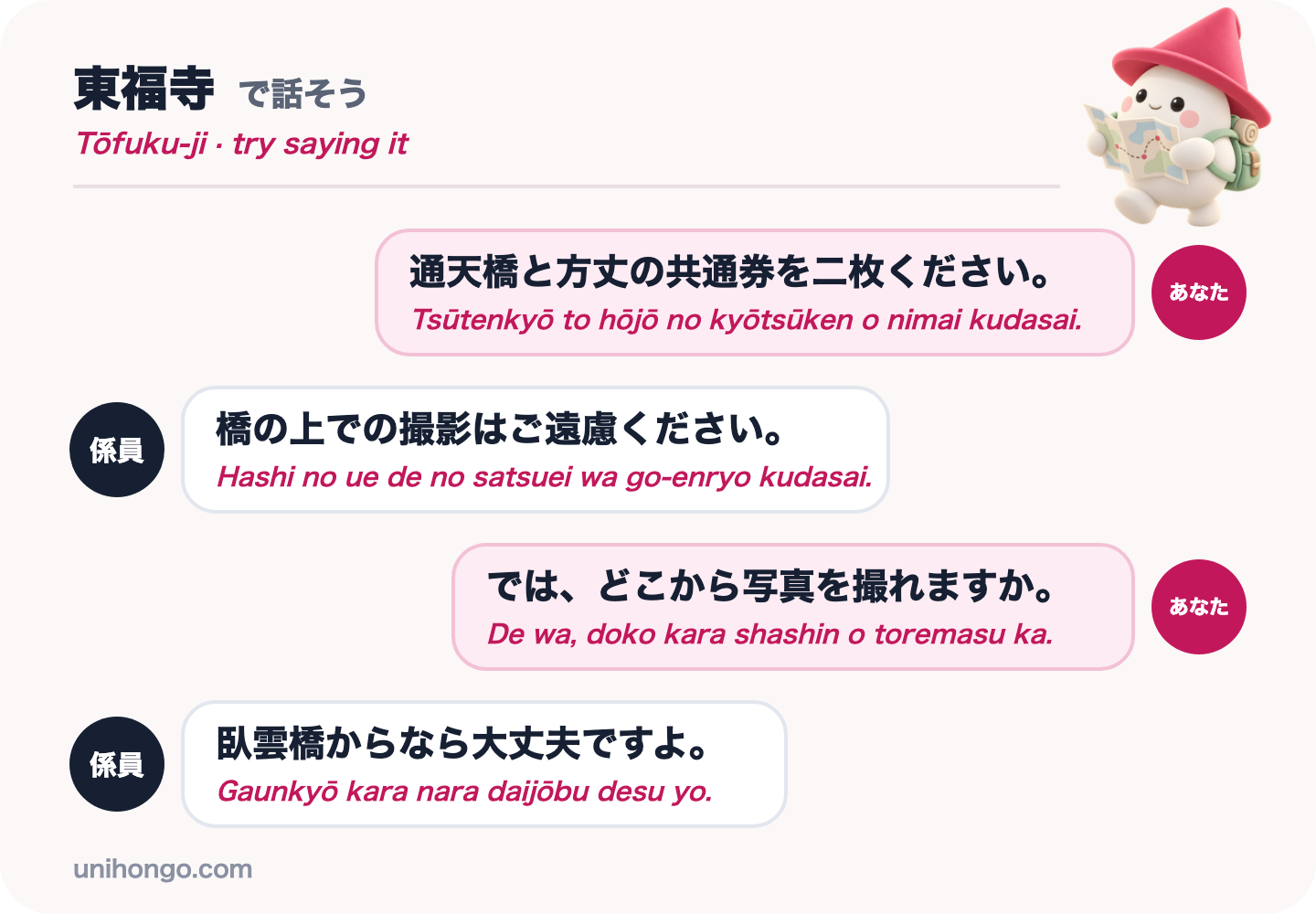
| Japanese | Romaji | Meaning |
|---|---|---|
| 通天橋と方丈の共通券を二枚ください。 | Tsūtenkyō to hōjō no kyōtsūken o nimai kudasai. | Two combined tickets for the Tsūtenkyō and the Hōjō, please. |
| 橋の上での撮影はご遠慮ください。 | Hashi no ue de no satsuei wa go-enryo kudasai. | Please refrain from taking photos on the bridge. |
| では、どこから写真を撮れますか。 | De wa, doko kara shashin o toremasu ka. | Then where can I take photos from? |
| 臥雲橋からなら大丈夫ですよ。 | Gaunkyō kara nara daijōbu desu yo. | From the Gaunkyō it is fine. |
Official information
Tōfuku-ji publishes its visiting hours, fees, the dates of the autumn special period and any closures, for example after typhoons, on its own website, in Japanese. Check it before you go, especially in November.