

Why Kinosaki is Japan's classic bath-hopping town
Kinosaki's story begins, according to local legend, with a monk named Dōchi Shōnin, who prayed for a thousand days until a hot spring rose to heal the sick. In old times, the official tourism site explains, visitors first climbed to Onsen-ji temple to give thanks to the spring's guardian and received a ladle that served as a pass to the baths. Today the pass is a modern card rather than a ladle, but the idea that the whole town is one big inn remains.
The town is small, with a few thousand residents, and almost everything is within walking distance: the station, the main street of shops, the canal crossed by arched stone bridges and the seven sotoyu. Inns lend you a yukata, a light cotton robe, and geta, wooden sandals, and from late afternoon the streets are full of people strolling between baths, which locals call sozoro aruki, walking with no particular aim.
This guide focuses on Kinosaki itself; for general bath rules, see our guide to onsen etiquette. For a Japanese learner, Kinosaki is ideal because the same short exchanges repeat all evening: at the front desk, at each bath entrance, in the changing room and in the shops along the canal.
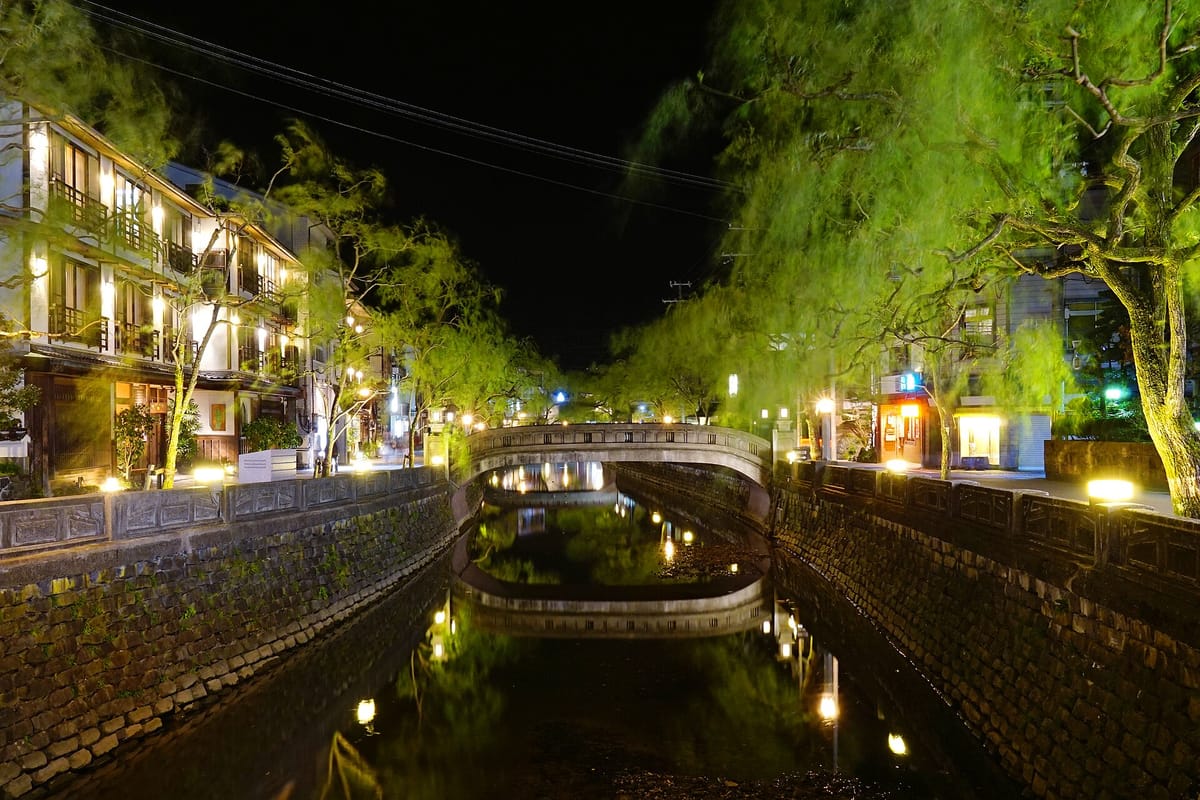
Getting there: JR limited express to Kinosaki Onsen Station
Kinosaki Onsen Station is on the JR San'in Line, one stop from the Sea of Japan coast. The Kinosaki limited express runs from Kyoto, the Kōnotori from Shin-Osaka and Osaka, and the Hamakaze from Sannomiya and Himeji, in roughly two and a half to three hours. The official tourism site advises reserving seats on all limited express trains in advance. The Japan Rail Pass and the JR West Rail Pass are valid.
There are also direct Zentan buses from Osaka and Kobe, and flights from Osaka Itami to Kōnotori Tajima Airport with a connecting bus. From the station, the main street leads to the canal in a few minutes; the ryokan information centre is in front of the station, and some ryokan offer pick-up.
| Japanese | Romaji | Meaning |
|---|---|---|
| 城崎温泉までの特急券をお願いします。 | Kinosaki Onsen made no tokkyūken o onegai shimasu. | A limited express ticket to Kinosaki Onsen, please. |
| 指定席はまだありますか。 | Shiteiseki wa mada arimasu ka. | Are there any reserved seats left? |
| この旅館まで歩いて行けますか。 | Kono ryokan made aruite ikemasu ka. | Can I walk to this ryokan? |
| 荷物を預かってもらえますか。 | Nimotsu o azukatte moraemasu ka. | Could you keep my luggage? |
| 一の湯はどちらですか。 | Ichi-no-yu wa dochira desu ka. | Which way is Ichi-no-yu? |
The seven sotoyu, Onsen-ji and the ropeway
Each of the seven bathhouses has a different building and a legend about the blessing it brings. Ichi-no-yu, in the centre of town, looks like a kabuki theatre and has a bath in a cave of natural boulders; its name, number one bath, is said to come from an eighteenth-century doctor's praise. Gosho-no-yu was built to resemble the Kyoto Imperial Palace, with painted screens inside and an outdoor bath facing a waterfall. Mandara-yu is linked to Dōchi Shōnin and is traditionally counted as Kinosaki's first spring.
Yanagi-yu, named after the willows, is the smallest, with a cypress-wood bath. Jizō-yu is a retro bathhouse favoured by local families, with a small lukewarm bath for children. Kō-no-yu, at the back of town, is the oldest bathhouse building and has an outdoor bath in the greenery; legend says its spring was found by a stork healing its wounds. It is closed for renovation until 30 October 2026. Satono-yu, next to the station, with a rooftop outdoor bath, has been closed for renovation since April 2024. Each open bath has one regular closing day a week, and some open only from mid-afternoon, so check before you plan your round.
Above the town, Onsen-ji is the temple of the spring's founder, reached on foot or by the Kinosaki ropeway, which continues to a viewpoint on Mount Daishi. In winter, snow crab from the Sea of Japan is the star of ryokan dinners. Kinosaki is also a literary town: the writer Shiga Naoya stayed here and wrote the short story Kinosaki nite, At Kinosaki.
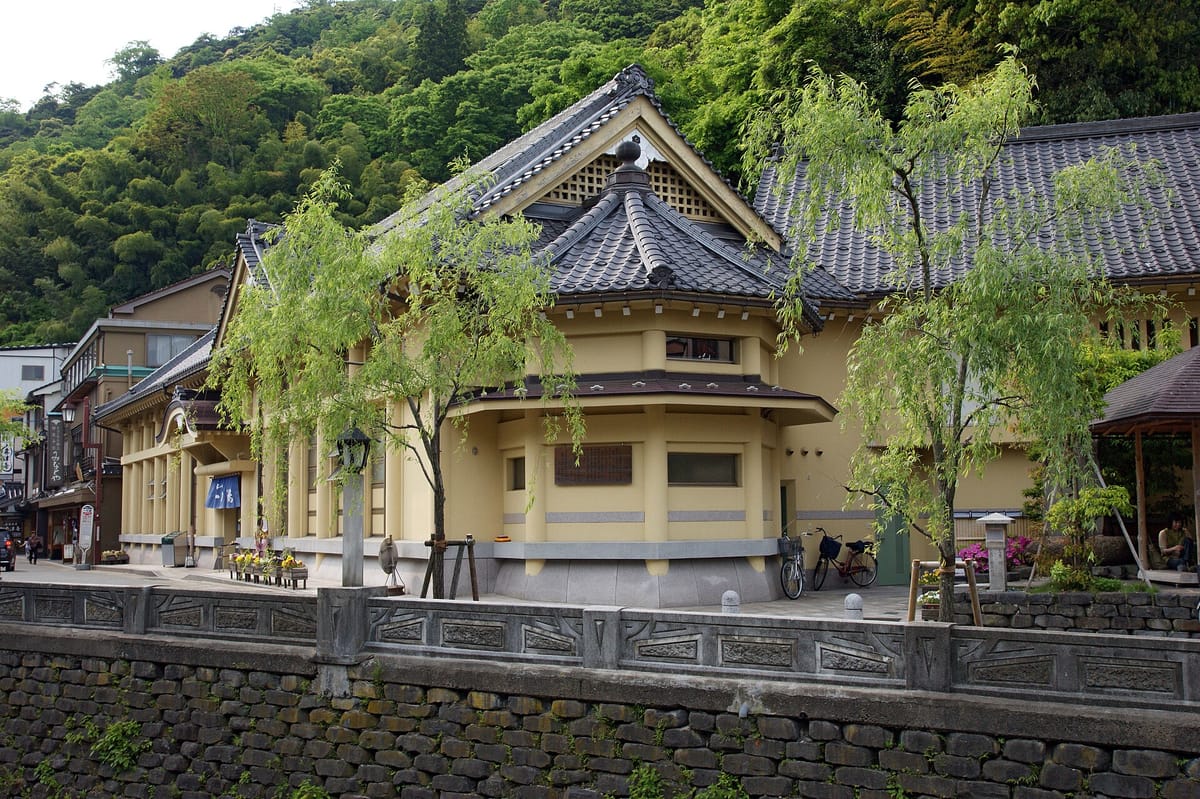
- Ichi-no-yu: the kabuki-style bathhouse with a cave bath.
- Gosho-no-yu: palace-style building with a waterfall view from the outdoor bath.
- Mandara-yu: linked to the town's founding monk, Dōchi Shōnin.
- Yanagi-yu: the smallest bath, with a cypress tub.
- Jizō-yu: the local families' favourite, with a children's bath.
- Kō-no-yu: the oldest bathhouse building; closed until 30 October 2026.
- Satono-yu: by the station; closed for renovation since April 2024.
- Onsen-ji and the ropeway: the founder's temple and the view over town.
Words on the signs in Kinosaki
Almost every important sign in Kinosaki contains 湯, yu, hot water or bath. It appears in the name of each bathhouse and on the noren curtains at the entrance, often in a large stylised form.
At the entrance, look for the curtains marked 男 and 女 for men and women, and for notices about the day's closing, 定休日, teikyūbi, the regular day off.
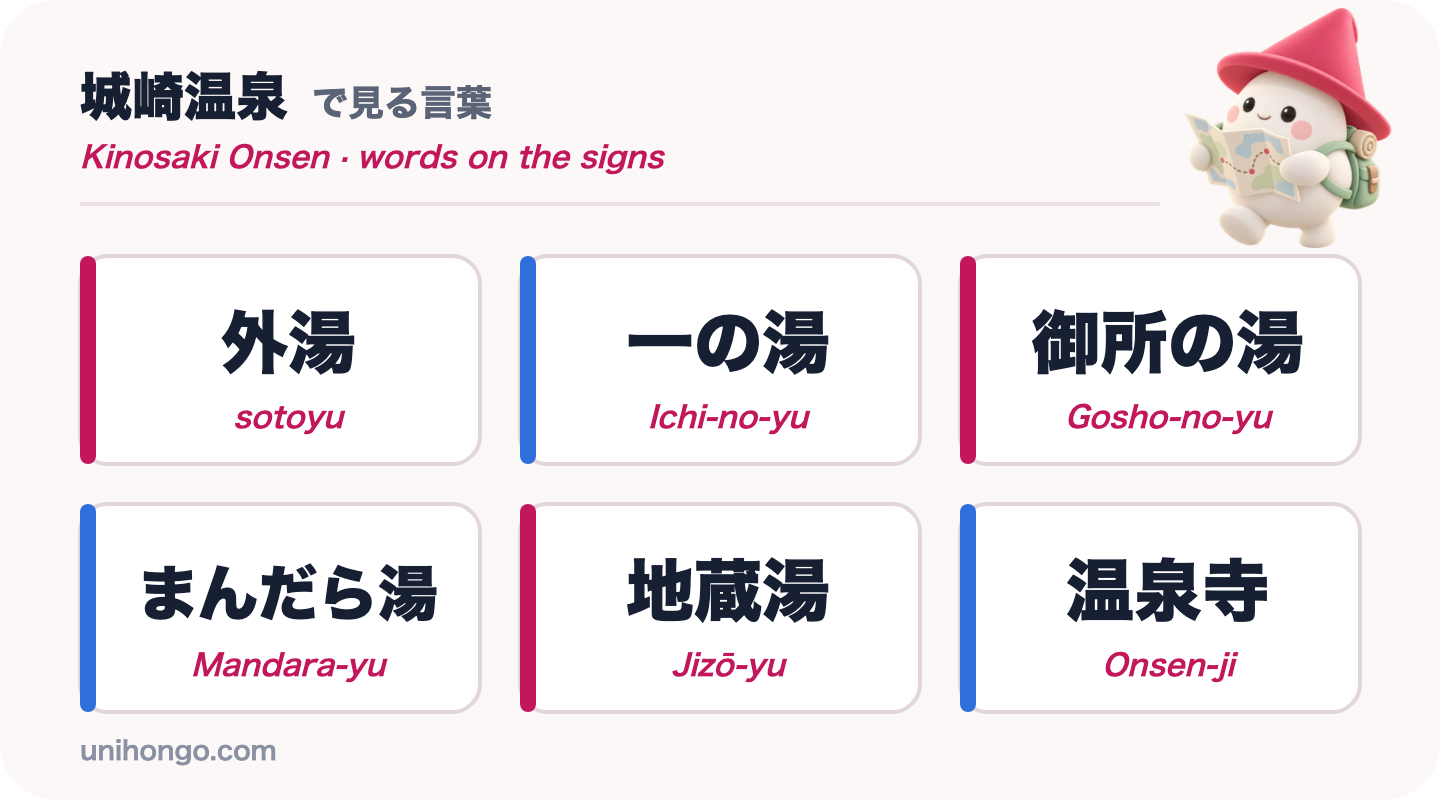
| Word | Reading | Meaning |
|---|---|---|
| 外湯 | sotoyu | Public bathhouse outside your inn |
| 外湯めぐり | sotoyu meguri | Going round the public baths one after another |
| 一の湯 | Ichi-no-yu | The kabuki-style bathhouse with a cave bath |
| 御所の湯 | Gosho-no-yu | Palace-style bathhouse with a waterfall view |
| まんだら湯 | Mandara-yu | Bath linked to the town's founding monk |
| 地蔵湯 | Jizō-yu | Retro bathhouse popular with local families |
| 温泉寺 | Onsen-ji | Temple of the spring's founder |
| 男湯 | otokoyu | Men's bath |
| 女湯 | onnayu | Women's bath |
| 定休日 | teikyūbi | Regular closing day |
Japanese at the ryokan desk and the bath entrance
Your evening starts at the ryokan front desk. Staff explain dinner and breakfast times, give you the bath pass, show you the yukata and geta, and often let you choose a coloured yukata. Ask whether there is a time you need to be back for dinner, and how the pass works at each bathhouse entrance.
At the baths, the routine is the same as anywhere in Japan: shoes or geta off at the entrance, men's and women's sides, lockers or baskets for clothes, a rinse before you get in, and the small towel kept out of the water. Bathhouses can get crowded in the early evening, and the official site shows crowd levels online.
| Japanese | Romaji | Meaning |
|---|---|---|
| 今日から一泊で予約しているスミスです。 | Kyō kara ippaku de yoyaku shite iru Sumisu desu. | I'm Smith, I have a reservation for one night from today. |
| 夕食は何時ですか。 | Yūshoku wa nanji desu ka. | What time is dinner? |
| 浴衣のサイズを替えてもらえますか。 | Yukata no saizu o kaete moraemasu ka. | Could I change my yukata for another size? |
| このパスで全部の外湯に入れますか。 | Kono pasu de zenbu no sotoyu ni hairemasu ka. | Can I get into all the public baths with this pass? |
| 今日休みの外湯はどこですか。 | Kyō yasumi no sotoyu wa doko desu ka. | Which public baths are closed today? |
| タオルはどこで借りられますか。 | Taoru wa doko de kariraremasu ka. | Where can I borrow a towel? |
| 今、一番すいている外湯はどこですか。 | Ima, ichiban suite iru sotoyu wa doko desu ka. | Which bath is least crowded right now? |
Yukata manners, timing and practical tips
Walking the town in yukata is part of the experience, and a few habits make it comfortable and polite.
- Wrap the yukata left side over right; right over left is how the dead are dressed.
- In cold months, wear the padded jacket, tanzen or haori, that the ryokan provides over your yukata.
- Carry a small bag for your towel, pass and phone; ryokan often lend one.
- Geta are noisy and slippery on wet stone; walk slowly on the bridges, especially at night.
- Kinosaki is a residential town; keep your voice down late in the evening.
- Check each bath's regular closing day and opening time; not every bath opens in the morning.
- Book ryokan early for weekends and the winter crab season.
Practise the evening before you go
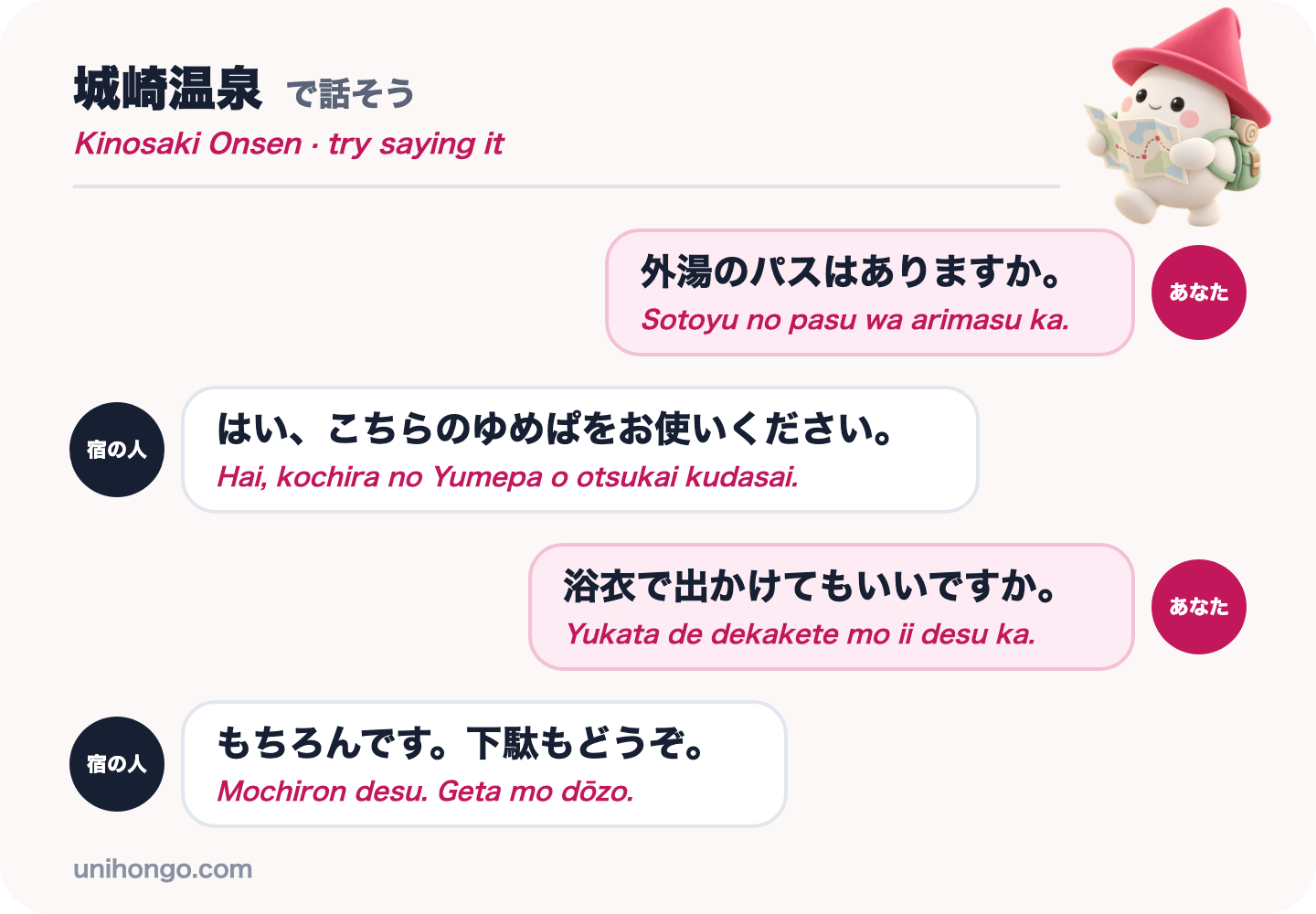
The key conversation happens at check-in. You ask for the bath pass, the host hands you the Yumepa, and you check that it is fine to go out in the inn's yukata and geta. Practise the four lines below until you can say them without reading; the pattern te mo ii desu ka, is it all right to, works for any permission question.
Then practise with a partner who answers back. In Unihongo, choose the Ryokan Stay topic and ask your AI Sensei to play the host at a Kinosaki inn, or the Onsen topic to rehearse the bath entrance. Saying the lines once before the trip makes them come out naturally at the desk.
| Japanese | Romaji | Meaning |
|---|---|---|
| 外湯のパスはありますか。 | Sotoyu no pasu wa arimasu ka. | Is there a pass for the public baths? |
| はい、こちらのゆめぱをお使いください。 | Hai, kochira no Yumepa o otsukai kudasai. | Yes, please use this Yumepa. |
| 浴衣で出かけてもいいですか。 | Yukata de dekakete mo ii desu ka. | May I go out in the yukata? |
| もちろんです。下駄もどうぞ。 | Mochiron desu. Geta mo dōzo. | Of course. Please take some geta too. |
Official information
Visit Kinosaki, the official tourism site run for Toyooka City, publishes each bathhouse's hours, closing days and renovation notices, live crowd levels, the Yumepa day pass, access and ryokan bookings. Check it before you go, especially for the 2026 renovation closures.