

Finding the tourist information centre
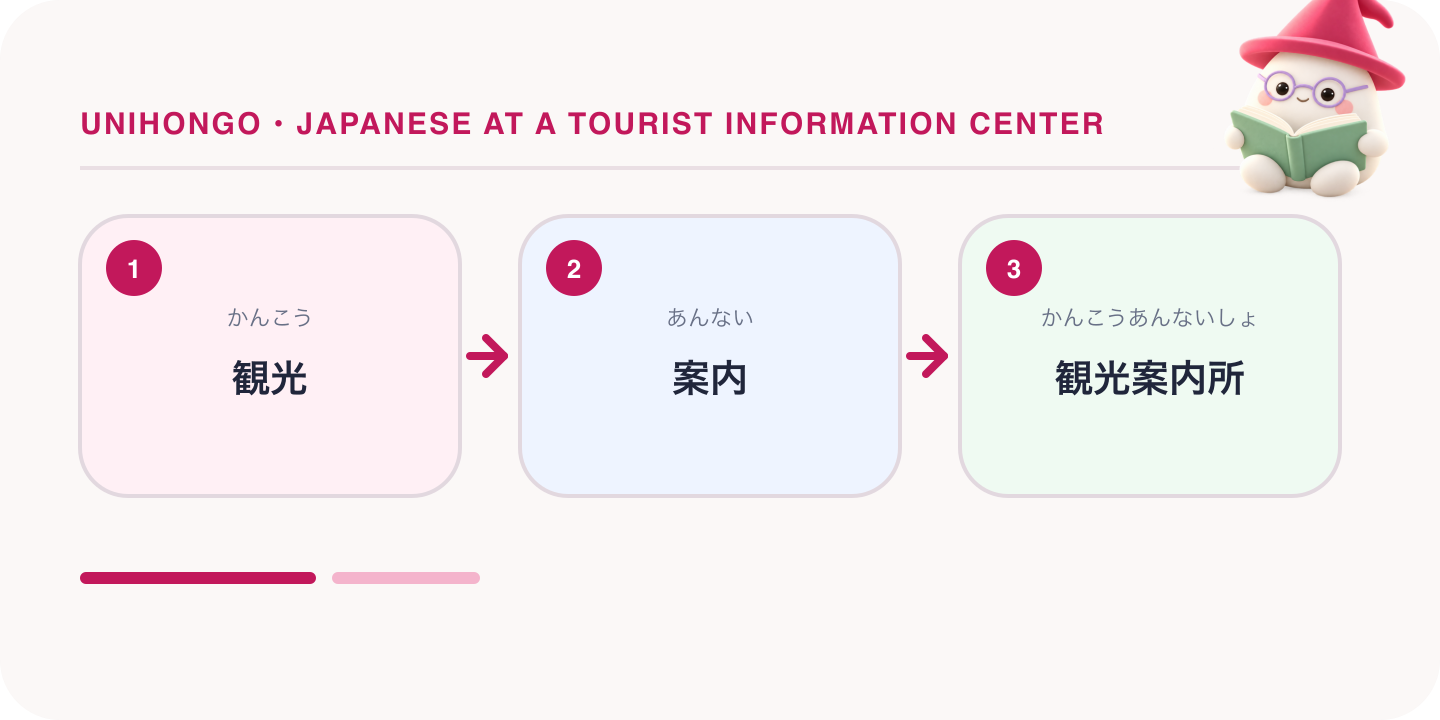
The Japanese word is kankō annaijo, literally sightseeing guidance office. At a large station you will often see signs saying kankō annai or tsūrisuto infomēshon, along with a question mark or a letter i symbol. In smaller towns the centre may be a desk inside the station building or a small office on the square in front of it.
Some centres display a certification mark from the Japan National Tourism Organization, which indicates a centre set up to help international visitors; the level of language support still differs from place to place.
| Japanese | Romaji | Meaning |
|---|---|---|
| 観光案内所はどこですか。 | Kankō annaijo wa doko desu ka. | Where is the tourist information centre? |
| Sign | Reading | Meaning |
|---|---|---|
| 観光案内所 | kankō annaijo | Tourist information centre |
| 観光案内 | kankō annai | Tourist information |
| 案内所 | annaijo | Information desk |
| 営業時間 | eigyō jikan | Opening hours |
| 定休日 | teikyūbi | Regular closing day |
| 年末年始 | nenmatsu nenshi | New Year holiday period |
| 無料 | muryō | Free of charge |
| 手荷物預かり | tenimotsu azukari | Luggage storage |
Asking for maps and English leaflets
The easiest opening is to ask for a map. Chizu is a map in general, and many centres also have walking maps, sanpo mappu, bus route maps and area guides. If you want another language, ask for eigo no, in English, in front of the word.
Staff often hand you a map and then draw on it. Asking them to mark places, shirushi o tsukeru, is completely normal and turns a free leaflet into a personal plan.
| Japanese | Romaji | Meaning |
|---|---|---|
| すみません、地図をもらえますか。 | Sumimasen, chizu o moraemasu ka. | Excuse me, could I have a map? |
| 英語のパンフレットはありますか。 | Eigo no panfuretto wa arimasu ka. | Do you have leaflets in English? |
| この辺の散歩マップはありますか。 | Kono hen no sanpo mappu wa arimasu ka. | Do you have a walking map of this area? |
| 地図に印をつけてもらえますか。 | Chizu ni shirushi o tsukete moraemasu ka. | Could you mark it on the map for me? |
| 今ここですね。 | Ima koko desu ne. | We're here now, right? |
| 英語が話せる方はいますか。 | Eigo ga hanaseru kata wa imasu ka. | Is there anyone who speaks English? |
Asking for recommendations
Information staff are local experts, so ask them what they would recommend. The key word is o-susume, recommendation. Tell them what you like, how much time you have and how you are travelling, and they can suggest places that are not in the guidebooks.
Be specific. Ask for somewhere that is walkable, somewhere quiet, a good place for lunch nearby, or what to do if it rains. If you want local food, ask for the area's specialities with meibutsu.
| Japanese | Romaji | Meaning |
|---|---|---|
| おすすめの観光地はありますか。 | O-susume no kankōchi wa arimasu ka. | Are there any places you'd recommend seeing? |
| 半日しか時間がありません。 | Hannichi shika jikan ga arimasen. | I only have half a day. |
| 歩いて行けるところがいいです。 | Aruite ikeru tokoro ga ii desu. | I'd prefer somewhere I can walk to. |
| この辺でおすすめのお昼ごはんはありますか。 | Kono hen de o-susume no o-hiru gohan wa arimasu ka. | Is there somewhere you'd recommend for lunch around here? |
| この地域の名物は何ですか。 | Kono chiiki no meibutsu wa nan desu ka. | What is this area's local speciality? |
| 雨の日でも楽しめるところはありますか。 | Ame no hi demo tanoshimeru tokoro wa arimasu ka. | Is there somewhere good on a rainy day? |
| 今日は何かイベントがありますか。 | Kyō wa nanika ibento ga arimasu ka. | Is there any event on today? |
Bus routes and getting there
One of the most useful things an information centre does is explain local buses, which can be confusing in a new town. Ask how to get to a place, which bus to take, where it leaves from and how long it takes. Staff will often write the bus number and stop on your map.
Listen for noriba, the boarding point, and the route number, followed by a time estimate with gurai or kurai, about. Timetables and routes change, so if you are travelling on a later day, ask them to confirm the times for that day.
| Japanese | Romaji | Meaning |
|---|---|---|
| 金閣寺へはどうやって行けばいいですか。 | Kinkakuji e wa dō yatte ikeba ii desu ka. | How should I get to Kinkakuji? |
| 何番のバスに乗ればいいですか。 | Nanban no basu ni noreba ii desu ka. | Which bus number should I take? |
| バス乗り場はどこですか。 | Basu noriba wa doko desu ka. | Where is the bus stop? |
| どのくらいかかりますか。 | Dono kurai kakarimasu ka. | How long does it take? |
| 最終バスは何時ですか。 | Saishū basu wa nanji desu ka. | What time is the last bus? |
| タクシーのほうが早いですか。 | Takushī no hō ga hayai desu ka. | Is a taxi faster? |
Understanding the directions you are given
The answers follow a small set of patterns: a boarding point and number, a direction, a landmark and a time. If you catch those four, you have what you need, even if the rest goes past you. Repeating the key points back is polite and lets staff correct any mistake.
| Japanese | Romaji | Meaning |
|---|---|---|
| 二番乗り場から出ます。 | Niban noriba kara demasu. | It leaves from stop number two. |
| ここから歩いて十分ぐらいです。 | Koko kara aruite juppun gurai desu. | It's about ten minutes on foot from here. |
| バスで二十分ぐらいかかります。 | Basu de nijuppun gurai kakarimasu. | It takes about twenty minutes by bus. |
| 駅を出て右に曲がってください。 | Eki o dete migi ni magatte kudasai. | Leave the station and turn right. |
| コンビニの角を左です。 | Konbini no kado o hidari desu. | Turn left at the corner with the convenience store. |
| 二番乗り場から、二十分ですね。 | Niban noriba kara, nijuppun desu ne. | So stop number two, twenty minutes, right? |
Luggage storage and travel passes
If you arrive before hotel check-in, the information centre is a good place to ask about your suitcase. Some centres store luggage themselves, some offer to send it to your hotel the same day, often called tebura kankō, hands-free sightseeing, and others point you to coin lockers, koin rokkā, or luggage services nearby. Services and fees vary, so ask what is available.
Staff can also tell you which day passes and sightseeing passes exist for the area, what they cover and whether they are worth it for your plan. Some centres sell them directly; others tell you where to buy them.
| Japanese | Romaji | Meaning |
|---|---|---|
| 荷物を預けられますか。 | Nimotsu o azukeraremasu ka. | Can I leave my luggage? |
| コインロッカーはどこにありますか。 | Koin rokkā wa doko ni arimasu ka. | Where are the coin lockers? |
| ホテルまで荷物を送れますか。 | Hoteru made nimotsu o okuremasu ka. | Can I send my luggage to my hotel? |
| 一日乗車券はありますか。 | Ichinichi jōshaken wa arimasu ka. | Is there a one-day pass? |
| このパスで何に乗れますか。 | Kono pasu de nani ni noremasu ka. | What can I ride with this pass? |
| どこで買えますか。 | Doko de kaemasu ka. | Where can I buy it? |
Opening hours, closing days and other practical questions
Information staff can tell you whether a museum or garden is open today, when it closes and when the last entry is. Many attractions close on a fixed weekday, teikyūbi, and last entry, saishū nyūkan or nyūjō, is often earlier than closing time. Details differ everywhere, so asking saves a wasted trip.
Centres are also a good place to ask about free Wi-Fi, toilets, cash machines and whether a place takes cards.
| Japanese | Romaji | Meaning |
|---|---|---|
| 美術館は今日開いていますか。 | Bijutsukan wa kyō aite imasu ka. | Is the art museum open today? |
| 何時まで開いていますか。 | Nanji made aite imasu ka. | Until what time is it open? |
| 定休日はいつですか。 | Teikyūbi wa itsu desu ka. | When is it closed? |
| 最終入館は何時ですか。 | Saishū nyūkan wa nanji desu ka. | What time is last entry? |
| 無料のWi-Fiはありますか。 | Muryō no waifai wa arimasu ka. | Is there free Wi-Fi? |
| 近くにATMはありますか。 | Chikaku ni ē-tī-emu wa arimasu ka. | Is there a cash machine nearby? |
When plans change or something goes wrong
Tourist information centres are also where to go when things go wrong in an unfamiliar town: a closed attraction, a cancelled bus, a lost item or no room for the night. Staff may not solve everything, but they know who to call and where to go.
Explain in one sentence and ask what you should do: dō sureba ii desu ka. For a lost item, they may direct you to the station's lost property office or the local police box.
| Japanese | Romaji | Meaning |
|---|---|---|
| バスが運休になりました。ほかの行き方はありますか。 | Basu ga unkyū ni narimashita. Hoka no ikikata wa arimasu ka. | The bus is cancelled. Is there another way to get there? |
| 財布をなくしました。どうすればいいですか。 | Saifu o nakushimashita. Dō sureba ii desu ka. | I've lost my wallet. What should I do? |
| 今夜泊まるところを探しています。 | Kon'ya tomaru tokoro o sagashite imasu. | I'm looking for somewhere to stay tonight. |
| 道に迷いました。 | Michi ni mayoimashita. | I'm lost. |
| もう一度ゆっくり言っていただけますか。 | Mō ichido yukkuri itte itadakemasu ka. | Could you say that again slowly? |
| 書いてもらえますか。 | Kaite moraemasu ka. | Could you write it down for me? |