

Why Atami is the classic Tokyo onsen escape
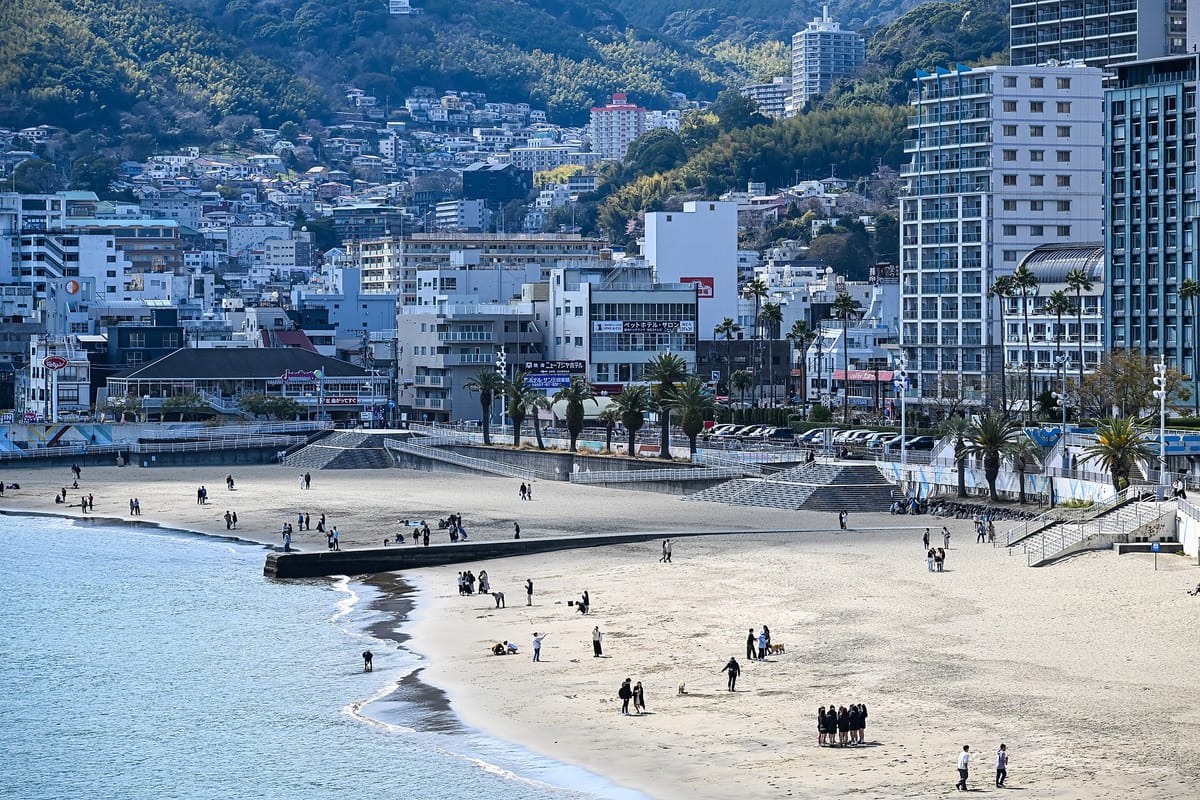
Atami lies at the north-eastern base of the Izu Peninsula, where steep green hills drop straight into Sagami Bay. Its hot springs have been famous for centuries; the station foot bath is named after Tokugawa Ieyasu, who visited the town's springs, and the old sources in the centre of town are still marked as the Atami Nanayu, the seven historic springs. One of them, the Ōyu, is a geyser, kanketsusen, that you can still see in the middle of town.
In the twentieth century the Shinkansen made Atami an easy trip from Tokyo, and through the boom years of the late 1980s it was packed with company retreats and large hotels. When the bubble burst, the town went quiet. In recent years it has bounced back with a younger crowd: renovated inns, cafés, a busy shopping arcade and a year-round programme of fireworks.
For a Japanese learner, Atami is an ideal first onsen town: compact, close to Tokyo and full of small, friendly shops. You can spend a day here speaking Japanese at a foot bath, a shrine, a fish shop and a café without ever needing a long conversation.
Getting there and around: Shinkansen, Tōkaidō Line and buses
The Tōkaidō Shinkansen stops at Atami, about forty to fifty minutes from Tokyo; not every train stops, so check before you board. The JR Tōkaidō Line takes around two hours and costs far less. Atami is also the gateway to the rest of Izu: the JR Itō Line runs south from here, with through trains onto the Izukyū line to Shimoda.
In town, most sights near the coast are within walking distance of Atami Station, but the town is steep, so expect hills. Kinomiya Shrine is near JR Kinomiya Station, one stop from Atami, or about fifteen minutes by bus. The MOA Museum of Art is a short bus ride up the hill from Atami Station. At the time of writing, the tourism association lists the Yu-Yu sightseeing loop bus as suspended, so use the regular city buses or a taxi.
| Japanese | Romaji | Meaning |
|---|---|---|
| この新幹線は熱海に止まりますか。 | Kono shinkansen wa Atami ni tomarimasu ka. | Does this Shinkansen stop at Atami? |
| 來宮神社へはどう行けばいいですか。 | Kinomiya Jinja e wa dō ikeba ii desu ka. | How do I get to Kinomiya Shrine? |
| 美術館行きのバスはどこから出ますか。 | Bijutsukan yuki no basu wa doko kara demasu ka. | Where does the bus to the art museum leave from? |
| サンビーチまで歩いて行けますか。 | San Bīchi made aruite ikemasu ka. | Can I walk to Sun Beach? |
| 帰りのきっぷを先に買いたいです。 | Kaeri no kippu o saki ni kaitai desu. | I would like to buy my return ticket in advance. |
What you will see: station streets, shrines, museums and the bay
Start at the station. Ieyasu no Yu, a free foot bath with natural hot spring water, sits right by the exit, and two covered shopping streets, Nakamise and Heiwa-dōri, run downhill from the station square, lined with shops selling himono, salt-dried fish, onsen manjū buns and street snacks. From there the town tumbles down to the sea, with the Sun Beach and its palm-lined promenade, the Shinsui Kōen park and the Moon Terrace by the water.
Kinomiya Shrine is the most visited sight. According to the shrine and the tourism association, its sacred camphor tree, the Ōkusu, is a national Natural Monument more than two thousand years old with a trunk about twenty-four metres round. It is said that walking once around it adds a year to your life, and that a wish made silently while circling it comes true. The tree is lit up at night.
- Ieyasu no Yu: the free foot bath in front of Atami Station.
- Nakamise and Heiwa-dōri: covered shopping streets for dried fish, sweets and souvenirs.
- Kinomiya Jinja: a shrine to the god of good fortune, with the ancient camphor tree beside the main hall.
- MOA Museum of Art: Japanese and East Asian art on the hillside above town, including three National Treasures, with a garden, tea houses and a noh stage.
- Kiunkaku: a 1919 villa that became a famous ryokan and is now owned by the city, with a garden and Roman-style tiled baths.
- Atami Sun Beach: the town beach, lit up at night, and the best place to watch the fireworks.
- Ōyu Kanketsusen: the old geyser among the seven historic springs of central Atami.
- Hatsushima: a small island reached by fast ferry from Atami port.
Words on the signs in Atami
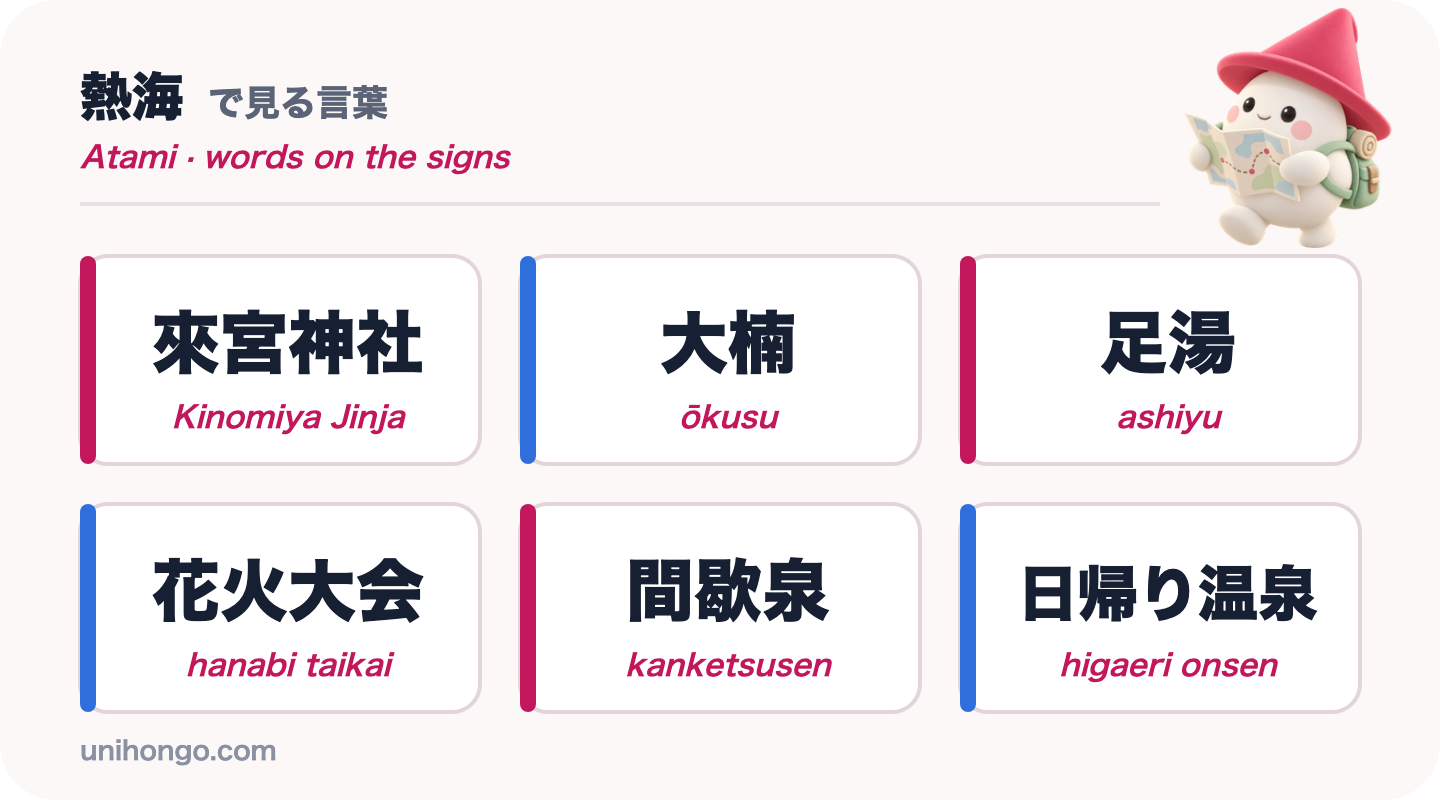
Hot water dominates Atami's signs. 湯, yu, hot water, appears in 足湯, foot bath, and in the names of the old springs; 温泉, onsen, is a hot spring; and 間歇泉, kanketsusen, is a geyser, from 間歇, intermittent. 日帰り温泉 is a hot spring you can use on a day trip without staying.
On posters around town, the word to look for is 花火大会, hanabi taikai, a fireworks display: 花火, hanabi, is literally fire flowers. At the shrine, 大楠 is the great camphor tree, from 大, big, and 楠, camphor.
| Word | Reading | Meaning |
|---|---|---|
| 熱海 | Atami | Hot sea, the name of the town |
| 來宮神社 | Kinomiya Jinja | Kinomiya Shrine |
| 大楠 | ōkusu | The great sacred camphor tree |
| 足湯 | ashiyu | Foot bath |
| 花火大会 | hanabi taikai | Fireworks display |
| 間歇泉 | kanketsusen | Geyser |
| 日帰り温泉 | higaeri onsen | Hot spring for day visitors |
| 干物 | himono | Salt-dried fish, an Atami speciality |
| 温泉まんじゅう | onsen manjū | Steamed bun sold in onsen towns |
Japanese for the shrine and the shopping street
At Kinomiya Shrine, start with the usual shrine routine: rinse your hands at the water basin, then at the main hall bow twice, clap twice, pray and bow once more. Then walk around the camphor tree, and if you want a charm, go to the counter where omamori are given. The shrine also has a café on its grounds, a pleasant place to rest.
Back on the station streets, shopping is quick and friendly. Himono, salt-dried horse mackerel and other fish, are Atami's classic souvenir, and many shops grill a sample or a set meal so you can taste before you buy. Onsen manjū, small steamed buns filled with sweet bean paste, are sold warm.
| Japanese | Romaji | Meaning |
|---|---|---|
| 大楠の周りを一周してもいいですか。 | Ōkusu no mawari o isshū shite mo ii desu ka. | May I walk once around the great camphor tree? |
| このお守りをいただけますか。 | Kono o-mamori o itadakemasu ka. | May I have this charm? |
| 御朱印をお願いできますか。 | Goshuin o onegai dekimasu ka. | Could I ask for a goshuin? |
| このアジの干物を二枚ください。 | Kono aji no himono o nimai kudasai. | Two of these dried horse mackerel, please. |
| お土産用に包んでもらえますか。 | O-miyage-yō ni tsutsunde moraemasu ka. | Could you wrap it as a souvenir? |
| 温泉まんじゅうを六個入りでお願いします。 | Onsen manjū o rokko-iri de onegai shimasu. | A box of six onsen manjū, please. |
| 今日中に食べたほうがいいですか。 | Kyō-jū ni tabeta hō ga ii desu ka. | Should I eat it today? |
Fireworks nights, timing and practical tips
The Atami fireworks began in 1952, after a typhoon and a great fire had devastated the town, and they are now held on more than ten nights a year. The tourism association explains that Atami Bay is surrounded on three sides by hills like a bowl, so the sound of each burst echoes back like a stadium, and every show ends with the Dai-kūchū Niagara, a curtain of silver fireworks launched across the whole bay.
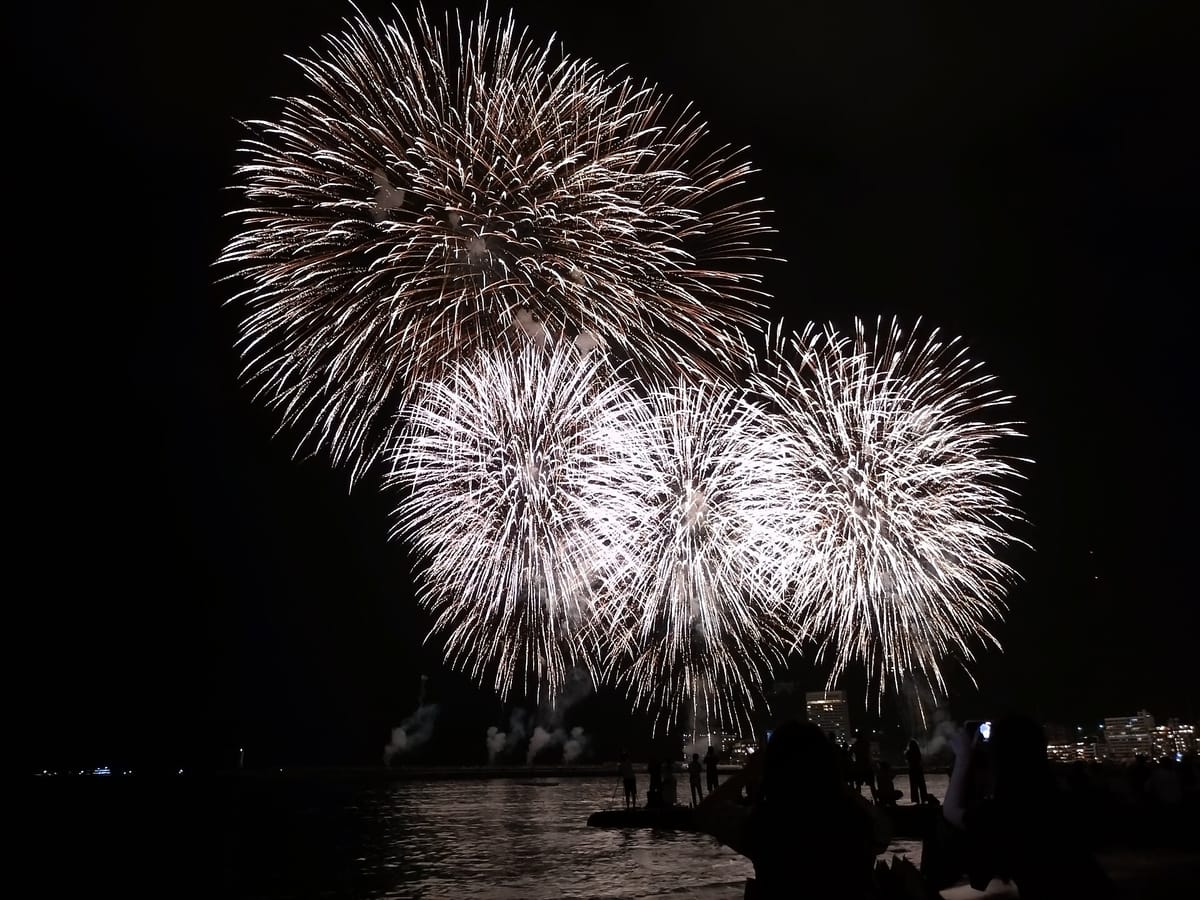
- Watch from the sand at Sun Beach, about fifteen minutes' walk from the station; the tourism association recommends it over the more crowded Shinsui Kōen.
- The area near the launch site is closed from midday on fireworks days for safety.
- Atami Station is extremely crowded after the show. Buy your return ticket or top up your IC card beforehand, or wait an hour before heading back.
- If you are going on to Itō or Shimoda after the fireworks, the tourism association suggests boarding at JR Kinomiya Station instead of Atami.
- The foot bath at the station is drained in the late afternoon, so use it earlier in the day.
- Atami is hilly. Wear comfortable shoes and use buses or taxis for the climb to Kinomiya Shrine and the MOA Museum.
- The MOA Museum of Art closes on Thursdays and between exhibitions; check its calendar before you go.
Practise the visit before you go
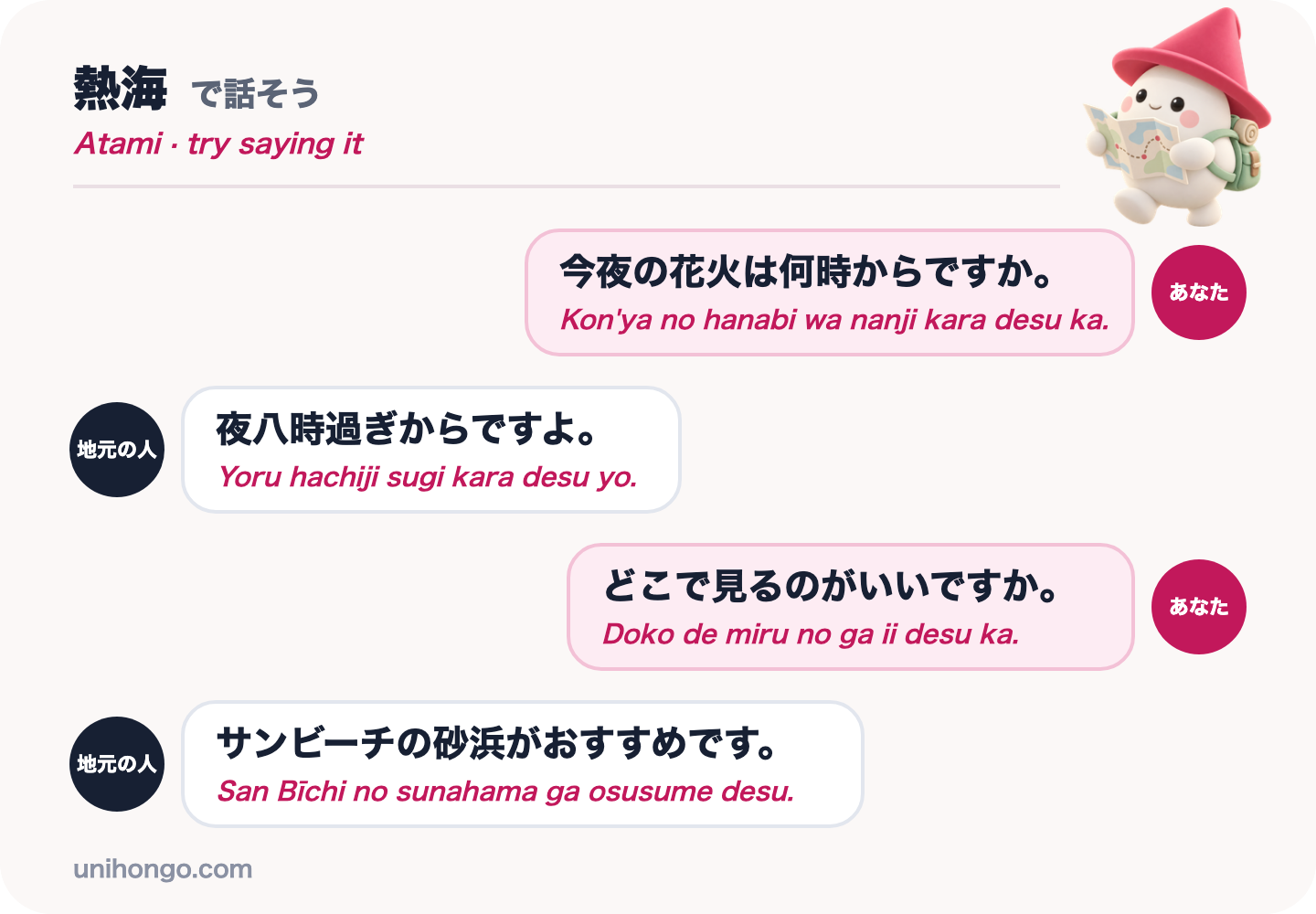
On a fireworks evening, the two questions everyone asks are when and where. The local's answer uses sugi, past, as in hachiji sugi, a little after eight, and osusume, recommendation, one of the most useful words in Japanese travel. Practise the four lines until you can say them without reading.
Then practise with someone who answers back. In Unihongo, choose the Seasonal Events topic and ask your AI Sensei to play a local on a fireworks night, or choose Onsen to rehearse a day bath at a hotel. Saying the lines aloud before you go makes the real conversation easy.
| Japanese | Romaji | Meaning |
|---|---|---|
| 今夜の花火は何時からですか。 | Kon'ya no hanabi wa nanji kara desu ka. | What time do tonight's fireworks start? |
| 夜八時過ぎからですよ。 | Yoru hachiji sugi kara desu yo. | A little after eight in the evening. |
| どこで見るのがいいですか。 | Doko de miru no ga ii desu ka. | Where is a good place to watch? |
| サンビーチの砂浜がおすすめです。 | San Bīchi no sunahama ga osusume desu. | I recommend the sand at Sun Beach. |
Official information
The Atami City Tourism Association publishes the fireworks dates, spot information, day-bathing facilities and access, mostly in Japanese. Kinomiya Shrine and the MOA Museum of Art have their own sites with hours, events and access.