

Why walk the Shikoku pilgrimage
Kōbō Daishi, the monk Kūkai who founded the Shingon school of Buddhism in the ninth century, was born on Shikoku and trained in its mountains and on its capes. The 88 temples associated with him, the fudasho, form a loop around the island, and pilgrims have followed it for centuries. A famous legend tells of Emon Saburō, a rich man who broke the begging bowl of a monk without knowing it was Kōbō Daishi, and who set out around Shikoku to seek forgiveness; his journey is said to be the origin of the henro.
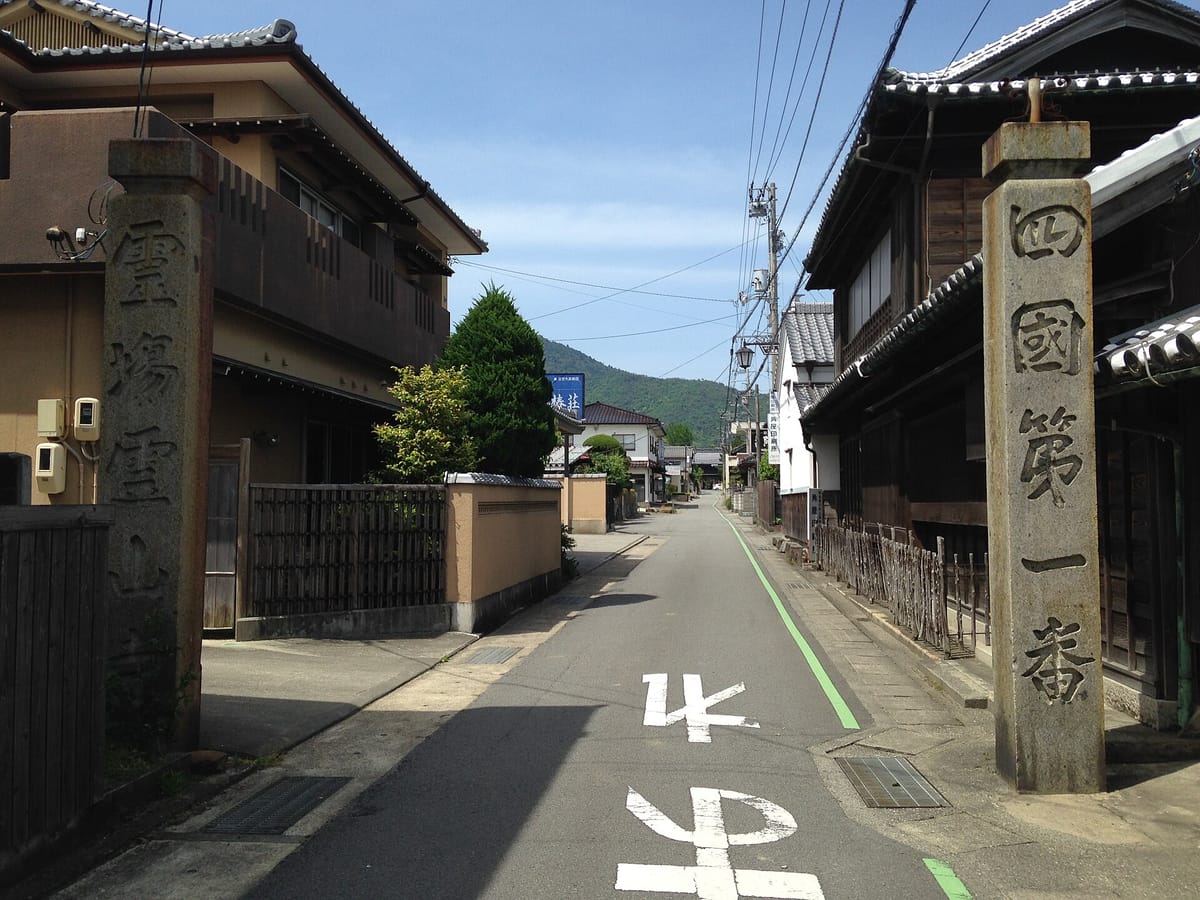
The circuit passes through all four prefectures, which are traditionally given spiritual meanings: Tokushima is the place of awakening, Kōchi of ascetic training, Ehime of enlightenment and Kagawa of nirvana. Between the temples the route crosses mountains, follows wild coastlines and runs through ordinary towns, and the pilgrim in white is a familiar sight to everyone who lives there.
You do not have to be Buddhist, or a walker, to take part. The pilgrims' association welcomes people of any faith, and many visitors simply spend a day or two visiting the first few temples in Tokushima. For a Japanese learner, the henro is a chance to step into a living tradition with its own small, polite vocabulary, used in exactly the same way at every temple.
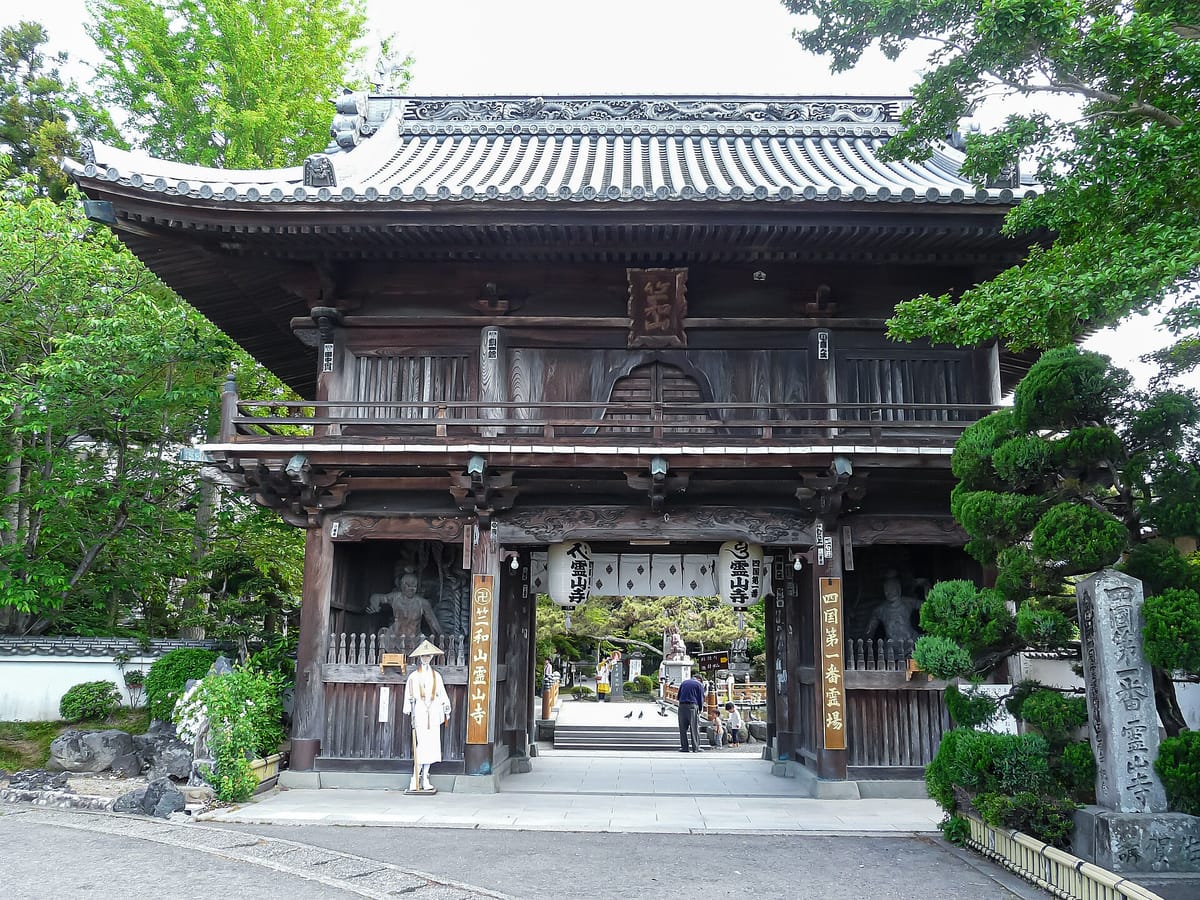
Getting there: Temple 1, Ryōzen-ji, near Bandō Station
Temple 1, Ryōzen-ji, is in Naruto, in the north-east of Tokushima Prefecture. By train, take the JR Kōtoku Line from Tokushima or Takamatsu to Bandō Station; from Naruto, take the JR Naruto Line to Ikenotani and change there. The temple is about ten minutes' walk from Bandō Station. Trains are roughly hourly. Infrequent buses between Naruto Station and Itano also stop at Ryōzen-ji-mae.
Ryōzen-ji is the traditional starting point because it is the temple closest to Kōyasan, the Shingon headquarters, where many pilgrims pray before and after the circuit. It sells everything a new pilgrim needs, from the white vest to the stamp book, and staff are used to explaining the basics. Temples 2 to 5 are all within walking distance of each other, so a first day can easily cover several.
| Japanese | Romaji | Meaning |
|---|---|---|
| 板東駅まで行きたいんですが、池谷で乗り換えですか。 | Bandō-eki made ikitai n desu ga, Ikenotani de norikae desu ka. | I want to go to Bandō Station. Do I change at Ikenotani? |
| 霊山寺はどちらですか。 | Ryōzen-ji wa dochira desu ka. | Which way is Ryōzen-ji? |
| 遍路用品はどこで買えますか。 | Henro yōhin wa doko de kaemasu ka. | Where can I buy pilgrim supplies? |
| 二番札所まで歩いて何分くらいですか。 | Niban fudasho made aruite nanpun kurai desu ka. | About how many minutes' walk is it to Temple 2? |
| この道は遍路道ですか。 | Kono michi wa henro michi desu ka. | Is this the pilgrim path? |
Clothes, the staff and the stamp book
Pilgrim clothing is mostly white and has a meaning for each piece. You do not need it all, and many pilgrims wear only the white vest over ordinary clothes, but wearing at least the vest tells everyone you are an o-henro-san, and people will greet you and offer help.
The most important item is the nōkyōchō, the stamp book. At each temple, after praying, you take it to the nōkyōsho, where staff write the temple's name in ink calligraphy and add red seals. The association stresses that this is not a souvenir stamp but proof that you prayed. With the stamp you also receive an osugata, a small paper image of the temple's main deity.
- Hakui (白衣): the white robe or vest, often printed with Namu Daishi Henjō Kongō.
- Sugegasa (菅笠): the sedge hat, inscribed with verses, that protects you from sun and rain.
- Kongōzue (金剛杖): the walking staff, said to represent Kōbō Daishi; by custom you do not tap it on bridges.
- Wagesa (輪袈裟): the stole worn around the neck when praying.
- Nōkyōchō (納経帳): the stamp book for the calligraphy and seals of all 88 temples.
- Osamefuda (納め札): name slips you leave at each hall, whose colour changes with how many circuits you have made.
- Zudabukuro (頭陀袋): the shoulder bag for your book, sutras, candles and incense.
Words on the signs: temples, halls and paths
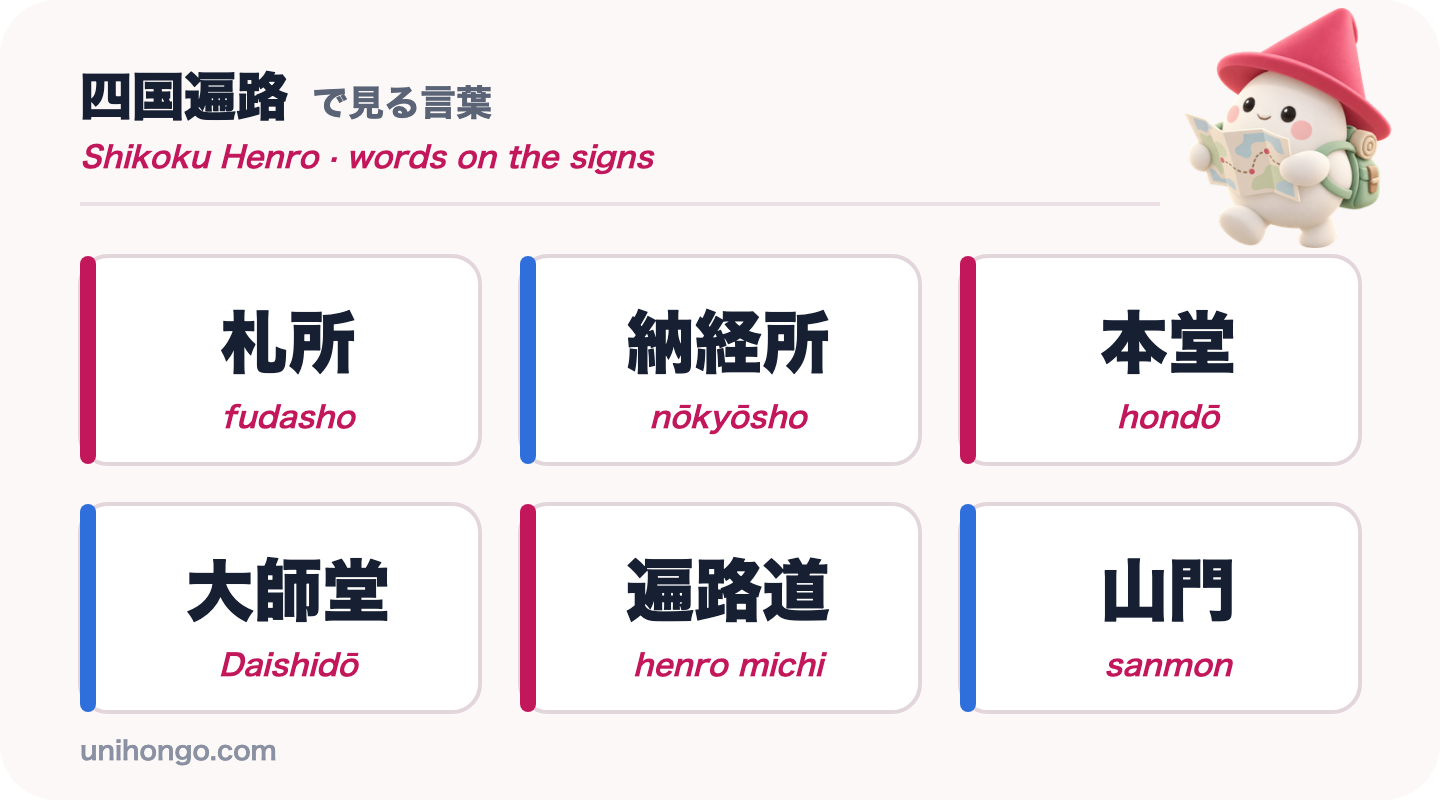
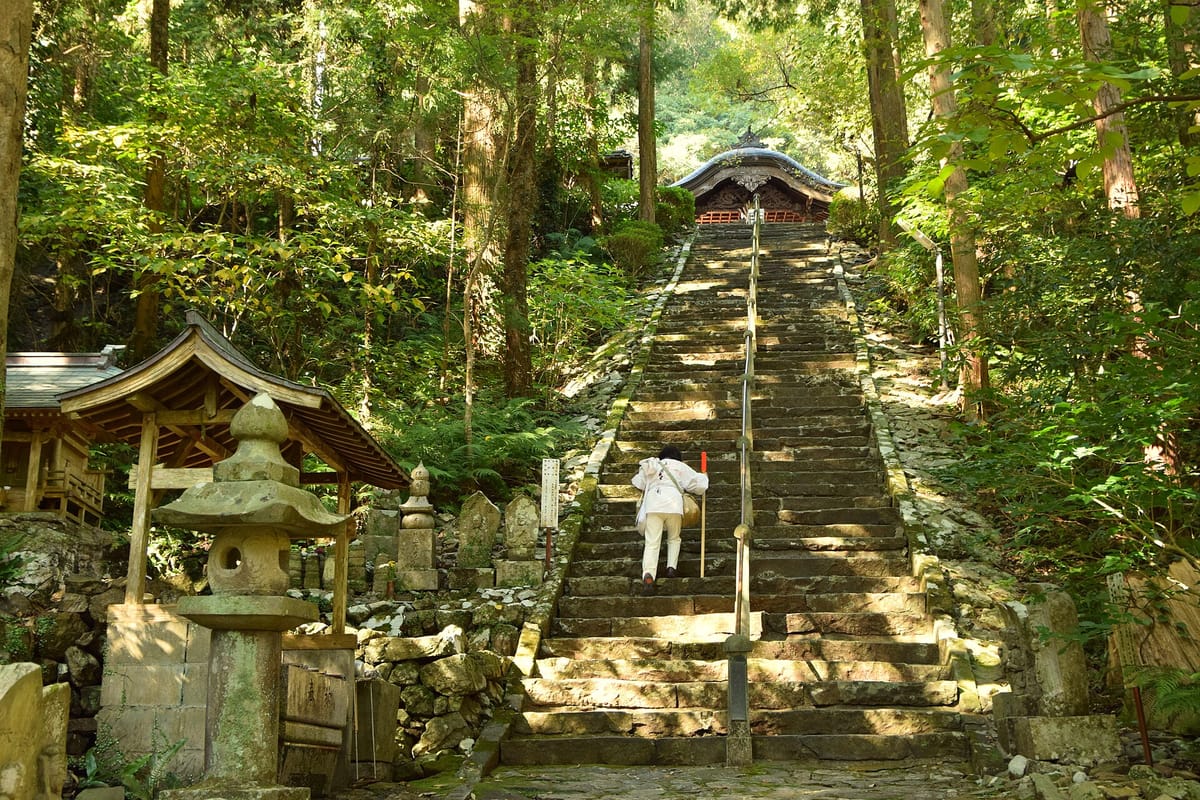
Each of the 88 temples has the same basic layout: a gate, a purification basin, a bell, the main hall and a hall dedicated to Kōbō Daishi, plus the stamp office. Once you can read these few signs, every temple becomes easy to navigate. Between temples, small signs and stickers showing a pilgrim figure and an arrow mark the henro michi, the pilgrim path.
| Word | Reading | Meaning |
|---|---|---|
| 札所 | fudasho | Numbered pilgrimage temple |
| 山門 | sanmon | Temple gate |
| 本堂 | hondō | Main hall |
| 大師堂 | Daishidō | Hall of Kōbō Daishi |
| 納経所 | nōkyōsho | Stamp office |
| 遍路道 | henro michi | Pilgrim path |
| お接待 | osettai | Gifts offered to pilgrims |
| 宿坊 | shukubō | Temple lodging |
| 結願 | kechigan | Completion of the pilgrimage |
Japanese for the temple and the stamp office
The order at each temple is the same. Bow at the gate, purify your hands and mouth at the basin, ring the bell once if it is permitted, then at the main hall light a candle and incense, put your name slip in the box, make an offering, and recite or read the sutras. Repeat at the Daishi hall. Only then go to the stamp office.
Stamp offices keep fixed daytime hours, and they can be busy in spring and autumn, so arrive with time to spare; the association asks pilgrims who arrive just before closing to explain why they need the stamp first. A simple polite request and a word of thanks at the end are all you need.
| Japanese | Romaji | Meaning |
|---|---|---|
| 納経帳をください。 | Nōkyōchō o kudasai. | A stamp book, please. |
| 白衣はどのサイズがありますか。 | Hakui wa dono saizu ga arimasu ka. | What sizes do you have for the white vest? |
| 鐘をついてもいいですか。 | Kane o tsuite mo ii desu ka. | May I ring the bell? |
| ろうそくとお線香はどこに置けばいいですか。 | Rōsoku to o-senkō wa doko ni okeba ii desu ka. | Where should I place the candle and incense? |
| 宿坊に泊まれますか。予約が必要ですか。 | Shukubō ni tomaremasu ka. Yoyaku ga hitsuyō desu ka. | Can I stay at the temple lodging? Do I need a reservation? |
| 次の札所までどのくらいですか。 | Tsugi no fudasho made dono kurai desu ka. | How far is it to the next temple? |
| お接待、ありがとうございます。 | O-settai, arigatō gozaimasu. | Thank you for your kindness to pilgrims. |
Etiquette, timing and practical tips
The henro is a religious journey, and the temples are active places of worship. Respect for the people who live along the route has kept the tradition of welcome alive for centuries.
- Bow when you enter and leave through each temple gate.
- Pray first, then receive your stamp; the stamp is a record of prayer, not a souvenir.
- Place incense in the centre of the burner and candles at the top, so others have room.
- Do not tap your staff on bridges: legend says Kōbō Daishi once slept under one.
- Accept osettai graciously, and do not ask for it.
- Book shukubō and inns in advance, especially in spring and autumn, the busiest pilgrimage seasons.
- In winter, days are short and some mountain paths are dangerous after dark; finish walking early.
- Carry cash for stamp offerings, small purchases and lodgings in rural areas.
Practise the stamp office before you go
You will have the same short conversation 88 times on the henro, so it is worth getting it right. You ask for the nōkyō, the staff may check that you have already prayed, and they take your book. Notice the honorific o-sumi desu ka, have you finished, and o-azukari shimasu, I will take it from you, both standard polite forms used at counters everywhere in Japan.
Say the four lines aloud until they are second nature. Then open Unihongo, choose the Cultural Etiquette topic and ask your AI Sensei to play temple staff, sometimes reminding you to pray first or telling you the office is about to close. Add the Directions topic to practise asking the way between temples.
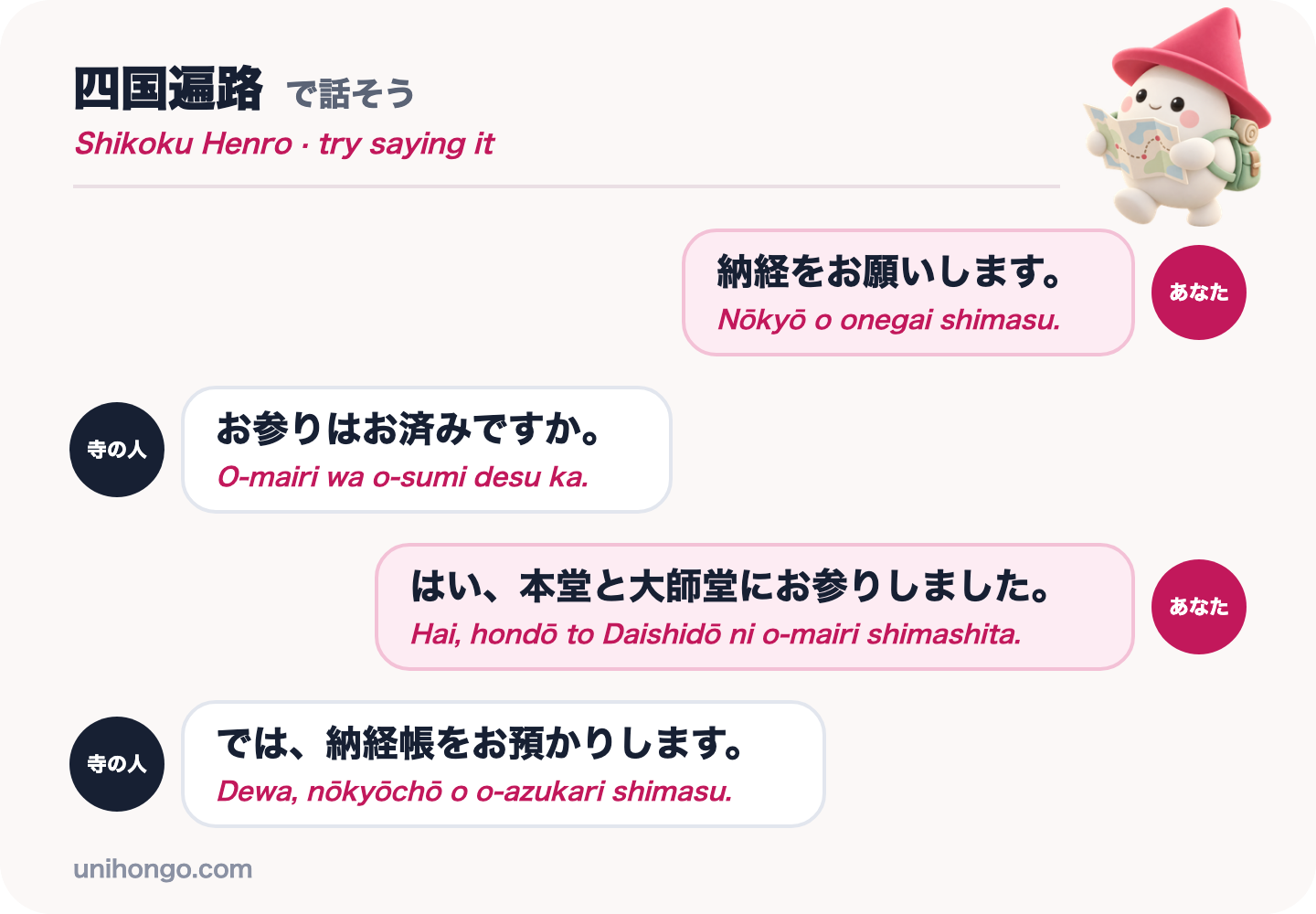
| Japanese | Romaji | Meaning |
|---|---|---|
| 納経をお願いします。 | Nōkyō o onegai shimasu. | May I have the temple stamp, please? |
| お参りはお済みですか。 | O-mairi wa o-sumi desu ka. | Have you finished your prayers? |
| はい、本堂と大師堂にお参りしました。 | Hai, hondō to Daishidō ni o-mairi shimashita. | Yes, I prayed at the main hall and the Daishi hall. |
| では、納経帳をお預かりします。 | Dewa, nōkyōchō o o-azukari shimasu. | Then I'll take your stamp book. |
Official information
The Shikoku 88 Sacred Sites association publishes the basics of the pilgrimage, the way to pray, the pilgrim supplies and answers to common questions in English. Read them before you start, and check each temple's details on the same site.