
Tendon or teishoku, sauce or salt: the first four words
Tendon (天丼) is short for tempura donburi: several pieces of tempura laid over a bowl of rice and finished with a sweet, salty soy-based sauce. The batter soaks up the sauce, so it is softer and richer than tempura on a plate. It is the quick, filling, everyday option.
Tempura teishoku (天ぷら定食) is the set meal: tempura on its own plate, with rice, miso soup and pickles beside it. Here the batter stays crisp and you season each piece yourself, either by dipping it in tentsuyu (天つゆ), a warm, thin sauce, or with a pinch of shio (塩), salt.
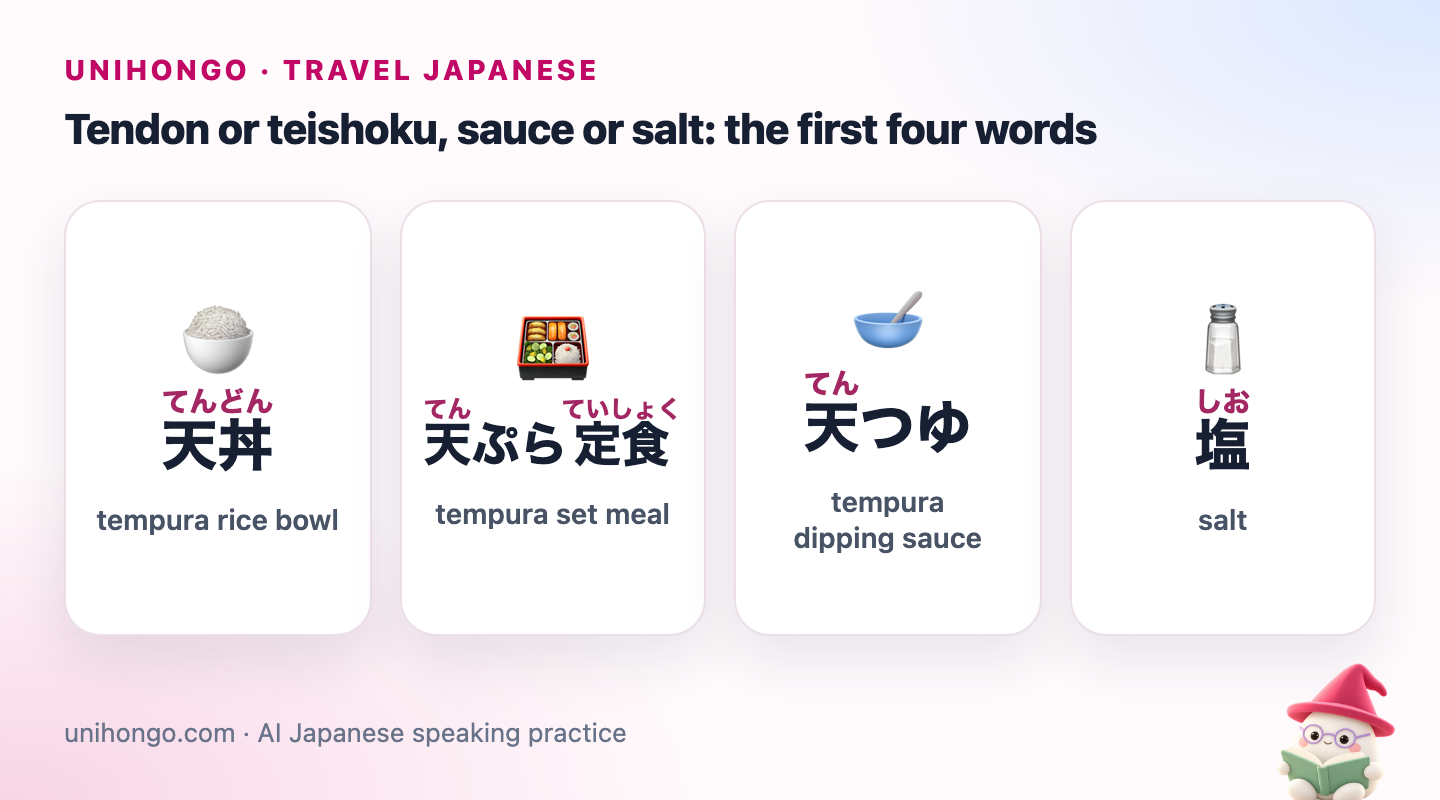
| Japanese | Romaji | Meaning |
|---|---|---|
| 天丼 | tendon | tempura rice bowl |
| 天ぷら定食 | tenpura teishoku | tempura set meal |
| 天つゆ | tentsuyu | tempura dipping sauce |
| 塩 | shio | salt |
| 盛り合わせ | moriawase | assorted plate |
| 揚げたて | agetate | freshly fried |
Tentsuyu or salt: how to eat each piece
Tentsuyu is made from dashi stock, soy sauce and mirin. It comes in a small bowl with a mound of grated daikon radish, daikon oroshi (大根おろし), and sometimes grated ginger. Stir the daikon into the sauce, dip the piece briefly and eat. A long soak makes the batter fall off.
Salt is the other route, and many shops suggest it for delicate items so that the taste of the ingredient comes through. You may get plain salt, salt mixed with matcha, or a wedge of lemon. Pinch a little salt onto the piece, or touch the piece lightly to the salt. Do not shake it over the whole plate.
| Japanese | Romaji | Meaning |
|---|---|---|
| 大根おろし | daikon oroshi | grated daikon radish |
| 抹茶塩 | matcha-jio | salt mixed with matcha |
| 塩でどうぞ。 | Shio de dōzo. | Please have this one with salt. |
| 天つゆでどうぞ。 | Tentsuyu de dōzo. | This one with the dipping sauce. |
| お好みでどうぞ。 | O-konomi de dōzo. | Whichever you prefer. |
The items on almost every menu
Tempura items are usually written in kana. Seafood tends to come first, then vegetables, then the fritter.
| Japanese | Romaji | Meaning |
|---|---|---|
| えび | ebi | shrimp, prawn |
| いか | ika | squid |
| きす | kisu | Japanese whiting, a small white fish |
| あなご | anago | conger eel |
| なす | nasu | eggplant |
| かぼちゃ | kabocha | Japanese pumpkin |
| れんこん | renkon | lotus root |
| しそ | shiso | perilla leaf |
| さつまいも | satsumaimo | sweet potato |
| かき揚げ | kakiage | mixed fritter |
Kakiage (かき揚げ) is the exception to the one-ingredient rule: small shrimp or shredded vegetables such as onion and carrot are mixed in batter and fried as a single thick disc. Shiso is often listed as ōba (大葉), the same leaf under another name. Seasonal items rotate, so expect mountain vegetables in spring and mushrooms in autumn.
Which order suits you
| Romaji | What arrives | Good when |
|---|---|---|
| tendon | Tempura on rice with sweet soy sauce, usually with miso soup | You want a fast, filling lunch |
| tempura teishoku | Tempura on a plate with rice, miso soup, pickles and tentsuyu | You want crisp batter and to try both salt and sauce |
| moriawase | An assorted plate of tempura without rice, often shared | You are ordering several dishes with drinks |
| okonomi | Single pieces chosen from the list and fried to order | You know what you like, or want one more of something |
| kōsu | A set sequence of pieces served at the counter | You are at a specialist shop and want the full experience |
Ordering at an everyday tempura shop
At a casual shop you order once, by the name of the bowl or the set. The lines below cover the order and the two things staff most often say when the food arrives.
| Japanese | Romaji | Meaning |
|---|---|---|
| 天丼を一つお願いします。 | Tendon o hitotsu onegai shimasu. | One tendon, please. |
| 天ぷら定食を二つください。 | Tenpura teishoku o futatsu kudasai. | Two tempura set meals, please. |
| 盛り合わせには何が入っていますか。 | Moriawase ni wa nani ga haitte imasu ka. | What is in the assorted plate? |
| 塩もいただけますか。 | Shio mo itadakemasu ka. | Could I have some salt as well? |
| お待たせしました、天丼です。 | Omatase shimashita, tendon desu. | Thank you for waiting. Here is your tendon. |
| 揚げたてですので、お気をつけください。 | Agetate desu no de, o-ki o tsuke kudasai. | It is freshly fried, so please be careful. |
Counter tempura: one piece at a time
At a specialist tempura restaurant you sit at a counter facing the chef and a pot of oil. Most guests order a course, kōsu (コース), or leave the choice to the chef with omakase (おまかせ). The chef fries one item, sets it on the paper-lined plate in front of you, names it, and often adds how to season it. Then the next one follows, timed to your pace.
The one rule is to eat each piece as it lands. Tempura is at its best agetate, just fried, and a piece left waiting while you take photographs goes soft. Near the end the chef may ask whether you would like anything more, and the meal usually closes with rice, often a small tendon.
| Japanese | Romaji | Meaning |
|---|---|---|
| こちら、きすです。 | Kochira, kisu desu. | This is kisu, whiting. |
| 熱いうちにどうぞ。 | Atsui uchi ni dōzo. | Please eat it while it is hot. |
| 追加はいかがですか。 | Tsuika wa ikaga desu ka. | Would you like to add anything? |
Asking for more and saying what you cannot eat
Say what you cannot eat at the start, when you order, not when the piece arrives. Taberarenai n desu, I can't eat it, is softer than kirai desu, I dislike it, and the n desu ending shows that you are explaining, not complaining. For an allergy, use the word arerugī (アレルギー) so that the kitchen treats it seriously, and remember that most shops fry everything in the same oil.
| Japanese | Romaji | Meaning |
|---|---|---|
| えびをもう一つお願いします。 | Ebi o mō hitotsu onegai shimasu. | One more shrimp, please. |
| 追加で、なすをお願いします。 | Tsuika de, nasu o onegai shimasu. | As an extra, eggplant, please. |
| えびが食べられないんです。 | Ebi ga taberarenai n desu. | I can't eat shrimp. |
| えびアレルギーです。 | Ebi arerugī desu. | I have a shrimp allergy. |
| えび抜きでお願いできますか。 | Ebi-nuki de onegai dekimasu ka. | Could you make it without shrimp? |
| 代わりに野菜をお願いします。 | Kawari ni yasai o onegai shimasu. | Vegetables instead, please. |
| もうお腹いっぱいです。 | Mō onaka ippai desu. | I am full now. |
Where the word tempura comes from
Frying in batter reached Japan with Portuguese traders and missionaries in the sixteenth century, and the word tempura is usually traced to Portuguese, though exactly which Portuguese word it comes from is still argued over. The kanji 天麩羅 were fitted to the sound later, which is why menus today mostly write 天ぷら, with the second half in hiragana.