

Why Zaō's snow monsters are worth the cold
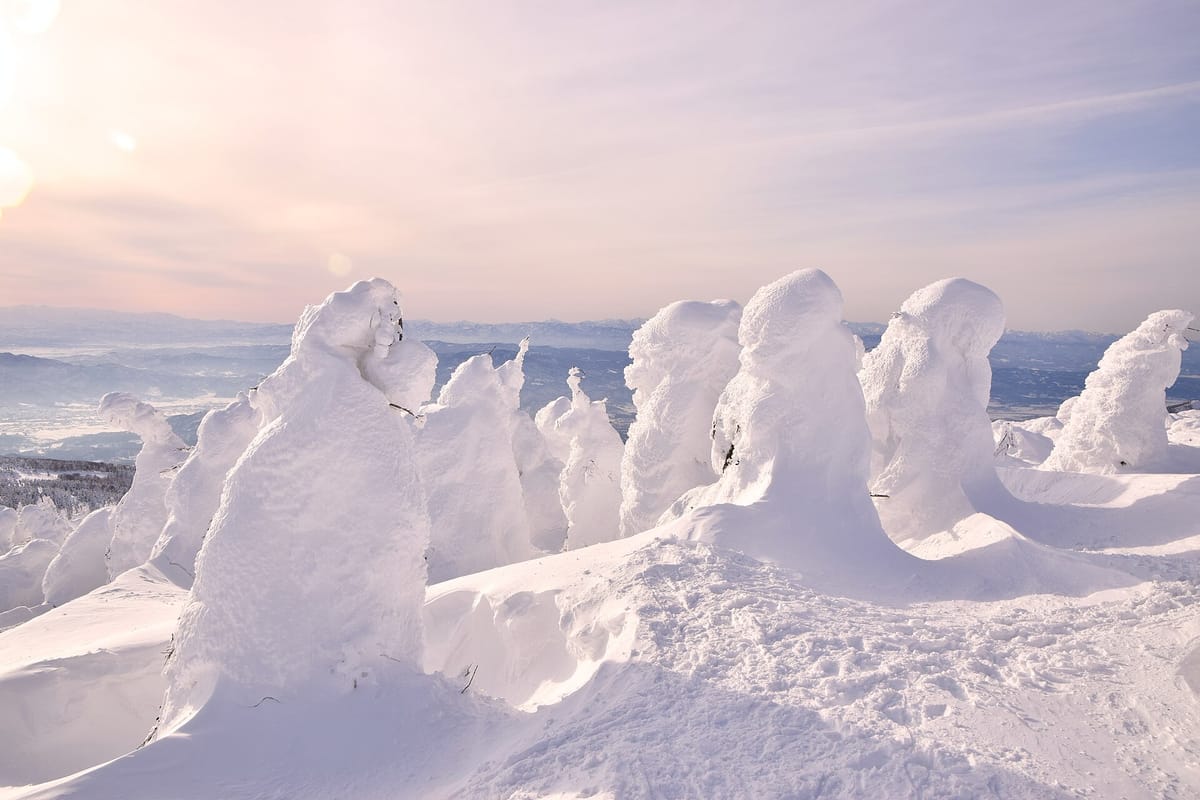
Juhyō form on the evergreen firs that grow high on the mountain. In midwinter, cold wind from Siberia picks up moisture over the Sea of Japan and blows it against Zaō as snow, cloud and freezing fog. The tiny droplets freeze the moment they touch a branch, and the ice builds up on the side facing the wind, layer after layer, with snow packing in between. Over weeks the trees vanish inside white shapes several metres tall, with ridged sides like fur, that can grow noticeably in a single night.
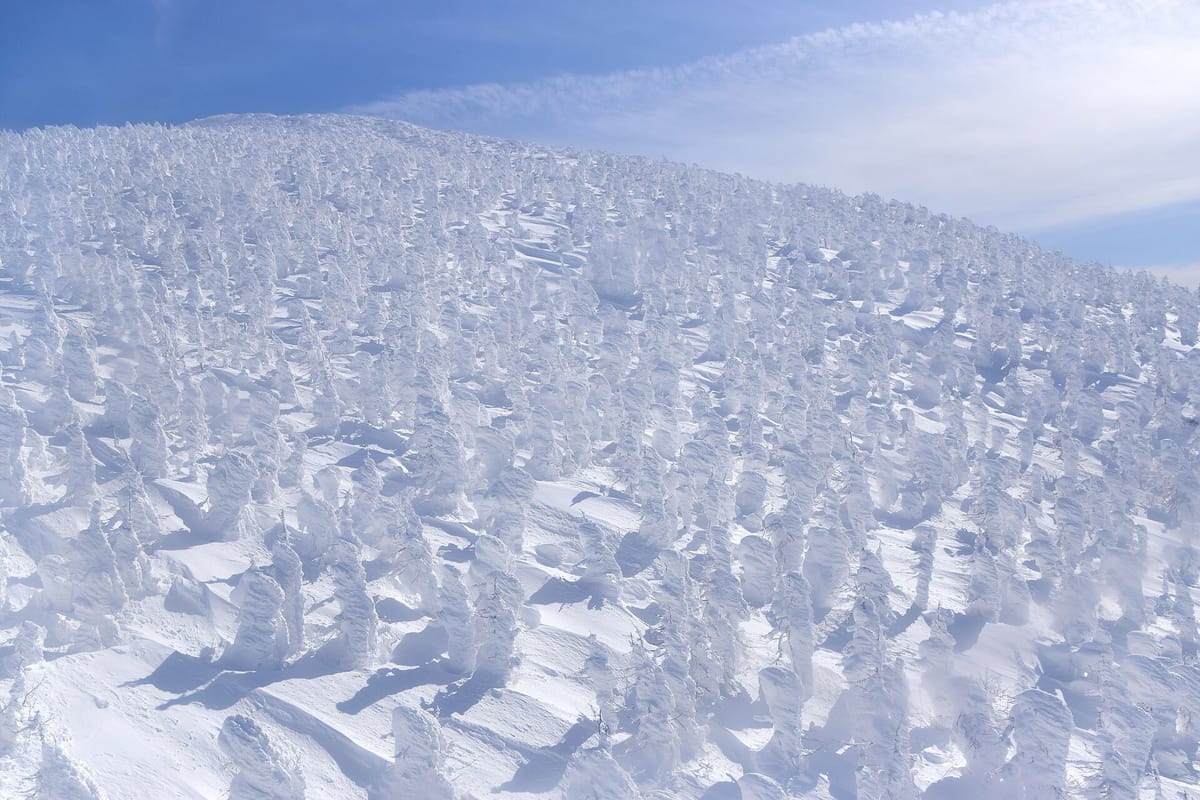
The result is a landscape unlike anything else in Japan: slopes covered with hundreds of looming figures that look, depending on your mood and the light, like monsters, ghosts or a crowd of giants frozen in place. On a clear day after fresh snow they shine against a blue sky; in fog they appear and disappear around you.
Zaō Onsen, the town at the bottom, is one of the oldest hot springs in the north, with a local tradition dating it to the second century. Its water is strongly acidic and sulphurous, and a soak after a cold morning at the top is part of the trip.
Getting there: Yamagata Station, Zaō Onsen and the ropeway
Yamagata Station is on the Yamagata Shinkansen, which runs from Tokyo in about three hours. From the bus terminal at the station, buses run to Zaō Onsen, climbing into the mountains to the town at about 880 metres. From the Zaō Onsen bus terminal, walk uphill through the town for a short distance to Zaō Sanroku Station, the lower station of the Zaō Ropeway.
The Zaō Ropeway has two lines. The Sanroku Line climbs from Zaō Sanroku Station to Juhyō Kōgen Station, the snow monster plateau, at about 1,330 metres. There you change to the Sanchō Line, a gondola that takes about ten minutes to reach Jizō Sanchō Station at about 1,660 metres, where the snow monsters stand thickest. The top station takes its name from Jizō-san, the stone Jizō statue that stands near the summit of the ropeway.
| Japanese | Romaji | Meaning |
|---|---|---|
| 蔵王温泉行きのバスは何番乗り場ですか。 | Zaō Onsen-iki no basu wa nanban noriba desu ka. | Which stand does the bus to Zaō Onsen leave from? |
| ロープウェイの山麓駅はどちらですか。 | Rōpuwei no Sanroku-eki wa dochira desu ka. | Which way is the ropeway's Sanroku Station? |
| 山頂まで往復でお願いします。 | Sanchō made ōfuku de onegai shimasu. | A return ticket to the summit, please. |
| 樹氷高原駅で乗り換えですか。 | Juhyō Kōgen-eki de norikae desu ka. | Do I change at Juhyō Kōgen Station? |
| 帰りの最終は何時ですか。 | Kaeri no saishū wa nanji desu ka. | What time is the last ride down? |
At the top: the snow monster fields and the view
Step out of Jizō Sanchō Station and the snow monsters are all around you. There is an observation area near the station, and on a clear day you can walk out onto the packed snow a short way to stand among them. The gondola ride up is itself part of the show: the forest below turns from dark trees dusted with snow to the fully formed white figures as you climb.
The weather decides everything. On a clear, calm day the views stretch over the white slopes and the mountains of Yamagata; in cloud or a blizzard you may see only the nearest shapes looming out of the fog, which has its own drama. Strong wind can suspend the upper line, so have a plan for the afternoon, such as the onsen, in case it does.
- Sanroku Line: the lower ropeway from the town to Juhyō Kōgen Station.
- Sanchō Line: the gondola from Juhyō Kōgen to Jizō Sanchō Station, about ten minutes.
- Jizō Sanchō Station: about 1,660 metres up, among the densest snow monsters.
- The Jizō statue: the stone figure near the top station that gives it its name.
- Evening viewings and snowcat tours: held on some dates in season; check in advance.
- Zaō Onsen: the sulphur hot spring town at the bottom, with public baths and inns.
Words on the signs at Zaō
The signs at Zaō are mostly about the ropeway and its three stations, and the names tell you where you are going: 山麓, sanroku, is the foot of the mountain, 高原, kōgen, a highland plateau, and 山頂, sanchō, the summit.
On a bad-weather day, look for 運休, unkyū, suspended, or 運転見合わせ, unten miawase, service on hold, on the board at the station. The table covers the words you are most likely to meet.
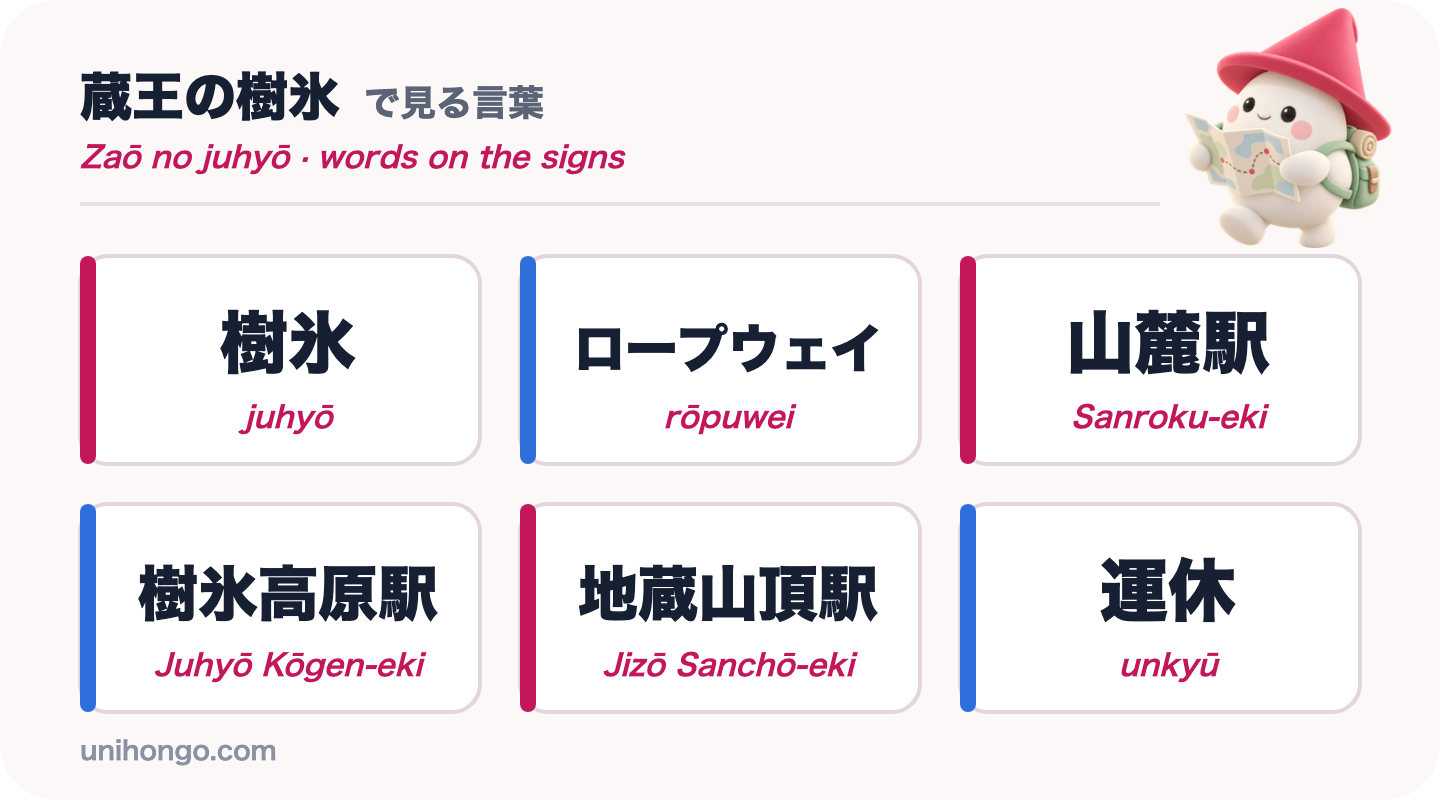
| Word | Reading | Meaning |
|---|---|---|
| 樹氷 | juhyō | Rime-covered trees, the snow monsters |
| ロープウェイ | rōpuwei | Ropeway, cable car |
| 山麓駅 | Sanroku-eki | The lower station at the foot of the mountain |
| 樹氷高原駅 | Juhyō Kōgen-eki | The middle station on the plateau |
| 地蔵山頂駅 | Jizō Sanchō-eki | The top station among the snow monsters |
| 運休 | unkyū | Service suspended |
| 運転見合わせ | unten miawase | Service on hold for now |
| 強風 | kyōfū | Strong wind |
| 往復 | ōfuku | Return trip |
Japanese for the ropeway, the weather and the onsen
At the ropeway, the two things everyone wants to know are whether it is running and what the weather is like at the top. Staff give the answer in short phrases: ugoite imasu, it is running, tomatte imasu, it has stopped, and kaze ga tsuyoi, the wind is strong.
Back in the town, the acidic water of Zaō Onsen is known for its strong sulphur smell. Public baths and inns welcome day visitors, and the usual bath rules apply: wash first, keep your towel out of the water, and take off metal jewellery, which the sulphur can discolour.
| Japanese | Romaji | Meaning |
|---|---|---|
| 山頂は今、何度くらいですか。 | Sanchō wa ima, nando kurai desu ka. | About what temperature is it at the summit now? |
| 樹氷は今が見頃ですか。 | Juhyō wa ima ga migoro desu ka. | Are the snow monsters at their best now? |
| 風で止まる可能性はありますか。 | Kaze de tomaru kanōsei wa arimasu ka. | Is there a chance it will stop because of the wind? |
| スキーをしない人も乗れますか。 | Sukī o shinai hito mo noremasu ka. | Can people who don't ski ride it too? |
| 日帰り入浴ができるお風呂はありますか。 | Higaeri nyūyoku ga dekiru o-furo wa arimasu ka. | Is there a bath I can use as a day visitor? |
| アクセサリーは外したほうがいいですか。 | Akusesarī wa hazushita hō ga ii desu ka. | Should I take off my jewellery? |
Clothing, safety and timing
The top of Zaō in midwinter is a serious mountain environment, even though you arrive by gondola.
- Dress for severe cold and wind: a warm hat, gloves, waterproof outer layers and boots with a good grip.
- Protect your phone and camera from the cold; batteries drain fast at the top.
- Stay in the marked areas near the station and do not walk in among the snow monsters off the path; skiers come down the slopes around them.
- Check the ropeway's status on the day. Strong wind often stops the upper line, especially in the afternoon.
- Go in the morning if you can, and leave time for the queue on weekends and holidays in the ski season.
- Outside winter, the ropeway runs for hiking and views, but there are no snow monsters; they need the deep cold of January and February.
Practise the ropeway before you go
The first question at Zaō is always about the ropeway and the weather. Practise the four lines below until you can say them without reading, and listen in the answer for kaze, wind, tsuyoi, strong, and sugu, straight away.
Then practise with a partner who answers back. In Unihongo, choose the Sightseeing topic and ask your AI Sensei to play the ropeway attendant, including a day when the upper line is suspended. Then use the Onsen topic to rehearse the bath in the town. Saying the lines once is what makes them come out in the cold.
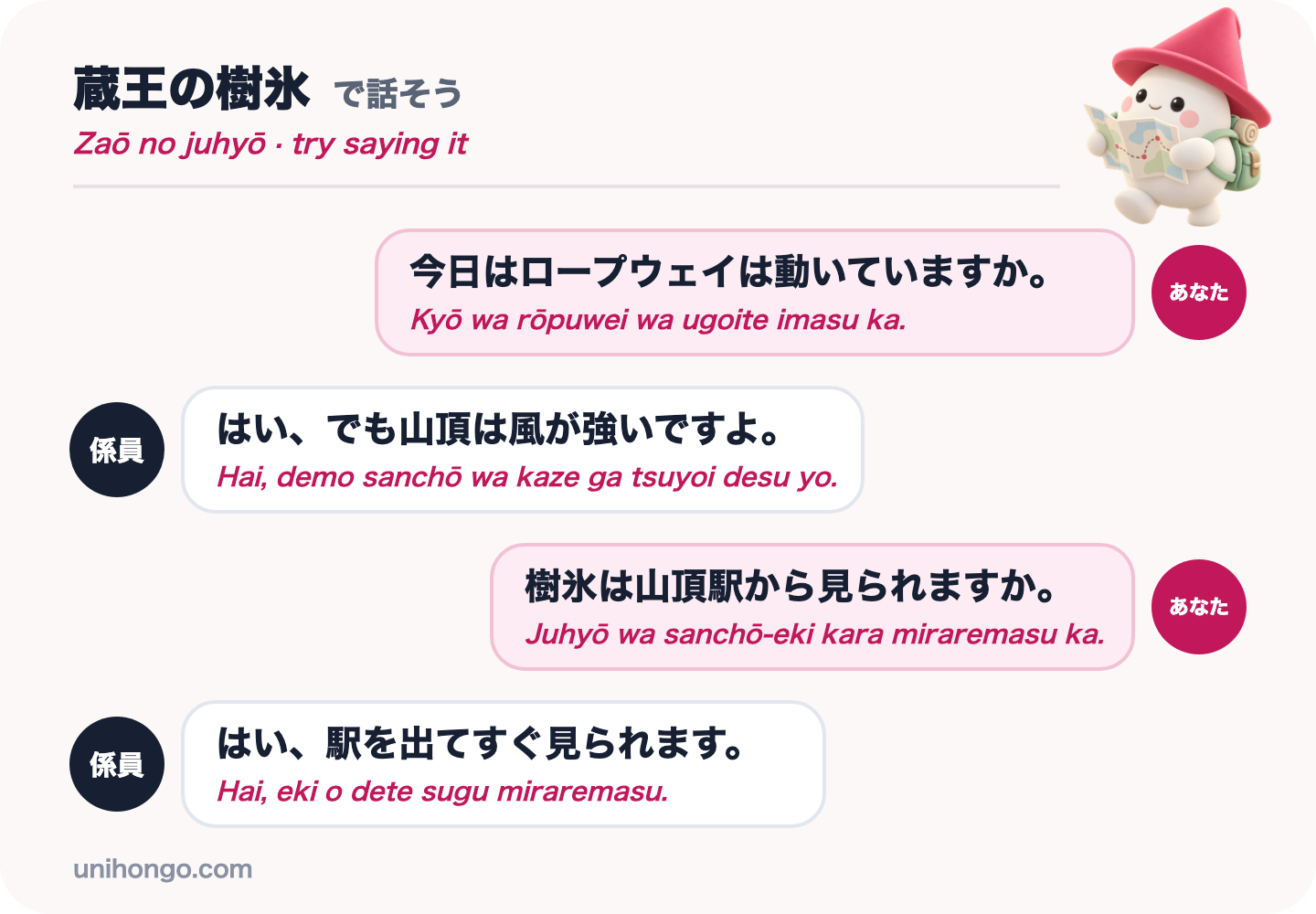
| Japanese | Romaji | Meaning |
|---|---|---|
| 今日はロープウェイは動いていますか。 | Kyō wa rōpuwei wa ugoite imasu ka. | Is the ropeway running today? |
| はい、でも山頂は風が強いですよ。 | Hai, demo sanchō wa kaze ga tsuyoi desu yo. | Yes, but it's windy at the summit. |
| 樹氷は山頂駅から見られますか。 | Juhyō wa sanchō-eki kara miraremasu ka. | Can I see the snow monsters from the top station? |
| はい、駅を出てすぐ見られます。 | Hai, eki o dete sugu miraremasu. | Yes, you can see them as soon as you leave the station. |
Official information
The Zaō Ropeway posts its operating status, winter events and fares on its site, and the Zaō Onsen resort site covers the town, the baths and the ski area. Check both on the morning of your visit.