

Why Meiji Jingū is worth the walk through the forest
Meiji Jingū is young by Japanese standards. It was founded in 1920, eight years after the death of Emperor Meiji, to enshrine the emperor and his wife, Empress Shōken, as kami. Their reign, from 1868 to 1912, saw Japan end its long isolation, build railways and a modern state, and the shrine was created as a national memorial to it. The original buildings were destroyed in the air raids of 1945 and rebuilt in 1958 in the same restrained style, in unpainted Japanese cypress with green copper roofs.
The forest is the other reason to come. When the shrine was built, the land was mostly open ground, and around 100,000 trees were donated from across Japan and planted to a plan designed to grow into a self-sustaining forest. A century later it covers about 70 hectares in the middle of the city, and walking the wide gravel approaches under its canopy is one of the calmest experiences Tokyo offers.
For a learner, it is a clear, well-signed introduction to Shinto. The signs are short and consistent, the purification routine is explained at the water basin, and the omikuji are poems that come with an English translation.
Getting there: Harajuku, Yoyogi and the three approaches
Meiji Jingū has three main approaches, sandō, each starting from a different station. The south approach, Minami-sandō, begins beside JR Harajuku Station on the Yamanote Line and a short walk from Meiji-jingumae Station on the Chiyoda and Fukutoshin lines, so most visitors use it. The north approach, Kita-sandō, starts near Yoyogi Station on the JR lines and the Ōedo Line and passes the Meiji Jingū Museum. The west approach, Nishi-sandō, is closest to Sangūbashi Station on the Odakyū Line.
Whichever you choose, the main shrine is about ten minutes' walk inside, so coming in from Harajuku and leaving towards Yoyogi, or the other way round, lets you see more of the forest without retracing your steps. The shrine follows the sun, opening at sunrise and closing at sunset, so the closing time is earlier in winter than in summer.
| Japanese | Romaji | Meaning |
|---|---|---|
| 明治神宮へはどの駅が近いですか。 | Meiji Jingū e wa dono eki ga chikai desu ka. | Which station is close to Meiji Jingū? |
| 原宿駅から歩いて行けますか。 | Harajuku-eki kara aruite ikemasu ka. | Can I walk from Harajuku Station? |
| 本殿はどちらですか。 | Honden wa dochira desu ka. | Which way is the main shrine? |
| 代々木駅に出る門はどこですか。 | Yoyogi-eki ni deru mon wa doko desu ka. | Where is the gate that comes out at Yoyogi Station? |
| 何時に閉まりますか。 | Nanji ni shimarimasu ka. | What time does it close? |
The great torii, the sake barrels and the wedded trees
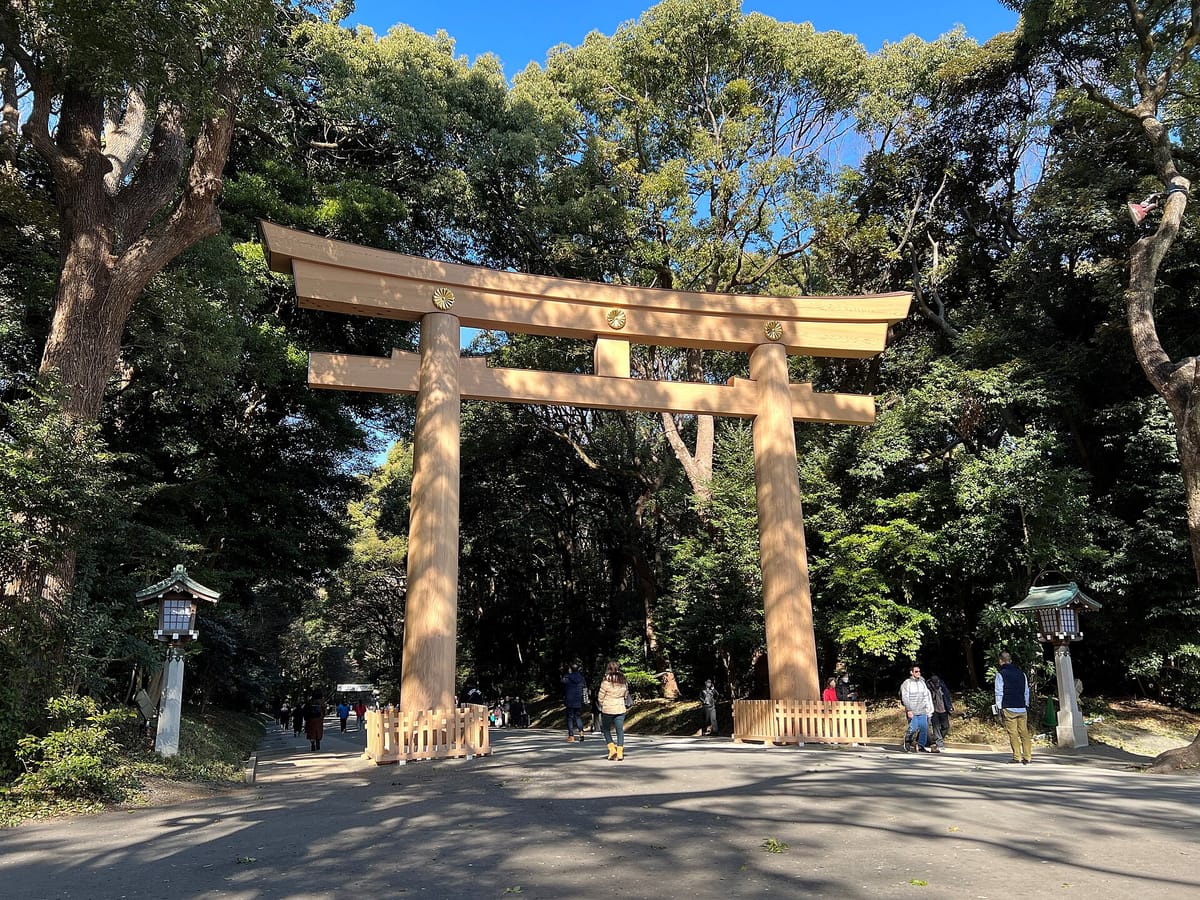
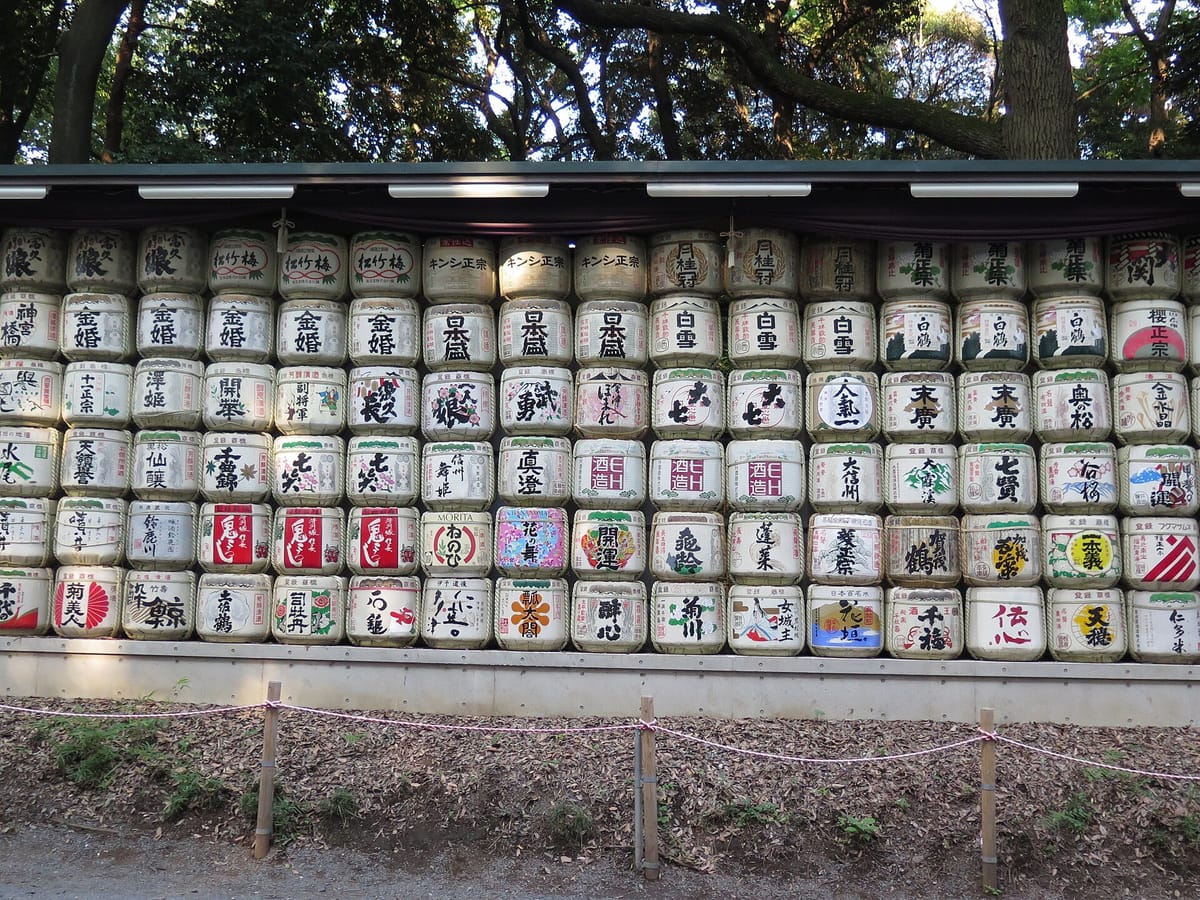
From Harajuku, the path turns under a first torii and runs through the trees to the wall of sake barrels, kazaridaru, offered to the shrine by brewers from all over Japan, with a row of French wine barrels opposite, a nod to the emperor's taste for Western things. A little further on is the Ōtorii, the great torii, made of cypress and one of the largest wooden torii of its style in the country.
Past it, after the water basin, you enter the courtyard of the main shrine. On either side of the inner gate stand two camphor trees planted when the shrine was founded, now grown together and tied with a sacred rope. They are called meoto kusu, the husband-and-wife camphors, and couples pray there for a happy marriage. The shrine office, where charms and omikuji are handed out, faces the courtyard.
- Ōtorii (大鳥居): the great wooden torii on the south approach.
- Kazaridaru (飾り樽): the wall of sake barrels given by brewers.
- Temizuya (手水舎): the water basin for purifying your hands and mouth.
- Honden (本殿): the main shrine; visitors pray in the courtyard in front of it.
- Meoto kusu (夫婦楠): the paired camphor trees in the courtyard.
- Gyoen (御苑): the Inner Garden with Kiyomasa's Well and an iris field, for a small fee.
- Meiji Jingū Museum: treasures and personal belongings of the emperor and empress, near the north approach.
The words on the shrine signs
Shrine signs use a handful of characters again and again. 鳥居 is torii, 参道 is the approach, and 神 is kami, which appears in the shrine's own name. 御 is an honorific prefix read go, gyo or o, and it turns a garden into a garden belonging to the shrine, 御苑, gyoen.
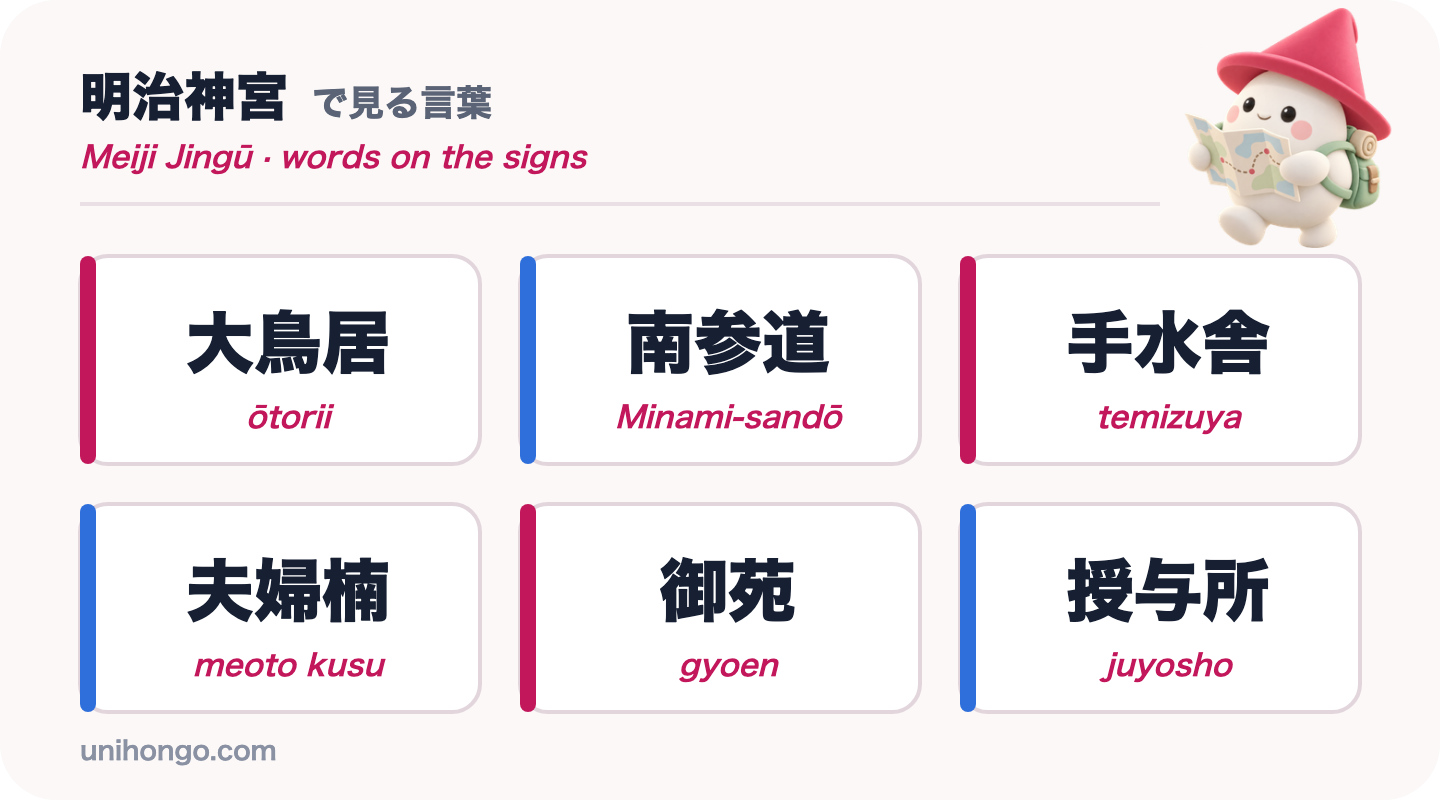
The table below covers the signposts on the approaches and around the courtyard. Try reading each sign before you look at the English board beside it.
| Word | Reading | Meaning |
|---|---|---|
| 大鳥居 | ōtorii | Great torii gate |
| 南参道 | Minami-sandō | South approach, from Harajuku |
| 北参道 | Kita-sandō | North approach, from Yoyogi |
| 手水舎 | temizuya | Water basin for purification |
| 本殿 | honden | Main shrine hall |
| 夫婦楠 | meoto kusu | Husband-and-wife camphor trees |
| 御苑 | gyoen | Inner Garden |
| 授与所 | juyosho | Office where charms and omikuji are given |
| 御朱印 | goshuin | Shrine stamp and calligraphy |
Japanese at the shrine office: omikuji, charms and goshuin
Meiji Jingū's omikuji are unusual. Instead of ranking your luck from great to bad, each slip carries one of thirty waka poems written by Emperor Meiji or Empress Shōken, with an explanation and an English translation. They are called Ōmikokoro, the great heart, and you read them as advice rather than a prediction, so there is nothing to tie up and leave behind.
At the office, the shrine maidens, miko, speak a formal, humble Japanese: o-hiki itadakemasu, you may draw, or gozaimasu instead of arimasu. You do not need to answer in the same register, but it helps to recognise it. As at other shrines, charms are received rather than bought, so itadakemasu ka is the natural way to ask.
| Japanese | Romaji | Meaning |
|---|---|---|
| おみくじを引いてもいいですか。 | Omikuji o hiite mo ii desu ka. | May I draw an omikuji? |
| 英語の説明はありますか。 | Eigo no setsumei wa arimasu ka. | Is there an explanation in English? |
| このお守りをいただけますか。 | Kono o-mamori o itadakemasu ka. | May I have this charm? |
| 健康のお守りはどれですか。 | Kenkō no o-mamori wa dore desu ka. | Which charm is for good health? |
| 御朱印をお願いできますか。 | Goshuin o onegai dekimasu ka. | Could I ask for a goshuin? |
| 絵馬はどこに掛ければいいですか。 | Ema wa doko ni kakereba ii desu ka. | Where should I hang my ema? |
Shrine etiquette and timing
Meiji Jingū is one of the most important shrines in Tokyo, with rituals every day and huge crowds at New Year, so a few habits make a good impression.
- Bow once as you pass under each large torii, and walk at the side of the approach; the centre is traditionally the path of the kami.
- At the temizuya, take the ladle in your right hand and rinse your left hand, then your right, pour a little water into your cupped left hand to rinse your mouth, and never drink from the ladle.
- At the main shrine, drop an offering in the box, then bow twice, clap twice, pray, and bow once more.
- Treat the grounds as a place of worship: keep your voice down in the courtyard and save your snacks for the streets of Harajuku.
- Come early in the morning for quiet paths and birdsong; the shrine closes at sunset, so start well before dusk in winter.
- Avoid the first days of January unless you want the crowds: Meiji Jingū draws some of the largest hatsumōde crowds in Japan.
Practise the visit before you go
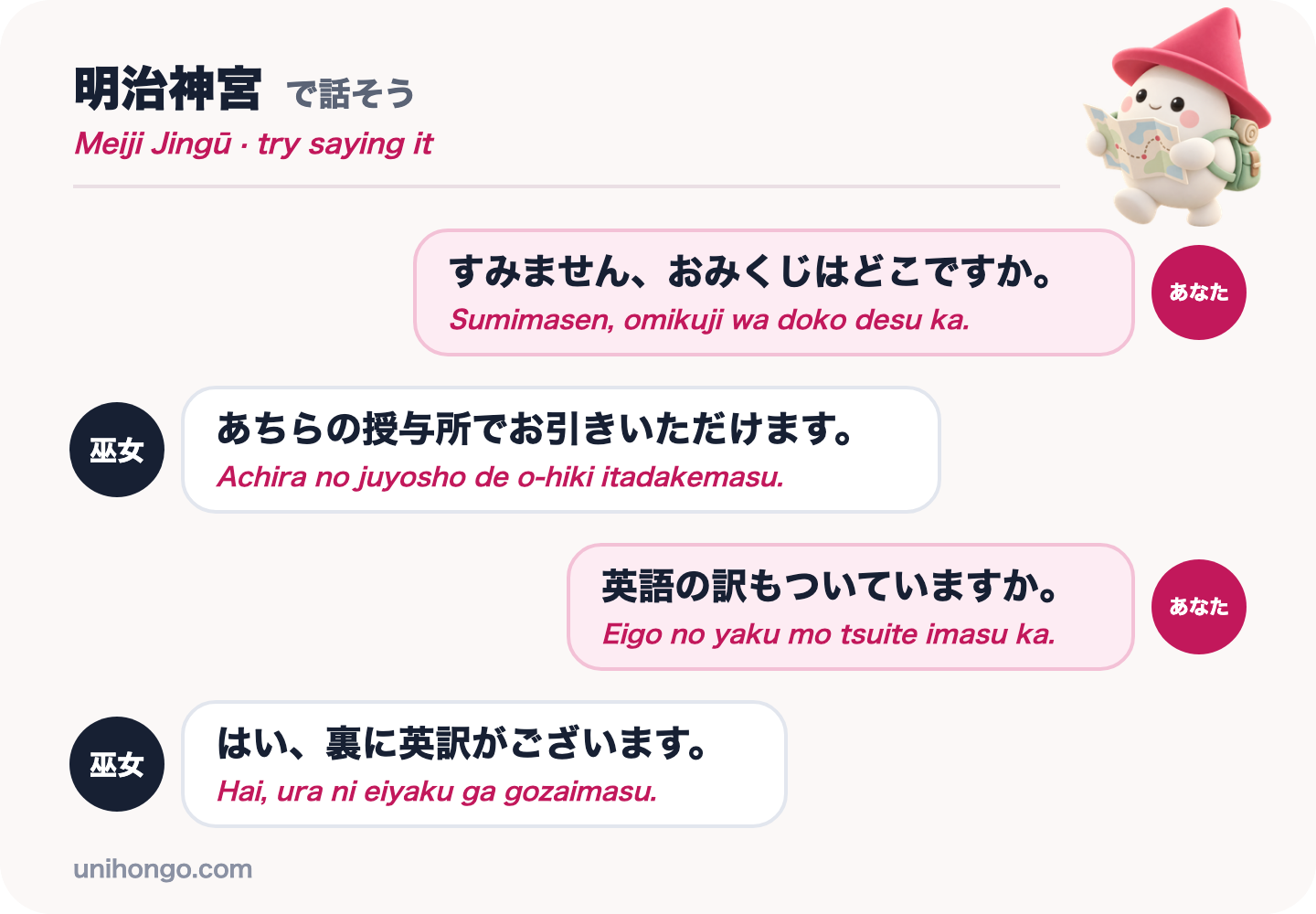
The exchange below is the one you are most likely to have at Meiji Jingū. Listen for achira, over there, and the humble o-hiki itadakemasu in the reply. Practise the four lines aloud until you can say your two without reading.
Then practise with a partner. In Unihongo, choose the Shrine Visit topic and ask your AI Sensei to play a shrine maiden at the office, or choose Cultural Etiquette to rehearse the bows and the water basin. Saying the lines once before you arrive makes them come out easily in the courtyard.
| Japanese | Romaji | Meaning |
|---|---|---|
| すみません、おみくじはどこですか。 | Sumimasen, omikuji wa doko desu ka. | Excuse me, where are the omikuji? |
| あちらの授与所でお引きいただけます。 | Achira no juyosho de o-hiki itadakemasu. | You can draw one at the shrine office over there. |
| 英語の訳もついていますか。 | Eigo no yaku mo tsuite imasu ka. | Does it have an English translation too? |
| はい、裏に英訳がございます。 | Hai, ura ni eiyaku ga gozaimasu. | Yes, there is an English translation on the back. |
Official information
The shrine publishes its opening and closing times for each month, the hours and fees of the Inner Garden and museum, and the dates of its festivals and rituals. Check them before you go, especially in winter and around New Year.