

Why Miyajima is worth the ferry
The island's official name is Itsukushima, but almost everyone calls it Miyajima, the shrine island. For centuries the whole island was treated as sacred, which is why the shrine was built over the water rather than on the land. Tradition dates the shrine's founding to the late sixth century, and its present layout goes back to the twelfth, when the warlord Taira no Kiyomori rebuilt it on a grand scale. Itsukushima Shrine was inscribed as a UNESCO World Heritage Site in 1996, together with the forest of Mount Misen behind it.
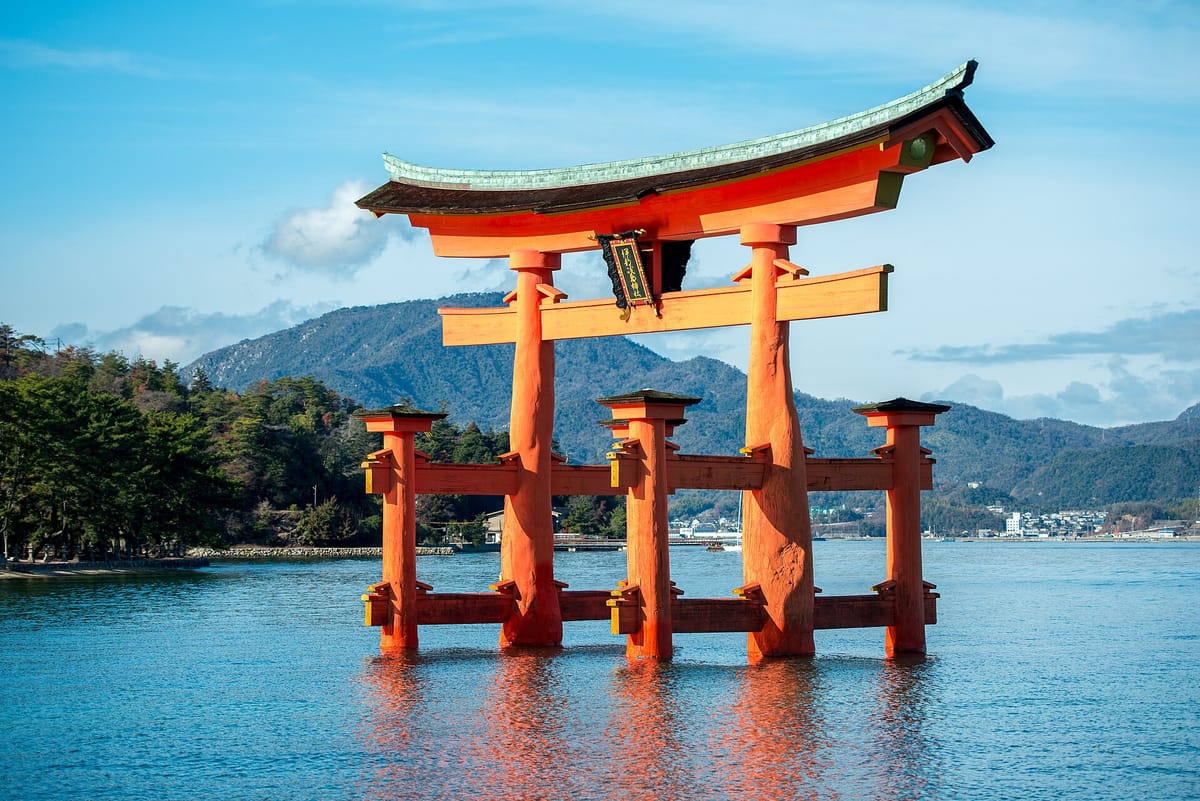
The view you have seen in photos is the Ōtorii, the great torii that stands in the bay about two hundred metres in front of the main hall. The current gate dates from 1875 and was restored between 2019 and 2022. It is not anchored to the sea floor; its own weight keeps it upright. Traditionally, the island is counted among Japan's three most scenic views, Nihon Sankei.
For a Japanese learner, Miyajima is full of practical reading: ferry signs, tide tables, shop names and shrine plaques. And because the tide really does change what you see, it gives you a real reason to ask a question and understand the answer.
Getting there: Miyajimaguchi and the ferry
From Hiroshima Station, JR San'yō Line local trains reach Miyajimaguchi Station in about thirty minutes. The Hiroden tram, route 2, also runs all the way to Hiroden Miyajima-guchi; it takes much longer but is scenic and cheap. From either station, walk a few minutes south to the ferry terminal at Miyajimaguchi port.
Two companies run ferries to the island, the JR West Miyajima Ferry and Miyajima Matsudai Kisen, each crossing in about ten minutes. The JR ferry is covered by the Japan Rail Pass and sails close to the Ōtorii, so stand on the right-hand side on the way over for the best view. Whichever you choose, the Miyajima visitor tax, 宮島訪問税, is collected with the fare: included in the ticket from the machine or counter, or deducted with your fare when you tap an IC card at the ferry gate. Rail Pass holders pay it separately before boarding.
A direct boat, the World Heritage Sea Route, also runs from a pier beside the Peace Memorial Park in central Hiroshima to Miyajima, which makes it easy to combine the two in one day.
| Japanese | Romaji | Meaning |
|---|---|---|
| 宮島行きのフェリー乗り場はどこですか。 | Miyajima-yuki no ferī noriba wa doko desu ka. | Where is the ferry terminal for Miyajima? |
| 大人二枚お願いします。 | Otona nimai onegai shimasu. | Two adults, please. |
| 訪問税はここで払えますか。 | Hōmonzei wa koko de haraemasu ka. | Can I pay the visitor tax here? |
| ICカードで乗れますか。 | IC kādo de noremasu ka. | Can I board with an IC card? |
| 次の船は何時ですか。 | Tsugi no fune wa nanji desu ka. | What time is the next boat? |
| 大鳥居の近くを通りますか。 | Ōtorii no chikaku o tōrimasu ka. | Does it pass near the great torii? |
High tide, low tide: what you will see
The same view looks completely different six hours apart. At high tide, manchō, the water reaches the shrine's corridors and the torii rises straight out of the sea. At low tide, kanchō, the bay drains to wet sand, and you can walk out to the torii and stand beneath it. The best plan is to be on the island for both: arrive for one, have lunch, and stay for the other. Tide times change every day, so check the table before you pick your ferry.
Inside the shrine, a single route leads through the corridors, past the main hall, the noh stage and the arched bridge, and out the far side. Beyond it, the rest of the island unfolds on foot.
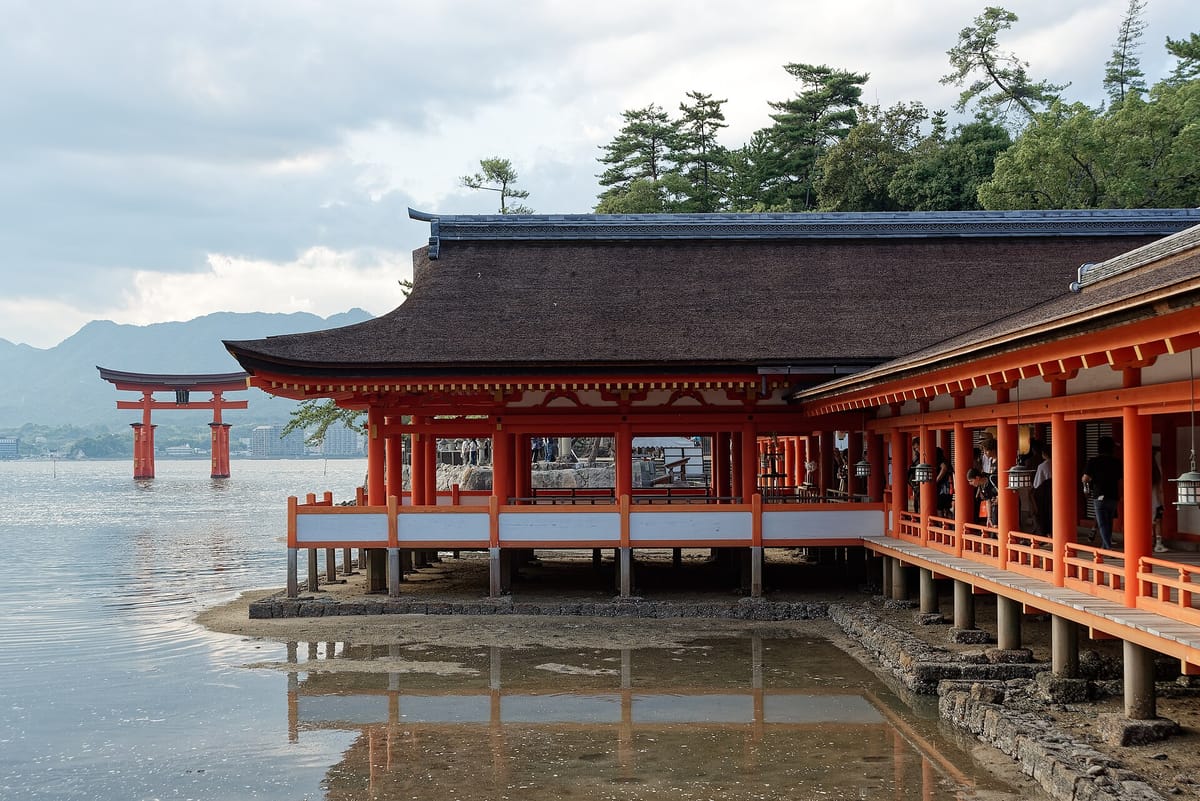
- Itsukushima Jinja: the shrine's corridors, main hall and noh stage, entered from the east side for a small fee.
- Ōtorii: the great torii in the bay, best seen at high tide from the shore and reachable on foot at low tide.
- Senjōkaku: the vast unfinished hall on the hill above the shrine, begun under Toyotomi Hideyoshi.
- Gojūnotō: the five-storey pagoda beside Senjōkaku, under repair with work scheduled into late 2026.
- Daishō-in: the island's main temple at the foot of the mountain, with stone statues and prayer wheels on its steps.
- Misen: the island's sacred mountain, reached by the Miyajima Ropeway or on foot by one of three trails.
- Omotesandō shōtengai: the covered shopping street, with momiji manjū cakes, grilled oysters and a giant wooden rice scoop.
On Mount Misen, the Miyajima Ropeway climbs in two stages from Momijidani to Shishiiwa Station, from where the summit is around thirty minutes of steep walking. The Reikadō hall near the summit, which kept a flame said to have burned since the time of the monk Kūkai, was lost to fire in spring 2026 and is to be rebuilt; check the latest before you plan around it.
Words on the signs: torii, pier and tide table
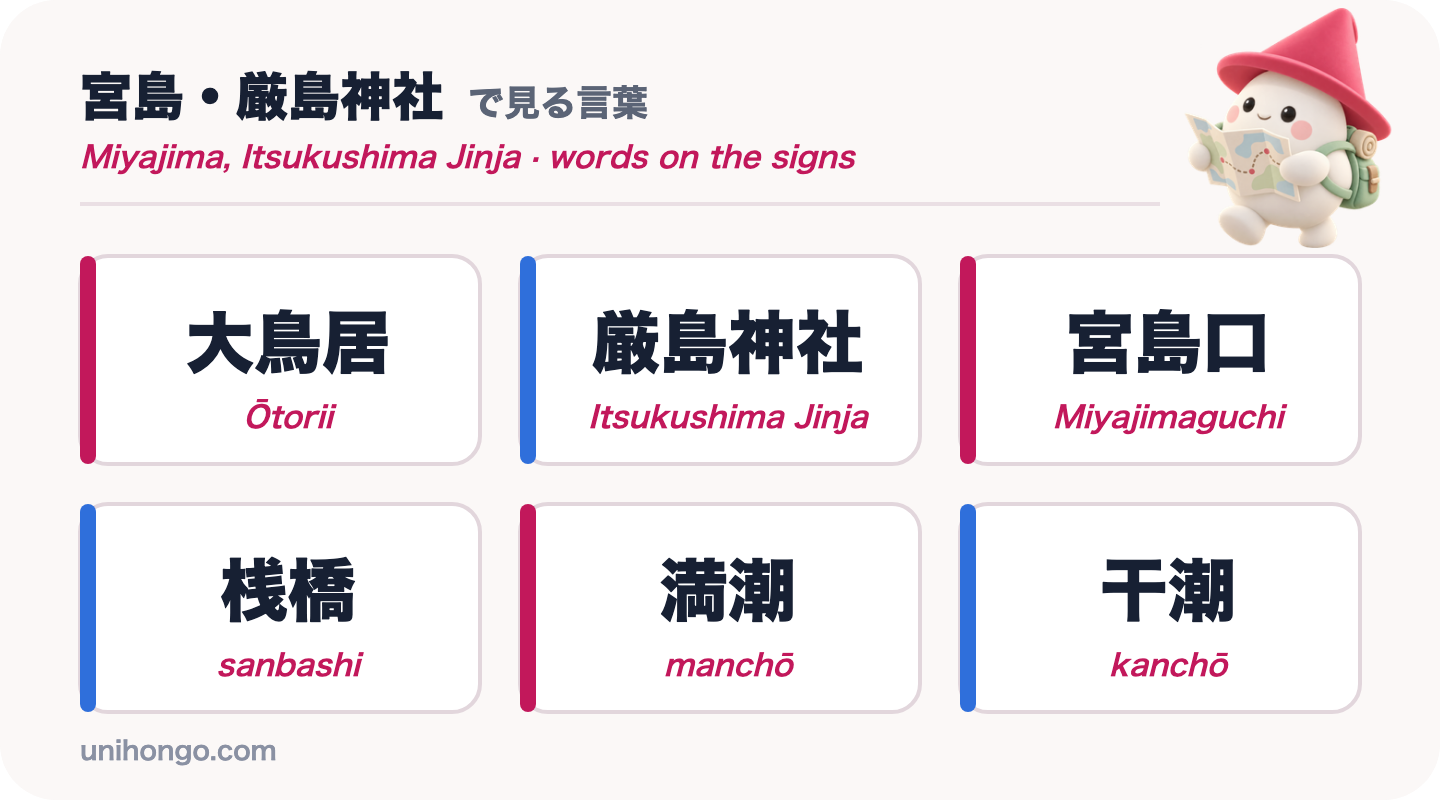
The two most useful kanji on the island are 潮, shio, tide, and the pair 満 and 干: full and dry. Put them together and you get 満潮, high tide, and 干潮, low tide, which you will see on the tide boards by the pier and in front of the shrine. The tide table itself is 潮見表, shiomihyō.
Look at the name of the shrine too. The island is written 厳島, Itsukushima, while the ferry terminal and station are 宮島口, Miyajimaguchi, the entrance to Miyajima. Guchi, from kuchi, mouth, turns up in station exits all over Japan.
| Word | Reading | Meaning |
|---|---|---|
| 大鳥居 | Ōtorii | The great torii in the bay |
| 厳島神社 | Itsukushima Jinja | Itsukushima Shrine |
| 宮島口 | Miyajimaguchi | The mainland station and ferry terminal |
| 桟橋 | sanbashi | Pier, landing stage |
| 満潮 | manchō | High tide |
| 干潮 | kanchō | Low tide |
| 潮見表 | shiomihyō | Tide table |
| 宮島訪問税 | Miyajima hōmonzei | Miyajima visitor tax |
| もみじ饅頭 | momiji manjū | Maple-leaf-shaped cake, the island's classic souvenir |
Japanese for the tide table, the shrine and the ropeway
The tourist information desk at the ferry terminal on the island is the place to ask about the tide, the ropeway and the walking trails. Staff give times in the twenty-four-hour clock on paper but say them aloud with gogo, afternoon, and gozen, morning, so it helps to practise both.
At the shrine you will pay at the entrance on the east side and follow a one-way route. At the ropeway, ask about the last trip down before you go up; the mountain is steep and dark paths are no place to discover you have missed it.
| Japanese | Romaji | Meaning |
|---|---|---|
| 今日の満潮は何時ですか。 | Kyō no manchō wa nanji desu ka. | What time is high tide today? |
| 潮見表はありますか。 | Shiomihyō wa arimasu ka. | Do you have a tide table? |
| 厳島神社の入口はこちらですか。 | Itsukushima Jinja no iriguchi wa kochira desu ka. | Is this the entrance to Itsukushima Shrine? |
| ロープウェイ乗り場まで歩いて何分ですか。 | Rōpuwei noriba made aruite nanpun desu ka. | How many minutes on foot to the ropeway station? |
| 下りの最終は何時ですか。 | Kudari no saishū wa nanji desu ka. | What time is the last trip down? |
| 焼きがきを二つください。 | Yaki-gaki o futatsu kudasai. | Two grilled oysters, please. |
Etiquette and practical tips on the island
Miyajima is both a busy day-trip destination and a place where people live and pray. A few habits help you enjoy it without friction.
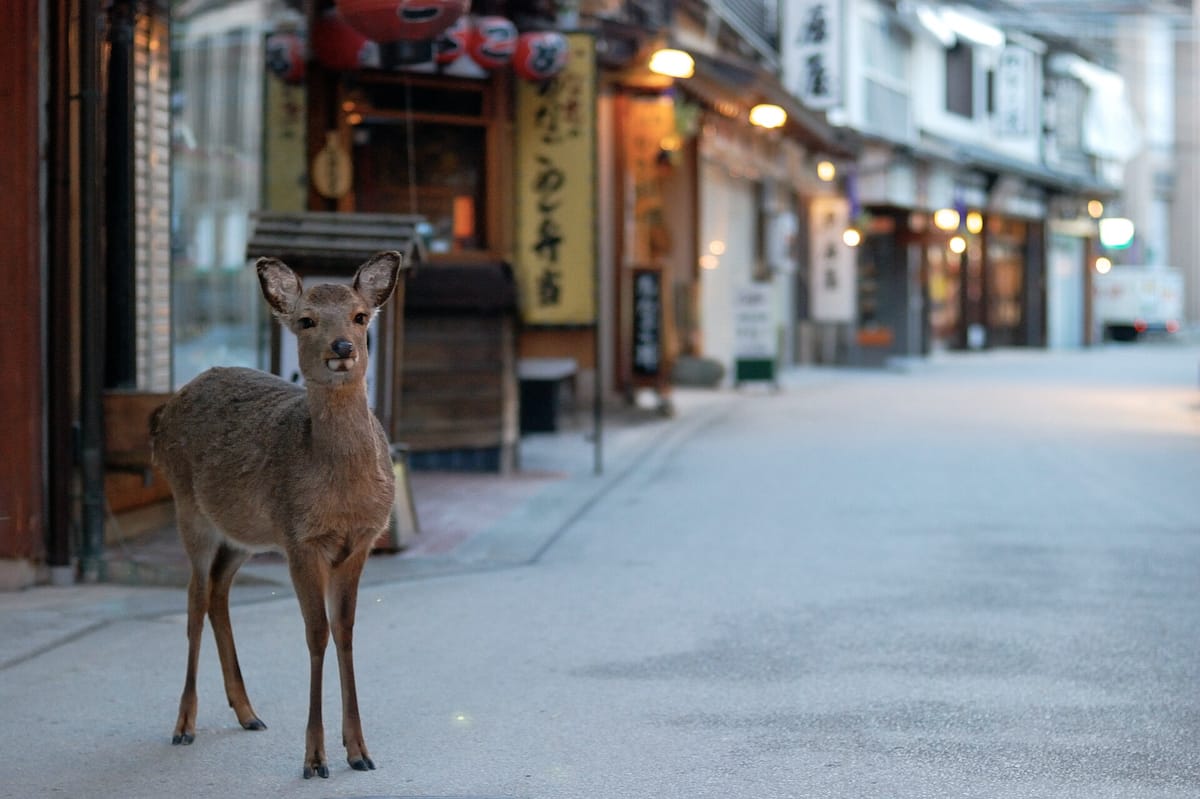
- Do not feed the deer. Feeding is not allowed on Miyajima, and the deer will try to eat paper, so keep maps, tickets and snack bags in a closed bag.
- Bow at the torii on the shore before entering the shrine grounds, and follow the one-way route through the corridors.
- When the sand is exposed, walk out to the torii, but do not climb it, carve or push coins into its pillars.
- Stay the night if you can. After the last day-trippers leave, the island becomes quiet and the shrine and torii are lit up in the evening.
- Bring good shoes for Mount Misen. Even with the ropeway, the last stretch to the summit is steep steps.
- Summer and autumn weekends are very busy. Early ferries in the morning are the calmest time to cross.
Practise the visit before you go
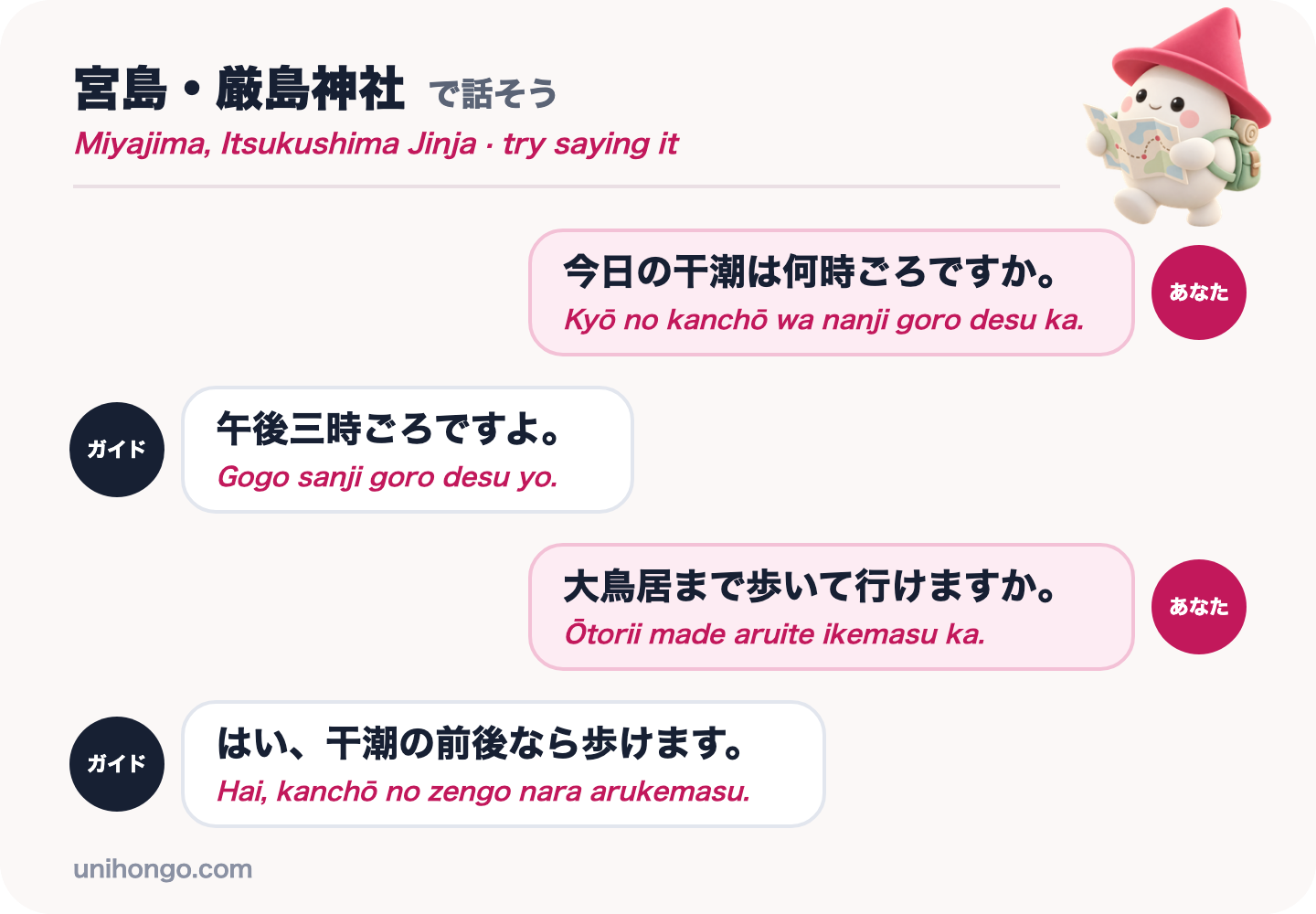
The most useful conversation on the island is about the tide. The answer comes back as a time with goro, about, and sometimes a condition with nara, if. Practise the four lines below until you can say them without reading, and listen for the numbers.
Then practise with a partner who answers back. In Unihongo, choose the Sightseeing topic and ask your AI Sensei to play a local guide on Miyajima, or use the Shrine Visit topic to rehearse the prayer at the main hall. Say the lines aloud once before you go, and they will be there on the pier.
| Japanese | Romaji | Meaning |
|---|---|---|
| 今日の干潮は何時ごろですか。 | Kyō no kanchō wa nanji goro desu ka. | About what time is low tide today? |
| 午後三時ごろですよ。 | Gogo sanji goro desu yo. | Around three in the afternoon. |
| 大鳥居まで歩いて行けますか。 | Ōtorii made aruite ikemasu ka. | Can I walk out to the great torii? |
| はい、干潮の前後なら歩けます。 | Hai, kanchō no zengo nara arukemasu. | Yes, around low tide you can walk there. |
Official information
The shrine publishes its hours and admission, the city explains the visitor tax, and the ropeway posts its operating days and any maintenance closures. Check all three before you go, along with the day's tide times.