

Why Tōdai-ji's Great Buddha is worth the crowds
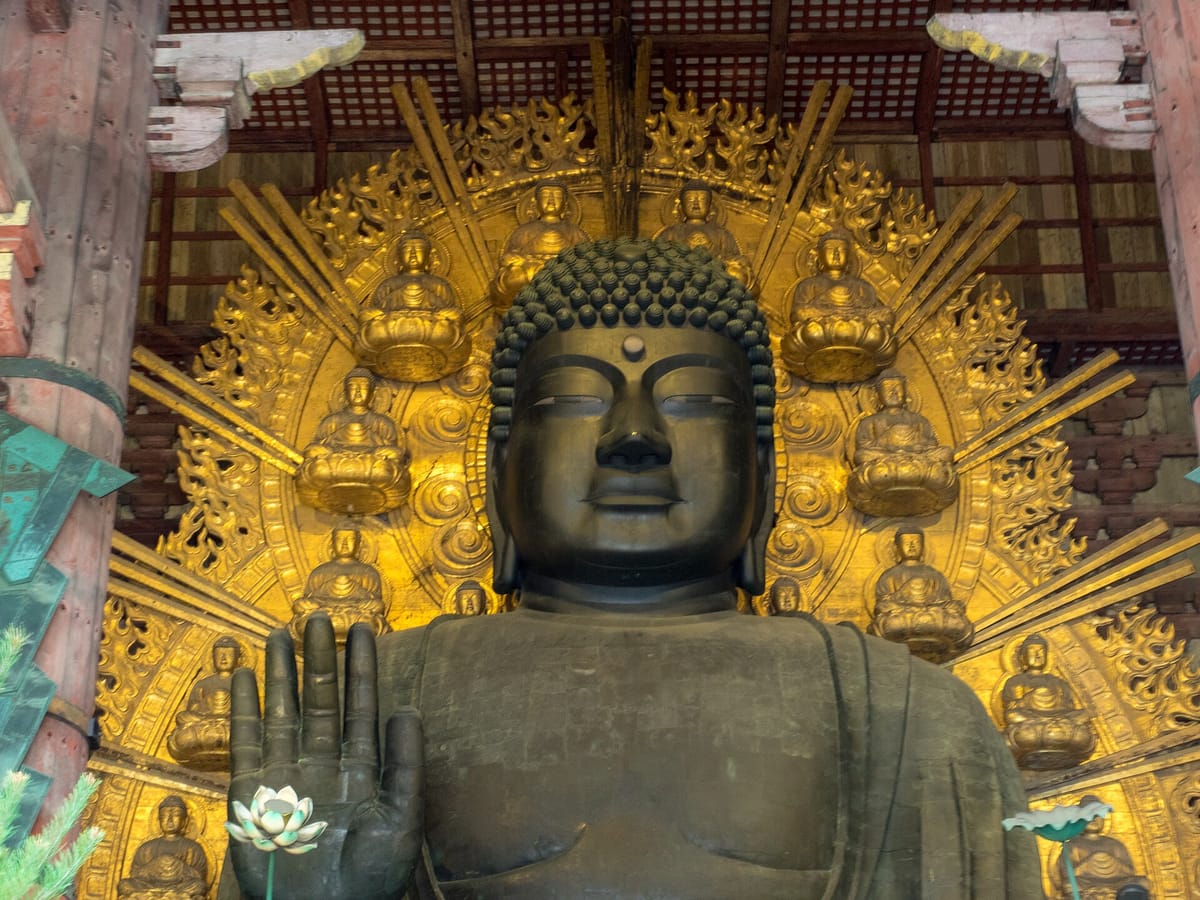
In the 740s Emperor Shōmu ordered a temple in every province of Japan and made Tōdai-ji, the Great Eastern Temple, their head. At its heart he placed a colossal bronze Buddha, dedicated in a grand eye-opening ceremony in 752. The project drew on the resources of the whole country, and the statue has been damaged and repaired several times since, but it remains the emotional centre of Nara.
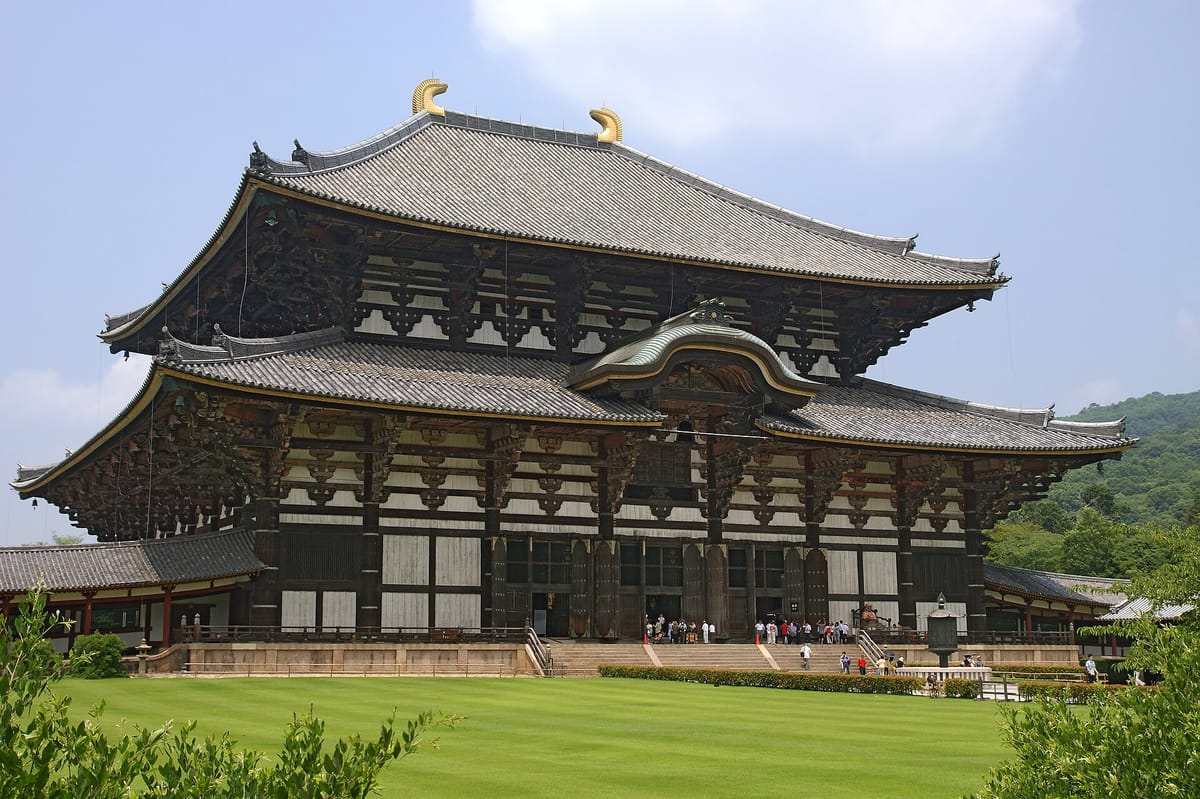
The present Daibutsuden is an Edo-period rebuilding, narrower than the original but still breathtaking when you step through the doors and look up. The Buddha sits on a lotus pedestal about fifteen metres high, flanked by two bodhisattvas, with guardian kings standing in the corners of the hall. Tōdai-ji is part of the Historic Monuments of Ancient Nara World Heritage Site.
It is also a busy place, full of school groups and deer, and that is part of its charm. Everything a visitor needs to do here, buying a ticket, finding the exit, asking what is free, can be done in short, polite Japanese, and the staff are used to hearing it from beginners.
Getting there: on foot through Nara Park or by bus
From Kintetsu Nara Station, Kintetsu Nara-eki, the temple's own directions are to walk east along Noboriōji for about twenty minutes, turning left at the lawns where the deer gather and following the approach north to the Nandaimon. The walk is part of the experience: you pass Kōfuku-ji and the edge of Nara Park on the way.
From JR Nara Station, or if you prefer not to walk, take a city loop bus and get off at the stop for Tōdai-ji Daibutsuden and Kasuga Taisha-mae, about five minutes on foot from the gate. Some loop buses from Kintetsu Nara also stop at the Daibutsuden-mae parking area nearby. Bus stop names are long, so it helps to recognise the kanji 大仏殿 on the screen at the front of the bus.
| Japanese | Romaji | Meaning |
|---|---|---|
| 東大寺に行きたいんですが、どのバスですか。 | Tōdai-ji ni ikitai n desu ga, dono basu desu ka. | I want to go to Tōdai-ji. Which bus is it? |
| 大仏殿の近くで降りたいです。 | Daibutsuden no chikaku de oritai desu. | I want to get off near the Great Buddha Hall. |
| 南大門はどちらですか。 | Nandaimon wa dochira desu ka. | Which way is the Nandaimon? |
| ここから歩いて何分くらいですか。 | Koko kara aruite nanpun kurai desu ka. | About how many minutes on foot from here? |
| 次のバス停で降ります。 | Tsugi no basutei de orimasu. | I'm getting off at the next stop. |
From the Nandaimon to Nigatsudō: what you will see
The visit starts at the Nandaimon, the Great South Gate, rebuilt around 1200. Look into the side bays: two wooden guardian kings, the Kongō Rikishi or Niō, glare down at you, each over eight metres tall. They were carved by the sculptors Unkei and Kaikei and their workshop, and both the gate and the statues are National Treasures.
Past the gate, the path leads to the Chūmon, the middle gate, and around to the ticket window for the Great Buddha Hall. Inside, you walk clockwise around the Buddha, past the guardian kings and the famous pillar with the hole through it, and out again. From the hall, a lane climbs east through the trees to the hillside halls, where the crowds thin quickly.
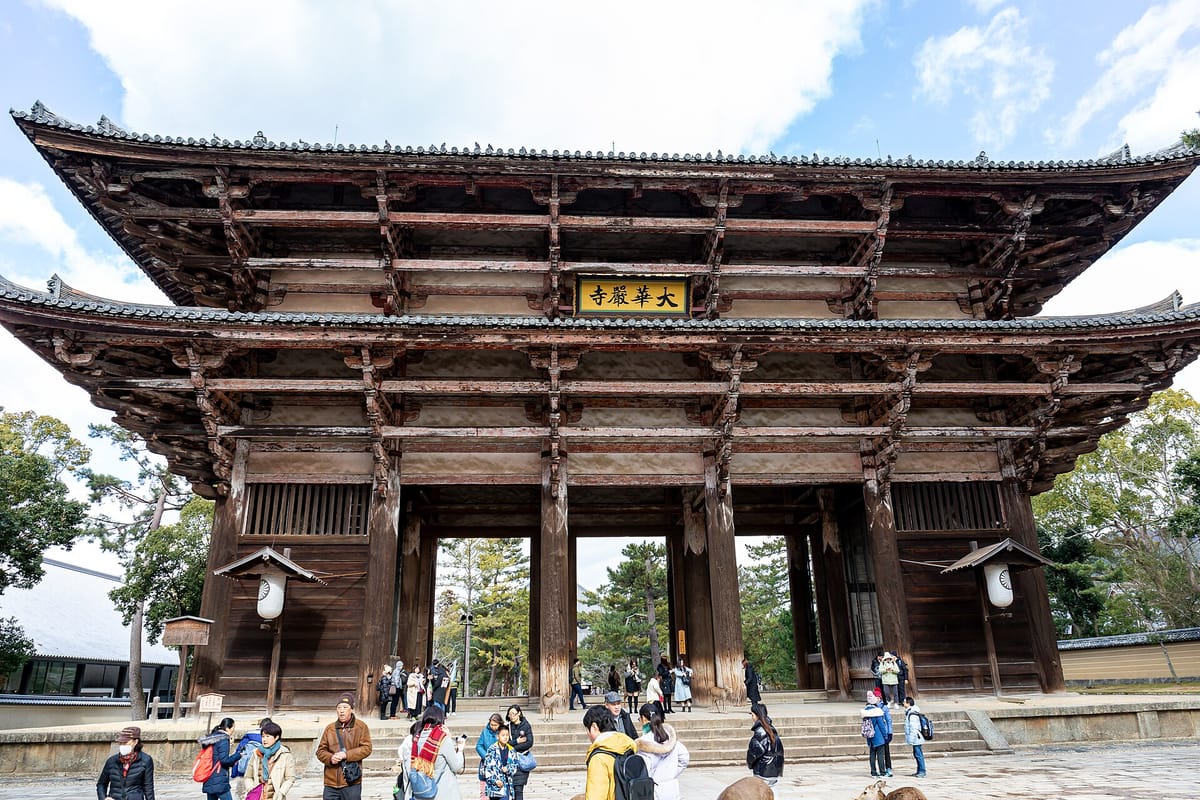
- Nandaimon: the Great South Gate with its two Niō guardian statues.
- Daibutsuden: the Great Buddha Hall and the bronze Daibutsu itself.
- Hashira no ana: the pillar with a nostril-sized hole behind the Buddha.
- Tōdai-ji Museum: rotating displays of the temple's statues and treasures, near the Nandaimon.
- Nigatsudō: the hillside hall with a wooden balcony and a wide view over Nara, free to visit.
- Hokkedō (Sangatsudō): one of the oldest buildings at the temple, with a group of Nara-period statues.
- Kaidandō: the ordination hall, known for its clay statues of the Four Heavenly Kings.
- Shōsōin: the eighth-century treasure storehouse, seen from outside only.
Words on the signs at Tōdai-ji
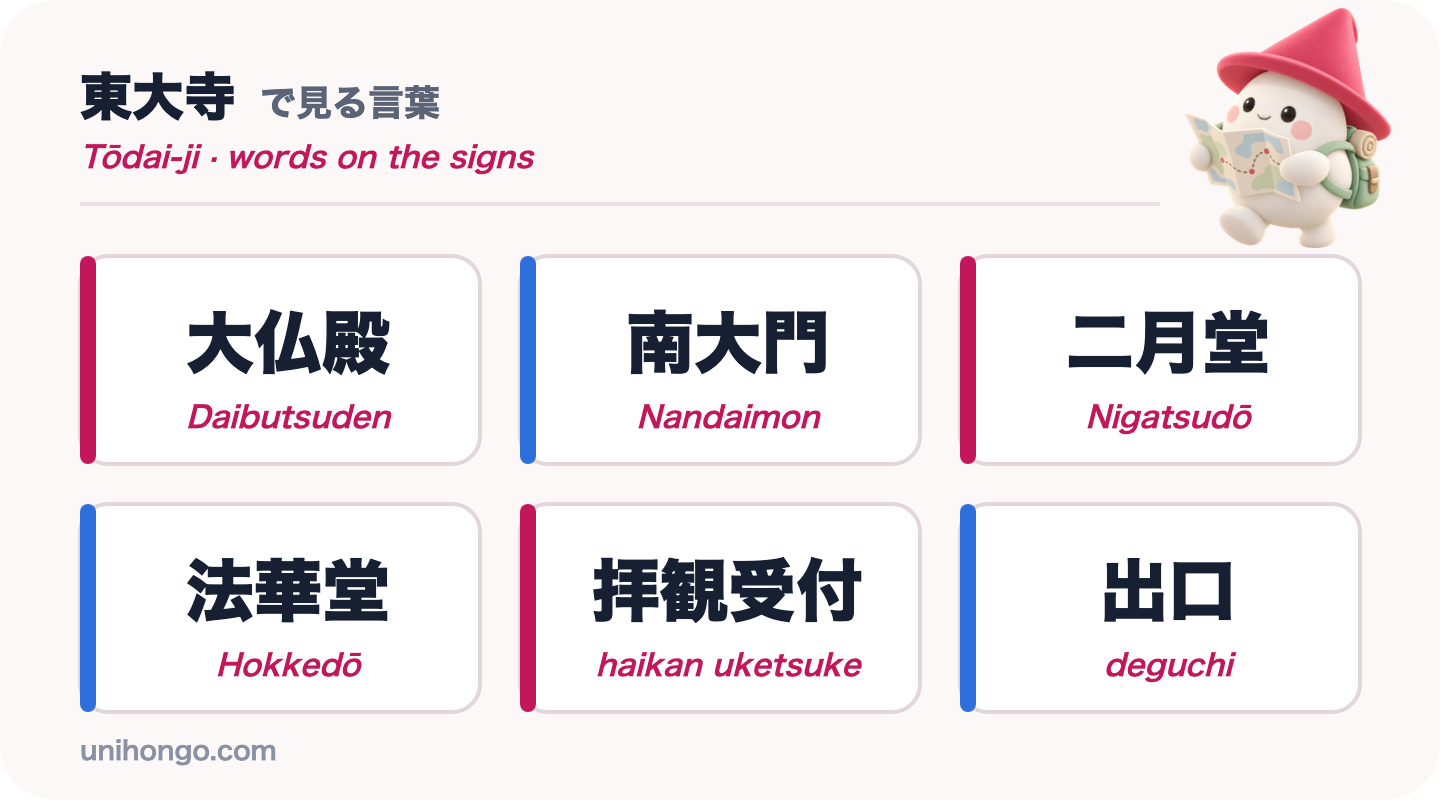
Temple signs in Japan use a small set of words again and again. 殿 and 堂 both mean hall, 門 means gate, and 大 means big, so 大仏殿 is the Great Buddha Hall and 南大門 is the Great South Gate. Many halls are named after the month in which a ceremony was first held there: Nigatsudō is the Second Month Hall, and Hokkedō is also called Sangatsudō, the Third Month Hall.
The word you will meet at every ticket window is 拝観, haikan, the respectful word for visiting a temple. 拝観受付 is the reception where you pay, and 拝観料 is the admission fee.
| Word | Reading | Meaning |
|---|---|---|
| 大仏殿 | Daibutsuden | The Great Buddha Hall |
| 大仏 | Daibutsu | The Great Buddha |
| 南大門 | Nandaimon | The Great South Gate |
| 二月堂 | Nigatsudō | Hillside hall of the Second Month, free to visit |
| 法華堂 | Hokkedō | Hall also called Sangatsudō |
| 拝観受付 | haikan uketsuke | Ticket window, visitor reception |
| 拝観料 | haikanryō | Admission fee |
| 共通券 | kyōtsūken | Combined ticket |
| 出口 | deguchi | Exit |
Japanese at the ticket window and inside the hall
Tickets for the Great Buddha Hall are bought at the reception just before the hall, and the combined ticket with the museum is sold there too. Staff will usually ask how many adults there are, so be ready with a counter: ichimai for one ticket, nimai for two.
Inside the hall you are free to walk and look. Photography is widely practised in the Great Buddha Hall, but notices in some halls ask you not to take pictures, so look for the signs and ask if unsure. The shop inside sells omamori charms and goshuin stamps, and the same polite phrases work there.
| Japanese | Romaji | Meaning |
|---|---|---|
| 大人二枚お願いします。 | Otona nimai onegai shimasu. | Two adults, please. |
| 大仏殿と博物館の共通券はありますか。 | Daibutsuden to hakubutsukan no kyōtsūken wa arimasu ka. | Is there a combined ticket for the hall and the museum? |
| 法華堂も見られますか。 | Hokkedō mo miraremasu ka. | Can I see Hokkedō too? |
| ここで写真を撮ってもいいですか。 | Koko de shashin o totte mo ii desu ka. | May I take photos here? |
| 柱の穴はどこですか。 | Hashira no ana wa doko desu ka. | Where is the pillar with the hole? |
| 御朱印をお願いできますか。 | Goshuin o onegai dekimasu ka. | Could I ask for a goshuin? |
Etiquette, timing and practical tips
Tōdai-ji is an active temple of the Kegon school, and the Great Buddha Hall is a place of worship as well as a sight.
- Take your hat off inside the halls and keep your voice low.
- If you want to pray, drop a coin in the offering box, put your hands together and bow; there is no clapping at a temple.
- Queue patiently at the pillar with the hole, and do not force anyone through it.
- Arrive early: the hall opens in the morning and is calmest before the school groups arrive.
- Keep tickets and maps out of reach of the deer around the Nandaimon.
- Wear shoes you can walk uphill in if you plan to go on to Nigatsudō.
Practise the visit before you go
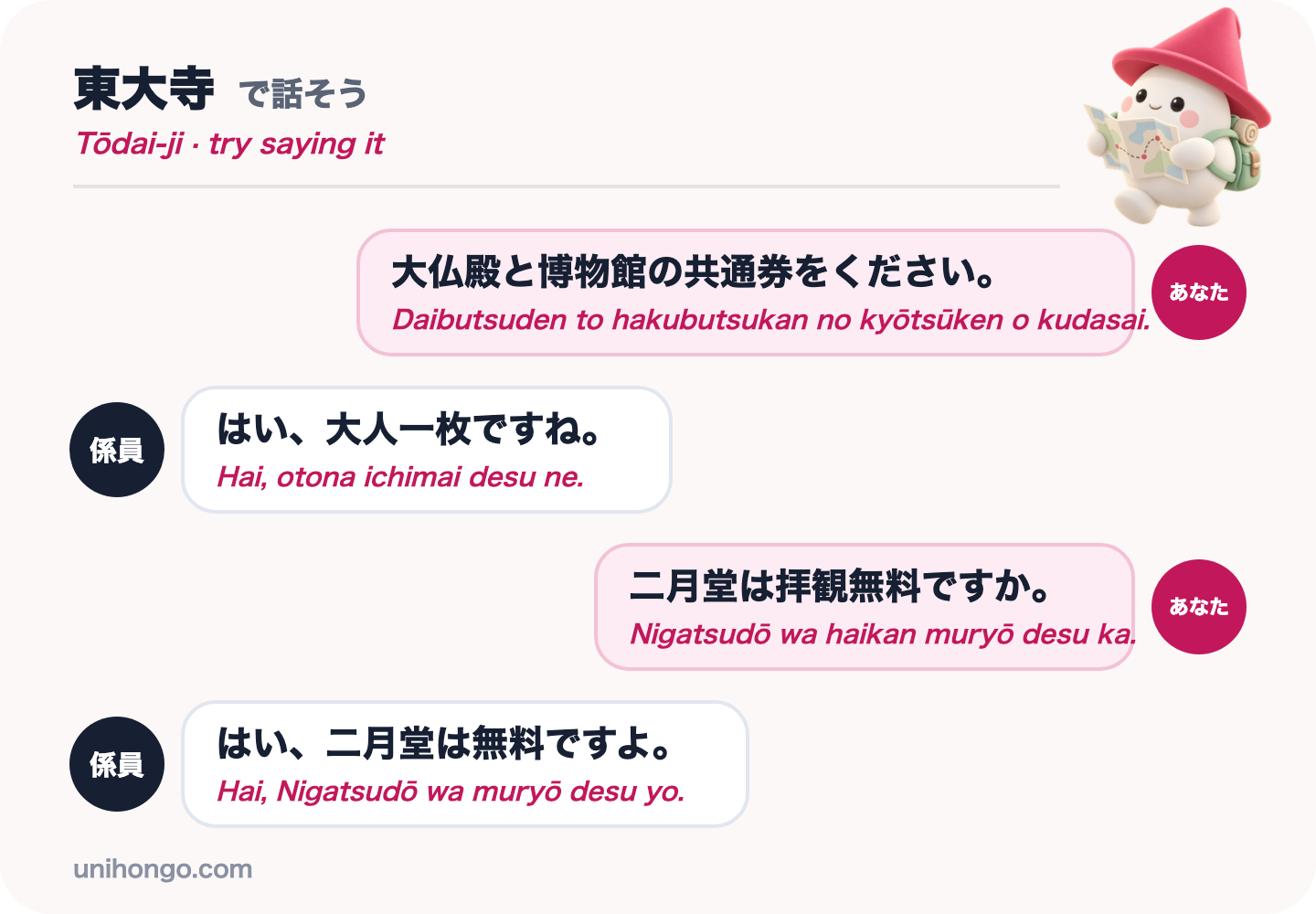
The one exchange you are sure to have at Tōdai-ji is at the ticket window. It is short, but it has all the pieces of a real conversation: a request, a check from the attendant, and a follow-up question from you. Say the lines below until they come out without reading.
Then rehearse it with a partner who answers back. In Unihongo, choose the Sightseeing topic and ask your AI Sensei to play the attendant at Tōdai-ji's ticket window, then a monk at Nigatsudō who tells you about the view.
| Japanese | Romaji | Meaning |
|---|---|---|
| 大仏殿と博物館の共通券をください。 | Daibutsuden to hakubutsukan no kyōtsūken o kudasai. | A combined ticket for the Great Buddha Hall and the museum, please. |
| はい、大人一枚ですね。 | Hai, otona ichimai desu ne. | Certainly, one adult, right? |
| 二月堂は拝観無料ですか。 | Nigatsudō wa haikan muryō desu ka. | Is Nigatsudō free to visit? |
| はい、二月堂は無料ですよ。 | Hai, Nigatsudō wa muryō desu yo. | Yes, Nigatsudō is free. |
Official information
Tōdai-ji publishes its opening hours, admission fees and access directions in English. Hours change with the season, so check before you go, especially for the museum and for special events at Nigatsudō.