

Why Asahiyama Zoo is worth the trip to Asahikawa
Asahiyama Zoo opened in 1967 on a hillside on the eastern edge of Asahikawa, Hokkaido's second city. It is the northernmost zoo in Japan, and for years it was a small, struggling one. In the 1990s visitor numbers fell, and an outbreak of disease among its animals forced a temporary closure. The zoo's keepers responded by rethinking what a zoo should show.
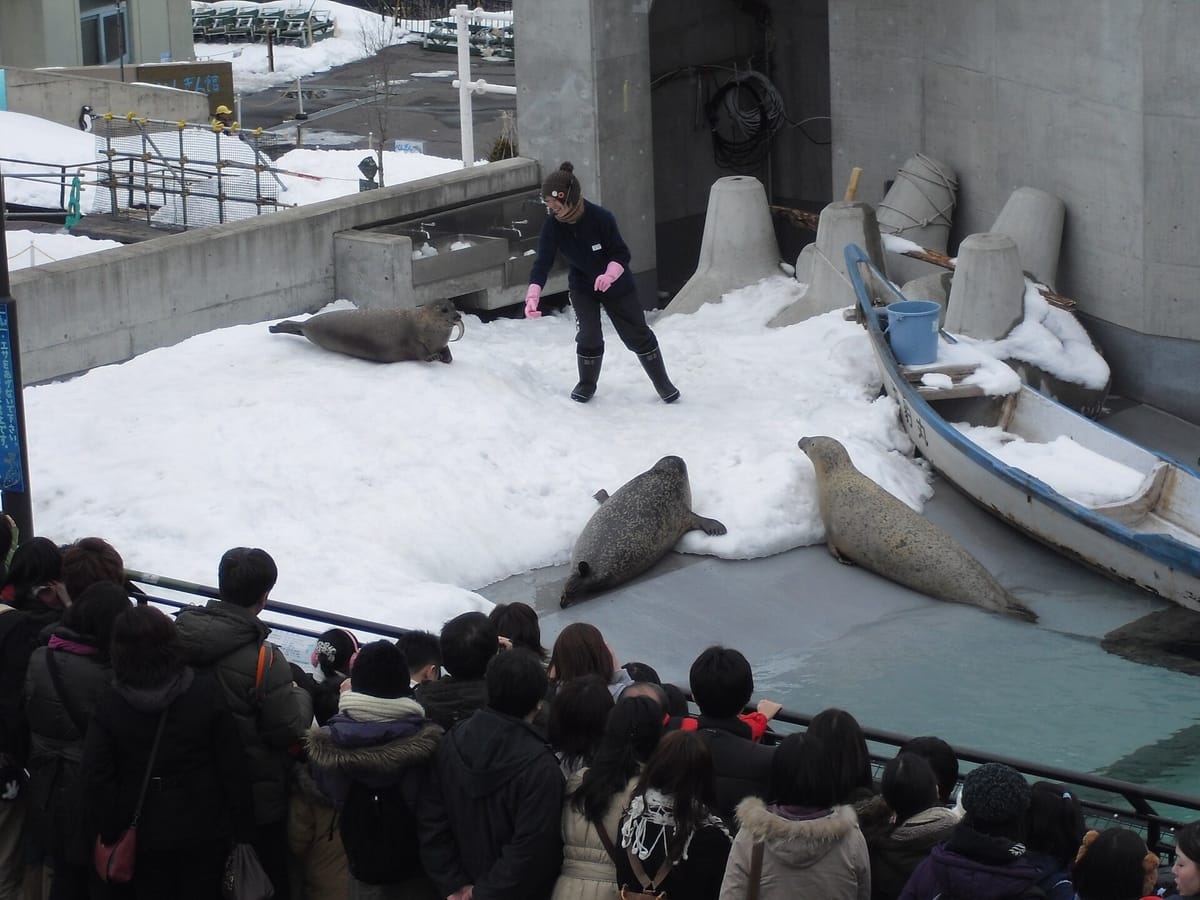
Their answer was the behavioural exhibit. Instead of animals behind bars, the zoo built houses that let you see them move as they would in the wild. In the penguin house you walk through an underwater tunnel while penguins shoot overhead as if flying; in the seal house the seals swim up and down a clear cylindrical tank in the middle of the visitor area; the orangutans climb on ropes and towers high above the paths. The new houses opened one by one from the late 1990s, and by the mid-2000s Asahiyama had become one of the most visited zoos in Japan.
The zoo's charm is also in its details. Keepers write and draw many of the information boards by hand, and the animal houses have friendly hiragana names. For a learner, that makes it one of the most readable places in Hokkaido.
Getting there: Asahikawa Station and the zoo bus
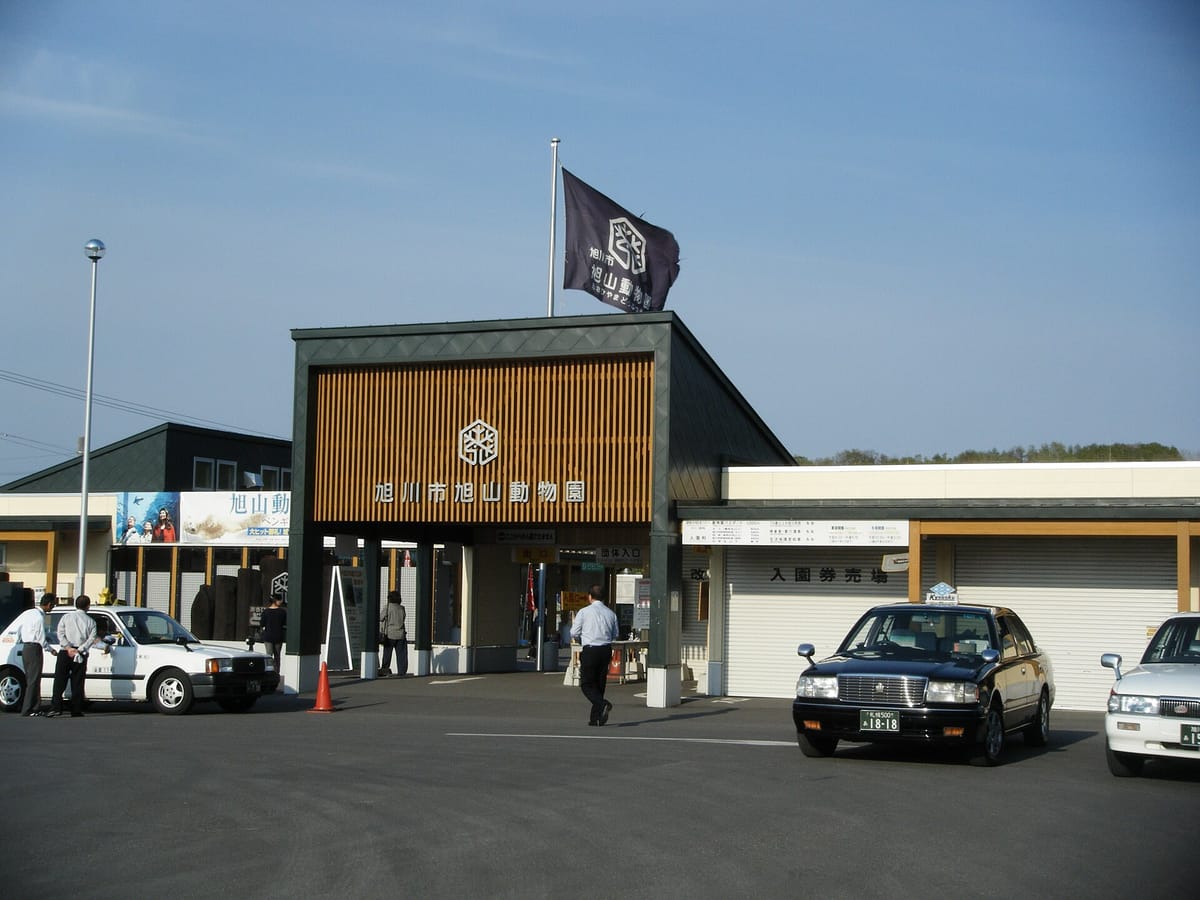
Asahikawa is the rail hub of central Hokkaido. Limited express trains from Sapporo reach JR Asahikawa Station in about eighty-five minutes, and Asahikawa Airport has flights from Tokyo. From the bus stops in front of Asahikawa Station, local buses run to Asahiyama Zoo in around forty minutes, stopping at the main gate, seimon. In busy seasons there are extra services. Tour packages from Sapporo that combine the zoo with Biei or Furano are also popular.
The zoo has several gates. The main gate is where the buses stop, and the site climbs uphill from there, so many visitors walk up to the far end first and work their way back down. Pick up a map at the gate; it shows the feeding times for the day and the order of the houses.
| Japanese | Romaji | Meaning |
|---|---|---|
| 旭山動物園行きのバスはどこから出ますか。 | Asahiyama Dōbutsuen-yuki no basu wa doko kara demasu ka. | Where does the bus to Asahiyama Zoo leave from? |
| このバスは動物園の正門に止まりますか。 | Kono basu wa dōbutsuen no seimon ni tomarimasu ka. | Does this bus stop at the zoo's main gate? |
| 大人二枚お願いします。 | Otona nimai onegai shimasu. | Two adults, please. |
| 園内マップはありますか。 | Ennai mappu wa arimasu ka. | Do you have a map of the zoo? |
| 帰りのバスは何時ですか。 | Kaeri no basu wa nanji desu ka. | What time is the bus back? |
Penguins, seals, polar bears and more: what you will see
The zoo is a string of themed houses, each built around one animal's natural behaviour. Most visitors head first for the three water houses, then work through the big cats, the Hokkaido wildlife and the primates.
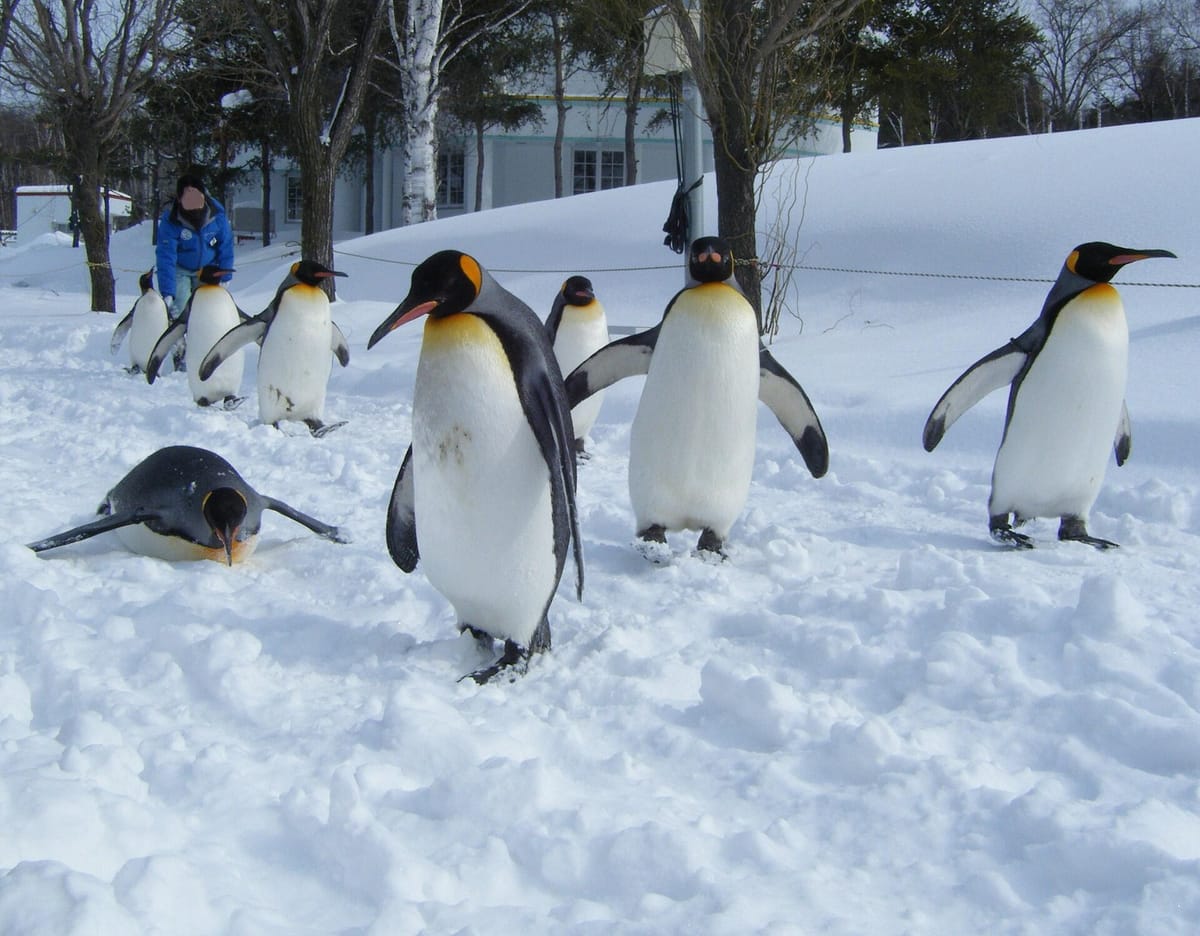
In winter, the star is the penguin walk. On snowy days, keepers lead a group of king penguins on a walk along a roped route through the visitor area. It began as a way to give the penguins exercise in winter, and it has become one of Hokkaido's most loved winter sights. The penguins set their own pace, stopping, sliding and turning back, so the walk is different every time.
Also look out for mogumogu time, the feeding sessions when keepers explain the animals' behaviour as they feed them. The times for the day are posted at the gates and on the zoo's boards.
- Pengin-kan: the penguin house, with an underwater tunnel where penguins swim overhead.
- Azarashi-kan: the seal house, with the clear cylindrical tank the seals swim through.
- Hokkyokuguma-kan: the polar bear house, with a pool where the bears dive in front of you.
- Mōjū-kan: the big cat house, with lions, tigers and leopards seen from below.
- Ōkami no Mori: the wolf forest, home to a pack of wolves.
- Ezo higuma-kan: the house for Hokkaido brown bears, opened in 2022.
- Orangutans climbing on towers and ropes high above the paths.
Hiragana houses and the words on the signs
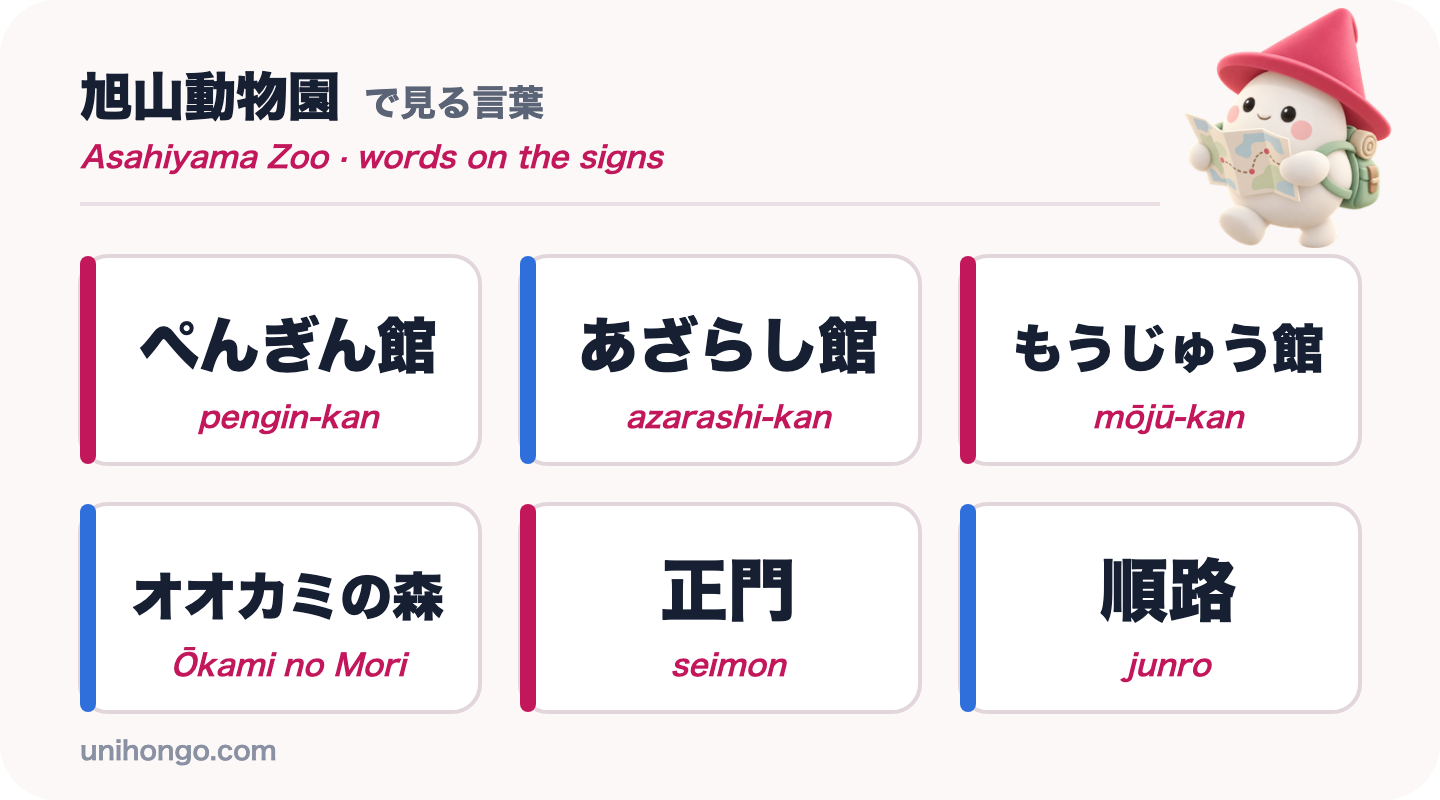
Most Japanese signs write animal names in katakana, but Asahiyama Zoo often uses hiragana for its houses: ぺんぎん館 rather than ペンギン館. It gives the zoo a soft, childlike feel, and it means that if you can read hiragana you can read most of the map. The 館, kan, at the end of each name means house or hall.
Other signs use a few kanji worth learning. 順路, junro, marks the suggested route through a building, and 正門, seimon, is the main gate. The keepers' handwritten boards use plain Japanese, often with drawings, so they are good practice even if you understand only part of them.
| Word | Reading | Meaning |
|---|---|---|
| ぺんぎん館 | pengin-kan | Penguin house |
| あざらし館 | azarashi-kan | Seal house |
| ほっきょくぐま館 | hokkyokuguma-kan | Polar bear house |
| もうじゅう館 | mōjū-kan | Big cat house (lions, tigers, leopards) |
| オオカミの森 | Ōkami no Mori | Wolf forest |
| 正門 | seimon | Main gate |
| 順路 | junro | Suggested route |
| もぐもぐタイム | mogumogu taimu | Feeding time with a keeper's talk |
| ペンギンの散歩 | pengin no sanpo | The winter penguin walk |
Japanese for feeding times and the penguin walk
The questions you will ask at the zoo are mostly about when and where: when the next feeding is, whether the penguin walk is on, where to stand, and how to get to a particular house. Staff and keepers are friendly and used to visitors from abroad, but a clear, polite question gets a clearer answer.
Listen for gozen, morning, gogo, afternoon, and the names of the houses in the answers. Keepers may also tell you chūshi, cancelled, if there is not enough snow or the weather is too bad.
| Japanese | Romaji | Meaning |
|---|---|---|
| もぐもぐタイムは何時からですか。 | Mogumogu taimu wa nanji kara desu ka. | What time does feeding time start? |
| ほっきょくぐま館はどちらですか。 | Hokkyokuguma-kan wa dochira desu ka. | Which way is the polar bear house? |
| ペンギンの散歩は中止ですか。 | Pengin no sanpo wa chūshi desu ka. | Is the penguin walk cancelled? |
| ここで写真を撮ってもいいですか。 | Koko de shashin o totte mo ii desu ka. | May I take photos here? |
| フラッシュは使えますか。 | Furasshu wa tsukaemasu ka. | Can I use a flash? |
| ベビーカーを借りられますか。 | Bebīkā o kariraremasu ka. | Can I borrow a pushchair? |
Seasons, etiquette and practical tips
A few habits make the visit better for you and for the animals.
- Check the season and the closure dates before travelling; the zoo is closed between its summer and winter seasons.
- In winter, dress for deep cold and wear boots: the paths are snowy and steep in places.
- Arrive early for the penguin walk and stay behind the rope; never touch or feed the penguins.
- Do not tap on the glass or use a flash, which can frighten the animals.
- Plan your route around the feeding times posted at the gate; the popular houses have queues at busy times.
- The zoo is on a hill: start at the top and work down if you want to save your legs.
Practise the penguin walk before you go
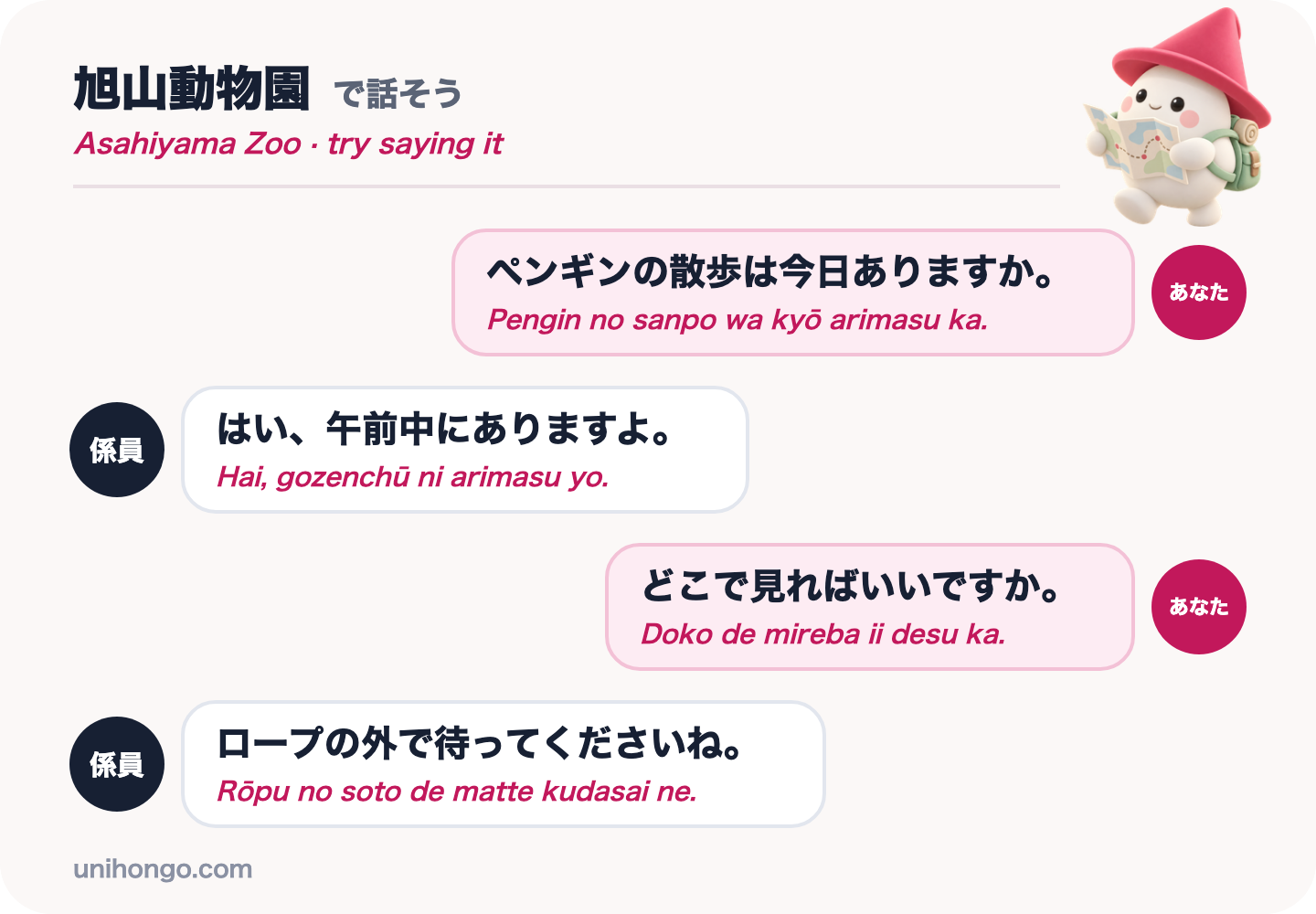
On a winter visit, the first thing you will want to know is whether the penguins are walking today. Practise the four lines below until you can say them without reading. Notice mireba ii desu ka, where should I watch, a pattern you can reuse for any question about where or how to do something.
Then practise with someone who answers back. In Unihongo, choose the Sightseeing topic and ask your AI Sensei to play a keeper at Asahiyama Zoo, including a day when the walk is cancelled. Hearing the answers once before you go makes them much easier to catch in the cold.
| Japanese | Romaji | Meaning |
|---|---|---|
| ペンギンの散歩は今日ありますか。 | Pengin no sanpo wa kyō arimasu ka. | Is there a penguin walk today? |
| はい、午前中にありますよ。 | Hai, gozenchū ni arimasu yo. | Yes, there's one in the morning. |
| どこで見ればいいですか。 | Doko de mireba ii desu ka. | Where should I watch from? |
| ロープの外で待ってくださいね。 | Rōpu no soto de matte kudasai ne. | Please wait outside the rope. |
Official information
Season dates, closure periods, penguin walk times and feeding schedules are published by the zoo, which is run by Asahikawa City. The official site is mainly in Japanese, with a machine-translated English version. Check it shortly before your visit.