

Why Naoshima is Japan's art island
Naoshima is a small island of about eight square kilometres in the Seto Inland Sea, Setonaikai, belonging to Kagawa Prefecture on Shikoku but lying closer to the Okayama coast. For most of the twentieth century it was known for a copper smelter on its north side. From the late 1980s the education company Benesse began building a cultural project here, and the result, now called Benesse Art Site Naoshima, has turned the island into a pilgrimage for anyone who loves architecture and contemporary art.
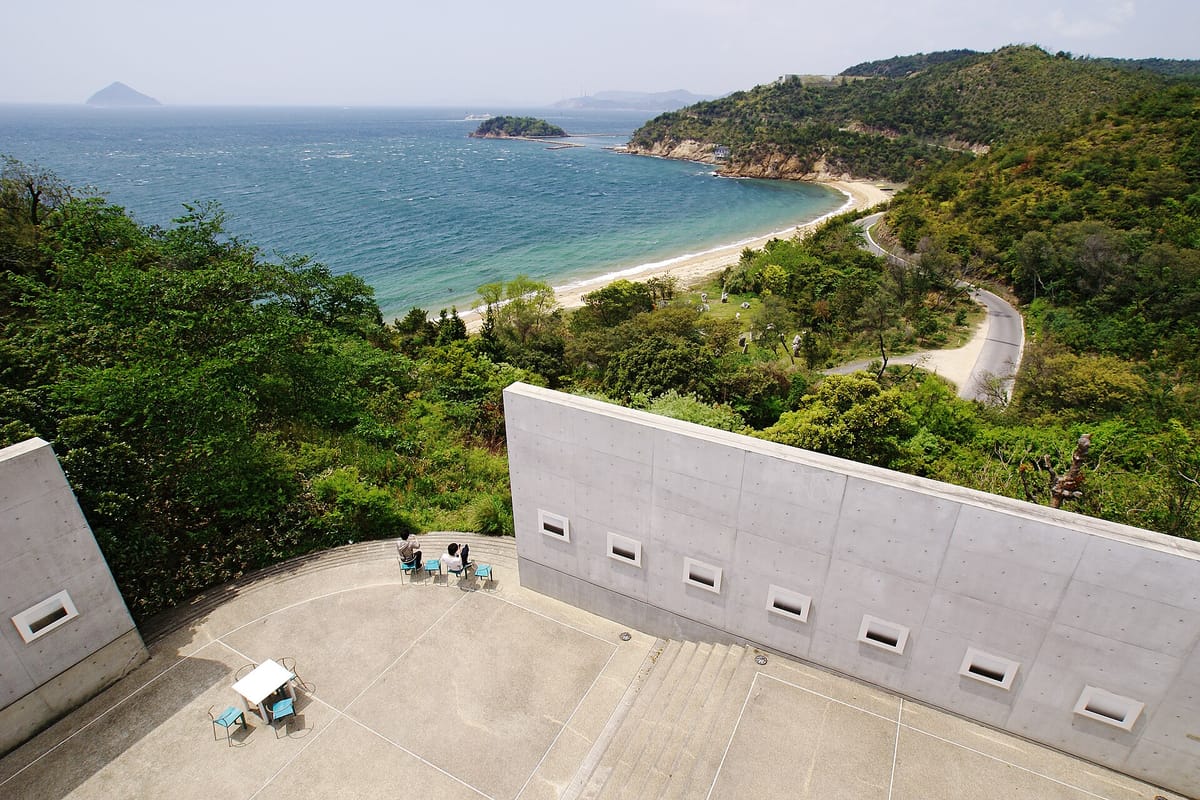
What makes Naoshima different from a city museum is the setting. Tadao Ando's concrete buildings are cut into hillsides, sculptures sit on beaches and piers, and in the village of Honmura artists have remade old houses, a shrine and a dentist's surgery into artworks you walk through. You move between them by bus, bicycle or on foot, with the sea always in view, and the travelling is part of the experience.
For a Japanese learner, Naoshima is a gentle place to practise. The island is small and used to visitors, the staff speak in the careful, polite register of museums, and the same handful of words appear again and again: 美術館, 予約, 休館日, 港. Once you can read those, you can plan your day from the Japanese signs and timetables as easily as from the English ones.
Getting there: ferries from Takamatsu and Uno
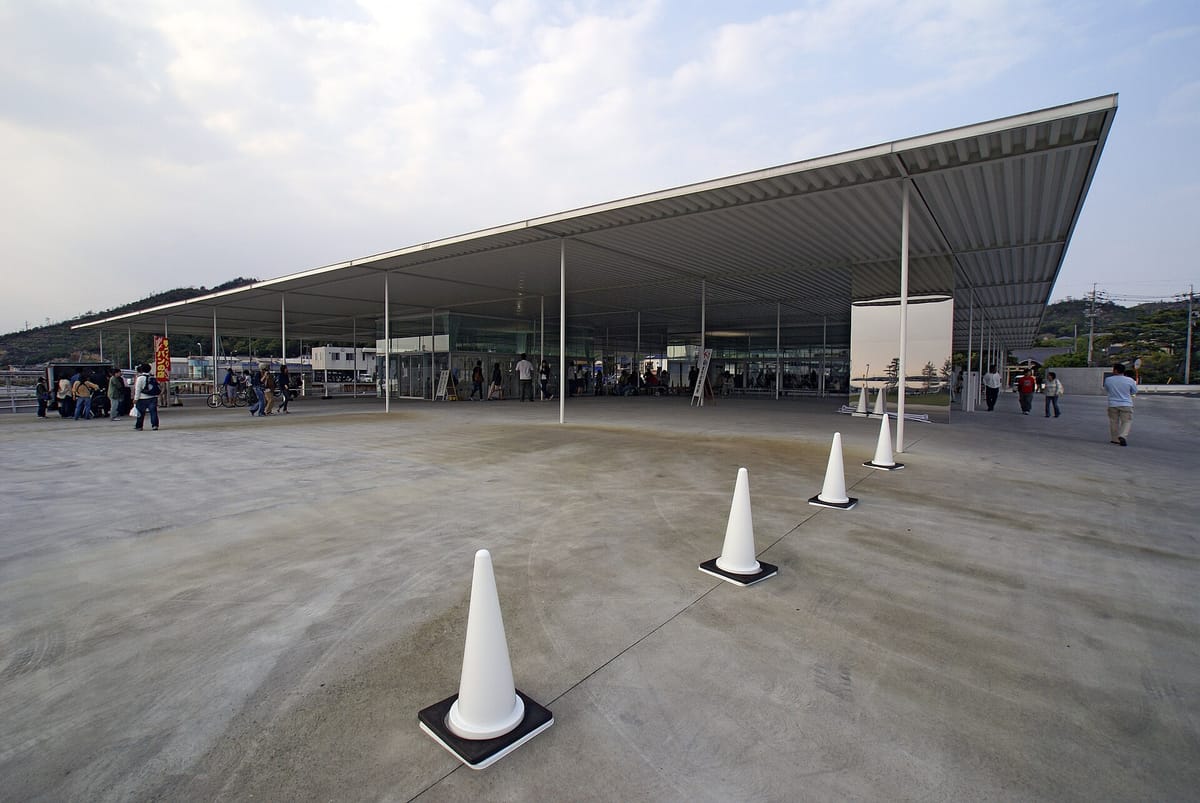
Naoshima has two public ports. Miyanoura, on the west coast, is the main one: ferries and high-speed boats arrive from Takamatsu and Uno, and the terminal building, the Marine Station, has the tourist information desk, coin lockers and bicycle rental. Honmura, on the east side, has a few boats from Uno and sits right next to the Art House Project.
From Shikoku, walk from JR Takamatsu Station to Takamatsu Port, Takamatsu-kō, a few minutes away. The car ferry takes about an hour and the faster passenger boat a little less; both go to Miyanoura. From Honshū, take the JR Uno Line from Okayama to Uno Station, a trip of just under an hour that sometimes needs a change at Chayamachi, then walk to Uno Port beside the station. Ferries to Miyanoura cross in about 20 minutes and are frequent.
On the island, the town-run bus, chōei basu, links Miyanoura, Honmura and Tsutsujisō near the Benesse area, and a free shuttle continues from Tsutsujisō to Benesse House, the Lee Ufan Museum and the Chichū Art Museum. Buses fill up quickly after a ferry arrives. Many visitors rent a bicycle at Miyanoura instead; the island is hilly, so an electric-assisted bike, denki no jitensha, is worth considering.
| Japanese | Romaji | Meaning |
|---|---|---|
| 直島行きのフェリーは何時ですか。 | Naoshima-yuki no ferī wa nanji desu ka. | What time is the ferry to Naoshima? |
| 宮浦港まで大人一枚お願いします。 | Miyanoura-kō made otona ichimai onegai shimasu. | One adult to Miyanoura Port, please. |
| 帰りの最終便は何時ですか。 | Kaeri no saishūbin wa nanji desu ka. | What time is the last boat back? |
| 地中美術館へ行くバスはどれですか。 | Chichū Bijutsukan e iku basu wa dore desu ka. | Which bus goes to the Chichū Art Museum? |
| 電動自転車を一日借りたいです。 | Dendō jitensha o ichinichi karitai desu. | I'd like to rent an electric bike for the day. |
What to see: museums, pumpkins and the Art House Project
Plan your day around one or two fixed booking times and fill the gaps with the places you can walk into. The Chichū Art Museum is the one most people build the trip around: Ando buried it almost entirely underground, and it holds only three artists, lit mainly by daylight. Benesse House combines a museum and a hotel on the hill above the south coast, and the Art House Project in Honmura is a village walk rather than a gallery.
Between them, much of the art is outdoors. Yayoi Kusama's red pumpkin, Aka Kabocha, sits on the quay at Miyanoura, and her yellow pumpkin, Kabocha, perches on a pier near Benesse House. The yellow one was swept away by a typhoon in 2021 and was reinstalled in 2022, so older guidebooks may say it is missing.
- Chichū Bijutsukan (地中美術館): Chichū Art Museum, with Claude Monet's Water Lilies, three James Turrell light works and Walter De Maria's room with a 2.2-metre granite sphere.
- Benesse House Museum (ベネッセハウス ミュージアム): the original museum-hotel on the hill, with works indoors and on the shore.
- Lee Ufan Museum (李禹煥美術館): a quiet Ando building for the Korean-born artist's stone and steel works.
- Naoshima Shin Bijutsukan (直島新美術館): the Naoshima New Museum of Art near Honmura, Ando's tenth building on the island, opened on 31 May 2025 and focused on contemporary art from Asia.
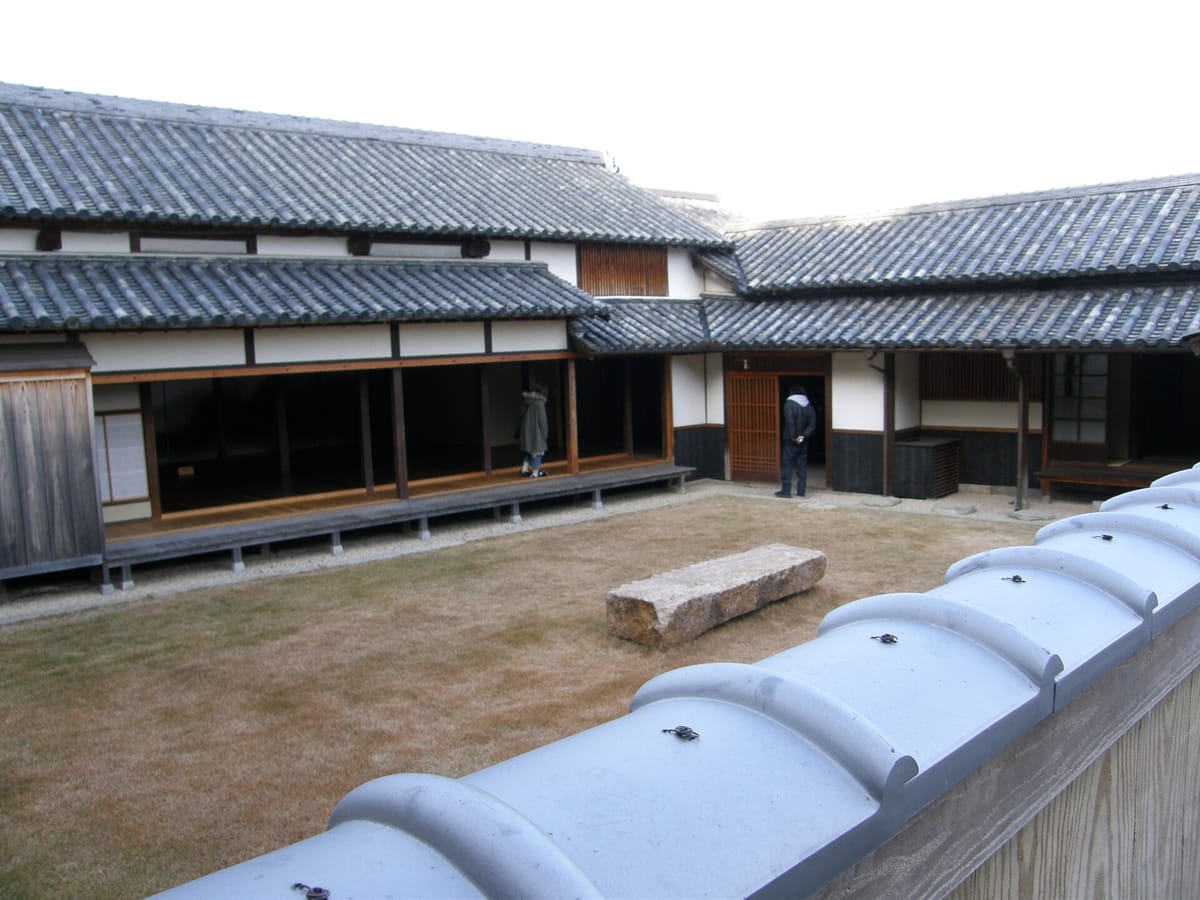
- Ie Purojekuto (家プロジェクト): the Art House Project in Honmura, including Minamidera with a James Turrell work in an Ando building, Kinza, which admits one person at a time, and Go'ō Shrine with its glass steps by Hiroshi Sugimoto.
- Aka Kabocha and Kabocha (赤かぼちゃ・南瓜): Yayoi Kusama's red pumpkin at Miyanoura and yellow pumpkin near Benesse House.
- I Love Yu (直島銭湯「I♥湯」): a working public bathhouse near Miyanoura designed by artist Shinro Ohtake, where you can actually take a bath.
Words on the signs: ports, museums and closing days
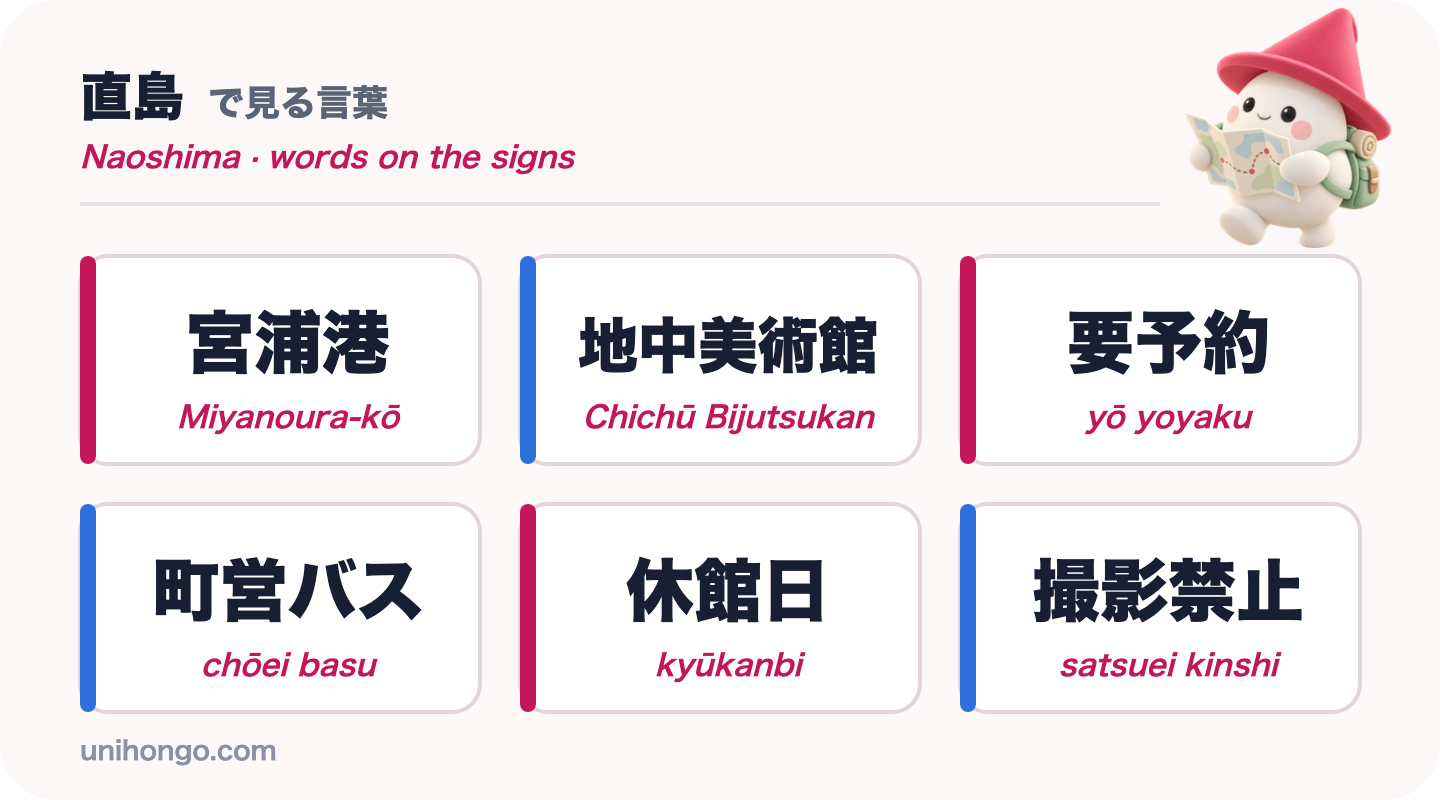
The key signs on Naoshima are practical rather than decorative. You need to recognise your port, your museum, whether it needs a reservation, whether it is open today and whether photos are allowed. The table below adds a few more words that appear on bus stops, museum calendars and the ferry timetable.
Notice how many of them share a kanji. 館, hall or building, appears in 美術館, museum, and 休館日, closing day, and 館内, inside the building. 港, port, appears in every harbour name, from 宮浦港 to 高松港 and 宇野港.
| Word | Reading | Meaning |
|---|---|---|
| 宮浦港 | Miyanoura-kō | Miyanoura Port, the main ferry terminal |
| 本村港 | Honmura-kō | Honmura Port, beside the Art House Project |
| 地中美術館 | Chichū Bijutsukan | Chichū Art Museum |
| 要予約 | yō yoyaku | Reservation required |
| 町営バス | chōei basu | Town-run bus |
| 休館日 | kyūkanbi | Closing day of a museum |
| 撮影禁止 | satsuei kinshi | Photography prohibited |
| 館内 | kannai | Inside the building |
| 最終便 | saishūbin | Last boat of the day |
Japanese for bookings, tickets and the museum entrance
At every reserved museum you will show a QR code or a ticket at the entrance and confirm your time. Staff speak keigo, the polite service register, so their sentences may sound longer than yours: misete itadakemasu ka, could you kindly show me, or to natte orimasu, it is the case that. You do not need to answer in the same register. Short desu and masu sentences are exactly right.
At the Chichū Art Museum some rooms have their own rules: you take off your shoes and change into slippers before entering the Monet room, and attendants may control how many people go in at once. Listen for kochira de omachi kudasai, please wait here.
| Japanese | Romaji | Meaning |
|---|---|---|
| 予約した名前はスミスです。 | Yoyaku shita namae wa Sumisu desu. | The booking is under the name Smith. |
| 予約の時間より早く入れますか。 | Yoyaku no jikan yori hayaku hairemasu ka. | Can I go in earlier than my booking time? |
| 当日券はありますか。 | Tōjitsuken wa arimasu ka. | Do you have same-day tickets? |
| 荷物を預けられますか。 | Nimotsu o azukeraremasu ka. | Can I leave my bags? |
| 靴はここで脱ぎますか。 | Kutsu wa koko de nugimasu ka. | Do I take my shoes off here? |
| 家プロジェクトのチケットはどこで買えますか。 | Ie purojekuto no chiketto wa doko de kaemasu ka. | Where can I buy tickets for the Art House Project? |
| タオルを借りられますか。 | Taoru o kariraremasu ka. | Can I borrow a towel? |
Etiquette, timing and practical tips
Naoshima is a place where people live, not just an open-air gallery, and its roads, buses and bathhouse are shared with residents. A little planning keeps your day calm and makes you a welcome guest.
- Book the reserved museums first, then pick ferries; the Chichū slots are the hardest to get.
- Check the closing days: many facilities close on Mondays, and on the day after a Monday holiday.
- Arrive at a reserved museum a little before your time; the shuttle bus and the walk from the stop take longer than you expect.
- Honmura is a residential village. Keep your voice down, do not look into private houses and do not block the lanes with bikes.
- Photography is not allowed inside the Chichū Art Museum, and rules vary elsewhere, so look for the sign.
- At I Love Yu, follow normal bathhouse rules: wash before you get in, keep towels out of the water and ask the staff about tattoos rather than assuming.
- Carry cash as a backup and water in summer; the island has few convenience stores and the hills are hot.
Practise the museum entrance before you go
The one conversation you will have again and again on Naoshima is at the entrance of a reserved museum. You state your booking, the attendant asks to see your code, and they may explain a rule. The attendant's last line uses to natte orimasu, a very polite way of stating a rule that you will hear all over Japan in shops, stations and museums.
Say the four lines aloud until you can do your side without reading. Then open Unihongo, choose the Sightseeing topic and ask your AI Sensei to be the attendant at the Chichū Art Museum, with a twist: your booking is for a later slot, or you have arrived without one. Handling the unexpected answer is what makes the real exchange easy.
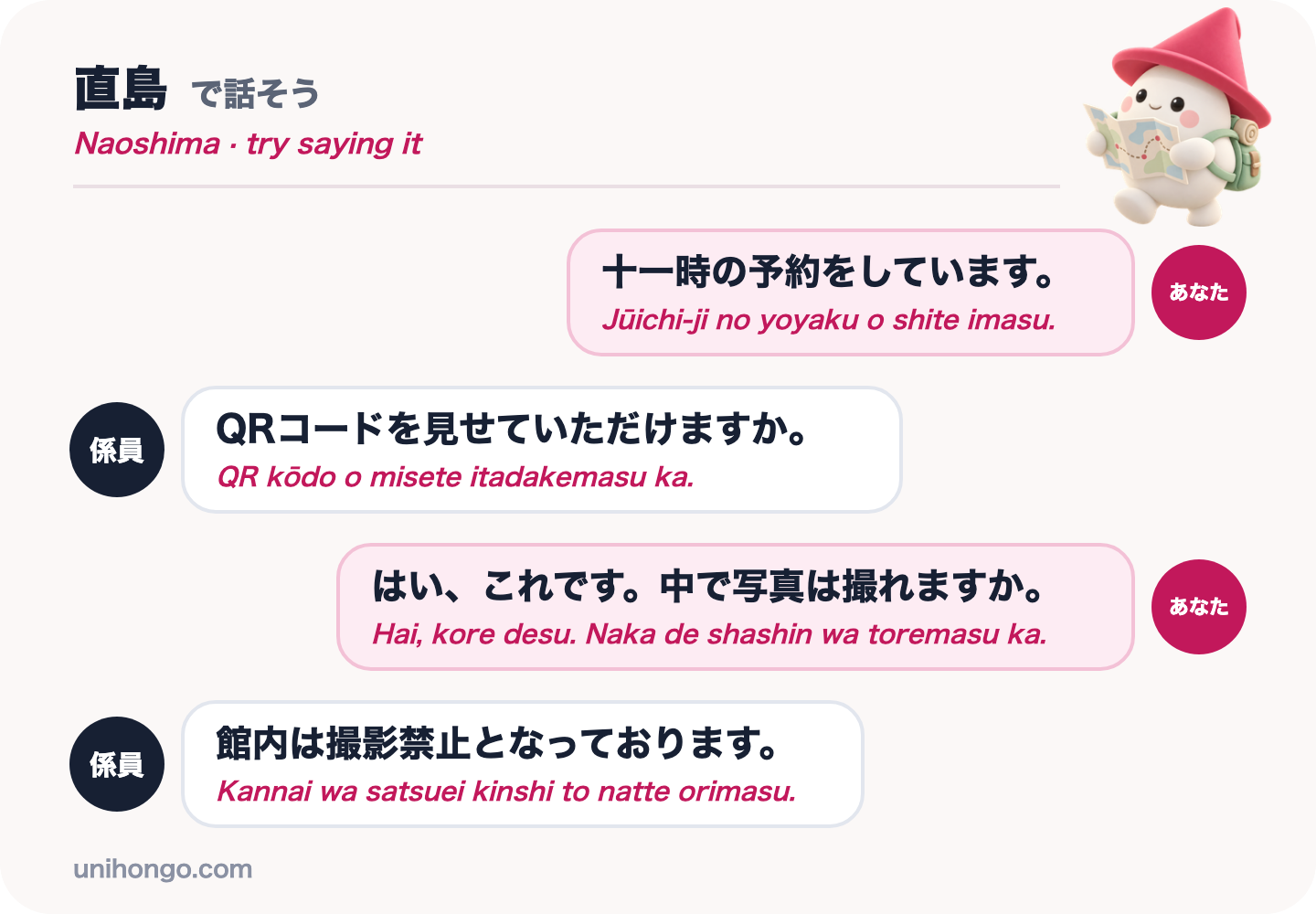
| Japanese | Romaji | Meaning |
|---|---|---|
| 十一時の予約をしています。 | Jūichi-ji no yoyaku o shite imasu. | I have a booking for eleven o'clock. |
| QRコードを見せていただけますか。 | QR kōdo o misete itadakemasu ka. | Could you show me the QR code, please? |
| はい、これです。中で写真は撮れますか。 | Hai, kore desu. Naka de shashin wa toremasu ka. | Yes, here it is. Can I take photos inside? |
| 館内は撮影禁止となっております。 | Kannai wa satsuei kinshi to natte orimasu. | Photography is not permitted inside the building. |
Official information
Booking slots, closing days, the ferry timetable and any temporary closures are published by Benesse Art Site Naoshima. Check them before you choose your dates, and again the day before you travel.