

Why Kitano Tenmangū matters to every student in Japan
Sugawara no Michizane was a brilliant scholar and poet of the ninth century who rose to high office at court and was then exiled to Kyushu after his rivals accused him falsely. After his death in 903, a series of disasters struck the capital and was blamed on his angry spirit. To calm it, he was honoured as a deity, and in 947 the shrine at Kitano was founded by imperial order. The shrine says it was the first in Japanese history to enshrine a real person as a god.
Today Michizane is worshipped as Tenjin, and although the shrine also calls him a god of agriculture, sincerity and the arts, he is best known as the god of academics. Every winter, students preparing for entrance exams come here, or to one of the thousands of Tenmangū shrines across Japan, to pray and buy charms. The ema racks overflow with wooden plaques naming the schools and universities people hope to enter.
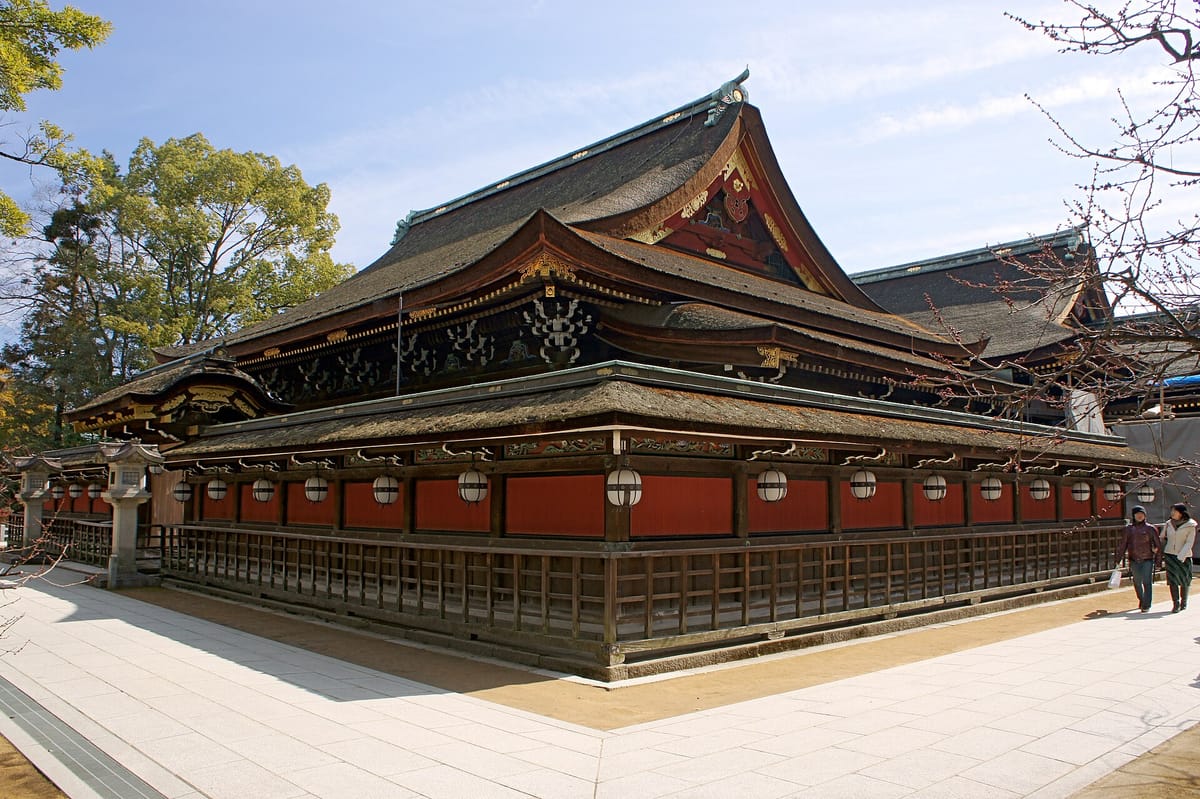
The main buildings date from the early seventeenth century and were built at the same time as the Rōmon and Sankōmon gates, all decorated with gold, fine carving and bright colours. The hall where the deity is enshrined is joined to the worship hall by a stone-floored room, the Ishi-no-ma, and the roofs combine into one great roof, a style called yatsumune-zukuri. The main hall is a National Treasure.
Getting there: buses 50 and 101, or the Randen
There is no JR or subway station at the shrine, so most visitors come by city bus. From Kyoto Station, buses 50 and 101 run to the Kitano Tenmangū-mae stop, right in front of the shrine, in about thirty minutes, longer in traffic. From Kinkaku-ji or Ryōan-ji, several buses run along Nishiōji-dōri, and the walk from Kinkaku-ji takes around twenty to thirty minutes.
The Randen Kitano Line, the small tram from Arashiyama and Ninna-ji, ends at Kitano-Hakubaichō Station, a short walk west of the shrine. That makes it easy to combine Kitano Tenmangū with Arashiyama in one day. The streets to the east of the shrine lead into Kamishichiken, the oldest geiko district in Kyoto.
| Japanese | Romaji | Meaning |
|---|---|---|
| 北野天満宮前に行くバスはどれですか。 | Kitano Tenmangū-mae ni iku basu wa dore desu ka. | Which bus goes to Kitano Tenmangū-mae? |
| このバスは北野天満宮に止まりますか。 | Kono basu wa Kitano Tenmangū ni tomarimasu ka. | Does this bus stop at Kitano Tenmangū? |
| 北野白梅町駅からどう行けばいいですか。 | Kitano-Hakubaichō-eki kara dō ikeba ii desu ka. | How do I get there from Kitano-Hakubaichō Station? |
| 上七軒はこの近くですか。 | Kamishichiken wa kono chikaku desu ka. | Is Kamishichiken near here? |
| 金閣寺まで歩いて行けますか。 | Kinkaku-ji made aruite ikemasu ka. | Can I walk to Kinkaku-ji? |
From the Rōmon to the plum garden: what you will see
From the great torii on Imadegawa-dōri, a long approach lined with stone lanterns and ox statues leads to the Rōmon, the two-storey tower gate. Just inside it, on the right, is the temizuya for purifying your hands. Next comes the Sankōmon, the gate of the three lights, named after carvings of the sun, the moon and the stars; the shrine hall lies beyond it.
Around the main buildings are plum trees, smaller shrines and the charm counters. To the west, the Momiji-en maple garden runs along a surviving section of the Odoi, the earthen rampart that Toyotomi Hideyoshi built around Kyoto in the late sixteenth century, now a national historic site with about 350 maple trees. The treasure hall holds the Illustrated Scroll of the Origin of Kitano Tenjin, a National Treasure, and opens on set days.
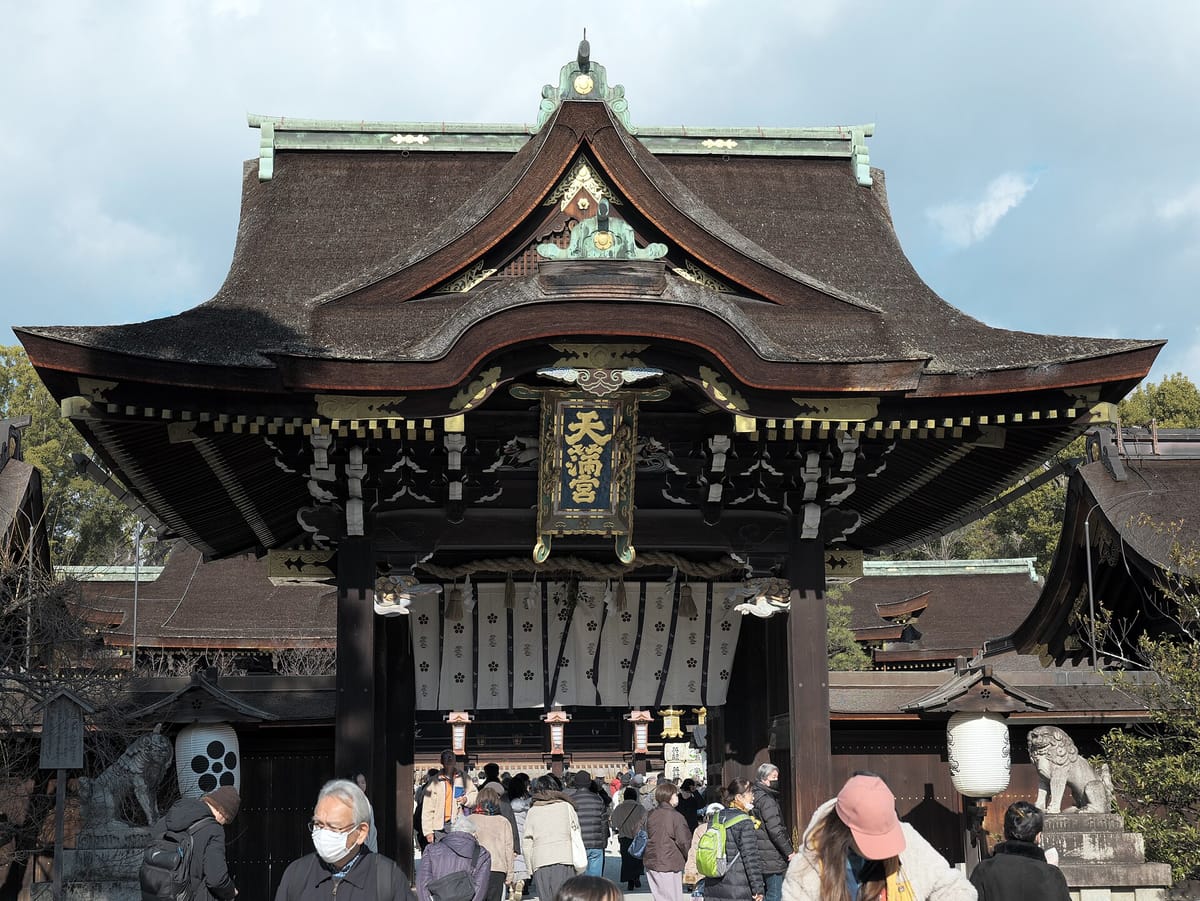
- Rōmon: the two-storey tower gate at the end of the approach.
- Sankōmon: the gate of the sun, moon and stars in front of the main hall.
- Honden and haiden: the National Treasure main hall and worship hall under one roof.
- Nade-ushi: the reclining ox statues people stroke for wisdom.
- Baien: the plum garden, open in the blossom season.
- Momiji-en: the maple garden along the Odoi rampart, open in autumn.
- Hōmotsuden: the treasure hall, open on set days.
Words on the signs at Kitano Tenmangū
The signs at Kitano Tenmangū are a mix of shrine vocabulary you will see all over Japan and words special to Tenjin. The two most common on banners and ema are 学業成就, gakugyō jōju, success in study, and 合格祈願, gōkaku kigan, a prayer to pass an exam.
Look out too for 天神, Tenjin, the popular name of the deity, and 梅, ume, plum, which appears everywhere from the garden signs to the shrine crest. The table below covers the words you will meet from the gate to the charm counter.
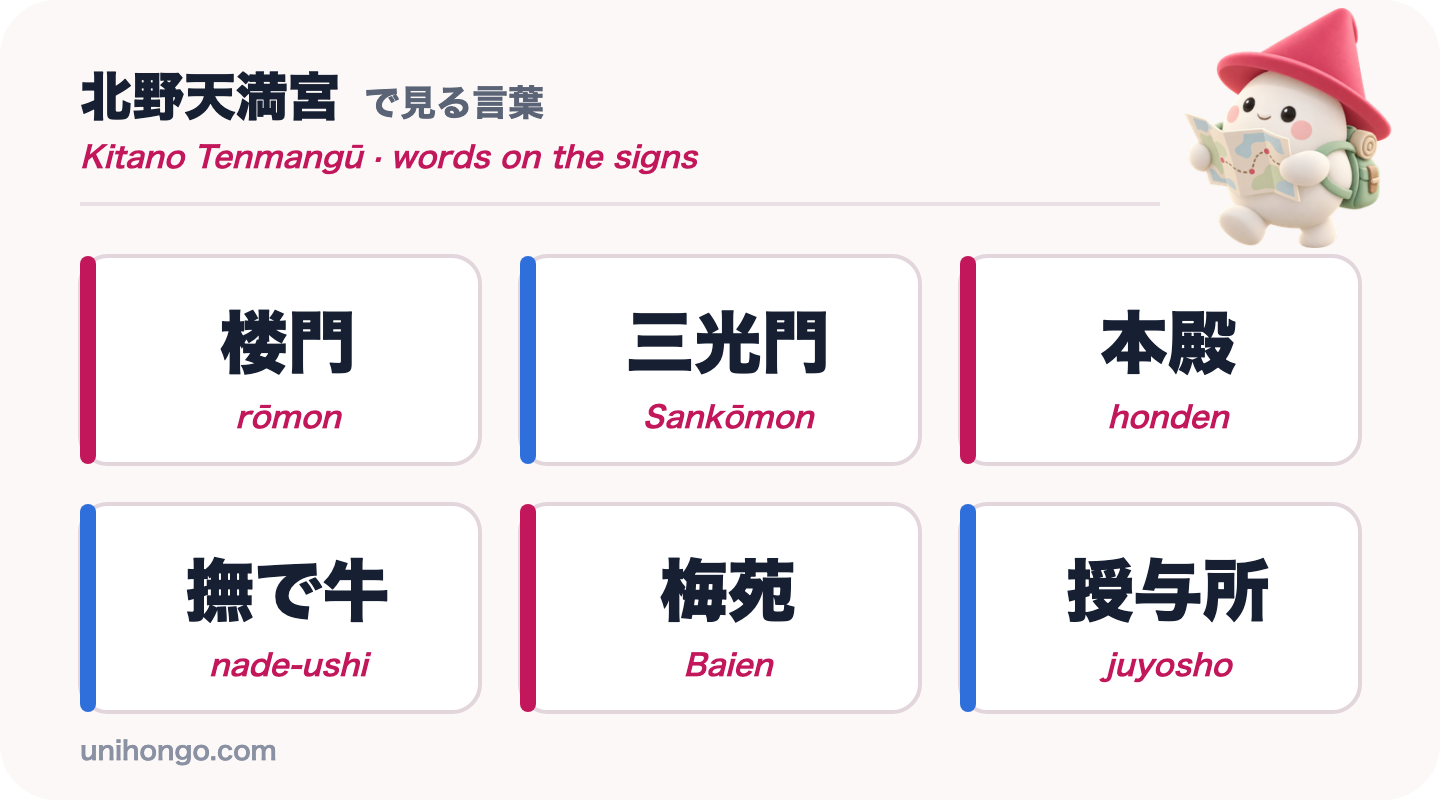
| Word | Reading | Meaning |
|---|---|---|
| 楼門 | rōmon | Two-storey tower gate |
| 三光門 | Sankōmon | Gate of the sun, moon and stars |
| 本殿 | honden | Main hall where the deity is enshrined |
| 撫で牛 | nade-ushi | Ox statue you stroke for wisdom |
| 梅苑 | Baien | The plum garden |
| もみじ苑 | Momiji-en | The maple garden |
| 授与所 | juyosho | Counter for charms and ema |
| 学業成就 | gakugyō jōju | Success in study |
| 合格祈願 | gōkaku kigan | Prayer to pass an exam |
Japanese at the charm counter: omamori, ema and goshuin
The juyosho sells charms for study and exams, ema plaques for writing your wish, and other charms linked to Tenjin, and the goshuin office writes the shrine's stamp in your book. Students often buy a charm for a friend or sibling who has an exam coming up, and staff are used to being asked which charm is for which purpose.
As at other shrines, it is more polite to say that you receive a charm, itadaku, than that you buy one. The phrases below cover the counter and the ema rack.
| Japanese | Romaji | Meaning |
|---|---|---|
| 学業成就のお守りをいただけますか。 | Gakugyō jōju no o-mamori o itadakemasu ka. | May I have a charm for success in study? |
| 友達の試験のために、お守りを買いたいんです。 | Tomodachi no shiken no tame ni, o-mamori o kaitai n desu. | I would like to buy a charm for a friend's exam. |
| 絵馬には何を書けばいいですか。 | Ema ni wa nani o kakeba ii desu ka. | What should I write on the ema? |
| 絵馬はどこに掛ければいいですか。 | Ema wa doko ni kakereba ii desu ka. | Where should I hang the ema? |
| 御朱印をお願いできますか。 | Goshuin o onegai dekimasu ka. | Could I ask for a goshuin? |
| 梅苑はいつから開きますか。 | Baien wa itsu kara hirakimasu ka. | From when is the plum garden open? |
Etiquette, seasons and practical tips
Kitano Tenmangū is a busy place of worship, especially in exam season, and a few habits keep your visit respectful.
- Bow at the Rōmon, purify your hands at the temizuya, then bow twice, clap twice, pray and bow once, as the shrine's own etiquette page explains.
- Stroke the ox gently on the head; do not sit on or climb the statues.
- Visit on the 25th for the Tenjin-san market, but expect crowds and arrive in the morning.
- Come in February or March for the plum blossom, and from late autumn for the maple garden.
- Photograph the ema racks from a distance; they carry people's names and private wishes.
- Combine the shrine with Kamishichiken and Kinkaku-ji, or ride the Randen on to Arashiyama.
Practise the shrine visit before you go
The charm counter and the ox statues are where visitors have questions. Practise the four lines below until you can say them without reading, and listen for gakugyō, study, in the first answer and yasashiku, gently, in the second.
Then practise with a partner who answers back. In Unihongo, choose the Shrine Visit topic and ask your AI Sensei to play a shrine attendant at Kitano Tenmangū, or try the Shopping topic for the Tenjin-san market. Saying the lines once before you go is what makes them come out at the counter.
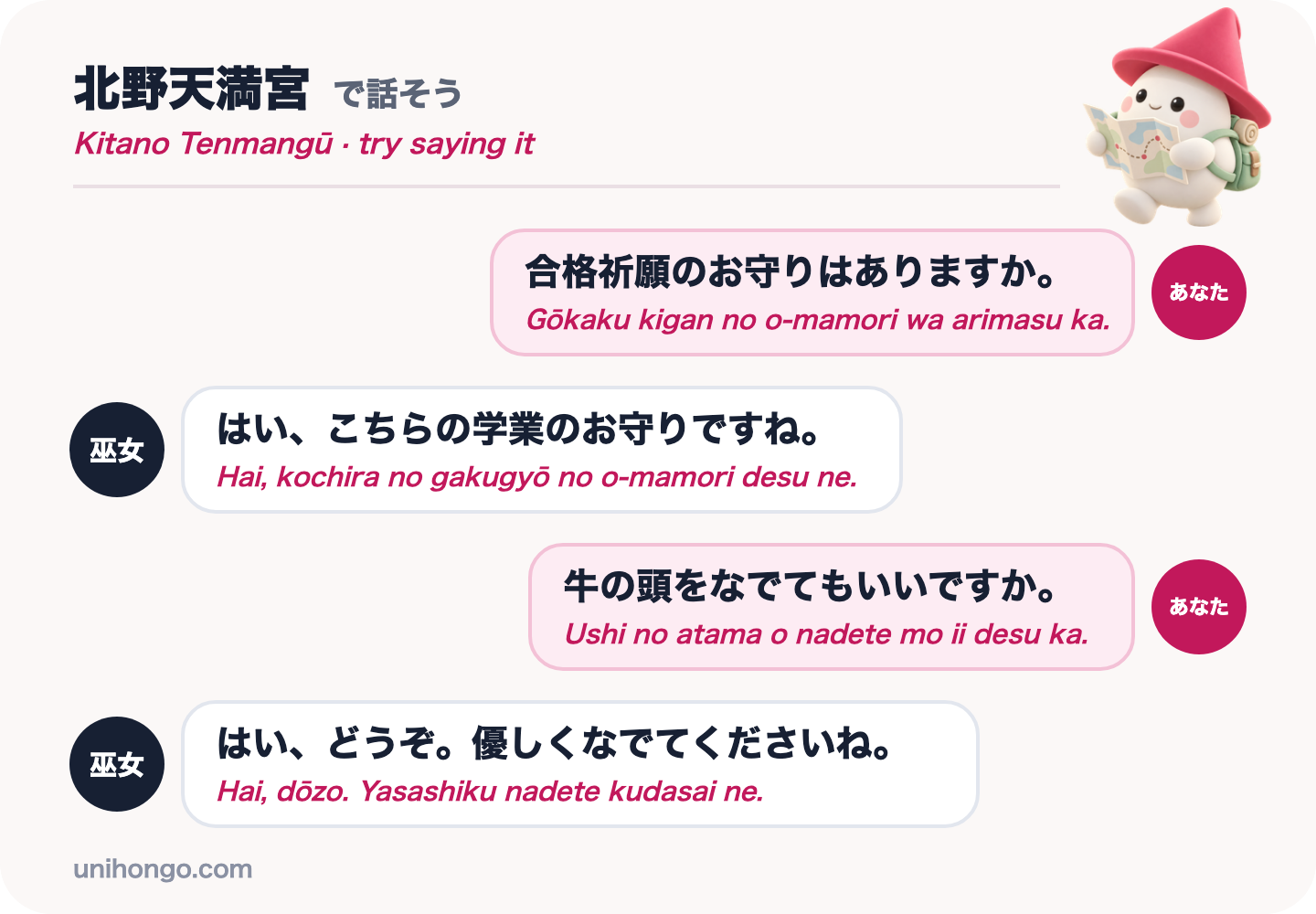
| Japanese | Romaji | Meaning |
|---|---|---|
| 合格祈願のお守りはありますか。 | Gōkaku kigan no o-mamori wa arimasu ka. | Do you have a charm for passing exams? |
| はい、こちらの学業のお守りですね。 | Hai, kochira no gakugyō no o-mamori desu ne. | Yes, it is this study charm here. |
| 牛の頭をなでてもいいですか。 | Ushi no atama o nadete mo ii desu ka. | May I stroke the ox's head? |
| はい、どうぞ。優しくなでてくださいね。 | Hai, dōzo. Yasashiku nadete kudasai ne. | Yes, go ahead. Please stroke it gently. |
Official information
Kitano Tenmangū publishes its hours, festival dates, the opening periods of the plum and maple gardens, treasure hall days and news on its website, with an English page on the shrine's history and etiquette.