

Why the Hozugawa boat ride is worth the trip to Kameoka
The river trip owes its existence to Suminokura Ryōi, a wealthy Kyoto merchant who in 1606 began clearing rocks from the gorge to open a waterway between the Tanba region and Kyoto. Timber, rice and firewood came down the river by raft and boat until the railway and then lorries took over in the twentieth century. Pleasure trips for visitors began in the Meiji era, around 1895, and Natsume Sōseki described the ride in his 1907 novel Gubijinsō.
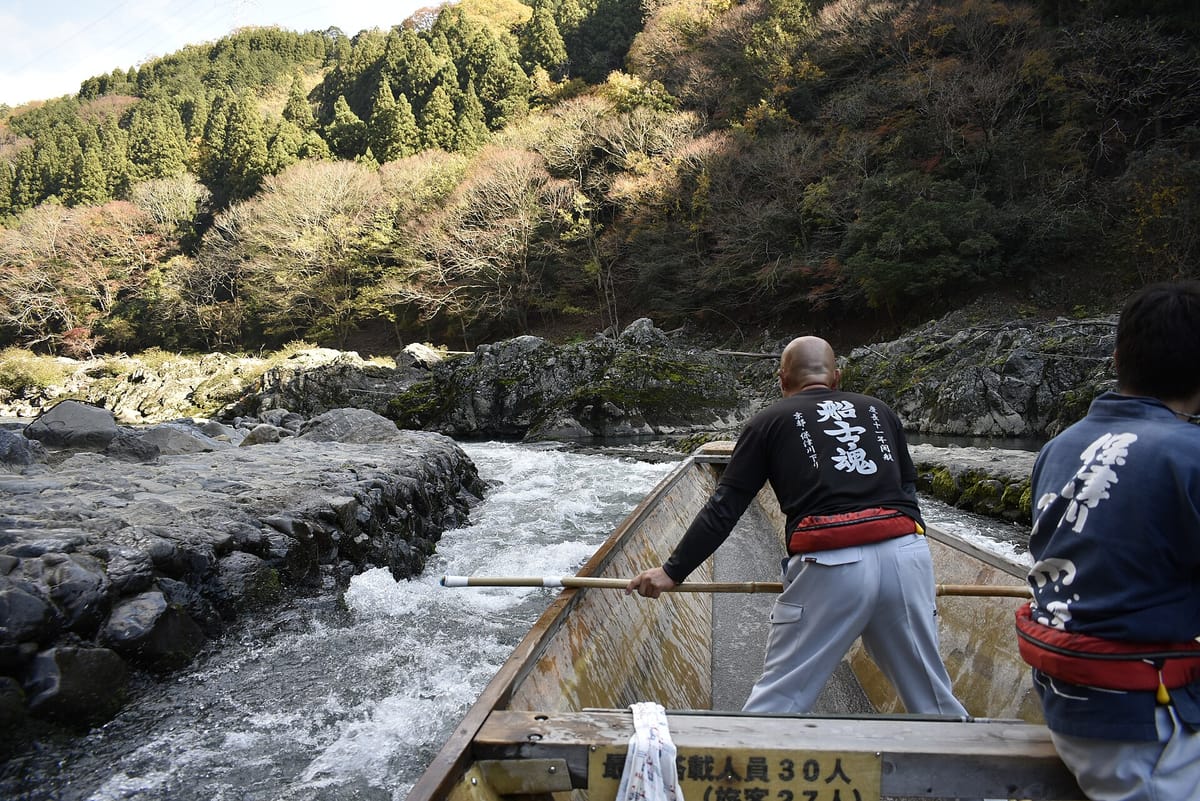
The route is sixteen kilometres long. The boats are long, flat wooden craft steered by a crew of boatmen, sendō, who take turns at the pole at the bow, the oars and the steering at the stern. As you go down you pass rapids with names, rocks shaped like frogs and books, and grooves worn into the rock by four hundred years of poles. The boatmen also point out marks left by the ropes used to haul empty boats back upstream on foot, a trip that took about four hours until the middle of the twentieth century.
It is also a very Japanese experience in the best sense. The boatmen talk the whole way, pointing out landmarks and joking with the passengers, mostly in the relaxed Kyoto and Kansai Japanese of people who have done this all their lives. Even if you catch only part of it, the rhythm of their commentary is a good workout for your listening.
Getting there: JR Kameoka Station and the boarding place
The boarding place, the jōsenba, is in Kameoka, in the Tanba basin just west of Kyoto. The usual approach is the JR Sagano Line, also shown as the San-in Line, from Kyoto Station to Kameoka Station; rapid trains stop there. From the station, follow the signs for 保津川下り to the boarding place, a short walk away. The operators' access page has maps for arriving by JR, by Hankyū and bus, and from the Sagano Romantic Train.
If you come on the Sagano Romantic Train, you arrive at Torokko Kameoka Station, which is further from the boarding place, so allow time for the connection. The boats land in Arashiyama, and the operators say the walk from the landing to JR Saga-Arashiyama Station takes about fifteen to twenty minutes, so you finish the day right in the middle of the sights.
| Japanese | Romaji | Meaning |
|---|---|---|
| 亀岡駅に止まりますか。 | Kameoka-eki ni tomarimasu ka. | Does this train stop at Kameoka Station? |
| 保津川下りの乗船場はどちらですか。 | Hozugawa kudari no jōsenba wa dochira desu ka. | Which way is the Hozugawa boat boarding place? |
| ここから歩いて行けますか。 | Koko kara aruite ikemasu ka. | Can I walk there from here? |
| トロッコ亀岡駅から乗船場まではどう行けばいいですか。 | Torokko Kameoka-eki kara jōsenba made wa dō ikeba ii desu ka. | How do I get from Torokko Kameoka Station to the boarding place? |
| 嵐山に着いたら、嵯峨嵐山駅まで歩けますか。 | Arashiyama ni tsuitara, Saga-Arashiyama-eki made arukemasu ka. | When we arrive in Arashiyama, can I walk to Saga-Arashiyama Station? |
The ride: rapids, rocks and still pools
The regular boats are shared, with up to about two dozen passengers, and the boatmen decide where everyone sits to balance the boat. After a safety briefing on wearing the life jacket, you push off from Kameoka on a wide, gentle river. The gorge closes in quickly, and from then on the trip alternates between fast white water, where the boatmen work hard and the splash sheets come up, and deep, still pools where they rest, chat and point out the sights.
The operators' course map names the landmarks. The Koayu no Taki, the little sweetfish falls, is the only point on the river called a waterfall, with a drop of about two metres. The Asahi no Se is a rapid, and the rocks along the way have names such as Shomotsu-iwa, book rock, and Kajika-iwa, after a frog it is said to resemble. Near the end the river opens out, the hills of Arashiyama appear, and the boats glide in among the rowing boats of the Arashiyama riverside.
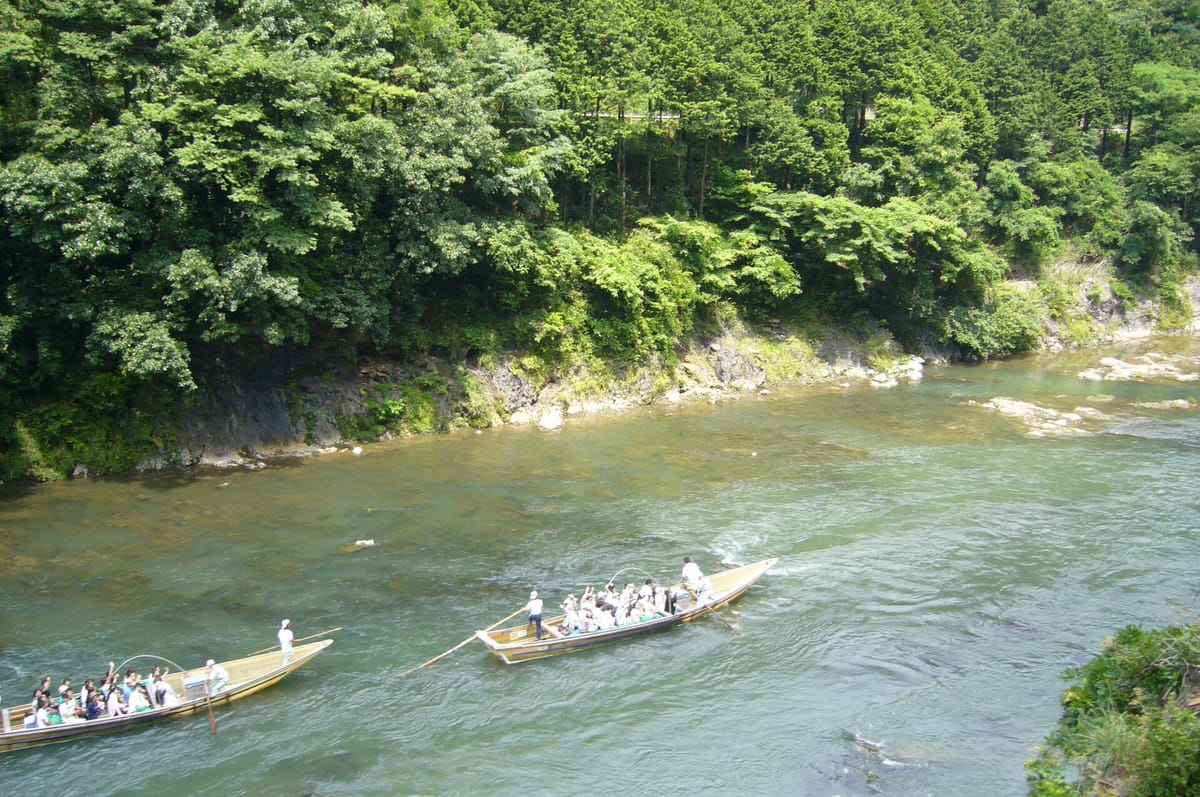
- Boarding in Kameoka: a wide, calm start with views back over the basin.
- Koayu no Taki: the little sweetfish falls, the one waterfall on the route.
- Asahi no Se: one of the named rapids.
- Shomotsu-iwa and Kajika-iwa: named rocks along the gorge.
- Pole marks and rope marks: grooves in the rock from centuries of boat traffic.
- The Sagano Romantic Train: you may see it passing on the cliffs above.
- Arashiyama: the landing, with the hills and riverside of the town around you.
Words on the signs at the boarding place
The boarding place is organised around the ticket window and the waiting area, and the signs are about tickets, boats and safety. The ticket is a jōsenken, a boarding ticket, and on the day you buy a tōjitsuken, a same-day ticket. The life jacket is a kyūmei dōi, literally a life-saving vest, and the boatmen are sendō.
Two other words appear on the website and at the window: 定期船, teikisen, the regular scheduled boats, and 貸切船, kashikirisen, a private charter boat. On weekends and holidays extra boats, rinjisen, may run as well. The table below covers the words you will see.
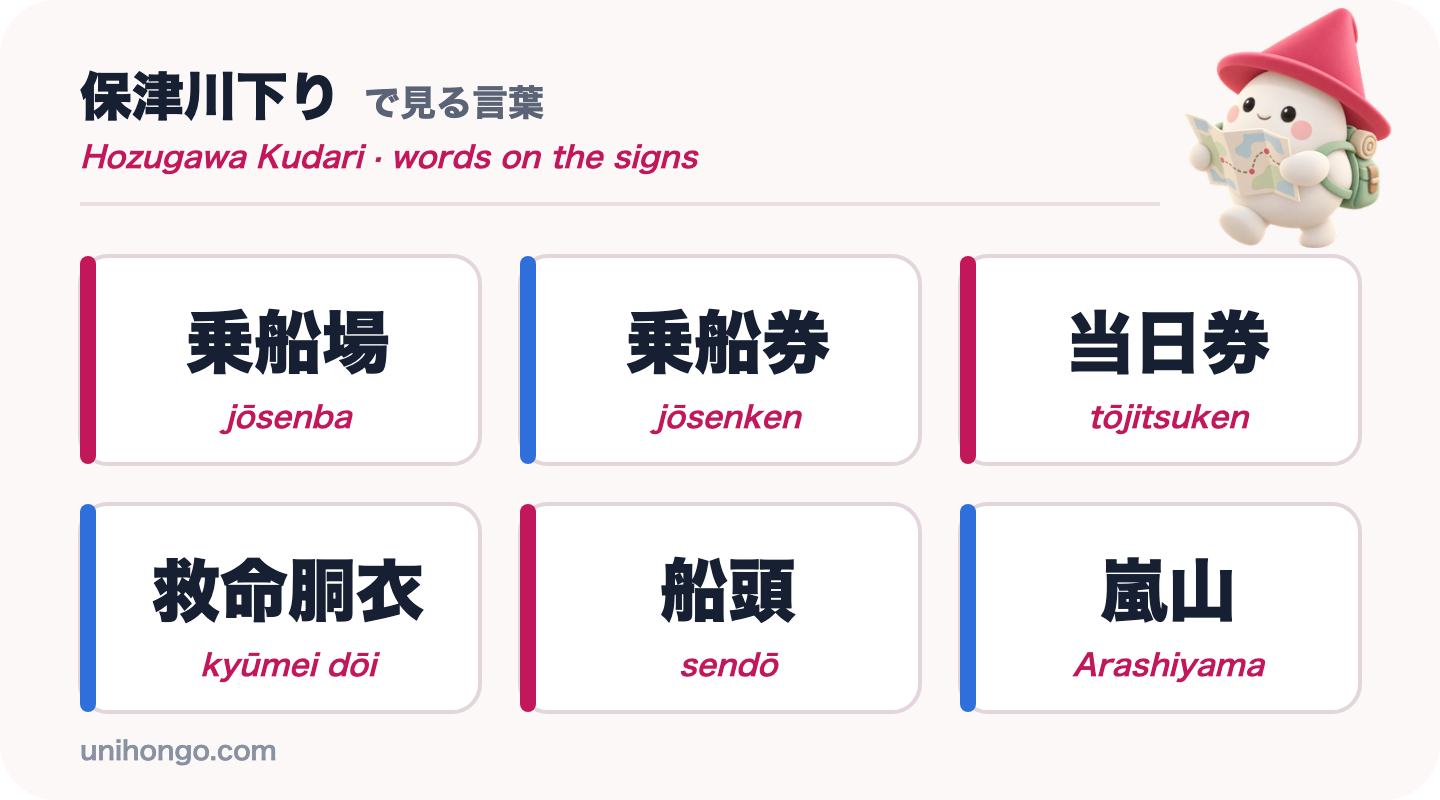
| Word | Reading | Meaning |
|---|---|---|
| 乗船場 | jōsenba | Boarding place |
| 乗船券 | jōsenken | Boat ticket |
| 当日券 | tōjitsuken | Same-day ticket |
| 救命胴衣 | kyūmei dōi | Life jacket |
| 船頭 | sendō | Boatman |
| 定期船 | teikisen | Regular scheduled boat |
| 貸切船 | kashikirisen | Private charter boat |
| 運航状況 | unkō jōkyō | Today's operating status |
| 嵐山 | Arashiyama | The landing at the end of the ride |
Japanese for the ticket window and the boat
At the window you give the number of people and ask about the next boat; staff tell you a time and, in busy periods, how long the wait is. There are toilets in the waiting area but none on board, and the ride is around an hour and a half, so plan for that before boarding.
On the boat, the boatmen give short instructions about sitting still, holding on and raising the splash sheet. The phrases below cover the window, the waiting area and the boat.
| Japanese | Romaji | Meaning |
|---|---|---|
| 大人二人、次の船に乗れますか。 | Otona futari, tsugi no fune ni noremasu ka. | Two adults, can we get on the next boat? |
| 待ち時間はどのくらいですか。 | Machi jikan wa dono kurai desu ka. | How long is the wait? |
| 今日は運航していますか。 | Kyō wa unkō shite imasu ka. | Are the boats running today? |
| トイレは乗る前に行ったほうがいいですか。 | Toire wa noru mae ni itta hō ga ii desu ka. | Should I go to the toilet before boarding? |
| この救命胴衣はこれで大丈夫ですか。 | Kono kyūmei dōi wa kore de daijōbu desu ka. | Is this life jacket on properly? |
| 水がかかりますか。 | Mizu ga kakarimasu ka. | Will we get splashed? |
Safety, timing and practical tips
The ride is gentle for most of its length but runs through real rapids, and the river level changes with the weather. A few points make the day go smoothly.
- Check the operating status on the official site on the morning of your trip; boats are cancelled in high water.
- Wear the life jacket exactly as the boatmen show you, and keep it on for the whole ride.
- Children must be at least 80 centimetres tall to ride.
- Bring a light raincoat and keep phones and cameras secure in the rapids.
- Book online in busy seasons, especially November; online booking closes the day before.
- Plan to spend the afternoon in Arashiyama after you land, rather than rushing back to Kameoka.
Practise the ticket window before you go
At the window, you will hear a departure time, an instruction and a duration. Practise the four lines below until you can say them without reading, and listen for the time, jūichiji, eleven o'clock, the word kyūmei dōi, life jacket, and nijikan kurai, about two hours.
Then practise with a partner who answers back. In Unihongo, choose the Sightseeing topic and ask your AI Sensei to play the staff at the boat window, or try the Catch the Right Train mission for the journey to Kameoka. Saying the lines once before you go is what makes them easy at the window.
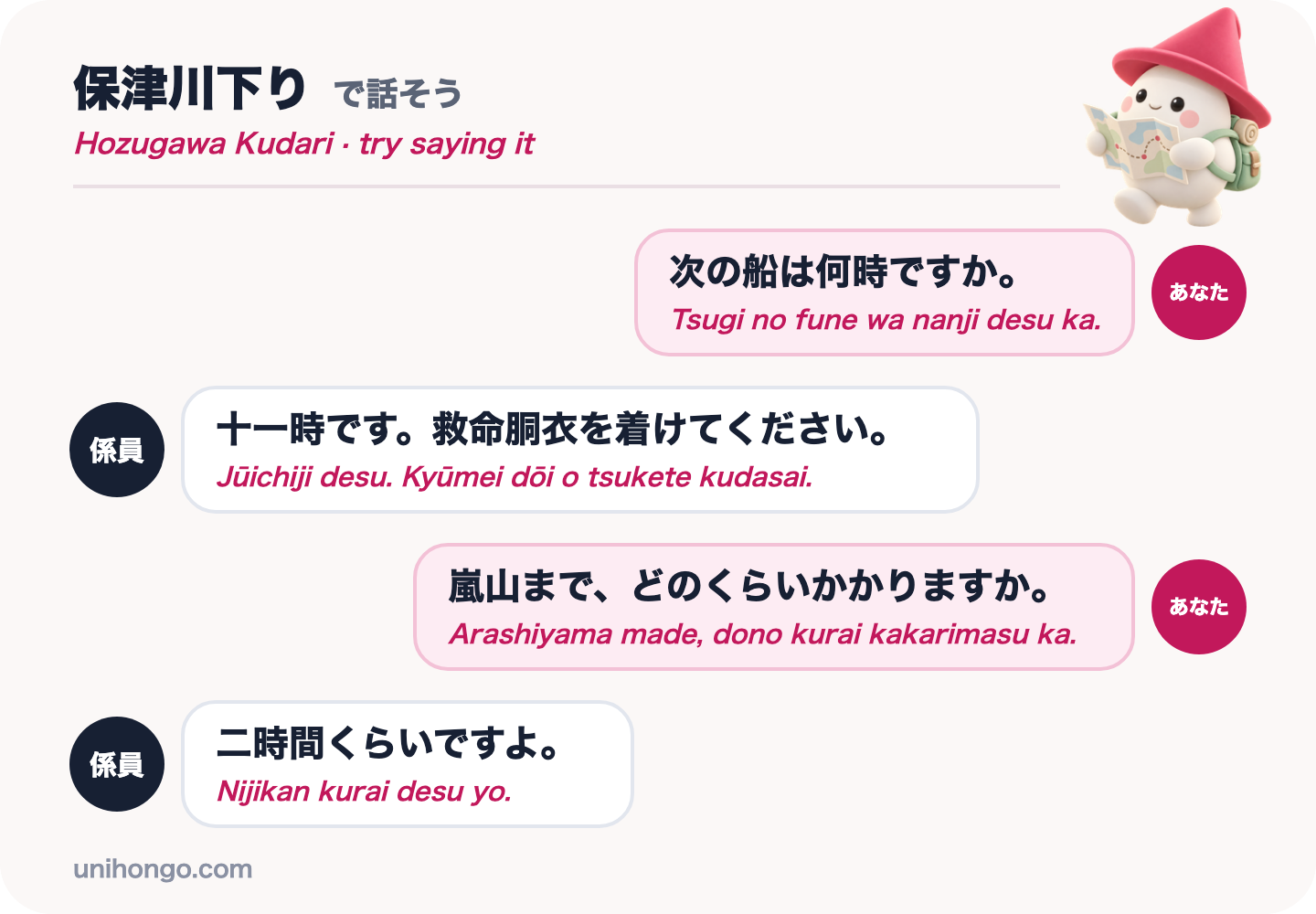
| Japanese | Romaji | Meaning |
|---|---|---|
| 次の船は何時ですか。 | Tsugi no fune wa nanji desu ka. | What time is the next boat? |
| 十一時です。救命胴衣を着けてください。 | Jūichiji desu. Kyūmei dōi o tsukete kudasai. | Eleven o'clock. Please put on a life jacket. |
| 嵐山まで、どのくらいかかりますか。 | Arashiyama made, dono kurai kakarimasu ka. | How long does it take to Arashiyama? |
| 二時間くらいですよ。 | Nijikan kurai desu yo. | About two hours. |
Official information
The Hozugawa boat operators publish the day's operating status, timetables, booking, safety measures and access maps on their website. Check the operating status on the day, especially after heavy rain.