

Why Ginzan Onsen looks like a film set
The name tells the story. Ginzan means silver mountain, and the town began as the camp of the Nobesawa silver mine, which opened in the fifteenth century and boomed in the early Edo period. Miners found hot springs in the valley in the early seventeenth century, and when the silver ran out the springs remained, turning the settlement into a place people came to bathe.
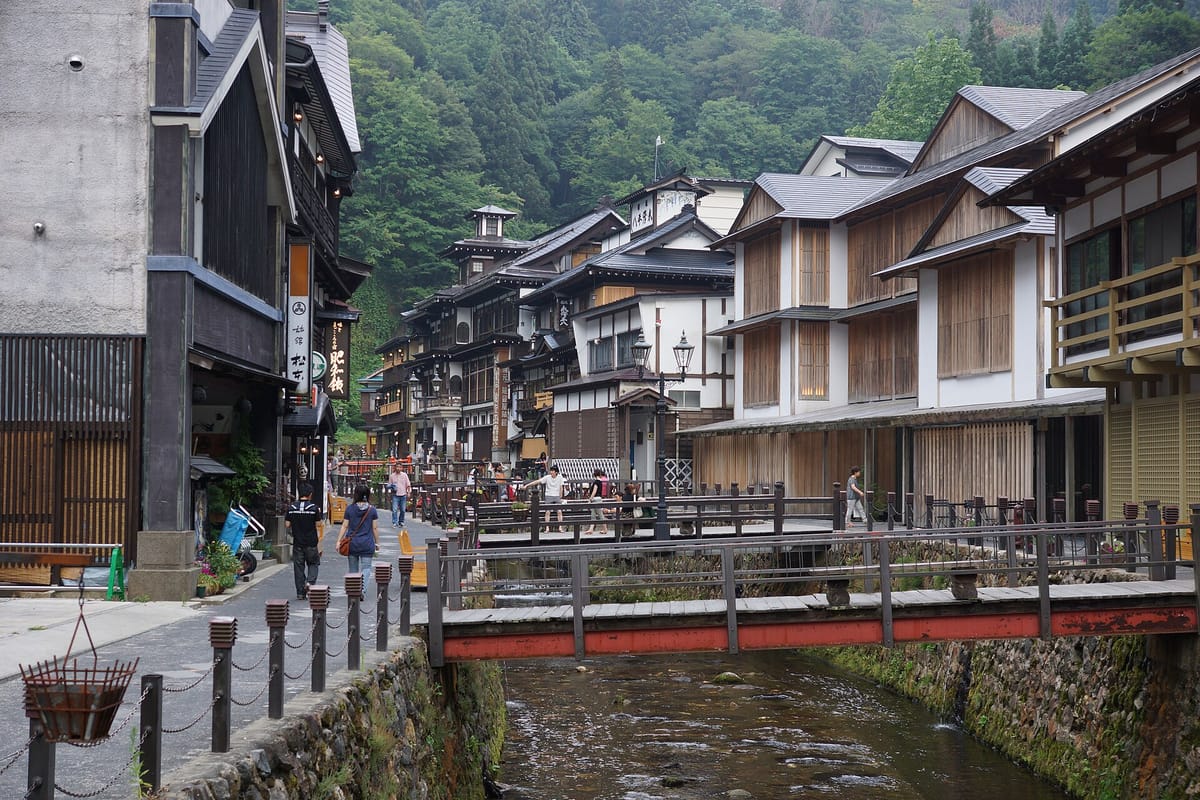
The street you see today dates from after a great flood in 1913. The inns were rebuilt in the Taishō and early Shōwa eras as tall wooden buildings with balconies, carved signboards and decorative plaster reliefs, kote-e, on their walls. Gas lamps line the stone paths on both sides of the river, and since 1986 the town has had rules to protect the look of the street. The NHK morning drama Oshin, first broadcast in 1983, used the area as a setting and made the name known across Japan.
It is small: you can walk from the entrance to the waterfall at the far end in ten minutes. What makes a visit is slowing down to that pace, reading the names painted on the inns, soaking your feet in the river-side foot bath and waiting for the lamps to come on.
Getting there, and the winter entry rules
The nearest station is Ōishida, on the JR Yamagata Shinkansen, which runs from Tokyo through Yamagata to Shinjō. From Ōishida Station a local bus climbs to Ginzan Onsen in around forty minutes. The buses run roughly every two hours, so plan the train around the bus rather than the other way round. If you are staying at an inn, ask whether it offers a pick-up.
Winter is different. For the 2026 to 2027 season, from December to early March, private cars are not allowed into the town. Drivers park at Taishō Roman-kan, a visitor centre about a kilometre and a half down the valley, and everyone arriving as a day visitor rides a shuttle bus in at a reserved departure time. The return shuttle is normally assigned for about an hour and twenty minutes after you arrive, with a longer allowance around lunchtime. Numbers are capped each hour because snow falling from the roofs leaves little safe space in the street, and the official page says very few same-day places are expected, so book in advance.
Two more rules matter. Do not try to walk the road between Taishō Roman-kan and the town: the pavement is buried in winter and walkers end up on the road in blizzards. And if you are staying overnight, you are counted in the same limits, so ask your inn how its guests arrive in winter when you book.
| Japanese | Romaji | Meaning |
|---|---|---|
| 銀山温泉行きのバスはどこから出ますか。 | Ginzan Onsen-iki no basu wa doko kara demasu ka. | Where does the bus to Ginzan Onsen leave from? |
| 次のバスは何時ですか。 | Tsugi no basu wa nanji desu ka. | What time is the next bus? |
| シャトルバスの予約をしています。 | Shatoru basu no yoyaku o shite imasu. | I have a shuttle bus reservation. |
| 帰りのバスは何時発ですか。 | Kaeri no basu wa nanji hatsu desu ka. | What time does the return bus leave? |
| 大正ろまん館で乗り換えですか。 | Taishō Roman-kan de norikae desu ka. | Do I change at Taishō Roman-kan? |
Bridges, baths, the waterfall and the silver mine
Walk the street on one bank and come back on the other. Each inn has its own character: look for the painted plaster reliefs on the walls and the wooden signboards with the inn's name in large kanji. Fujiya, one of the inns, was redesigned by the architect Kuma Kengo, who set a modern interior inside the traditional wooden frame, and it is worth seeing from the outside even if you are not staying.
At the top of the street the river drops over Shirogane no taki, a waterfall of about twenty-two metres, and a path continues into the woods to the remains of the old silver mine, where you can step into lit sections of the old tunnels. The trail to the mine is closed in winter and early spring, when snow covers it.
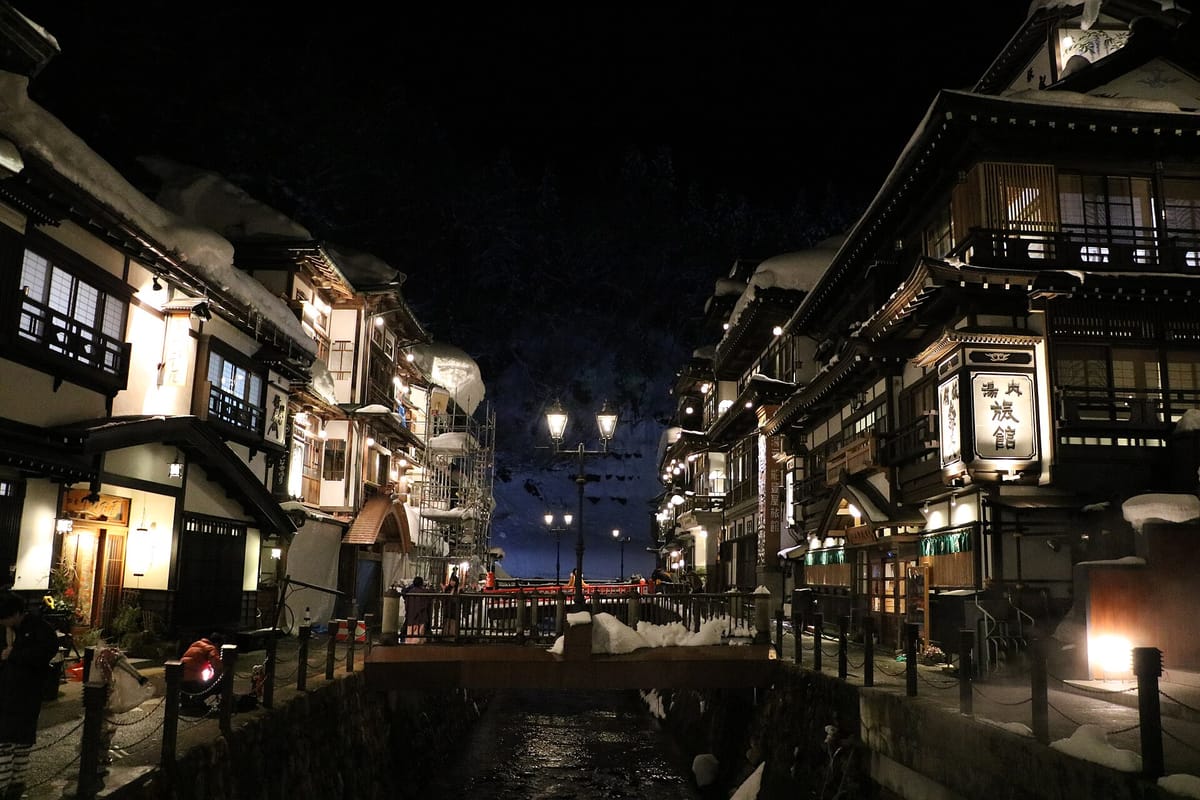
- The inn street: wooden inns of the Taishō and early Shōwa eras on both banks of the Ginzan-gawa.
- The foot bath: a free ashiyu by the river, open to everyone; bring a small towel.
- Shirogane-yu: the small public bath redesigned by Kuma Kengo, in the middle of the street.
- Shirogane no taki: the waterfall at the top of the town, about twenty-two metres high.
- The silver mine remains: old tunnels reached by a short woodland trail, closed in winter.
- The gas lamps: lit at dusk; in winter the evening hours are the most wanted, so plan your reservation around them.
Words on the signs at Ginzan Onsen
Most signs in Ginzan Onsen are about bathing. 湯, yu, hot water, is everywhere: in 足湯, ashiyu, the foot bath, in the name of the public bath, and on the curtains, noren, that hang over bath entrances. The curtain tells you which side is which: 男 for men, 女 for women. Learn those two before anything else.
Outside the inns, small boards say whether day bathers are welcome and when. In winter you will also meet the vocabulary of reservations and shuttles. The table covers the words you are most likely to see.
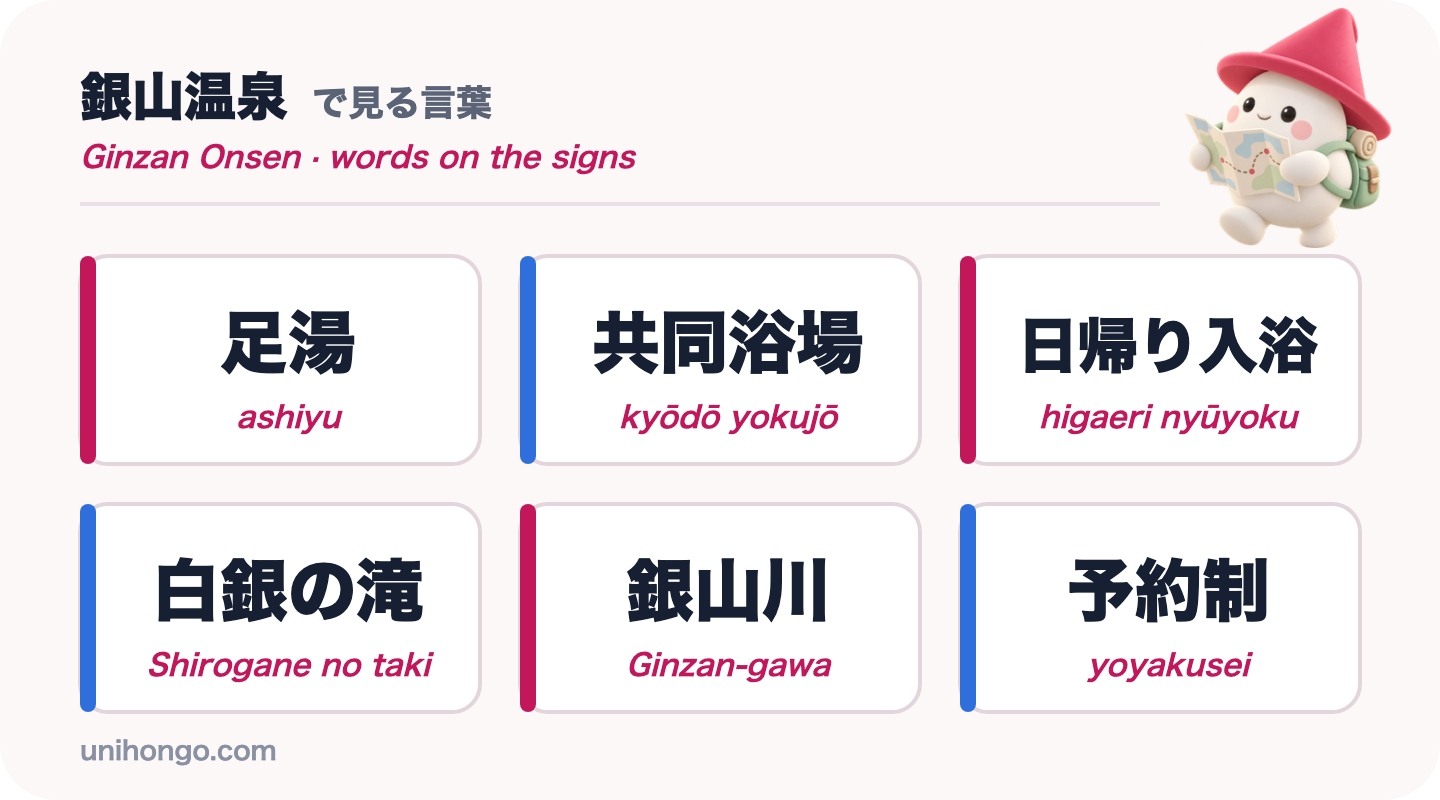
| Word | Reading | Meaning |
|---|---|---|
| 足湯 | ashiyu | Foot bath |
| 共同浴場 | kyōdō yokujō | Public bath shared by the town |
| 日帰り入浴 | higaeri nyūyoku | Day bathing for non-guests |
| 白銀の滝 | Shirogane no taki | The waterfall at the top of the town |
| 銀山川 | Ginzan-gawa | The river through the town |
| 予約制 | yoyakusei | By reservation only |
| 男湯 | otoko-yu | Men's bath |
| 女湯 | onna-yu | Women's bath |
| 源泉 | gensen | The spring source |
Onsen Japanese: day bathing and bath manners
Day bathing at an inn usually works like this: you ask at the front desk, pay a fee, and are shown to the bath, often during a set window in the middle of the day when overnight guests are out. Towels may be sold or lent. Some inns only take day bathers on certain days, and in busy seasons many stop altogether, so ask rather than assume.
Inside, the rules are the same as anywhere in Japan: wash thoroughly at the taps before getting in, keep your towel out of the water, tie up long hair, and do not swim or splash. Tattoo policies vary from inn to inn, so if it matters, ask politely before you pay.
| Japanese | Romaji | Meaning |
|---|---|---|
| 日帰り入浴はできますか。 | Higaeri nyūyoku wa dekimasu ka. | Can I bathe here as a day visitor? |
| 何時まで入れますか。 | Nanji made hairemasu ka. | Until what time can I bathe? |
| タオルは借りられますか。 | Taoru wa kariraremasu ka. | Can I borrow a towel? |
| 男湯はどちらですか。 | Otoko-yu wa dochira desu ka. | Which way is the men's bath? |
| タトゥーがあるんですが、入浴できますか。 | Tatū ga aru n desu ga, nyūyoku dekimasu ka. | I have a tattoo. Am I allowed to bathe? |
| 足湯は誰でも使えますか。 | Ashiyu wa dare demo tsukaemasu ka. | Can anyone use the foot bath? |
| いいお湯でした。ありがとうございました。 | Ii o-yu deshita. Arigatō gozaimashita. | That was a lovely bath. Thank you. |
Etiquette, snow and timing
Ginzan Onsen is a place people save up to stay in, and the street is narrow, so day visitors are guests in someone else's holiday.
- In winter, book the shuttle as soon as reservations open, and treat the assigned return time as fixed.
- Wear boots with a good grip and a warm coat: the paths are icy and snow slides off the roofs without warning.
- Do not stand in the middle of a bridge for long photos; people staying at the inns need to get through.
- Do not walk into inn entrances or lobbies to take pictures unless you are a guest or have asked.
- Keep your voice down in the evening. The inns are close together and windows face the street.
- Outside winter the town is much calmer. Late spring and autumn give you the lamps and the river without the reservation rush.
Practise the inn door before you go
The one conversation almost every day visitor has is at an inn's front desk, asking about the bath. The answer usually comes with a time, ~ji made, until a certain hour, and sometimes a no: kyō wa yatte imasen, not today. Practise the four lines below until you can say them without reading.
Then practise with a partner who answers back. In Unihongo, choose the Onsen topic and ask your AI Sensei to play the inn staff, including a polite refusal so you hear how it sounds. Saying the lines once before you arrive is what makes them easy on the day.
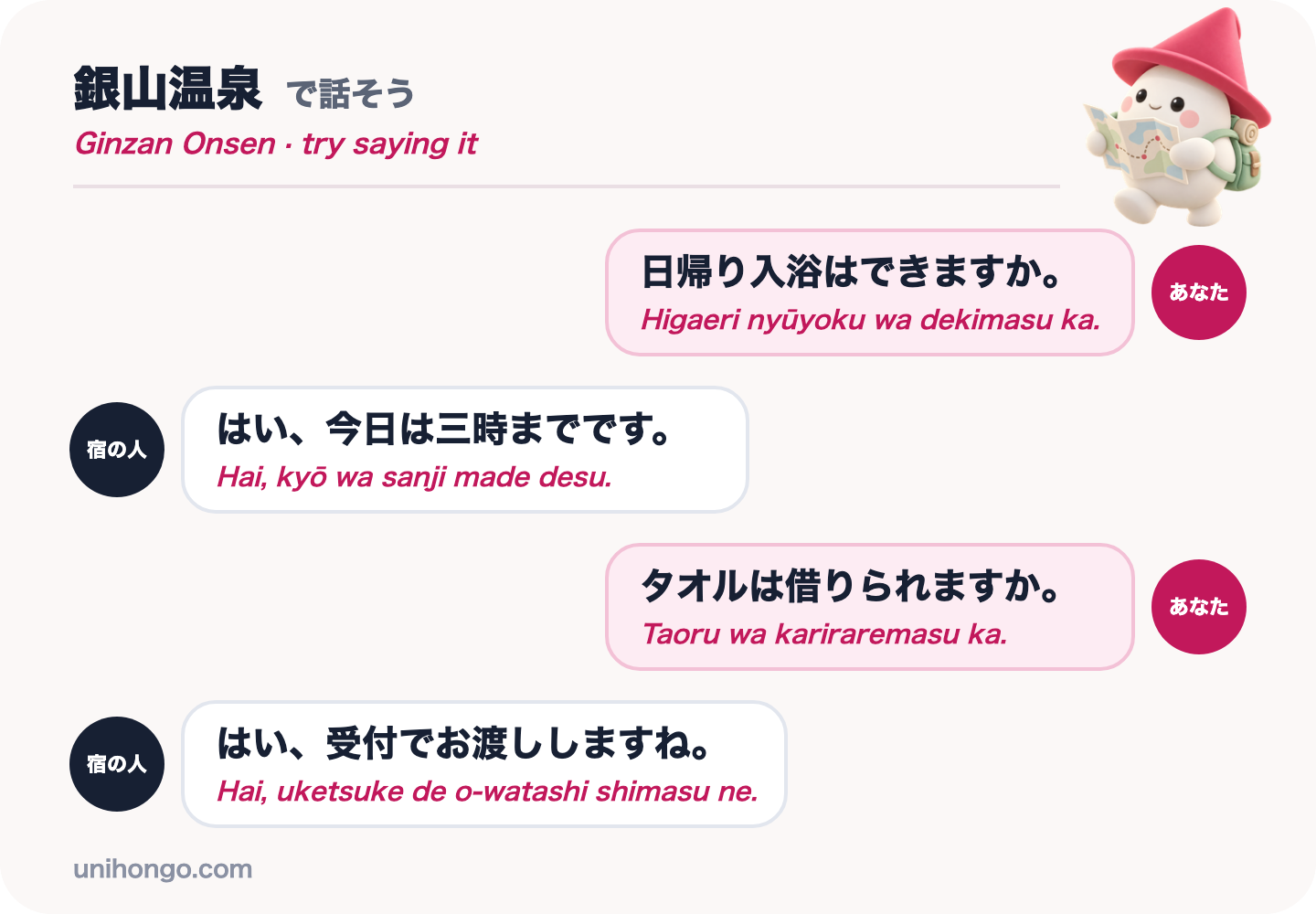
| Japanese | Romaji | Meaning |
|---|---|---|
| 日帰り入浴はできますか。 | Higaeri nyūyoku wa dekimasu ka. | Can I bathe here as a day visitor? |
| はい、今日は三時までです。 | Hai, kyō wa sanji made desu. | Yes, until three o'clock today. |
| タオルは借りられますか。 | Taoru wa kariraremasu ka. | Can I borrow a towel? |
| はい、受付でお渡ししますね。 | Hai, uketsuke de o-watashi shimasu ne. | Yes, we will give you one at reception. |
Official information
The town's official site carries the winter rules, reservation links and access details, and the final winter dates are announced there. Read the winter page before you plan any trip between December and March.