

Why Osaka Castle is worth the walk
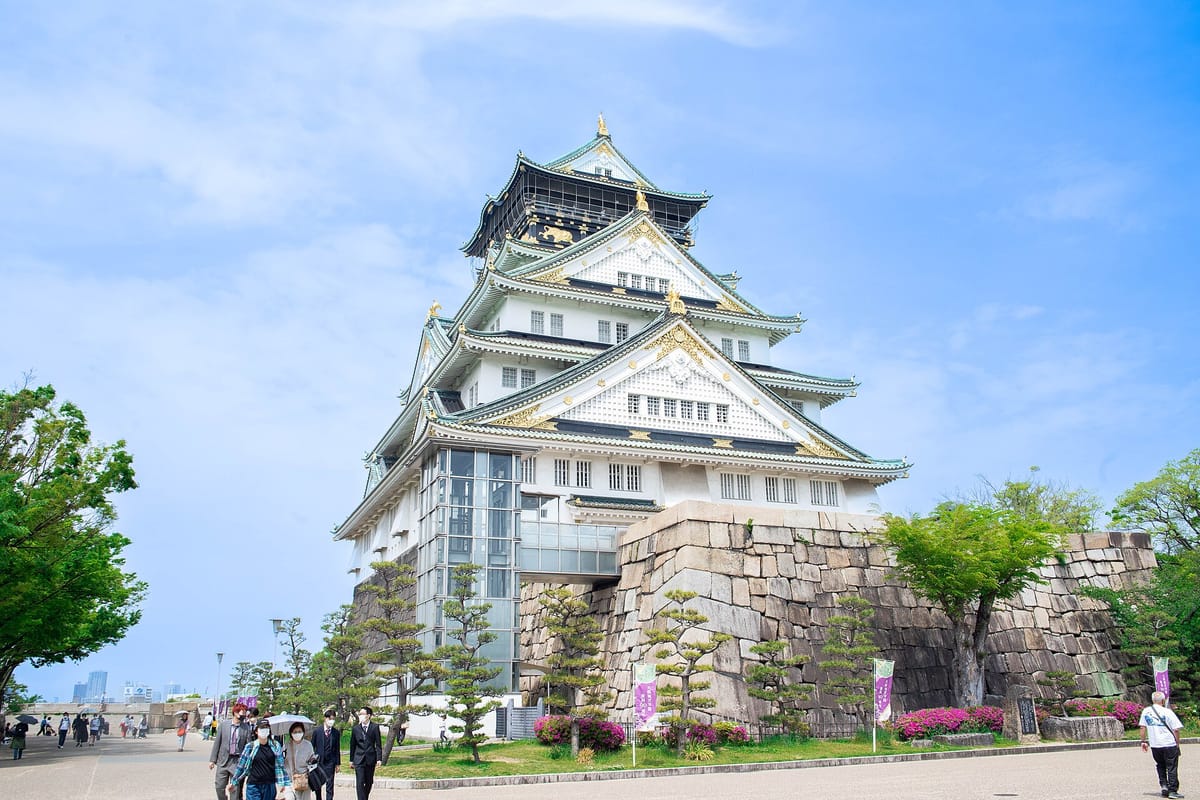
Osaka Castle stands for one of the great turning points in Japanese history. Toyotomi Hideyoshi, who unified the country at the end of the Warring States period, began building it in 1583 on the site of a fortified temple, and made it the largest castle of its time. After his death the Tokugawa clan besieged it in the winter and summer campaigns of 1614 and 1615, destroyed it, and ended the Toyotomi line. The Tokugawa then buried Hideyoshi's castle and built a new one on top, with even larger stone walls.
The main tower burned after a lightning strike in 1665, and for more than two and a half centuries the castle had no keep at all. In 1931 the people of Osaka paid for a new one through public donations, and that reinforced-concrete tower survived the air raids of the Second World War. Inside it is a museum rather than a period interior, which makes it one of the easiest castles in Japan to visit, with a lift and clear displays.
For a learner, it is a good place to meet the vocabulary of castles: tenshukaku, the main tower; ishigaki, stone walls; hori, moats; mon, gates. The same words appear at every castle in Japan, from Himeji to Matsumoto.
Getting there: Tanimachi Yonchōme, Osakajōkōen and Morinomiya
The classic approach is from the south-west. Take the Osaka Metro Tanimachi or Chūō Line to Tanimachi Yonchōme Station and walk a few minutes to the Ōtemon gate, the castle's traditional main entrance. From there you pass through the gates in the order an Edo-period visitor would have done, which is the best way to feel how the defences worked.
From Osaka Station, the JR Osaka Loop Line takes you to Osakajōkōen Station, Osaka Castle Park Station, in about ten minutes. You enter the park from the east, near the Osaka-Jo Hall and the JO-TERRACE restaurants, and walk around to the Honmaru, the central enclosure where the tower stands. Morinomiya Station, on the Loop Line and two subway lines, is closer to the south-east corner, and Temmabashi Station on the Keihan line to the north-west.
| Japanese | Romaji | Meaning |
|---|---|---|
| 大手門はどちらですか。 | Ōtemon wa dochira desu ka. | Which way is the Ōtemon gate? |
| 天守閣まで歩いて何分くらいですか。 | Tenshukaku made aruite nanpun kurai desu ka. | About how many minutes' walk is it to the main tower? |
| 大阪城公園駅に行くのは何番線ですか。 | Ōsakajōkōen-eki ni iku no wa nanbansen desu ka. | Which platform is for Osakajōkōen Station? |
| 谷町四丁目駅は近いですか。 | Tanimachi Yonchōme-eki wa chikai desu ka. | Is Tanimachi Yonchōme Station close? |
| 帰りは森ノ宮駅から乗れますか。 | Kaeri wa Morinomiya-eki kara noremasu ka. | Can I take the train back from Morinomiya Station? |
From the Ōtemon gate to the eighth floor: what you will see
Through the Ōtemon gate you enter a square walled courtyard, a masugata, designed to trap attackers, and then climb towards the Sakuramon gate. Just inside it, set into the wall, is the Takoishi, the octopus stone, one of the largest stones in any Japanese castle wall. Beyond lies the Honmaru, the inner enclosure, with the main tower at its centre.
The tower's lower floors hold the museum: models and screens of Hideyoshi's original castle, armour, letters and a detailed retelling of the Summer Siege of Osaka. The eighth floor is the observation deck, an open walkway around the tower with views over the park and the city. Nearby, the Toyotomi stone wall museum, opened in 2025, shows a section of Hideyoshi's original stone wall that the Tokugawa had buried under their own castle. It is included with the main tower ticket.
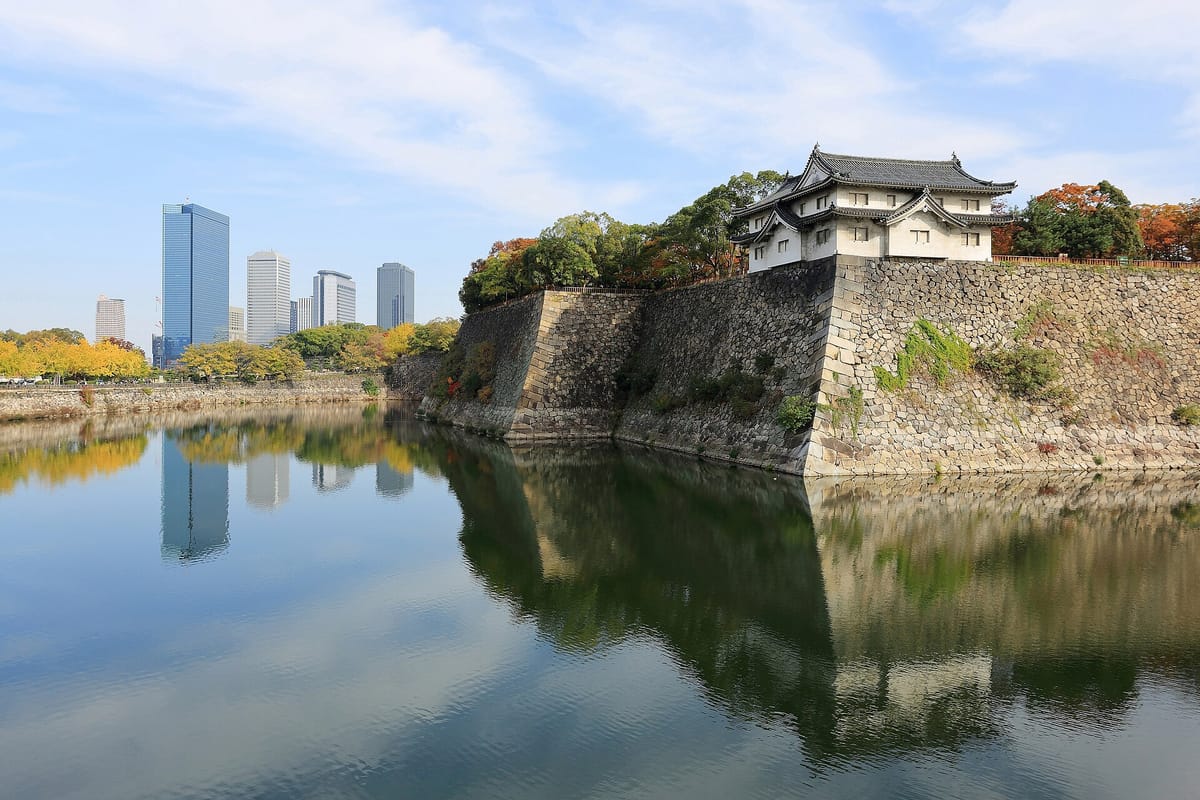
- Ōtemon: the main gate in the south-west, and the start of the classic route.
- Sakuramon and the Takoishi: the gate to the Honmaru and the giant stone beside it.
- Tenshukaku: the main tower museum, with the observation deck on the eighth floor.
- Toyotomi stone wall museum: Hideyoshi's buried stone wall, shown underground.
- Nishinomaru Garden: a lawn garden in the western enclosure with a view up to the tower, famous for cherry blossom; separate ticket.
- Hōkoku Shrine: the shrine to Hideyoshi near the south of the park.
- The moats: walk the outer path for the finest views of the stone walls, or take the gozabune pleasure boat on the inner moat when it is running.
Castle words on the signs
Castle signs are compact and repeat the same building blocks. 門, mon, is a gate, and it combines with a name: 大手門, Ōtemon, the main gate, and 桜門, Sakuramon, the cherry gate. 丸, maru, is an enclosure of the castle: 本丸, Honmaru, the inner one, and 西の丸, Nishinomaru, the western one. With these few pieces you can read the park map at the entrance.
At the tower itself, look for 入場券, nyūjōken, admission ticket, above the ticket windows and machines, and 展望台, tenbōdai, observation deck, on the floor guide inside.
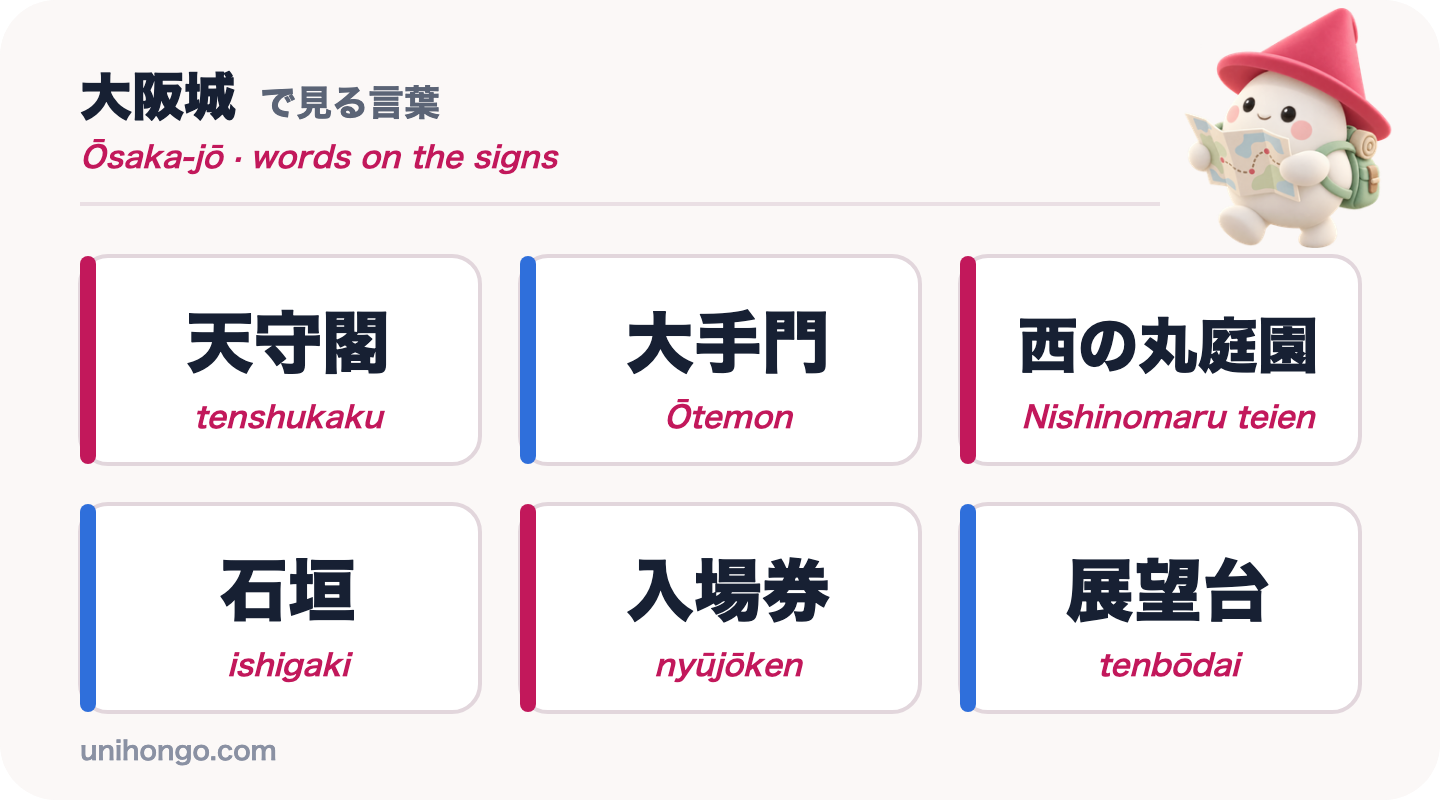
| Word | Reading | Meaning |
|---|---|---|
| 天守閣 | tenshukaku | Main tower of the castle |
| 大手門 | Ōtemon | Main gate, the traditional front entrance |
| 本丸 | Honmaru | Inner enclosure where the tower stands |
| 西の丸庭園 | Nishinomaru teien | Garden in the western enclosure |
| 石垣 | ishigaki | Stone wall |
| 堀 | hori | Moat |
| 蛸石 | Takoishi | The octopus stone, the giant stone by the Sakuramon gate |
| 入場券 | nyūjōken | Admission ticket |
| 展望台 | tenbōdai | Observation deck |
Japanese at the ticket window and inside the tower
The main tower has ticket machines and staffed windows near the entrance, and on busy days a queue forms outside. Tickets can also be bought online in advance. Inside, a lift and stairs link the floors, and the museum follows a set route, junro, marked with arrows.
Staff at the tower use polite service Japanese, so expect o-susumi kudasai, please go ahead, and dōzo, please. Your own sentences can be short and simple.
| Japanese | Romaji | Meaning |
|---|---|---|
| 大人二枚お願いします。 | Otona nimai onegai shimasu. | Two adults, please. |
| 西の丸庭園は別のチケットですか。 | Nishinomaru teien wa betsu no chiketto desu ka. | Is the Nishinomaru Garden a separate ticket? |
| エレベーターはどこですか。 | Erebētā wa doko desu ka. | Where is the lift? |
| コインロッカーはありますか。 | Koin rokkā wa arimasu ka. | Are there coin lockers? |
| 英語のパンフレットはありますか。 | Eigo no panfuretto wa arimasu ka. | Do you have a leaflet in English? |
| ここで写真を撮ってもいいですか。 | Koko de shashin o totte mo ii desu ka. | May I take photos here? |
Etiquette, timing and practical tips
Osaka Castle Park is large and open, and a little planning makes the day easier.
- Arrive early, especially at weekends and in cherry blossom season from late March to early April, when both the park and the tower are crowded.
- Wear comfortable shoes: from Ōtemon to the tower is an uphill walk on gravel and stone.
- Photography rules can differ between museum rooms and special exhibitions; follow the signs, and ask if you are unsure.
- Do not climb on the stone walls or lean over the moat railings.
- In summer, carry water and a hat: the Honmaru has little shade.
- The observation deck is narrow; take your photos and move along so others can reach the railing.
Practise the visit before you go
This exchange covers the two things everyone does at the tower: buy a ticket and find the view. Listen for hachikai, eighth floor, in the reply. Floors use the counter kai, and a few numbers change their sound with it: sangai for the third floor and nangai for which floor.
Then practise with a partner who replies at natural speed. In Unihongo, choose the Sightseeing topic and ask your AI Sensei to play the ticket attendant, or a local in the park who gives you directions to the Ōtemon gate. Saying the lines once before you arrive makes them easy on the day.
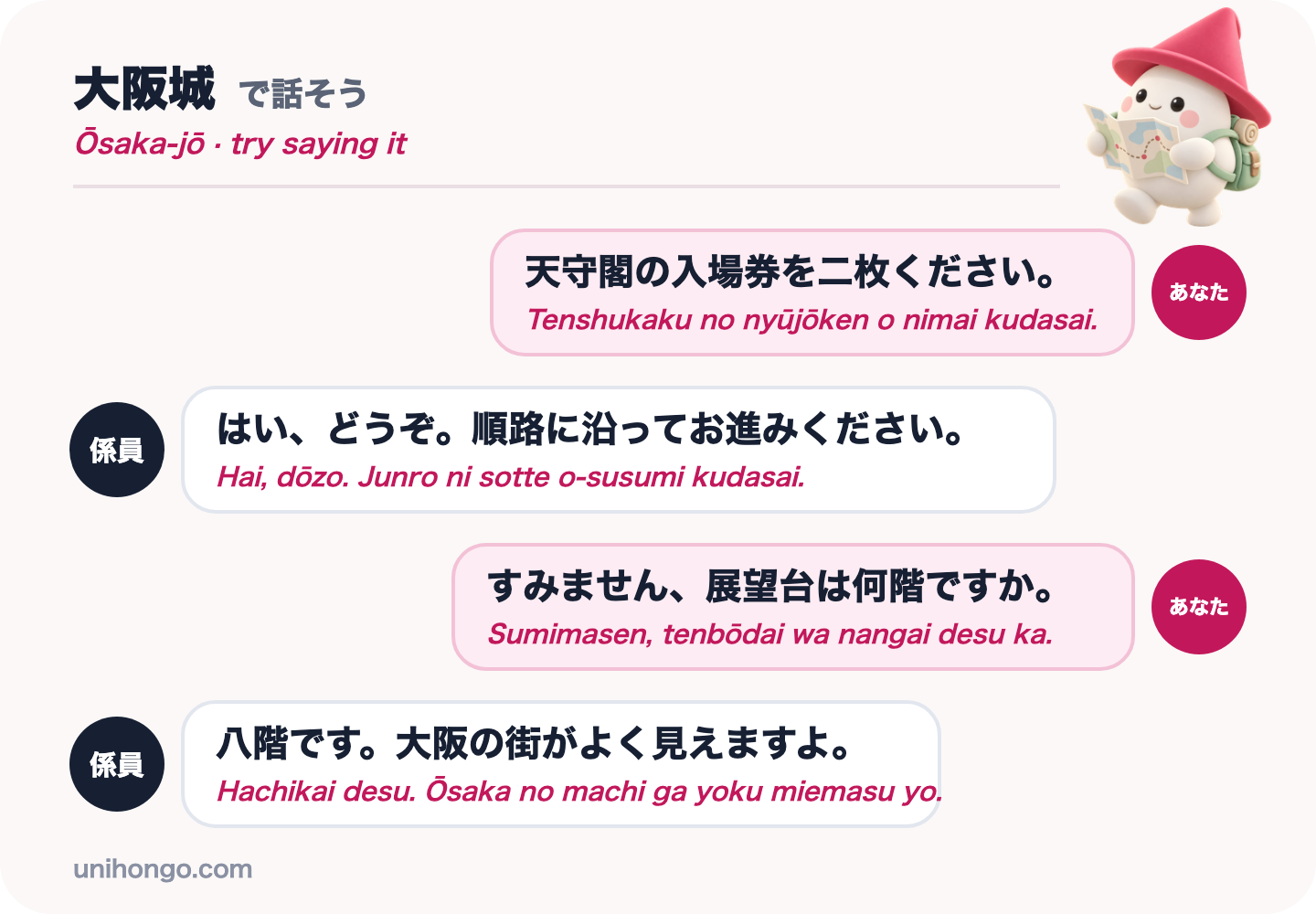
| Japanese | Romaji | Meaning |
|---|---|---|
| 天守閣の入場券を二枚ください。 | Tenshukaku no nyūjōken o nimai kudasai. | Two tickets for the main tower, please. |
| はい、どうぞ。順路に沿ってお進みください。 | Hai, dōzo. Junro ni sotte o-susumi kudasai. | Here you are. Please follow the marked route. |
| すみません、展望台は何階ですか。 | Sumimasen, tenbōdai wa nangai desu ka. | Excuse me, which floor is the observation deck on? |
| 八階です。大阪の街がよく見えますよ。 | Hachikai desu. Ōsaka no machi ga yoku miemasu yo. | The eighth floor. You get a good view of Osaka. |
Official information
Fees, opening hours, special exhibitions and closures of the main tower are published on its official site, and the park's own site lists events that can affect crowds. Check before you go.