

Why the Umeda Sky Building is Osaka's favourite view
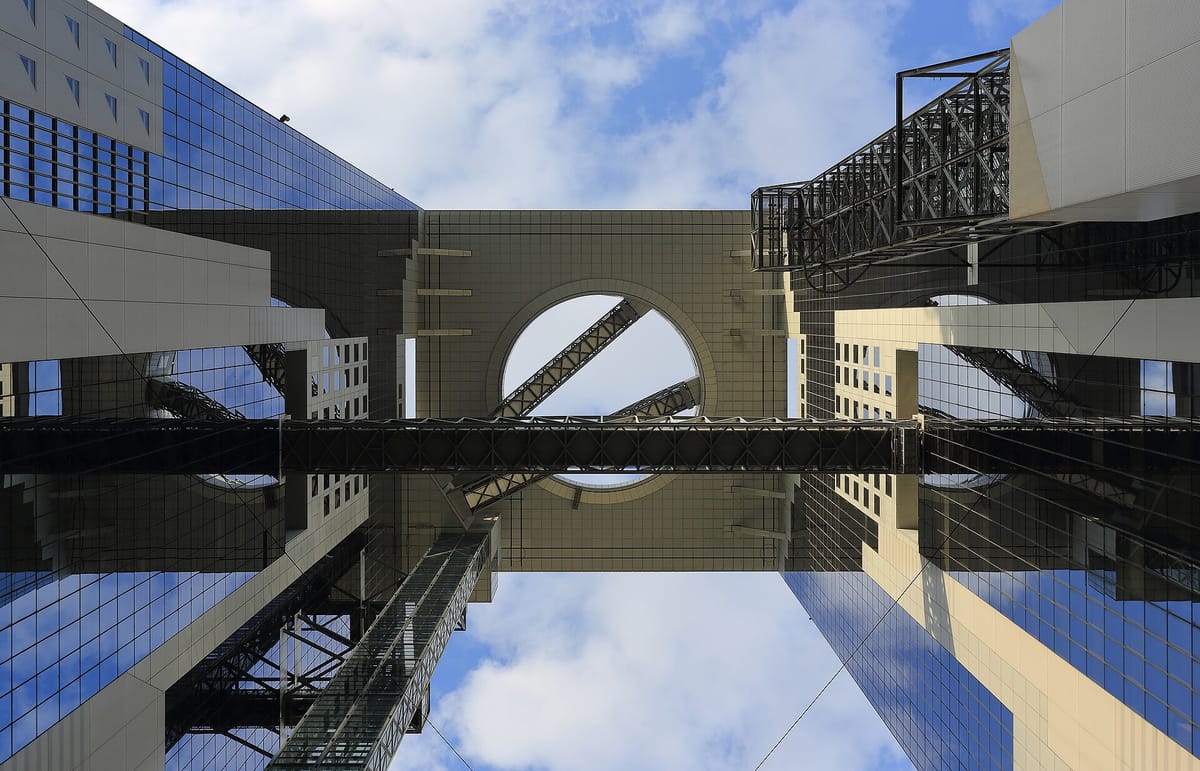
Most observation decks are the top of a single tall tower. The Umeda Sky Building is different: two 40-storey towers stand side by side and are joined at the top by the Kūchū Teien, a circular observatory with a hole in the middle that frames the sky. Completed in 1993 and designed by Hara Hiroshi, who also designed Kyoto Station, it looks like a gateway, and many people think it is the most striking building in Osaka.
The observatory covers the 39th and 40th floors, with a café and indoor viewing areas, and above them the open-air rooftop deck at 173 metres. Up there you walk a ring around the roof with a full 360-degree view: the Yodo River curving past to the north, Osaka Castle and the Ikoma mountains to the east, and Osaka Bay and the Rokkō mountains to the west on a clear day.
For a learner, a viewing deck is a good place to practise talking about what you see: directions, big and small, near and far, and the word everyone in Japan uses about a city at night, yakei.
Getting there: the walk from Osaka and Umeda stations
The building is in the Umeda district, north-west of JR Osaka Station. The usual route takes you out of the station's north side, past the Grand Front Osaka complex, and then through an underground passage that runs beneath the railway tracks; signs for 梅田スカイビル appear along the way. Allow about ten minutes on foot.
The same route works from Hankyū Osaka-Umeda Station and from Umeda Station on the Osaka Metro Midōsuji Line, both of which connect to the Osaka Station area underground. Umeda's underground malls are famous for confusing visitors, so ask for directions rather than guessing; most people know the Sky Building by name.
| Japanese | Romaji | Meaning |
|---|---|---|
| 梅田スカイビルはどちらですか。 | Umeda Sukai Biru wa dochira desu ka. | Which way is the Umeda Sky Building? |
| 北口はどこですか。 | Kitaguchi wa doko desu ka. | Where is the north exit? |
| 地下道を通って行けますか。 | Chikadō o tōtte ikemasu ka. | Can I go through the underground passage? |
| この道で合っていますか。 | Kono michi de atte imasu ka. | Am I on the right way? |
| 大阪駅に戻るにはどう行けばいいですか。 | Ōsaka-eki ni modoru ni wa dō ikeba ii desu ka. | How do I get back to Osaka Station? |
From the escalator tube to the rooftop: what you will see
The journey up is part of the fun. A lift from the lower floors takes you to the 35th floor, and from there an escalator carries you through a glass tube across the open space between the towers to the 39th floor. If you do not like heights, look straight ahead; if you do, it is one of the best photos in Osaka.
On the 39th and 40th floors you find the indoor observatory, a café and a shop. Stairs lead up to the rooftop, where a circular walkway, the Sky Walk, runs around the edge. After dark its floor lights up, and the whole city spreads out below you. Back on the ground floor, take the stairs down to Takimi Kōji, a basement street built to look like Osaka in the early Shōwa era, with lanterns, wooden shopfronts and small restaurants serving okonomiyaki, kushikatsu and other local food.
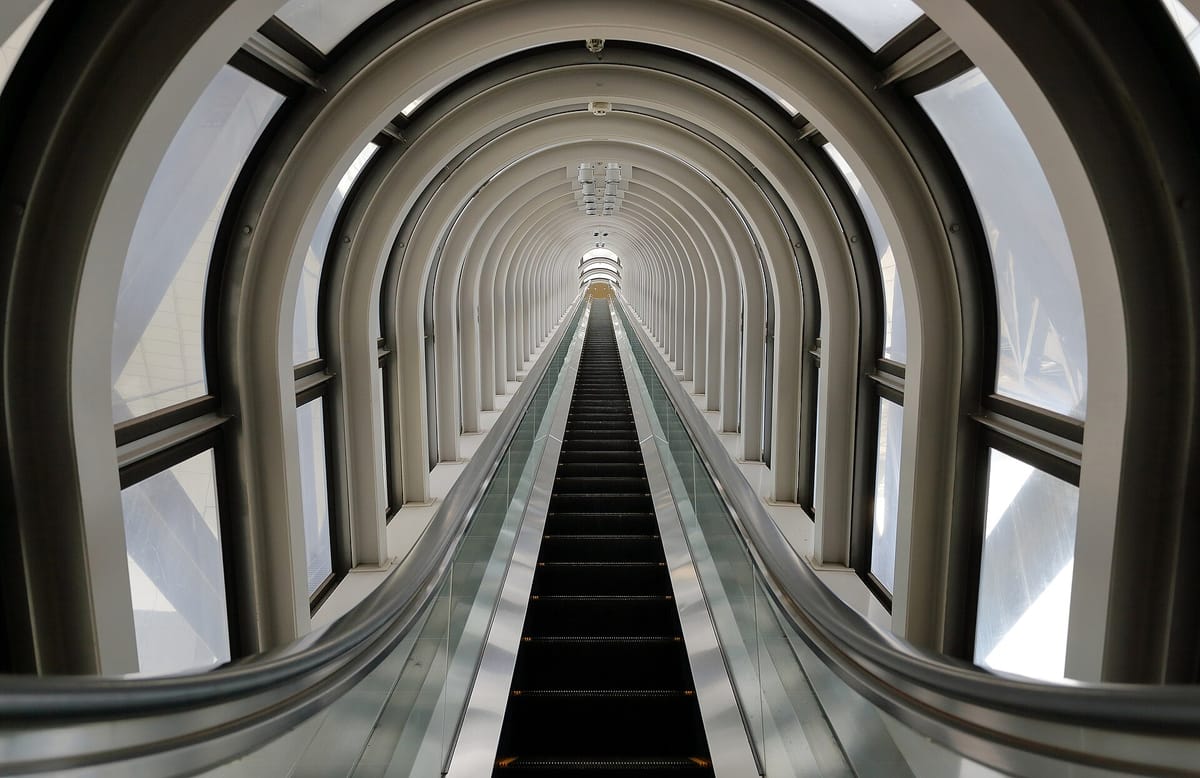
- The escalator tube: from the 35th to the 39th floor across the gap between the towers.
- Kūchū Teien observatory: indoor viewing on the 39th and 40th floors.
- The rooftop Sky Walk: the open-air circular deck at 173 metres.
- Sunset over the west: towards Osaka Bay and the Rokkō mountains.
- Takimi Kōji: the retro restaurant street in the basement.
- The garden at the foot of the towers: a small green space for a break before or after.
Words on the signs
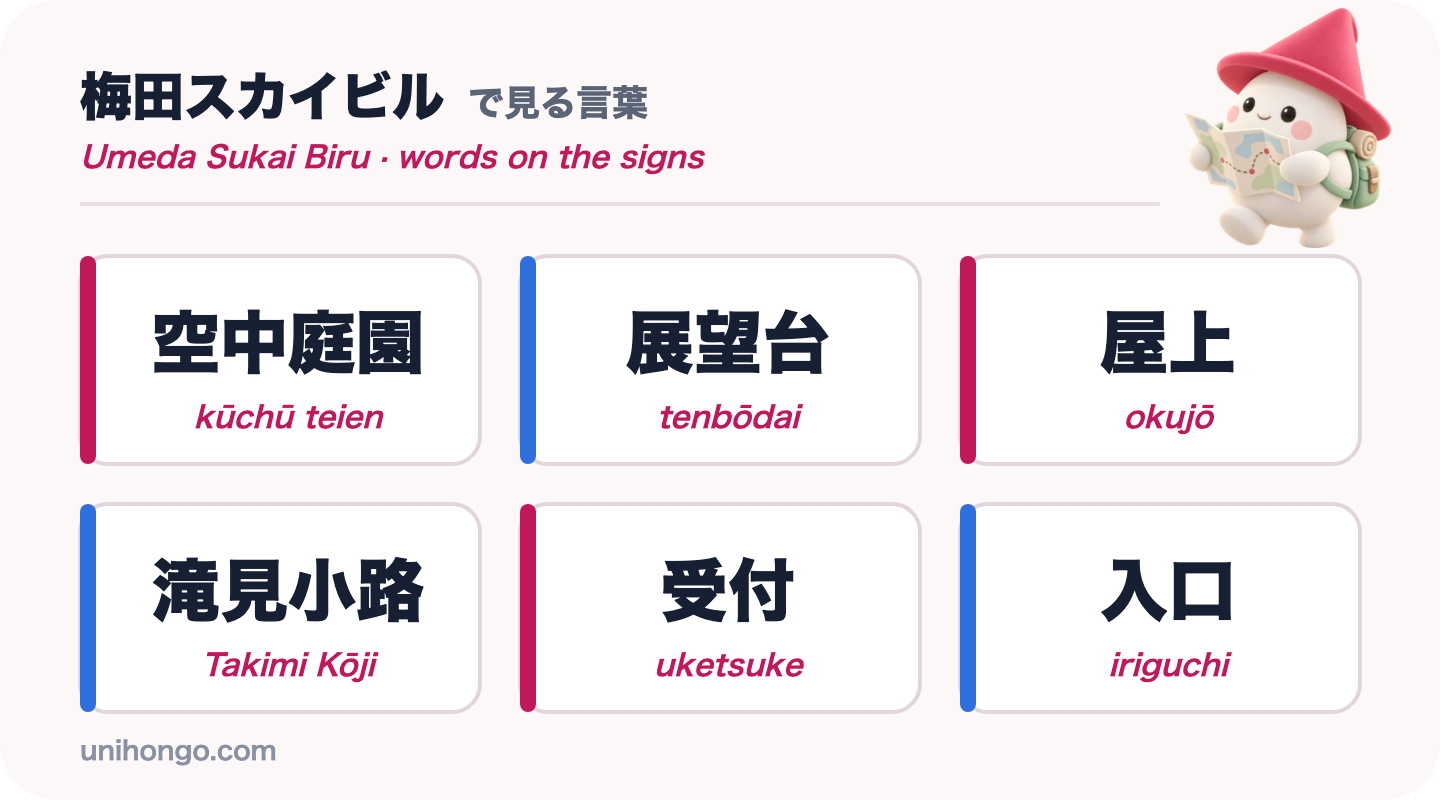
The building's signs are clear and mostly bilingual, but the Japanese words are worth learning because you will meet them at every observatory in Japan. 展望台, tenbōdai, observation deck, and 屋上, okujō, rooftop, are the two you need to find the view. 受付, uketsuke, reception, is where you show or buy your ticket.
Floors are written with the number and 階, kai or gai: 三十九階 is the 39th floor, sanjūkyū-kai, and 地下一階, chika ikkai, is the first basement.
| Word | Reading | Meaning |
|---|---|---|
| 空中庭園 | kūchū teien | Floating Garden, the observatory |
| 展望台 | tenbōdai | Observation deck |
| 屋上 | okujō | Rooftop |
| 滝見小路 | Takimi Kōji | The retro restaurant street in the basement |
| 受付 | uketsuke | Reception |
| 入口 | iriguchi | Entrance |
| 地下 | chika | Underground, basement |
| 夜景 | yakei | Night view |
Japanese for tickets and talking about the view
At the observatory the language is simple: buy a ticket, find the rooftop, and share what you see. Most of the fun Japanese here is description. Kirei, beautiful; ōkii, big; tōku, far; and mieru, can be seen, will carry you through most conversations on the deck.
Osaka people may also describe the view in dialect. Meccha kirei, really beautiful, is Kansai slang that has spread to young people across Japan; the standard form is totemo kirei.
| Japanese | Romaji | Meaning |
|---|---|---|
| チケットはどこで買えますか。 | Chiketto wa doko de kaemasu ka. | Where can I buy a ticket? |
| 屋上には出られますか。 | Okujō ni wa deraremasu ka. | Can we go out onto the roof? |
| 大阪城はどっちに見えますか。 | Ōsaka-jō wa dotchi ni miemasu ka. | Which direction can you see Osaka Castle in? |
| 今日は日の入りが何時ごろですか。 | Kyō wa hi no iri ga nanji goro desu ka. | About what time is sunset today? |
| 写真を撮っていただけますか。 | Shashin o totte itadakemasu ka. | Could you take a photo of us? |
| めっちゃきれい! | Meccha kirei! | So beautiful! (Kansai slang; standard: totemo kirei) |
Etiquette, timing and practical tips
The Floating Garden is calm and well run; a little timing makes the visit better.
- Arrive about half an hour before sunset to see the city in daylight, at dusk and after dark.
- The rooftop is open-air and windy: bring a layer, and hold on to hats and loose items.
- Take your photos and move along the railing so others can see.
- Tripods and large equipment may be restricted; check the rules before you bring them.
- Check the weather: low cloud or heavy rain can hide the view and may close the rooftop.
- Save dinner for Takimi Kōji in the basement, or eat first and come up for the night view.
Practise the directions before you go
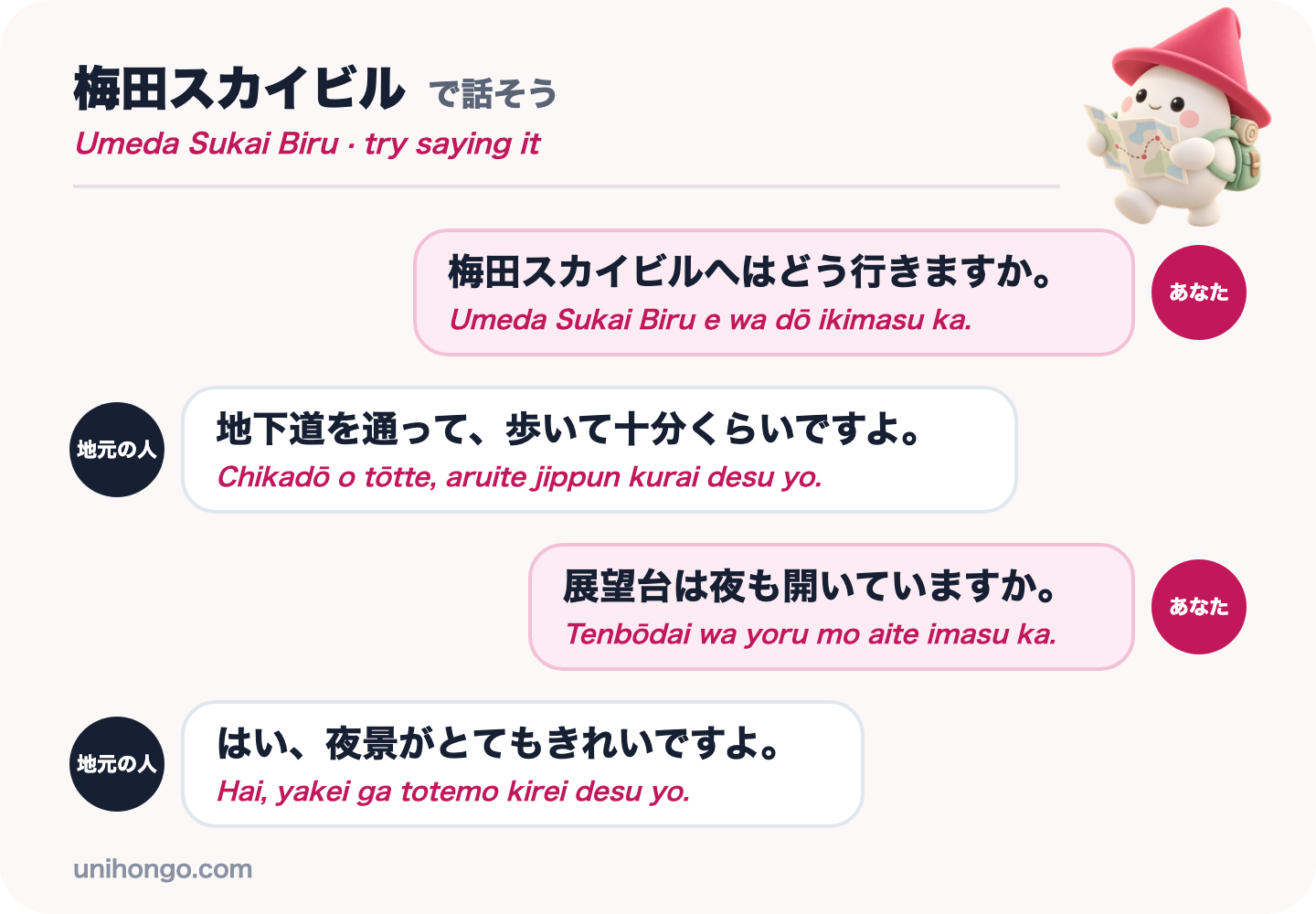
Finding the building is the hardest part of the visit, so this exchange starts with directions. Listen for chikadō, underground passage, and jippun, ten minutes. Then ask about the evening: aite imasu ka means is it open?
Then practise with a partner who answers back. In Unihongo, choose the Directions topic and ask your AI Sensei to play an Osaka office worker who guides you from the station to the Sky Building, then switch to Sightseeing to chat about the view. One spoken run-through makes the real Umeda underground much less daunting.
| Japanese | Romaji | Meaning |
|---|---|---|
| 梅田スカイビルへはどう行きますか。 | Umeda Sukai Biru e wa dō ikimasu ka. | How do I get to the Umeda Sky Building? |
| 地下道を通って、歩いて十分くらいですよ。 | Chikadō o tōtte, aruite jippun kurai desu yo. | Go through the underground passage; it's about ten minutes on foot. |
| 展望台は夜も開いていますか。 | Tenbōdai wa yoru mo aite imasu ka. | Is the observation deck open at night too? |
| はい、夜景がとてもきれいですよ。 | Hai, yakei ga totemo kirei desu yo. | Yes, and the night view is beautiful. |
Official information
Admission, opening hours and any closures of the rooftop for weather or events are published on the building's official site. Check before you go, especially if you are planning around sunset.