

Why Kamakura is the classic day trip from Tokyo
In 1180 the warlord Minamoto no Yoritomo made Kamakura his base, and a few years later it became the seat of the first shogunate, the warrior government that ruled Japan until 1333. Temples, shrines and narrow mountain passes from that age are still scattered through the valleys, which is why Kamakura is sometimes called the Kyoto of eastern Japan.
Today it is a relaxed coastal town with surfers on the beach and shops selling pickles, sweets and whitebait along the old streets. The big three sights sit at two ends of the centre: the Great Buddha and Hase-dera near Hase Station in the west, and Tsurugaoka Hachimangū at the top of Wakamiya-ōji avenue near Kamakura Station. The Enoden, a small train that trundles along the coast, ties them together.
For a Japanese learner Kamakura is ideal because everything is close, signposted and repeated. You read 大仏 on the bus, 長谷 on the Enoden and 八幡宮 on the stone pillars, and you ask the same two or three questions about the way several times in one day.
Getting there: JR Kamakura Station and the Enoden to Hase
From Tokyo the simplest route is the JR Yokosuka Line, which runs directly from Tokyo Station and Shinagawa to Kamakura Station, Kamakura-eki, in about an hour. From Shinjuku or Shibuya, the JR Shōnan-Shinjuku Line also reaches Kamakura; some trains run through, while others ask you to change at Ōfuna, so check the destination on the platform display.
At Kamakura Station the east exit, higashiguchi, leads to Komachi-dōri, the shopping street that runs to Tsurugaoka Hachimangū, and to Wakamiya-ōji, the broad avenue with the Dankazura path down its middle. For the Great Buddha and Hase-dera, change to the Enoden, the Enoshima Electric Railway, whose Kamakura terminal stands right beside the JR station. Hase Station is three stops along; from there Hase-dera is about five minutes' walk and Kōtoku-in about seven. Local buses from Kamakura Station also stop at Daibutsu-mae, right by the temple.
IC cards such as Suica and Pasmo work on JR, the Enoden and the local buses, so you rarely need to buy a paper ticket. The Enoden is a single-track line with small trains, and on weekends and in June the queue at Kamakura and Hase can be long; walking between Hase and the station along the main road takes about twenty to twenty-five minutes.
| Japanese | Romaji | Meaning |
|---|---|---|
| この電車は鎌倉に止まりますか。 | Kono densha wa Kamakura ni tomarimasu ka. | Does this train stop at Kamakura? |
| 大船で乗り換えですか。 | Ōfuna de norikae desu ka. | Do I change at Ōfuna? |
| 江ノ電の乗り場はどこですか。 | Enoden no noriba wa doko desu ka. | Where do I board the Enoden? |
| 長谷駅は何番目の駅ですか。 | Hase-eki wa nanbanme no eki desu ka. | How many stops along is Hase Station? |
| 大仏まで歩いて何分くらいですか。 | Daibutsu made aruite nanpun kurai desu ka. | About how many minutes on foot to the Great Buddha? |
| 鶴岡八幡宮へはどう行けばいいですか。 | Tsurugaoka Hachimangū e wa dō ikeba ii desu ka. | How do I get to Tsurugaoka Hachimangū? |
The Great Buddha, Hase-dera and Tsurugaoka Hachimangū: what you will see
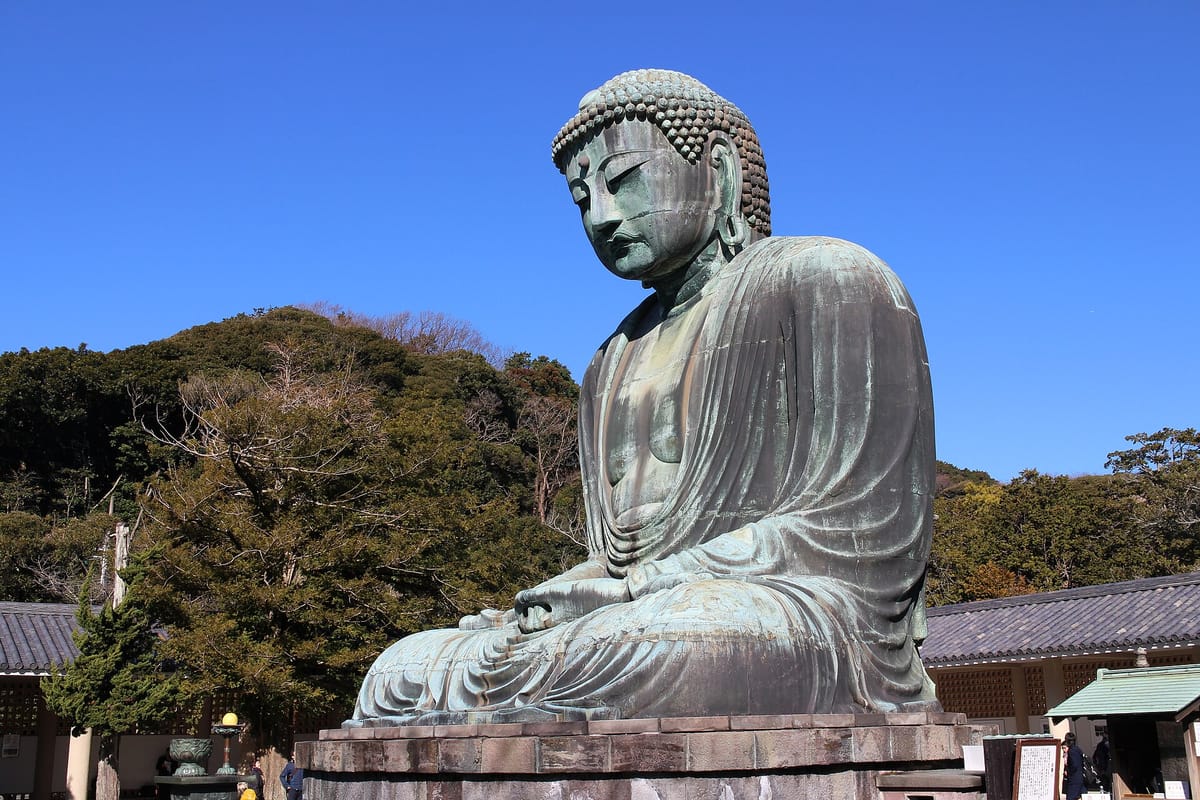
Kōtoku-in's Great Buddha, the Kamakura Daibutsu, is a bronze statue of Amida Buddha a little over eleven metres tall. Casting began in 1252, and the statue originally sat inside a large wooden hall, but storms and a tsunami in the fourteenth and fifteenth centuries destroyed the buildings, and since the late fifteenth century it has sat under the open sky. Walk around to the back to see the two small windows in its back, and pay the small extra fee to step inside the hollow body.
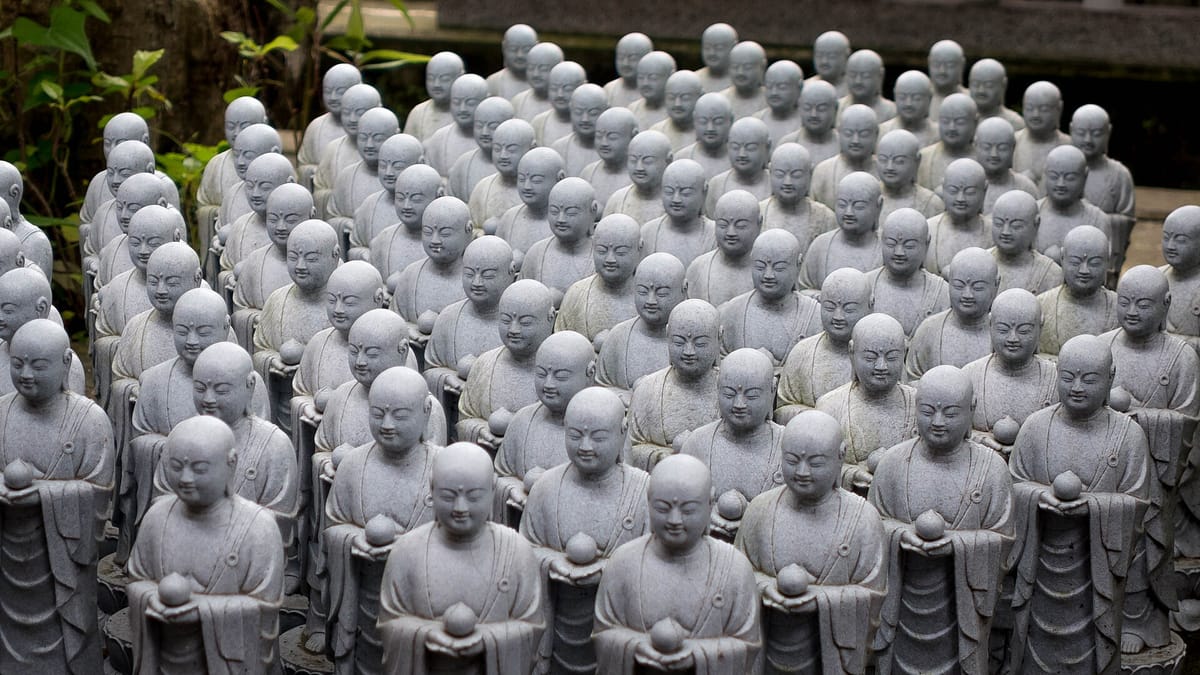
Hase-dera, a few minutes away, climbs a hillside in terraces. Its main hall, the Kannon-dō, holds an eleven-headed Kannon of gilded wood about nine metres tall, one of the largest wooden statues in Japan. Below it, the Jizō-dō is surrounded by hundreds of small stone Jizō left by parents in memory of children, and near the garden ponds the Benten-kutsu is a low cave with figures carved into its walls. From the viewing terrace you look straight over the roofs of Hase to Yuigahama beach and Sagami Bay.
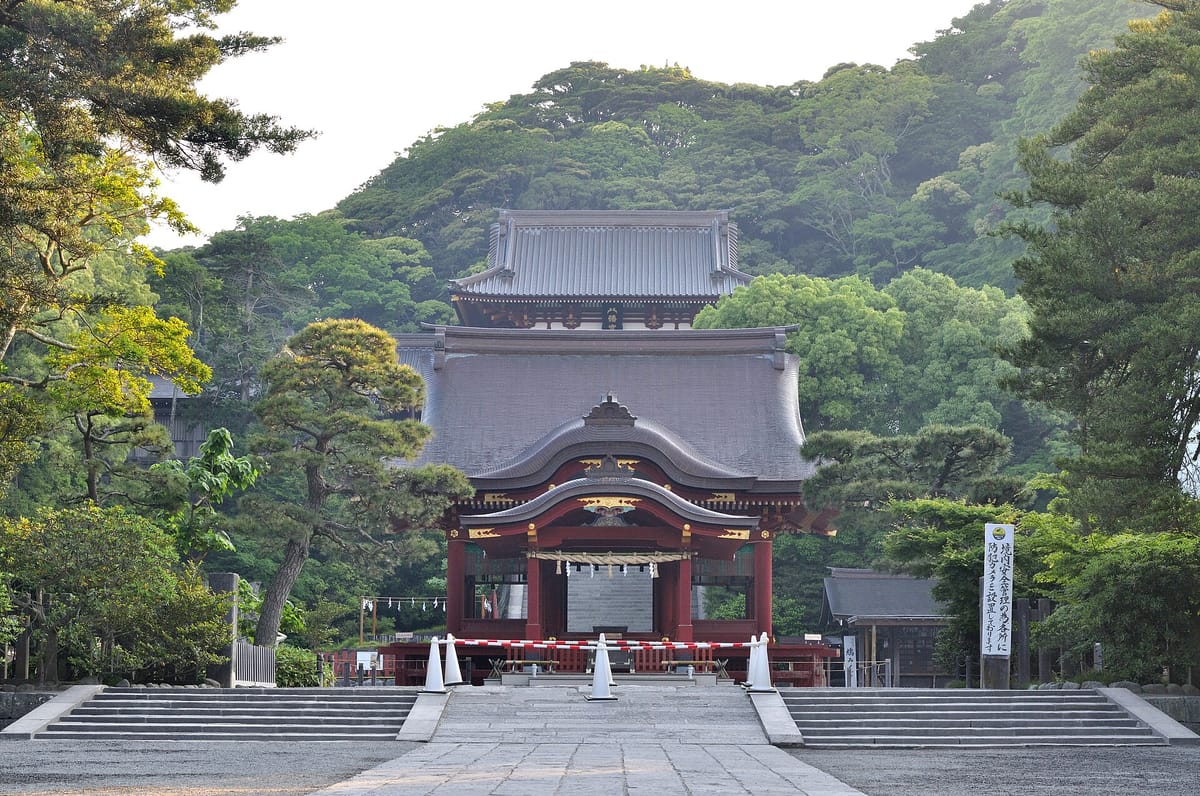
Tsurugaoka Hachimangū is Kamakura's most important shrine. It was founded in 1063 by Minamoto no Yoriyoshi and moved to its present site in 1180 by Yoritomo, and it is dedicated to Hachiman, the patron deity of the Minamoto and of warriors. The approach from the sea is Wakamiya-ōji, with the raised Dankazura path lined with cherry trees down its centre. Inside the grounds, the two Genpei ponds are said to stand for the rival Minamoto and Taira clans, and a broad flight of steps leads to the main hall with its view back down the avenue.
- Kamakura Daibutsu at Kōtoku-in: the open-air bronze Amida Buddha; you can go inside for a small extra fee.
- Hase-dera: the gilded eleven-headed Kannon, the Jizō statues, the Benten-kutsu cave and the sea view.
- Tsurugaoka Hachimangū: the stone steps, the main hall on its terrace, the Maiden stage and the Genpei ponds.
- Dankazura: the raised, tree-lined path down the middle of Wakamiya-ōji, beautiful at cherry blossom time.
- Komachi-dōri: the busy shopping street between Kamakura Station and the shrine, full of snacks and souvenirs.
Temple and shrine words on Kamakura's signs
The signs in Kamakura mix place names with a small set of temple and shrine words. Place names ending in 寺 are temples, read -ji or -dera; names ending in 宮 or 神社 are shrines. Hase-dera and Kōtoku-in both charge a small entry fee, 拝観料, paid at a window by the gate, while Tsurugaoka Hachimangū, like most shrines, is free.
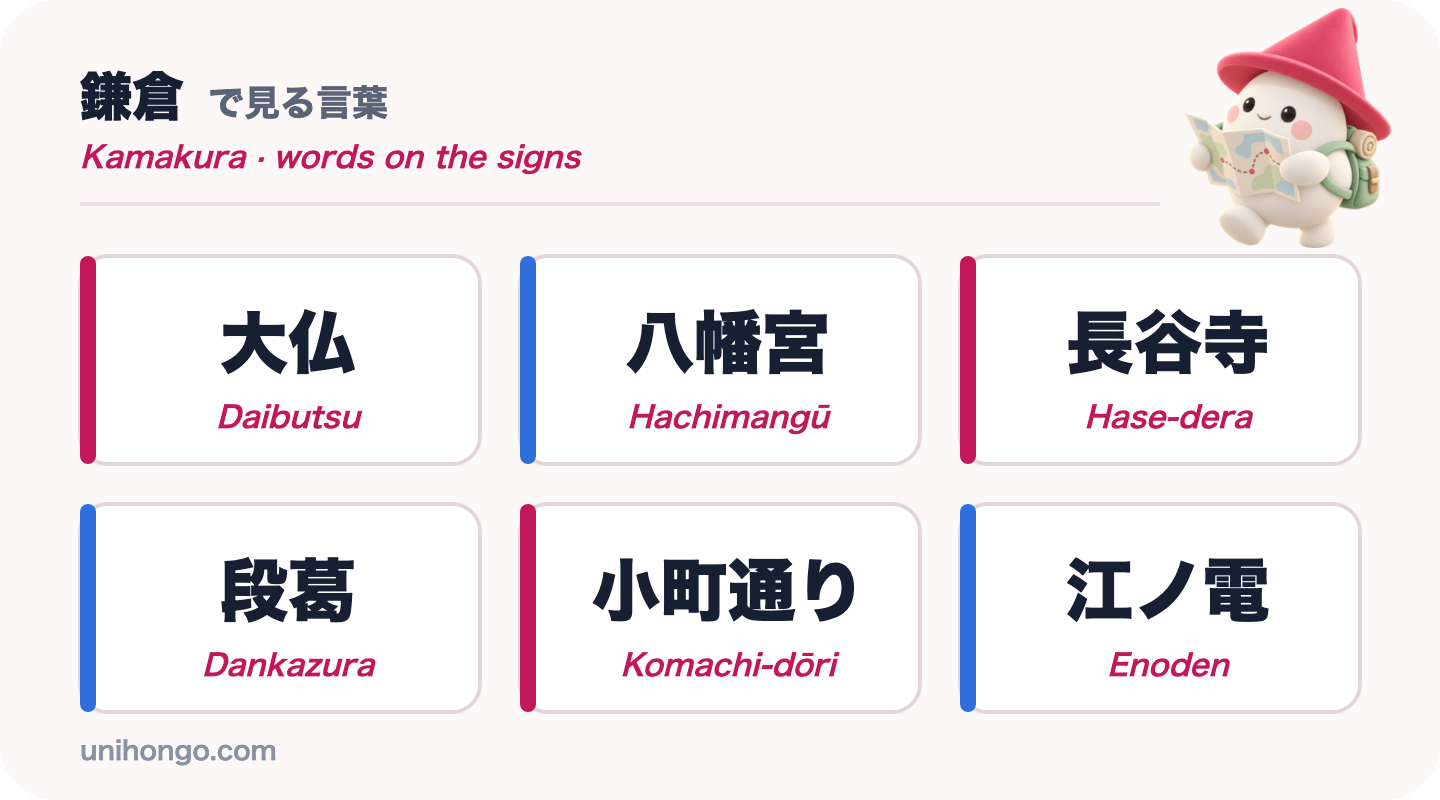
The table below collects the words you meet on the Enoden, on the stone markers and at the temple gates. Learn to recognise 大仏 and 八幡宮 first: between them they point you to half the town.
| Word | Reading | Meaning |
|---|---|---|
| 大仏 | Daibutsu | Great Buddha |
| 高徳院 | Kōtoku-in | The temple that owns the Great Buddha |
| 胎内 | tainai | The interior of the Buddha, literally inside the body |
| 長谷寺 | Hase-dera | Hillside temple of the eleven-headed Kannon |
| 観音堂 | Kannon-dō | Hall of Kannon, the bodhisattva of compassion |
| 八幡宮 | Hachimangū | Shrine to Hachiman, as in Tsurugaoka Hachimangū |
| 段葛 | Dankazura | Raised path down the middle of Wakamiya-ōji |
| 源平池 | Genpei-ike | The two ponds at the shrine entrance |
| 小町通り | Komachi-dōri | Shopping street from the station to the shrine |
| 江ノ電 | Enoden | The Enoshima Electric Railway |
| 拝観料 | haikanryō | Admission fee at a temple |
Japanese for temple tickets, the Buddha's interior and a shirasu lunch
At Kōtoku-in and Hase-dera you buy a ticket at the gate before you enter. Staff are used to visitors, but a short, polite sentence makes the exchange smooth, and the interior of the Great Buddha has its own small fee. Shrines and temples also sell omamori charms and write goshuin, the calligraphy stamps that collectors gather in a special book; Kamakura has enough of both to fill several pages in a day.
Lunch is the other conversation you will have. Kamakura and the coast towards Enoshima are known for shirasu, tiny whitebait, served over rice as shirasu-don, either boiled, kama-age, or raw, nama, when the catch allows. Raw shirasu depends on the season and the day's fishing, so it is worth asking.
| Japanese | Romaji | Meaning |
|---|---|---|
| 大人二枚お願いします。 | Otona nimai onegai shimasu. | Two adults, please. |
| 大仏の中に入れますか。 | Daibutsu no naka ni hairemasu ka. | Can I go inside the Great Buddha? |
| ここで写真を撮ってもいいですか。 | Koko de shashin o totte mo ii desu ka. | May I take photos here? |
| 観音堂はどちらですか。 | Kannon-dō wa dochira desu ka. | Which way is the Kannon hall? |
| 御朱印はどこでいただけますか。 | Goshuin wa doko de itadakemasu ka. | Where can I receive a goshuin? |
| 今日は生しらすがありますか。 | Kyō wa nama-shirasu ga arimasu ka. | Do you have raw whitebait today? |
| しらす丼をひとつお願いします。 | Shirasu-don o hitotsu onegai shimasu. | One shirasu rice bowl, please. |
Etiquette and timing in a busy small town
Kamakura is a residential town that receives a very large number of visitors, and the city and its temples ask for a little care in return. These habits make the day easier for everyone.
- Eat snacks at the stall where you bought them rather than while walking through the crowds on Komachi-dōri, and carry your rubbish with you; public bins are rare.
- Kōtoku-in asks visitors not to eat or drink in the temple grounds.
- Look for 撮影禁止, satsuei kinshi, no photography, especially inside halls with statues; outdoors, photography is usually fine.
- At Tsurugaoka Hachimangū, bow at the torii, rinse your hands at the temizuya, then bow twice, clap twice, pray and bow once at the main hall.
- Keep to the side on the narrow Enoden platforms and let people off the train before you board.
- Arrive before about nine on weekends, or come on a weekday. By late morning the Enoden and Hase are at their busiest, especially in June.
Practise the day before you go
The one question you will certainly ask in Kamakura is how to get to the Great Buddha, and the answer will include a station name, a verb for getting off, orite, and a time in minutes. The four lines below are the whole exchange. Say them aloud until the station names come out without hesitation, and listen for the number in each reply.
Then practise with someone who answers back. In Unihongo, choose the Directions topic or the Ask the Way to the Station mission and ask your AI Sensei to play a station attendant at Kamakura, or choose Sightseeing and ask about Hase-dera and the shrine. Speaking the lines once before the trip is what lets you use them on the platform.
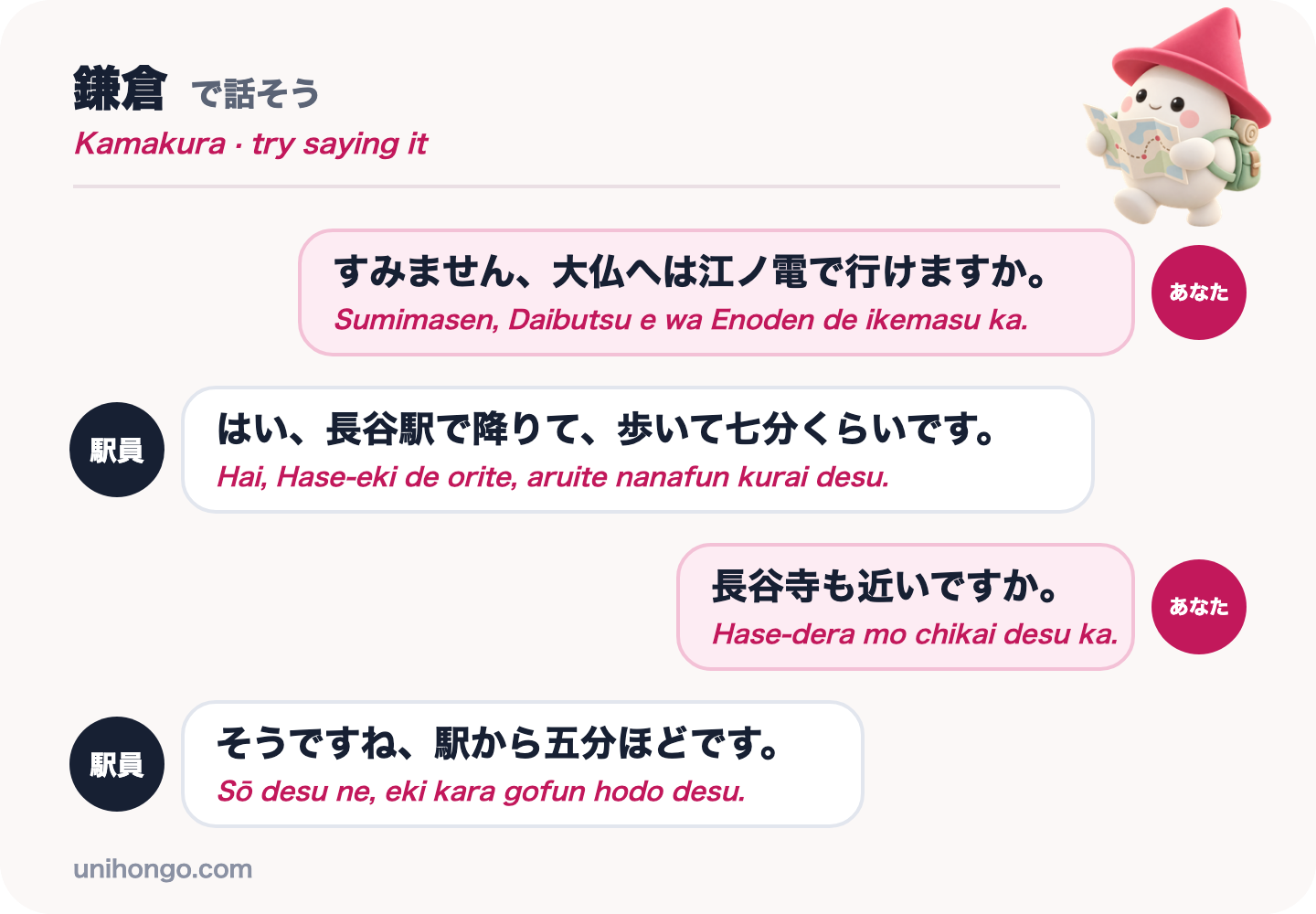
| Japanese | Romaji | Meaning |
|---|---|---|
| すみません、大仏へは江ノ電で行けますか。 | Sumimasen, Daibutsu e wa Enoden de ikemasu ka. | Excuse me, can I get to the Great Buddha on the Enoden? |
| はい、長谷駅で降りて、歩いて七分くらいです。 | Hai, Hase-eki de orite, aruite nanafun kurai desu. | Yes, get off at Hase Station; it is about seven minutes on foot. |
| 長谷寺も近いですか。 | Hase-dera mo chikai desu ka. | Is Hase-dera close too? |
| そうですね、駅から五分ほどです。 | Sō desu ne, eki kara gofun hodo desu. | Yes, it is about five minutes from the station. |
Official information
Hours, the Great Buddha's interior, hydrangea-season arrangements at Hase-dera and festival dates at the shrine all change through the year. Check the official sites before you go, and the Kamakura tourism association's site for seasonal events and crowd information.