

Why Hida Takayama feels like old Japan
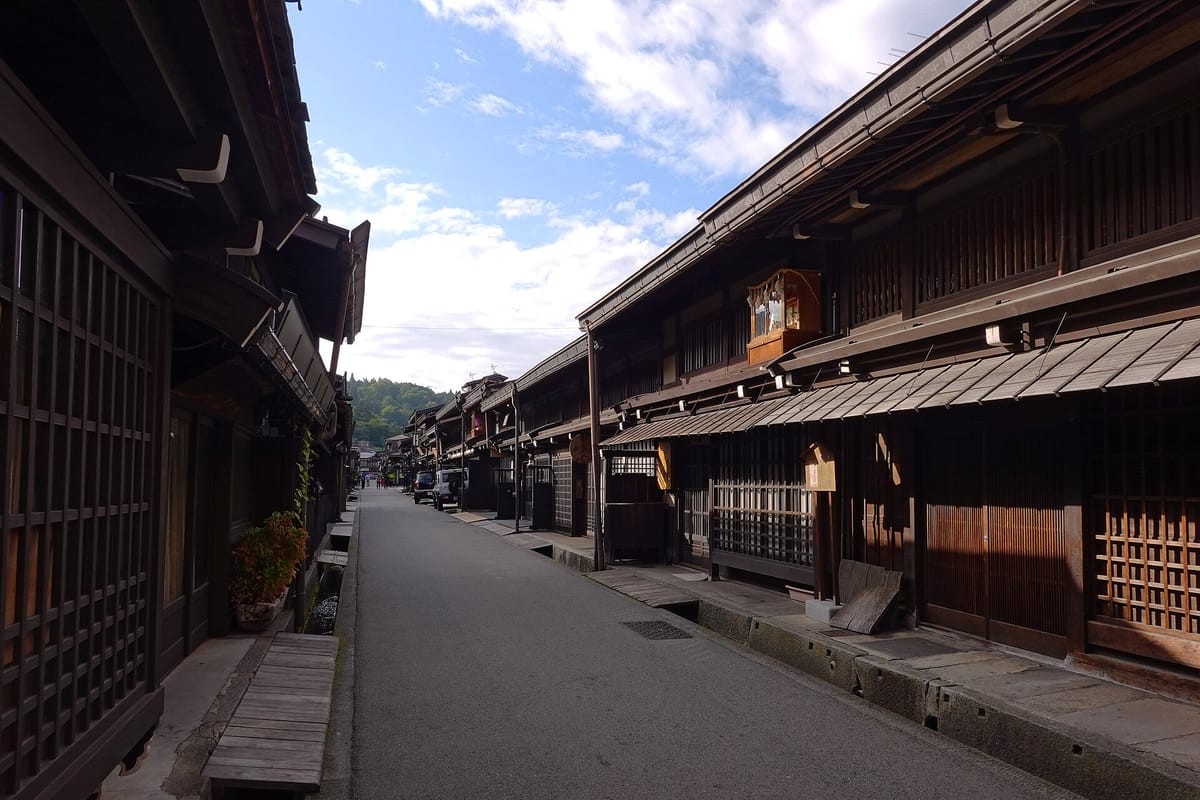
Takayama sits in a basin in the Hida mountains, and for centuries its forests and carpenters were its wealth. The Kanamori family built a castle town here in the late sixteenth century, and in 1692 the shogunate took the area under direct rule for its timber. The merchants who grew rich on that trade built the houses that still line the old town, with dark lattice fronts, low eaves and deep, narrow interiors.
The city today is the largest in Japan by area, stretching all the way to the Northern Alps, but the part visitors see is compact. Sanmachi, the old quarter, is a few blocks east of the station across the Miyagawa river, and almost everything else is within a twenty-minute walk.
For a Japanese learner Takayama is a town of short, friendly exchanges: buying pickles at the market, tasting sake, ordering street food and asking the way. Shopkeepers are used to visitors, and a little Japanese is noticed and appreciated.
Getting there: the Hida limited express and highway buses
Takayama Station is on the JR Takayama Main Line. The Hida limited express runs from Nagoya in about two and a half hours, following the Hida River through a steep, forested gorge; sit on the side facing the river if you can. Some Hida trains also start from Osaka.
The bus centre next to the station has highway buses to and from Shinjuku in Tokyo, Kanazawa, Shirakawa-gō and Matsumoto, and local buses to Hirayu Onsen for Kamikōchi. Buses to Shirakawa-gō should be reserved in advance at busy times.
| Japanese | Romaji | Meaning |
|---|---|---|
| 高山まで、ひだの指定席をお願いします。 | Takayama made, Hida no shiteiseki o onegai shimasu. | A reserved seat on the Hida to Takayama, please. |
| 川が見える席はありますか。 | Kawa ga mieru seki wa arimasu ka. | Is there a seat with a view of the river? |
| 白川郷行きのバスを予約したいです。 | Shirakawa-gō yuki no basu o yoyaku shitai desu. | I'd like to book the bus to Shirakawa-gō. |
| 三町の古い町並みはどちらですか。 | Sanmachi no furui machinami wa dochira desu ka. | Which way is the Sanmachi old town? |
| 飛騨の里へ行くバスはありますか。 | Hida no Sato e iku basu wa arimasu ka. | Is there a bus to the Hida Folk Village? |
From the morning markets to the folk village
Start early at a morning market, walk through Sanmachi as the shops open, visit the Jinya, and in the afternoon take the bus up to the Hida Folk Village. In the evening the old town empties and is lovely to walk through.
- Miyagawa asaichi (宮川朝市): a morning market along the east bank of the Miyagawa river, with vegetables, pickles, miso and crafts.
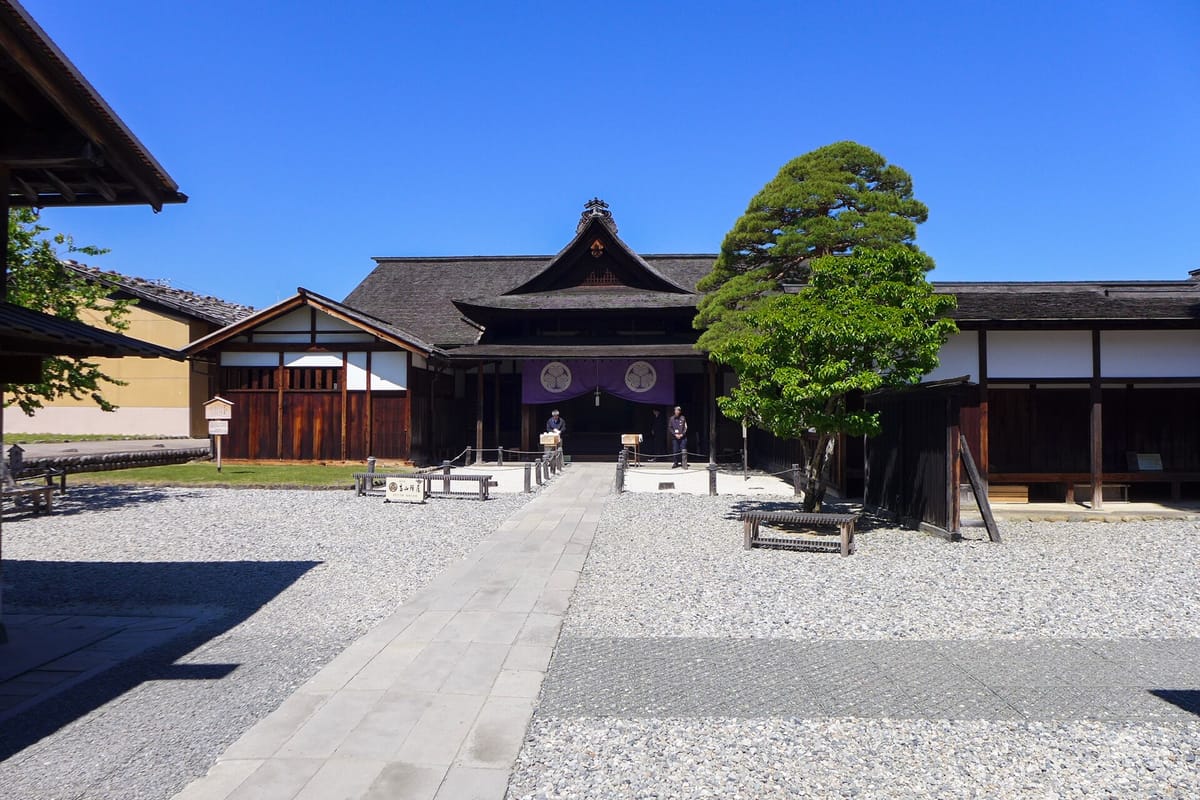
- Jinya-mae asaichi (陣屋前朝市): a smaller morning market in front of the Takayama Jinya.
- Sanmachi (三町): the old merchant quarter, with sake breweries, miso and craft shops, cafés and street food.
- Takayama Jinya (高山陣屋): the magistrate's office, the only one of its kind whose main buildings survive, used as a government office until 1969.
- Festival Floats Exhibition Hall (高山祭屋台会館): part of the Sakurayama Hachimangū grounds, where four of the autumn festival's eleven floats are on display at a time.
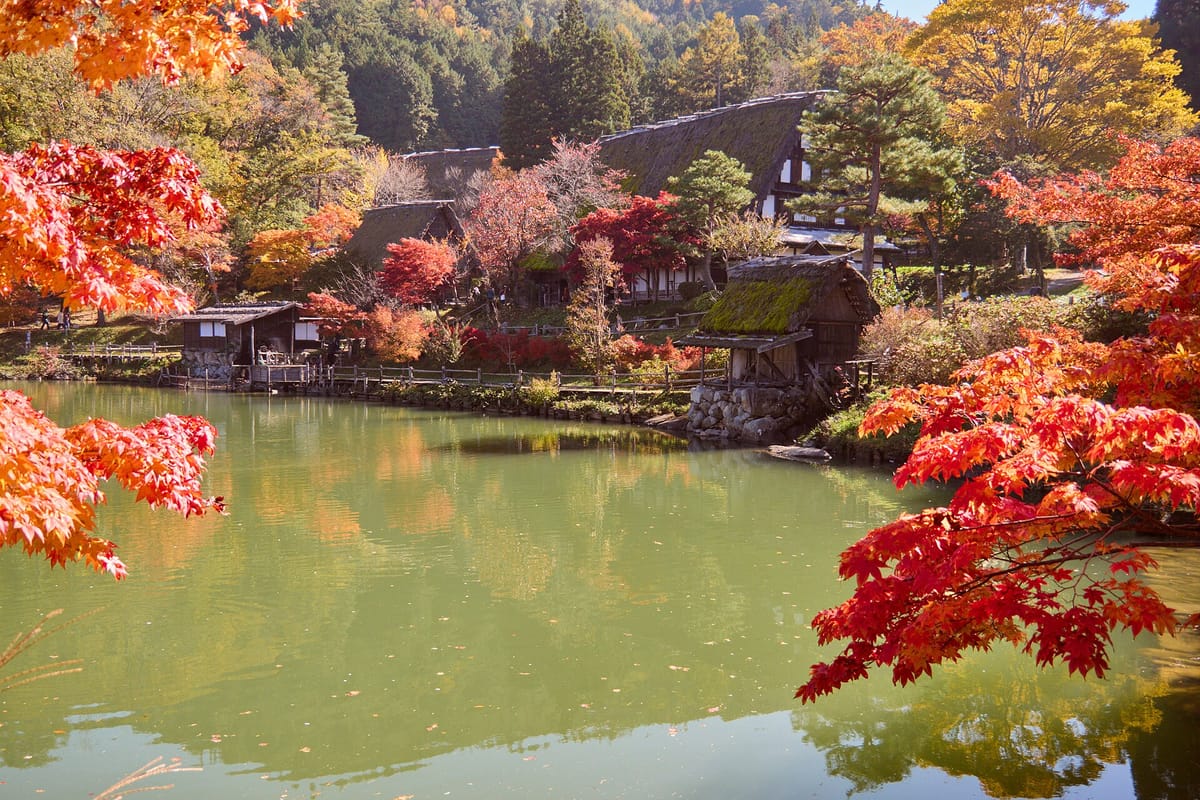
- Hida no Sato (飛騨の里): the Hida Folk Village, an open-air museum of thatched farmhouses, including gasshō-style houses, gathered from around the region.
- Sarubobo (さるぼぼ): the faceless red baby-monkey doll that is Takayama's lucky charm.
Words on the signs in Takayama
In the old town, look up as well as around. A large brown ball of cedar leaves, sugidama, hanging over a doorway marks a sake brewery; it is hung up green when the new sake is pressed and turns brown as the sake matures. Beside it you will often see 試飲, shiin, tasting.
Menus and street stalls use 飛騨牛, Hida-gyū, Hida beef, and 串, kushi, skewer. The kanji 牛 is read gyū in compounds but ushi on its own, as in the cattle you may see on the way into town.
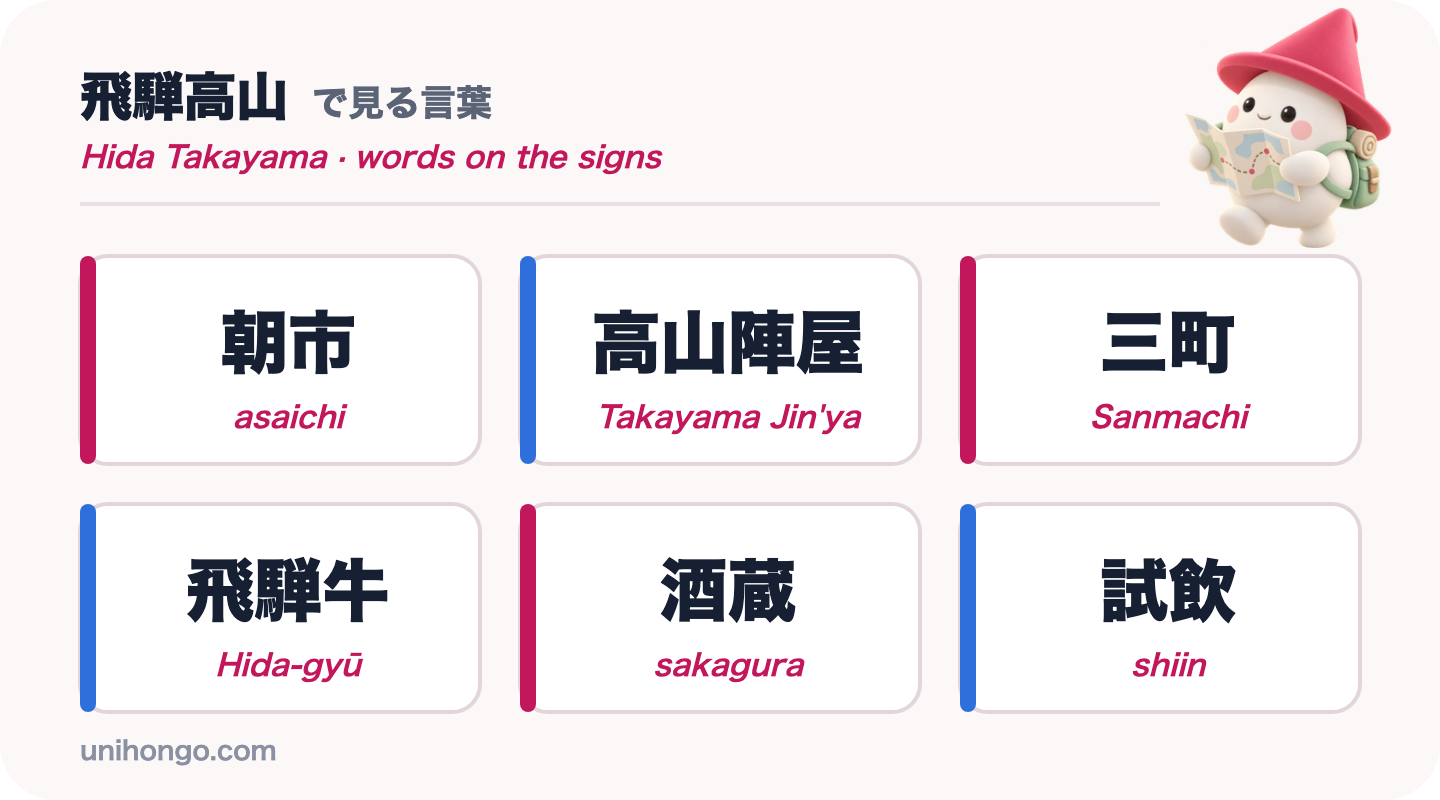
| Word | Reading | Meaning |
|---|---|---|
| 朝市 | asaichi | Morning market |
| 高山陣屋 | Takayama Jin'ya | Takayama Jinya, the old government office |
| 三町 | Sanmachi | The old merchant quarter |
| 飛騨牛 | Hida-gyū | Hida beef |
| 酒蔵 | sakagura | Sake brewery |
| 試飲 | shiin | Tasting |
| 杉玉 | sugidama | Cedar ball hung outside sake breweries |
| 屋台 | yatai | Festival float, also a food stall |
Japanese for sake tasting and Hida beef
Several sake breweries in Sanmachi offer tastings. Some pour a sample for free, while others sell a small cup that lets you try several kinds; either way, the phrases are the same. Sake is described as karakuchi, dry, or amakuchi, sweet, and junmaishu is sake brewed from rice, water and kōji only.
For food, Hida beef is served everywhere from street stalls to formal restaurants. Hōba miso, miso and vegetables grilled on a dried magnolia leaf over a small burner, is the local breakfast in many inns.
| Japanese | Romaji | Meaning |
|---|---|---|
| 辛口と甘口、どちらがおすすめですか。 | Karakuchi to amakuchi, dochira ga osusume desu ka. | Which do you recommend, dry or sweet? |
| この地酒を一本ください。 | Kono jizake o ippon kudasai. | One bottle of this local sake, please. |
| 飛騨牛の握りを二つください。 | Hida-gyū no nigiri o futatsu kudasai. | Two pieces of Hida beef nigiri, please. |
| 朴葉味噌の定食はありますか。 | Hōba miso no teishoku wa arimasu ka. | Do you have a hōba miso set meal? |
| これは何の漬物ですか。 | Kore wa nan no tsukemono desu ka. | What kind of pickle is this? |
| これは飛行機に持ち込めますか。 | Kore wa hikōki ni mochikomemasu ka. | Can I take this on the plane? |
Etiquette, timing and the festivals
The Takayama Festival, held in spring by Hie Shrine and in autumn by Sakurayama Hachimangū, is one of the best known festivals in Japan, and its floats are part of the UNESCO-listed Yama, Hoko, Yatai float festivals. Outside festival days, Takayama is a calm town where life follows the shops' hours.
- Go to a morning market early; stalls start to pack up before midday.
- Most Sanmachi shops close in the late afternoon, so plan dinner and evening walks accordingly.
- Do not walk while eating in the narrow old streets; eat at the stall or step aside.
- At sake tastings, sip and move on; do not drink the samples like a bar.
- Book hotels months ahead for 14 to 15 April and 9 to 10 October, and expect crowds.
- Winters are cold and snowy, but the old town under snow is beautiful and quiet.
- The Hida Folk Village is uphill from the station; take the bus up and walk back if you like.
Practise the sake tasting before you go
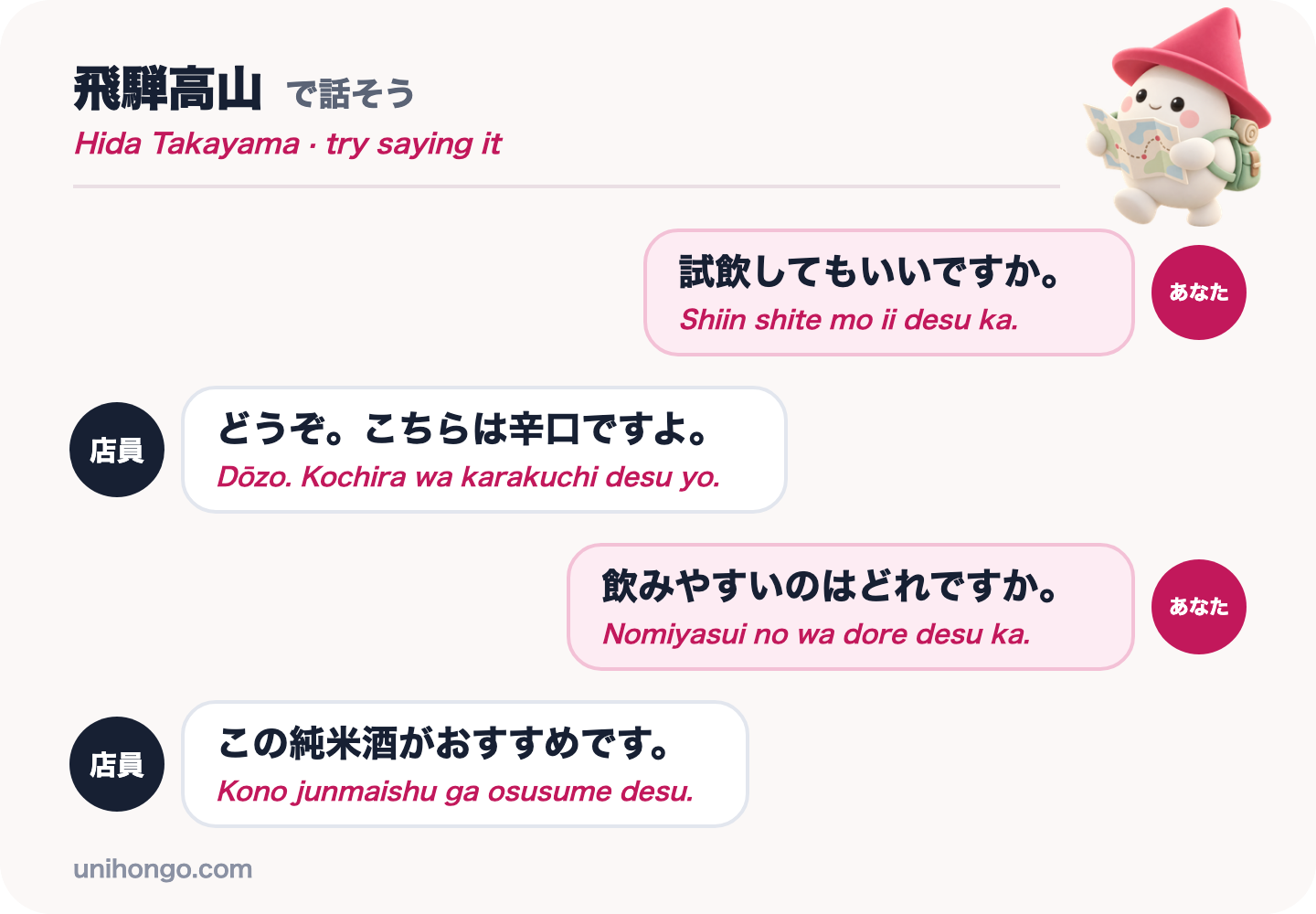
The sake counter is the most fun conversation in Takayama. Staff describe sake as karakuchi or amakuchi, and they will recommend something if you ask what is nomiyasui, easy to drink.
Practise the four lines until you can say them without reading. Then rehearse with a partner who answers back: in Unihongo, choose the Izakaya topic and ask your AI Sensei to play the staff at a Takayama brewery, and try asking about the sweet sake next time.
| Japanese | Romaji | Meaning |
|---|---|---|
| 試飲してもいいですか。 | Shiin shite mo ii desu ka. | May I have a taste? |
| どうぞ。こちらは辛口ですよ。 | Dōzo. Kochira wa karakuchi desu yo. | Go ahead. This one is dry. |
| 飲みやすいのはどれですか。 | Nomiyasui no wa dore desu ka. | Which one is easy to drink? |
| この純米酒がおすすめです。 | Kono junmaishu ga osusume desu. | I recommend this junmai sake. |
Official information
Festival details, sights, access and seasonal events are published on Takayama's official tourism site, and the Jinya's own site has its hours and fee. Check them before you go, especially around the festival dates.