

Why Kusatsu is Japan's favourite hot spring town
Kusatsu has been drawing bathers for centuries, and in the late nineteenth century the German physician Erwin von Bälz, who taught medicine in Tokyo, praised its waters and helped spread its fame. The water is strongly acidic and sulphurous, and it flows in enormous quantities: Kusatsu has the largest natural flow of hot spring water in Japan. It is so hot at the source that the whole town has grown up around the problem of cooling it.
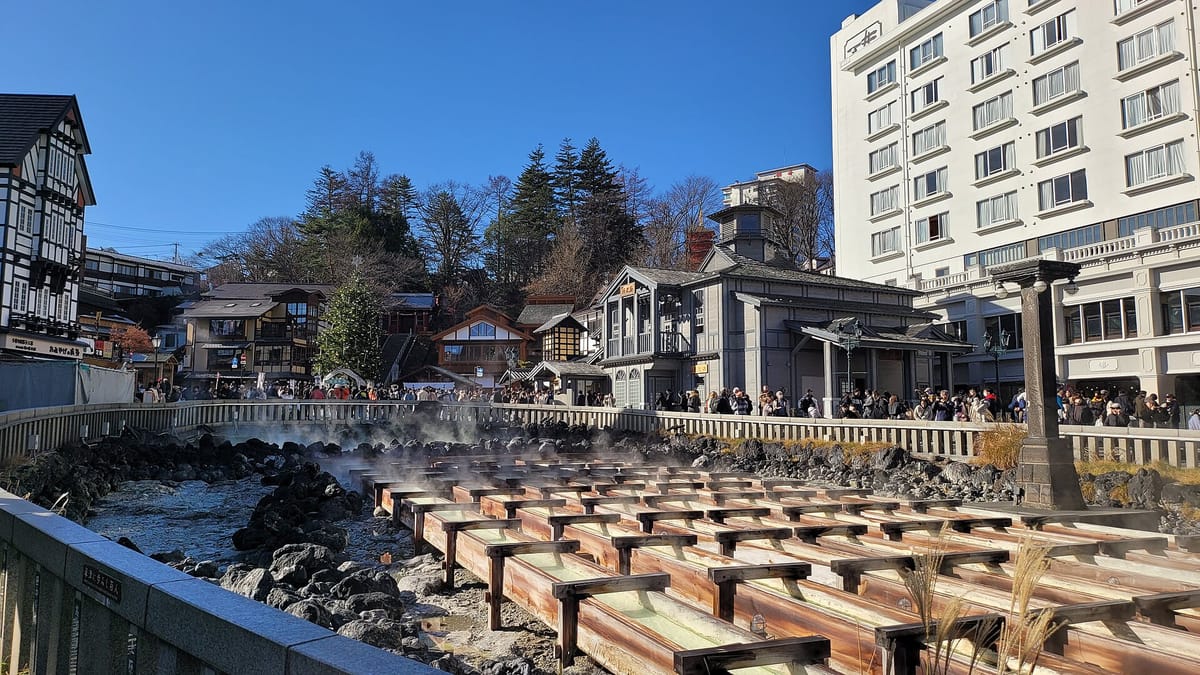
The answer is the Yubatake, literally the hot water field, in the middle of town. Steaming water pours over a bed of rock and runs through long wooden troughs where it cools a little and deposits a yellow-white mineral crust, yu-no-hana, which is collected and sold as bath powder. Ryokan, shops and bathhouses crowd around it, and in the evening, when it is lit, people stroll round it in yukata.
For a learner, Kusatsu is a crash course in onsen vocabulary. Every sign involves 湯, hot water, and the same questions, how hot, how much, is there soap, come up at every bathhouse. By the end of a stay you will have used them all.
Getting there: Naganohara-Kusatsuguchi, Karuizawa or the highway bus
Kusatsu has no railway station; everyone arrives by bus at the Kusatsu Onsen bus terminal, about five minutes' walk above the Yubatake. By train, the most direct route is a JR limited express from Ueno to Naganohara-Kusatsuguchi Station, about two and a half hours with only a few services a day, or a shinkansen to Takasaki and a local train on the JR Agatsuma Line. From Naganohara-Kusatsuguchi, JR buses take about 30 minutes to the terminal.
Another option is the Hokuriku Shinkansen from Tokyo to Karuizawa, then a bus of about 80 minutes over the mountains to Kusatsu. Highway buses also run directly from Busta Shinjuku in about four hours and are often the cheapest way. In winter, roads can be snowy, so allow extra time.
The town itself is compact. The Yubatake, Netsunoyu, the main bathhouses and most ryokan are within about fifteen minutes' walk of each other, and small town buses run loops for those staying further out.
| Japanese | Romaji | Meaning |
|---|---|---|
| 長野原草津口までの特急券をください。 | Naganohara-Kusatsuguchi made no tokkyūken o kudasai. | A limited express ticket to Naganohara-Kusatsuguchi, please. |
| 草津温泉行きのバスはどこから出ますか。 | Kusatsu Onsen-yuki no basu wa doko kara demasu ka. | Where does the bus to Kusatsu Onsen leave from? |
| 湯畑まで歩いて何分くらいですか。 | Yubatake made aruite nanpun kurai desu ka. | About how many minutes on foot to the Yubatake? |
| 荷物を旅館まで送れますか。 | Nimotsu o ryokan made okuremasu ka. | Can I send my luggage to the ryokan? |
| 帰りの高速バスは予約が必要ですか。 | Kaeri no kōsoku basu wa yoyaku ga hitsuyō desu ka. | Do I need to reserve the highway bus back? |
Yubatake, yumomi and Sainokawara: what you will see
Start at the Yubatake. Walk all the way round it, look into the wooden troughs, and soak your feet in the free foot bath at its edge. On one side, the Netsunoyu hall holds the yumomi shows several times a day: performers in traditional dress stir a pool of hot water with long wooden boards, singing Kusatsu-bushi in rhythm, and members of the audience are sometimes invited to try. Beside the Yubatake, the Gozanoyu bathhouse, opened in 2013 in a traditional wooden style, and the small free Shirohata-no-yu let you bathe right in the centre of town.
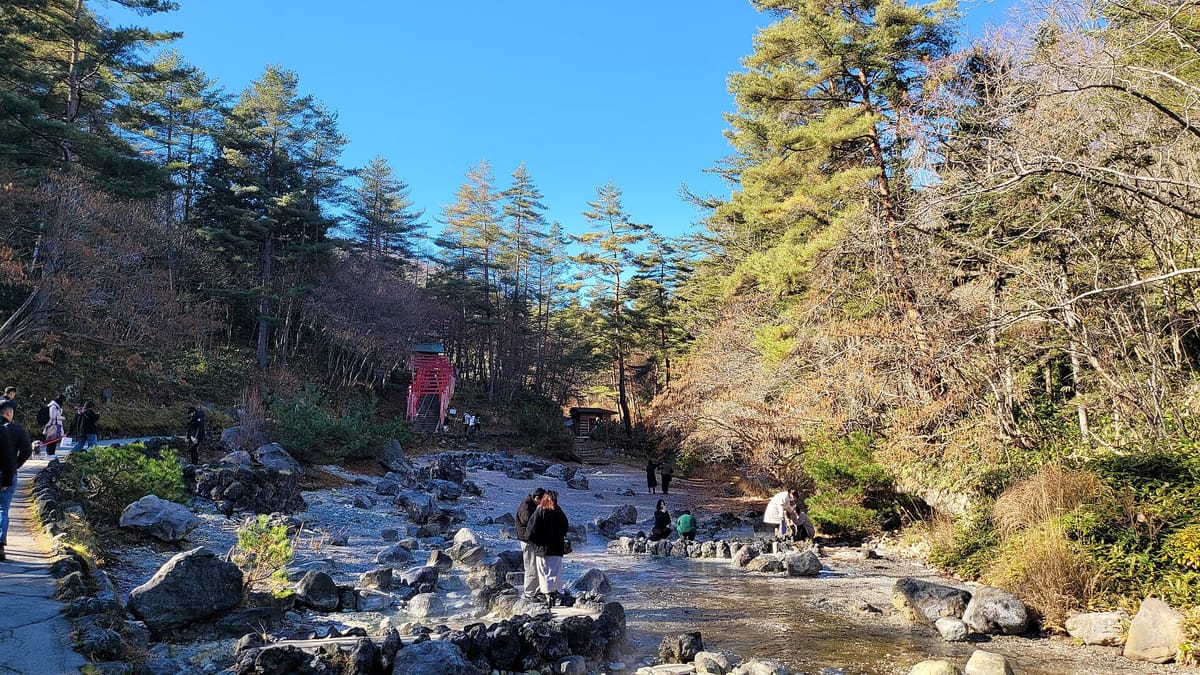
A ten-minute walk west along a lane of ryokan and shops brings you to Sainokawara Park, a valley where hot water bubbles up among the rocks and runs down in steaming streams. At the top of the park, the Sainokawara Rotenburo is one of the largest outdoor baths in Japan, split into large pools for men and women among the trees.
Between baths, try onsen manjū, soft steamed buns filled with sweet bean paste, sold in shops around the Yubatake, and onsen tamago, eggs slowly cooked in hot spring water. Kōsen-ji temple, on the slope above the Yubatake, gives a good view down over the steam.
- Yubatake: the hot water field, lit up in the evening.
- Netsunoyu: the hall of the yumomi performances.
- Gozanoyu: a wooden bathhouse beside the Yubatake.
- Ōtaki-no-yu: a bathhouse known for its awase-yu, tubs at different temperatures.
- Sainokawara Park and Rotenburo: hot streams and a huge outdoor bath.
- Free community baths: Shirohata-no-yu, Jizō-no-yu and Chiyo-no-yu.
- Foot baths: free ashiyu at the Yubatake, the bus terminal and Sainokawara.
Hot water words on the signs
In Kusatsu almost every sign contains 湯, yu, hot water. It is read yu on its own and in names such as 湯畑, but tō in some compounds, as in 銭湯, sentō, a public bathhouse. Bathhouse names end in -no-yu, the hot water of, and the curtains at the entrance, noren, carry 男 or 女, or simply ゆ.
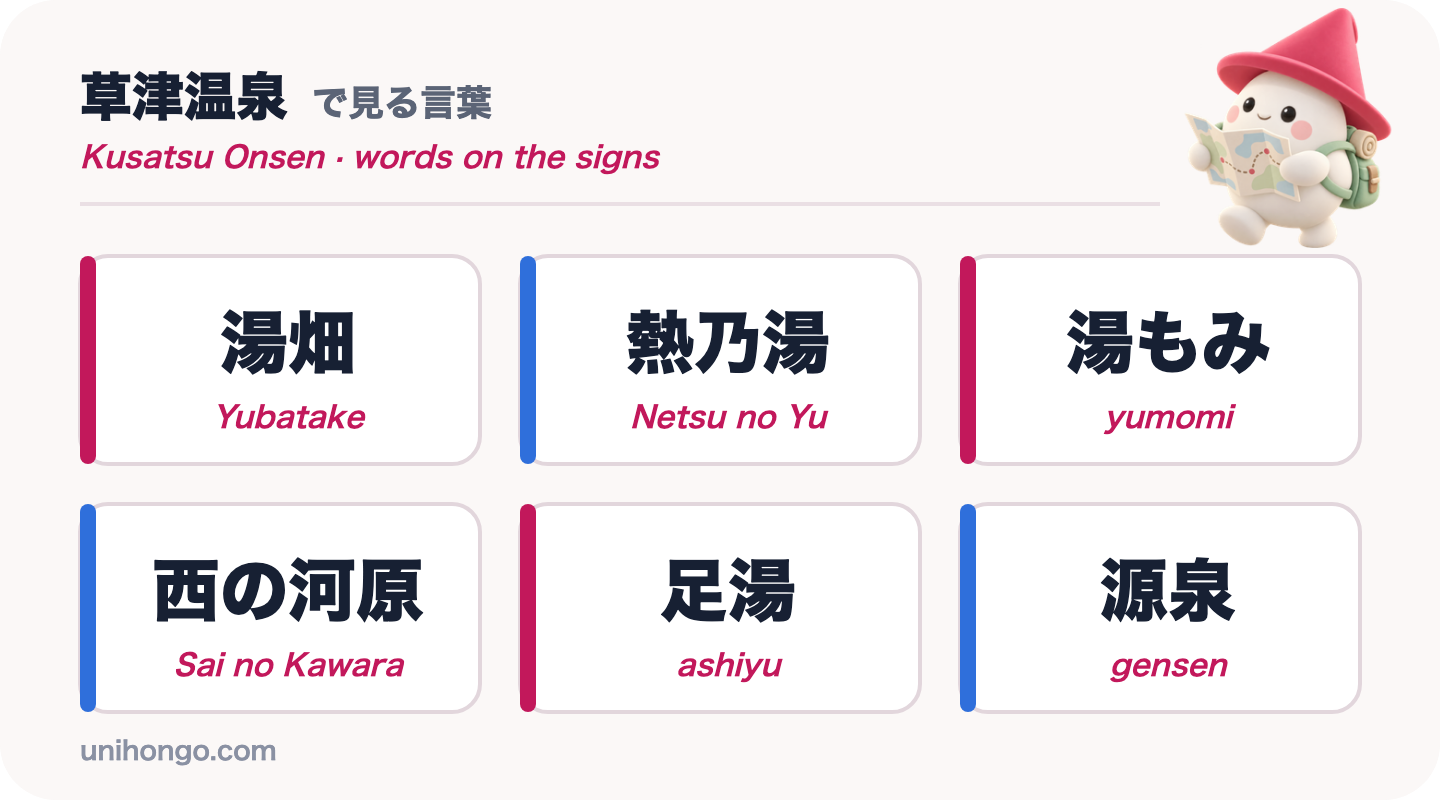
The table below lists the words you will see around the Yubatake and at the baths.
| Word | Reading | Meaning |
|---|---|---|
| 湯畑 | Yubatake | The hot water field in the town centre |
| 熱乃湯 | Netsu no Yu | Hall of the yumomi shows |
| 湯もみ | yumomi | Cooling the water by stirring with boards |
| 西の河原 | Sai no Kawara | The park of hot streams and its outdoor bath |
| 源泉 | gensen | Hot spring source |
| 足湯 | ashiyu | Foot bath |
| 共同浴場 | kyōdō yokujō | Community bathhouse |
| 湯の花 | yu-no-hana | Mineral deposit sold as bath powder |
| 合わせ湯 | awase-yu | Several tubs at different temperatures |
| 男湯 | otoko-yu | Men's bath |
| 女湯 | onna-yu | Women's bath |
Japanese for public baths and very hot water
Kusatsu's water is famously hot, and in the small community baths it can be well over what most visitors are used to. Enter slowly, keep your first soak short, and never add cold water to a community bath without asking the locals already in it. In the bathhouses, the awase-yu tubs let you start in a cooler pool and move to a hotter one.
Bring your own small towel and soap to the free community baths, which have nothing but the hot water. The larger bathhouses have washing areas and sell or rent towels. Because the water is strongly acidic and sulphurous, take off silver jewellery, which can discolour, and rinse your eyes with fresh water if any splashes in.
| Japanese | Romaji | Meaning |
|---|---|---|
| 大人一人お願いします。 | Otona hitori onegai shimasu. | One adult, please. |
| タオルは売っていますか。 | Taoru wa utte imasu ka. | Do you sell towels? |
| 石けんとシャンプーはありますか。 | Sekken to shanpū wa arimasu ka. | Are there soap and shampoo? |
| ぬるいお湯はどれですか。 | Nurui o-yu wa dore desu ka. | Which is the cooler bath? |
| 観光客も入っていいですか。 | Kankōkyaku mo haitte ii desu ka. | May visitors bathe here too? |
| 湯もみを体験できますか。 | Yumomi o taiken dekimasu ka. | Can I try the yumomi myself? |
| 温泉まんじゅうをひと箱ください。 | Onsen manjū o hitohako kudasai. | One box of onsen manjū, please. |
Bath etiquette, timing and practical tips
Kusatsu's community baths are used daily by residents, and visitors are welcome as long as they follow the local rules. The same etiquette applies in the bathhouses and ryokan.
- Rinse your body before entering; in community baths with no showers, pour water over yourself from the bath with a basin.
- Keep your towel out of the water, tie up long hair, and do not swim or splash.
- Bathe briefly at first; the hot, acidic water is strong, and it is easy to feel faint.
- Photography is not allowed in any bath or changing room.
- Tattoo policies vary between bathhouses and ryokan, so check before you go.
- Evenings around the Yubatake are busiest; come early in the morning for a quiet walk in the steam.
- Winter brings snow and skiing on the slopes above town; pack warm clothes for the walk between baths.
Practise the bathhouse conversation before you go
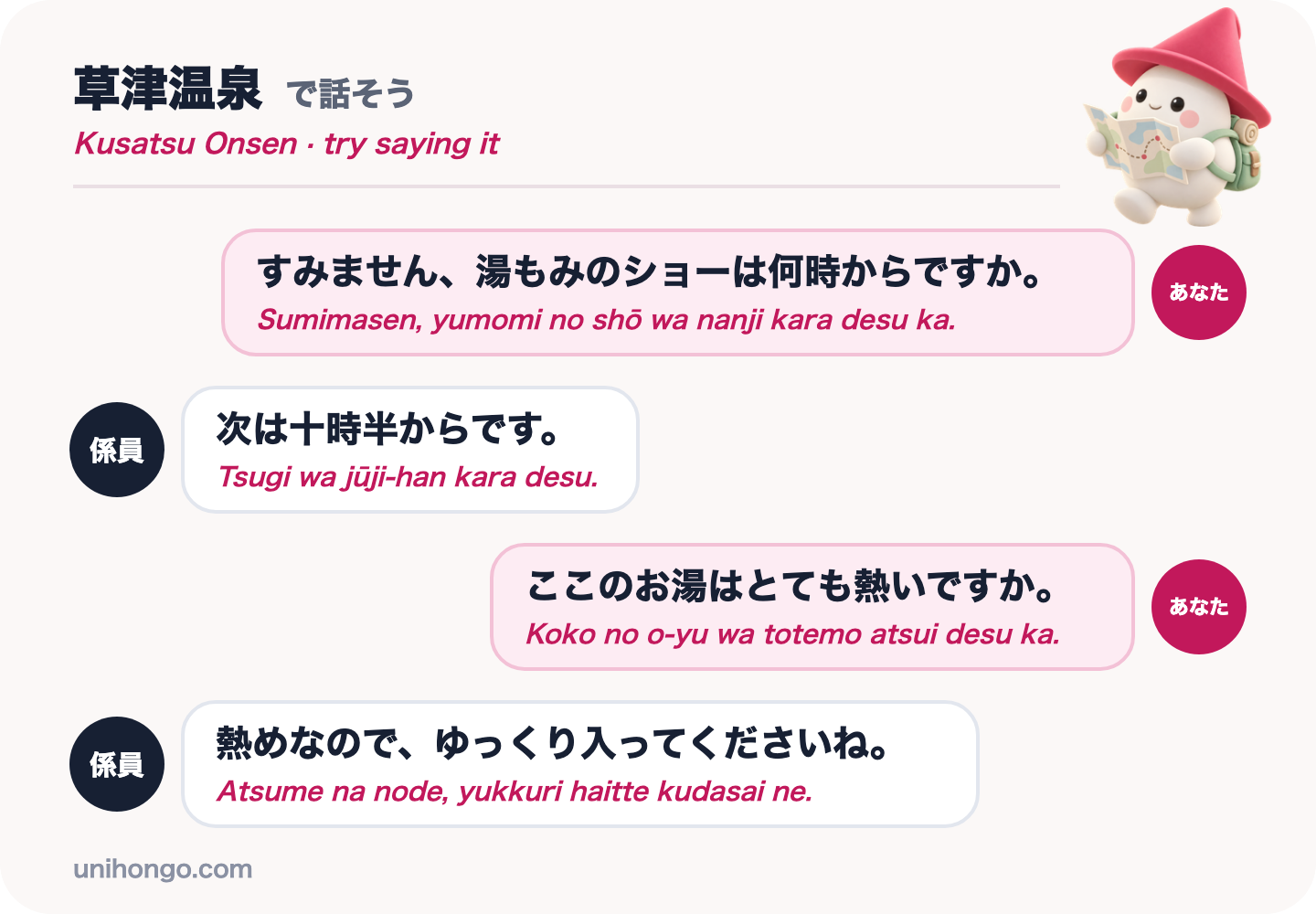
In Kusatsu you will ask two questions again and again: when is the yumomi show, and how hot is the water. The four lines below cover both, and the answer atsume na node, because it is on the hot side, is a phrase you will hear at every bathhouse. Practise until you can say the lines without reading them.
Then practise with a partner who answers. In Unihongo, choose the Onsen topic and ask your AI Sensei to play the staff at a Kusatsu bathhouse, or the Ryokan Stay topic to rehearse your check-in and questions about the bath. One spoken run-through makes the real conversation relaxed.
| Japanese | Romaji | Meaning |
|---|---|---|
| すみません、湯もみのショーは何時からですか。 | Sumimasen, yumomi no shō wa nanji kara desu ka. | Excuse me, what time does the yumomi show start? |
| 次は十時半からです。 | Tsugi wa jūji-han kara desu. | The next one starts at half past ten. |
| ここのお湯はとても熱いですか。 | Koko no o-yu wa totemo atsui desu ka. | Is the water here very hot? |
| 熱めなので、ゆっくり入ってくださいね。 | Atsume na node, yukkuri haitte kudasai ne. | It is on the hot side, so get in slowly. |
Official information
Yumomi show times, bathhouse hours, bus information, events such as the Yubatake illuminations and volcanic notices for Mount Shirane are published by the Kusatsu Onsen tourism association and the town. Check them before you go, especially for access to the mountain.