

The waiting sheet by the door
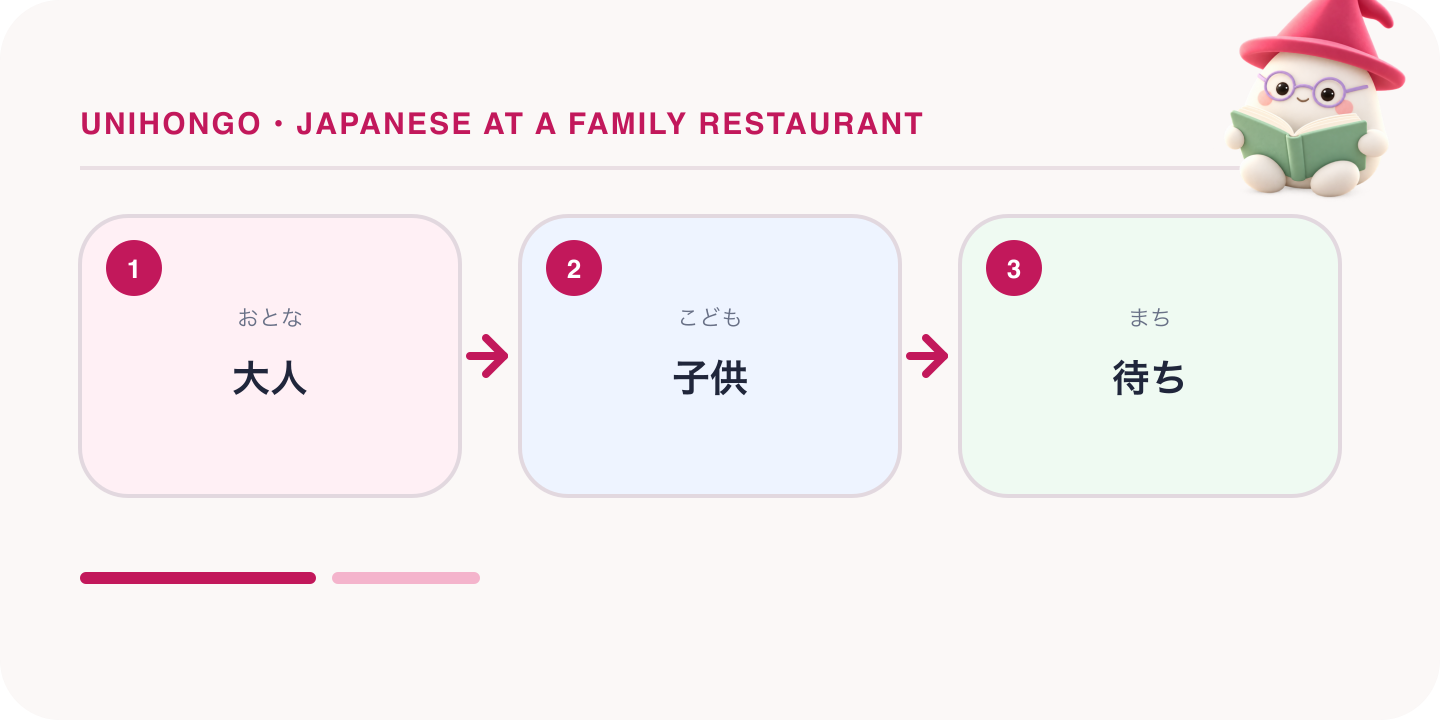
Walk in and look for a clipboard or a small stand by the entrance. At busy times you write your name, the number of people and sometimes your seating preference on the sheet, then sit on the bench and wait to be called. Some branches have a touch screen instead, and a few give a numbered ticket. Write your name in katakana if you can, or in Roman letters; staff will manage either.
The columns usually ask for the name, the number of adults and children, ninzū, and whether you accept a counter seat or want a table. When it is your turn, staff call your name with -sama and confirm the number, then lead you to the booth. If nobody is at the door, wait by the sign asking you to wait to be seated.
| Japanese | Romaji | Meaning |
|---|---|---|
| 三名です。 | San-mei desu. | Three people. |
| 大人二人と子供一人です。 | Otona futari to kodomo hitori desu. | Two adults and one child. |
| どのくらい待ちますか。 | Dono kurai machimasu ka. | How long is the wait? |
| 名前を書いてお待ちください。 | Namae o kaite o-machi kudasai. | Please write your name and wait. |
| カウンターでも大丈夫です。 | Kauntā demo daijōbu desu. | A counter seat is fine too. |
| テーブル席でお願いします。 | Tēburu-seki de onegai shimasu. | A table seat, please. |
Being seated and the first questions
Once staff take you to a table, they bring water, o-hiya, and a wet towel, o-shibori, without being asked, and both are free. Staff then leave you alone until you order, which surprises visitors: family restaurants run with few staff, and the call button or the tablet is how you get attention.
If a child is with you, staff may offer a high chair or a child seat and a set of child-sized cutlery. Booths usually seat four; larger groups may be split or wait longer for a big table.
| Japanese | Romaji | Meaning |
|---|---|---|
| こちらのお席へどうぞ。 | Kochira no o-seki e dōzo. | This seat, please. |
| お子様用の椅子はありますか。 | O-kosama-yō no isu wa arimasu ka. | Do you have a child's chair? |
| お水のおかわりをお願いします。 | O-mizu no okawari o onegai shimasu. | More water, please. |
| 取り皿をもらえますか。 | Torizara o moraemasu ka. | Could I have a small plate? |
| 席を移ってもいいですか。 | Seki o utsutte mo ii desu ka. | May I move seats? |
The call button and the tablet
The call button, yobidashi botan, sits on the table or the wall of the booth, and pressing it makes a chime at the counter with your table number. Press it once and wait; repeated pressing looks impatient. Staff arrive with o-kimari desu ka, have you decided, and you point at the menu and give the item and the number, or ask for a little longer.
Most chains have replaced much of this with a table tablet, taburetto. The screen shows categories down the side, pictures of each dish, and buttons for size, toppings and set options. You add dishes to a cart, kāto, and press the order button, chūmon suru. A language button often switches to English, but the screen vocabulary is worth learning, because it is the same at almost every chain: sū-ryō, quantity; henkō, change; torikeshi, cancel; kakutei, confirm; and tenin o yobu, call staff.
| Japanese | Romaji | Meaning |
|---|---|---|
| ご注文はお決まりですか。 | Go-chūmon wa o-kimari desu ka. | Have you decided what to order? |
| もう少し待ってください。 | Mō sukoshi matte kudasai. | A little longer, please. |
| これを二つお願いします。 | Kore o futatsu onegai shimasu. | Two of these, please. |
| タブレットの使い方を教えてもらえますか。 | Taburetto no tsukaikata o oshiete moraemasu ka. | Could you show me how the tablet works? |
| 注文を間違えてしまいました。 | Chūmon o machigaete shimaimashita. | I ordered the wrong thing. |
| 英語のメニューはありますか。 | Eigo no menyū wa arimasu ka. | Is there an English menu? |
| 追加で注文したいです。 | Tsuika de chūmon shitai desu. | I'd like to order something more. |
Set menus, kids menus and the drink bar
The menu is built around setto, sets. A dish on its own is tanpin; the same dish with rice, soup or bread and often a drink bar is a setto, priced a little higher. Lunch sets, ranchi setto, run until an afternoon hour that varies by chain and are the best value. Rice, raisu, or bread, pan, is usually a choice. Chains list allergens, arerugī, with icons on the tablet and in a printed table you can ask for.
Kids menus, o-kosama menyū or o-kosama setto, come on a plate with several small items, a small juice and often a toy or a coin for a capsule machine. Many chains set an age limit for ordering them, commonly primary school age or under, and the limit is printed on the menu.
The drink bar, dorinku bā, is charged once per person and gives unlimited refills for the whole visit. Order it alone or add it to a meal for a reduced price; the two prices are printed side by side. Do not pour a drink for someone who has not paid for the drink bar; staff notice.
| Japanese | Romaji | Meaning |
|---|---|---|
| ハンバーグセットをライスでお願いします。 | Hanbāgu setto o raisu de onegai shimasu. | The hamburg steak set with rice, please. |
| ドリンクバーをつけてください。 | Dorinku bā o tsukete kudasai. | Please add the drink bar. |
| お子様セットは何歳までですか。 | O-kosama setto wa nan-sai made desu ka. | Up to what age is the kids set? |
| ランチセットは何時までですか。 | Ranchi setto wa nan-ji made desu ka. | Until what time is the lunch set? |
| アレルギー表はありますか。 | Arerugī-hyō wa arimasu ka. | Do you have an allergen table? |
| ライスは大盛りにできますか。 | Raisu wa ōmori ni dekimasu ka. | Can I have a large rice? |
Words on the menu and the tablet
The same short vocabulary appears at every chain, on the paper menu, the tablet screen and the bill. Learn them and you can order anywhere.
| Word | Reading | Meaning |
|---|---|---|
| 単品 | tanpin | Dish on its own, no set |
| セット | setto | Set with rice or bread and often a drink bar |
| ドリンクバー | dorinku bā | Self-service drinks, unlimited refills |
| お子様メニュー | o-kosama menyū | Kids menu |
| 呼び出しボタン | yobidashi botan | Call button |
| 数量 | sūryō | Quantity, on the tablet |
| 確定 | kakutei | Confirm, on the tablet |
| 取り消し | torikeshi | Cancel, on the tablet |
| 伝票 | denpyō | The bill slip you take to the register |
| お会計 | o-kaikei | Payment, the bill |
| クーポン | kūpon | Coupon |
| 深夜料金 | shin'ya ryōkin | Late-night surcharge |
A few chains add a shin'ya ryōkin, late-night surcharge, after a certain hour, typically a percentage of the bill. The hour and the percentage differ by chain and by branch and are printed on the menu, so look for the word if you are eating late.
Paying at the register and using coupons
You do not pay at the table. When you are ready to leave, take the bill slip, denpyō, from the table to the register, reji, near the door; where the tablet has produced no slip, the screen or a card on the table shows a table number, and you give that. Many branches now have self-checkout machines, serufu reji, where you scan the slip's barcode and pay by cash, card, IC card or QR code.
Coupons come from the chain's app, from paper flyers and from the receipt itself. The app coupon is shown on the phone screen at the register or, at some chains, entered as a code on the tablet before you order. Point apps and the big loyalty schemes are accepted at many chains; ask which ones. Splitting the bill, betsubetsu, is possible at most registers if you say so before paying.
| Japanese | Romaji | Meaning |
|---|---|---|
| お会計をお願いします。 | O-kaikei o onegai shimasu. | The bill, please. |
| クーポンを使いたいんですが。 | Kūpon o tsukaitai n desu ga. | I'd like to use a coupon. |
| 別々でお願いできますか。 | Betsubetsu de onegai dekimasu ka. | Could we pay separately? |
| ポイントカードはありますか。 | Pointo kādo wa arimasu ka. | Do you have a point card? |
| カードで払えますか。 | Kādo de haraemasu ka. | Can I pay by card? |
| 領収書をください。 | Ryōshūsho o kudasai. | A receipt, please. |
Staying a long time: the unwritten rules
Family restaurants tolerate long stays better than most places in Japan, which is why students study there and remote workers write there. The tolerance has limits, and they vary by branch and time of day. Some post a time limit at busy hours; others say nothing but expect you to read the room. A few restrict laptops at weekend lunch, so look for the sign near the door.
- Order something, at least a drink bar, and add a dish if you stay past a couple of hours
- Keep to one seat, not a whole booth, when you are alone and the shop is filling up
- Take one drink at a time and never fill a bottle to take away
- Use headphones and keep calls short; families and children are the main customers
- Leave when the queue at the door grows at lunch or dinner, even if no one asks
- Check the sign for time limits, laptop rules and late-night surcharges, which differ by branch
If staff come and say konde imasu node, it is busy so, followed by a request, they are asking you to finish. A polite wakarimashita, sumimasen and paying within a few minutes is the expected response.
When something goes wrong
Problems at a famiresu are usually about the order: a dish is late, the wrong dish came, or something was forgotten from the set. Press the call button, say the problem in one sentence, and staff will check the kitchen. Tablet orders are logged, so staff can see exactly what was sent and when.
If you drop a glass, spill the drink bar coffee or a child makes a mess, tell staff and they will clean it; there is no charge. If you leave something behind, the register keeps lost property for a while.
| Japanese | Romaji | Meaning |
|---|---|---|
| まだ料理が来ていないんですが。 | Mada ryōri ga kite inai n desu ga. | The food hasn't come yet. |
| これは注文していません。 | Kore wa chūmon shite imasen. | I didn't order this. |
| セットのスープがまだです。 | Setto no sūpu ga mada desu. | The set's soup hasn't come yet. |
| すみません、こぼしてしまいました。 | Sumimasen, koboshite shimaimashita. | Sorry, I spilled something. |
| 忘れ物をしたかもしれません。 | Wasuremono o shita kamo shiremasen. | I think I left something behind. |
| 持ち帰りはできますか。 | Mochikaeri wa dekimasu ka. | Can I take this away? |