

Why Kōraku-en is one of Japan's great gardens
Ikeda Tsunamasa, lord of Okayama, began the garden in 1687 on the far bank of the Asahi River opposite his castle, and it was largely completed in 1700. The lords used it for receiving guests, for noh performances and for relaxing, and it was opened to the public in 1884. Although floods and wartime bombing damaged it, the garden was restored using detailed records and paintings kept by the Ikeda family, and it is designated a Special Place of Scenic Beauty.
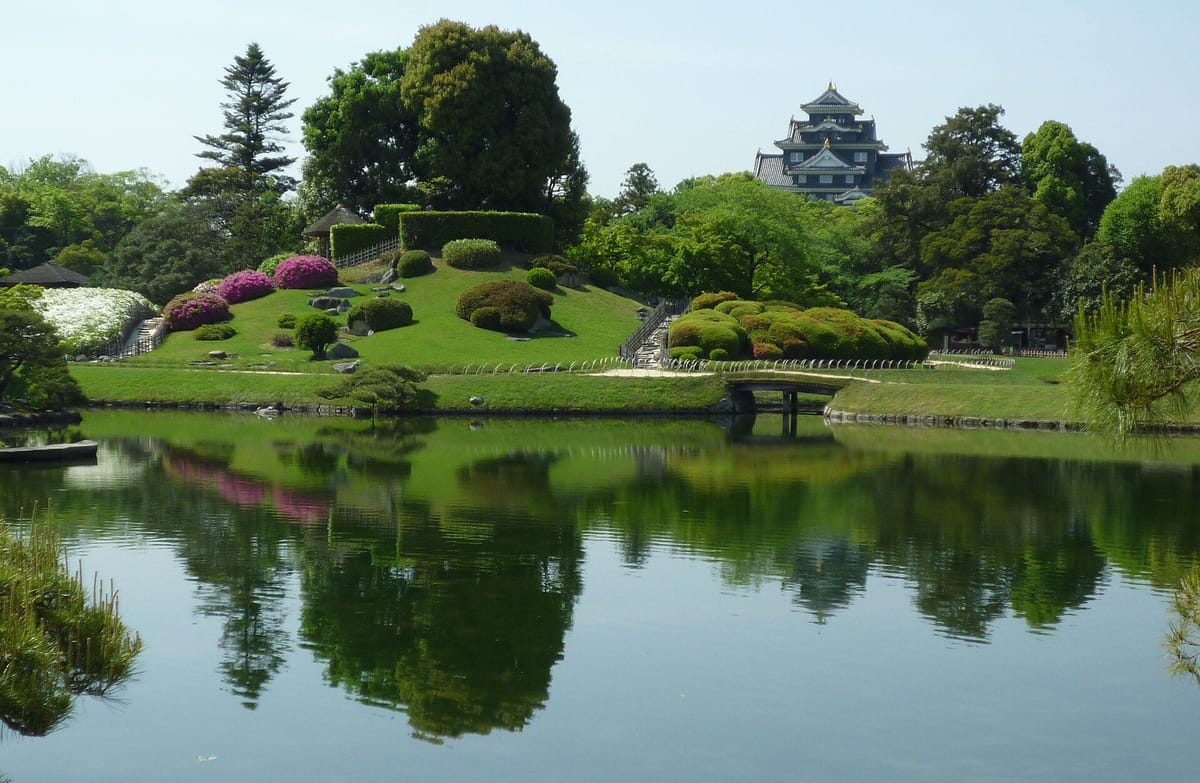
What makes Kōraku-en different is its openness. Many Japanese gardens are enclosed and intricate; this one spreads out in lawns, with the castle and the surrounding hills used as borrowed scenery, shakkei, so that the garden seems to continue beyond its walls. Paths loop round a large central pond, over bridges and up a small hill, and every turn is composed as a view.
For a Japanese learner, a garden is a quiet classroom. The signs are short, the names of buildings and ponds follow simple patterns, and the staff at the gate have time to answer a question.
Getting there: from Okayama Station by foot or tram
Okayama Station, on the San'yō Shinkansen, is the gateway. From the east exit, where a statue of the folk hero Momotarō greets travellers, the garden is about twenty-five to thirty minutes on foot, straight along the main avenue and then north along the river past the castle. It is a pleasant walk, and it lets you see the castle before you arrive.
The quicker way is the Okayama tram, the Higashiyama line, to Shiroshita, about five minutes, and then a ten-to-fifteen-minute walk. Buses from the east exit stop at Kōraku-en-mae near the Main Gate, Seimon, on the north side of the garden. The South Gate, Minamimon, faces the castle across the river.
| Japanese | Romaji | Meaning |
|---|---|---|
| 後楽園に行きたいんですが。 | Kōraku-en ni ikitai n desu ga. | I'd like to go to Kōraku-en. |
| 城下で降りればいいですか。 | Shiroshita de orireba ii desu ka. | Should I get off at Shiroshita? |
| 後楽園行きのバスはどれですか。 | Kōraku-en-yuki no basu wa dore desu ka. | Which bus goes to Kōraku-en? |
| 正門はどちらですか。 | Seimon wa dochira desu ka. | Which way is the Main Gate? |
| ここから歩いて何分くらいですか。 | Koko kara aruite nanpun kurai desu ka. | About how many minutes on foot from here? |
Ponds, hills and tea fields: what you will see
A circuit of the garden takes about an hour at an easy pace. You can walk it in any direction, but the classic route leads from the Main Gate past the lord's residence, around the pond and up the hill, then down past the stream and fields to the South Gate and the castle.
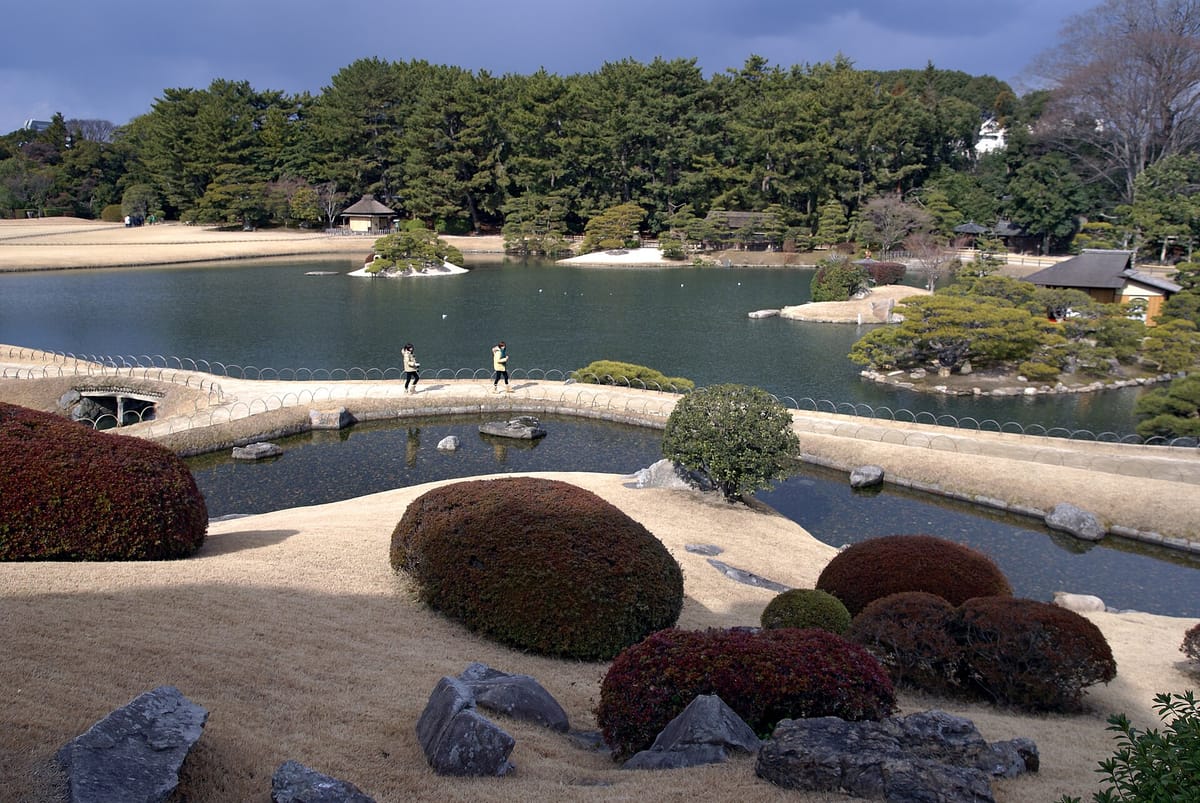
- Enyōtei: the lord's residence and the garden's central building, from which the main views were designed.
- Sawa-no-ike: the large central pond with three islands, the heart of the garden.
- Yuishinzan: a small man-made hill, about six metres high, with views over the whole garden.
- Ryūten: an open rest house with a stream running through the middle of its floor.
- Kayō-no-ike: a lotus pond with a waterfall and large rocks.
- The tea field and rice paddies: working fields kept since the lords' time.
- The crane aviary: home to red-crowned cranes, tanchō, the garden's symbol.
- Nishiki-ga-oka and the plum grove: groves of maple, cherry and plum, for autumn colour and early spring blossom.
Seasonal events include tea-picking in spring and rice-planting in early summer, and on some evenings the garden opens after dark for illuminations. The events calendar on the official site lists this year's dates.
Words on the garden signs
Garden names follow simple patterns. A 池, ike, is a pond; a 山, zan or yama, is a hill; and the endings 亭, tei, and 店 or 軒 mark a pavilion or rest house. Once you know these endings, you can tell at a glance whether a signpost is pointing to water, a hill or a building, even before you can read the rest of the name.
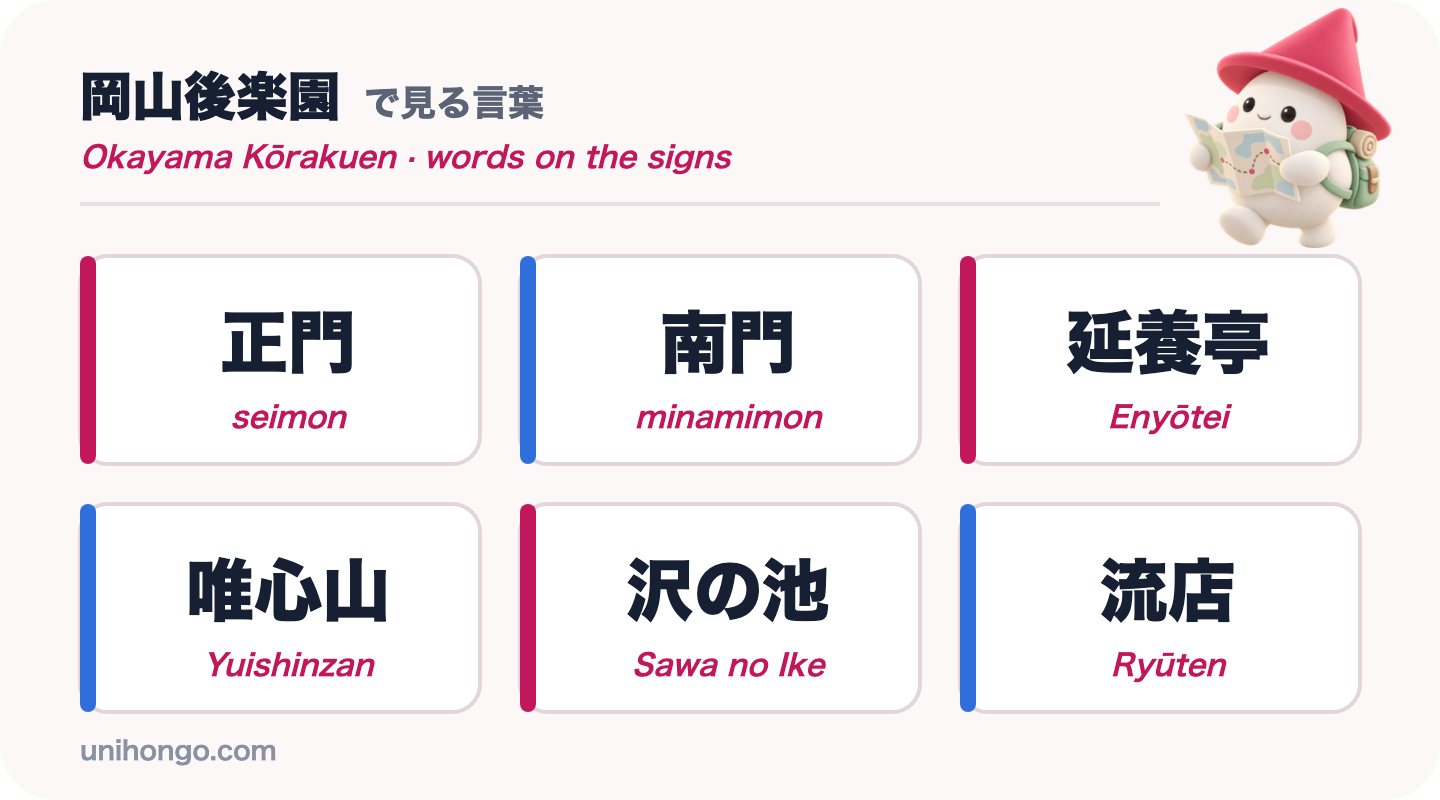
| Word | Reading | Meaning |
|---|---|---|
| 正門 | seimon | Main Gate, on the north side |
| 南門 | minamimon | South Gate, towards the castle |
| 延養亭 | Enyōtei | The lord's residence |
| 唯心山 | Yuishinzan | The small hill with a view |
| 沢の池 | Sawa no Ike | The large central pond |
| 流店 | Ryūten | Rest house with a stream through it |
| 茶畑 | chabatake | Tea field |
| 丹頂 | tanchō | Red-crowned crane |
| 共通券 | kyōtsūken | Combined ticket for garden and castle |
Japanese for tickets, tea and the castle
Buy your ticket at the Main Gate or the South Gate. If you plan to see Okayama Castle, ask for the combined ticket; it is cheaper than two separate tickets. Inside the garden, rest houses and shops sell green tea and the local sweet kibi dango, small soft dumplings linked to the Momotarō story.
Okayama Castle, across the Tsukimi-bashi bridge, is known as U-jō, the crow castle, for its black walls. The keep is a post-war reconstruction with a museum inside, and its top floor looks back down on the garden.
| Japanese | Romaji | Meaning |
|---|---|---|
| 大人一枚お願いします。 | Otona ichimai onegai shimasu. | One adult, please. |
| 岡山城との共通券をください。 | Okayama-jō to no kyōtsūken o kudasai. | A combined ticket with Okayama Castle, please. |
| パンフレットは英語もありますか。 | Panfuretto wa Eigo mo arimasu ka. | Is there a pamphlet in English as well? |
| 抹茶が飲めるところはありますか。 | Matcha ga nomeru tokoro wa arimasu ka. | Is there somewhere I can have matcha? |
| きびだんごを一箱ください。 | Kibi dango o hito-hako kudasai. | One box of kibi dango, please. |
| タンチョウはどこで見られますか。 | Tanchō wa doko de miraremasu ka. | Where can I see the cranes? |
Etiquette, timing and practical tips
Kōraku-en is spacious and rarely feels crowded, but a few habits help keep it the way it is meant to be seen.
- Stay on the paths and off the lawns unless a sign or rope shows that an area is open.
- Do not feed the carp or the cranes, and do not reach into the aviary.
- Go early in the morning for the quietest views and softest light; the garden opens early.
- Plum blossom in late winter, cherry blossom in spring, irises in early summer and maples in autumn are the busiest times.
- In summer there is little shade on the lawns. Bring water and a hat.
- Walk to the castle over the Tsukimi-bashi bridge and look back: the garden and castle were designed to be seen together.
Practise the visit before you go
This is the exchange to have at the ticket window, and it covers the rest of your visit too. The directions in the reply use te-form, dete, going out, and watatte, crossing, one after another, which is how Japanese strings together a route.
Then practise with a partner who answers back. In Unihongo, choose the Sightseeing topic and ask your AI Sensei to play the ticket staff at Kōraku-en, or try the Directions topic for the walk back to the station. Say the lines aloud once before you go, and they will come out easily at the gate.
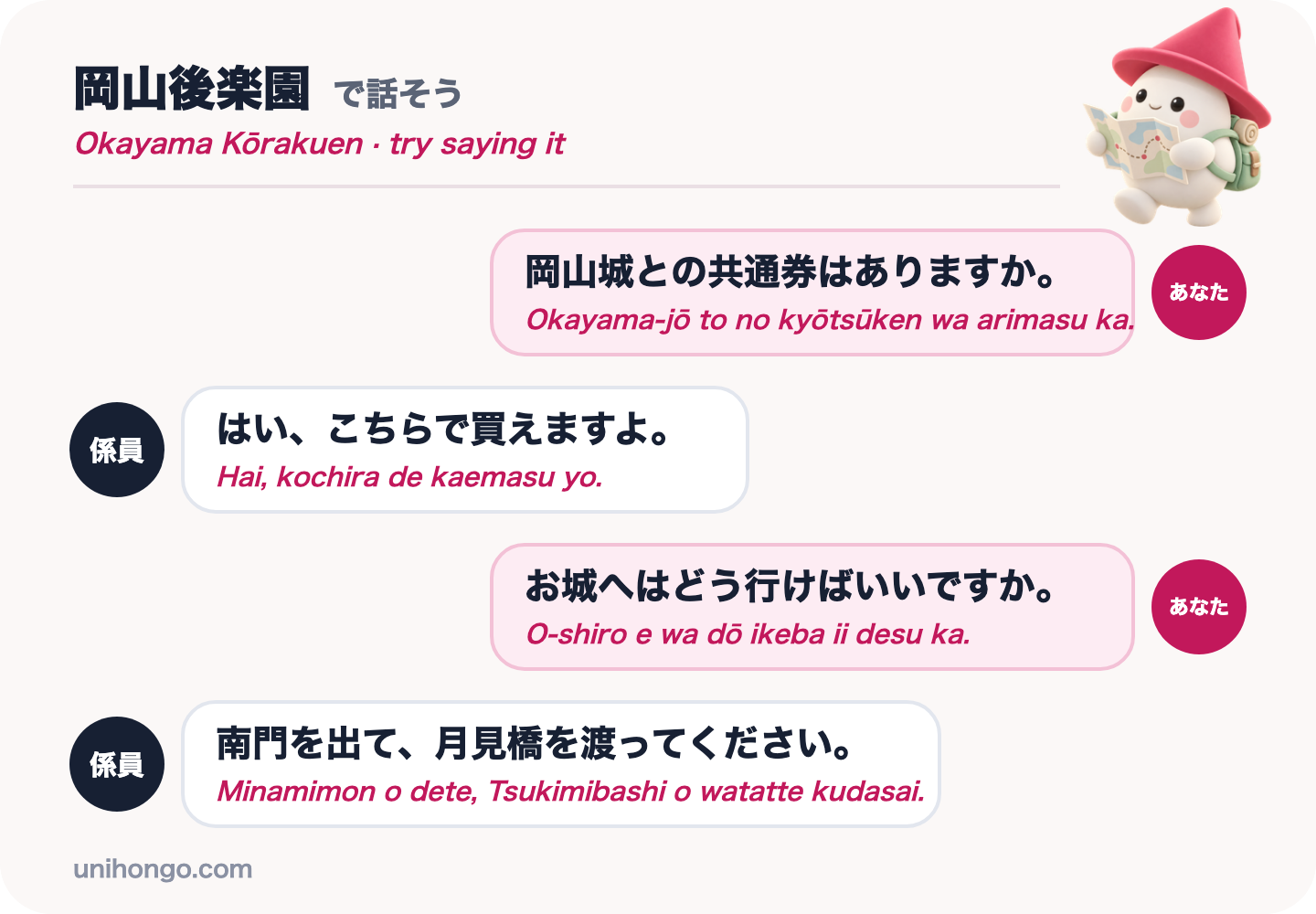
| Japanese | Romaji | Meaning |
|---|---|---|
| 岡山城との共通券はありますか。 | Okayama-jō to no kyōtsūken wa arimasu ka. | Is there a combined ticket with Okayama Castle? |
| はい、こちらで買えますよ。 | Hai, kochira de kaemasu yo. | Yes, you can buy it here. |
| お城へはどう行けばいいですか。 | O-shiro e wa dō ikeba ii desu ka. | How do I get to the castle? |
| 南門を出て、月見橋を渡ってください。 | Minamimon o dete, Tsukimibashi o watatte kudasai. | Go out of the South Gate and cross the Tsukimi Bridge. |
Official information
The garden publishes its seasonal hours, admission and combined ticket details, and the dates of events and illuminations. Check before you go.