

Why Takeda Castle is worth an early alarm
Takeda Castle was founded in the fifteenth century, in the time of the Yamana clan, to guard the routes through the Tajima region. Its final form came at the end of the sixteenth century, when its last lord, Akamatsu Hirohide, rebuilt it with the massive stone walls you see today. After the Battle of Sekigahara in 1600 he was forced to take his own life, the castle was abandoned, and its buildings disappeared, leaving the walls almost intact on the ridge.
The ruins stretch about 400 metres along the top of Kojōzan, with enclosures reaching out along three ridges from the central keep platform. Seen from below, the shape is said to resemble a crouching tiger, which gave the castle its old name, Toragajō, the castle of the lying tiger. It was designated a National Historic Site in 1943, is one of the Japan Castle Foundation's 100 Fine Castles, and is often called Japan's Machu Picchu.
For a Japanese learner, Takeda is a lesson in castle words and weather words at once. The signs on the ridge use the vocabulary of every Japanese castle, honmaru, tenshudai, ishigaki, and the whole trip depends on a forecast you will want to ask about: will there be a sea of clouds tomorrow?
Getting there: JR Takeda Station and the Tenkū bus
The ruins rise directly above Takeda Station, 竹田駅, on the JR Bantan Line, 播但線, which runs north from Himeji through the mountains. From Himeji the journey takes around ninety minutes to two hours, usually with a change at Teramae; from Osaka or Kyoto, travel to Himeji first. The line is covered by the major JR rail passes.
From the station you have two choices. You can walk up one of the trails, the most direct starting behind the station, in about forty minutes of steady climbing on stone steps and forest path. Or you can take the Tenkū bus, 天空バス, a small loop bus that runs from spring to the end of November via Yamashiro no Sato, a roadside rest area, to a stop below the ruins. Private cars are not allowed on this last road. Wherever you get off, everyone walks the final 900 metres or so, about twenty minutes, to the entrance. The bus is paid in cash when you get off, and IC cards are not accepted. On November weekend and holiday mornings, a special early bus runs for the sea of clouds.
| Japanese | Romaji | Meaning |
|---|---|---|
| 天空バスの乗り場はどこですか。 | Tenkū basu no noriba wa doko desu ka. | Where does the Tenkū bus leave from? |
| ICカードは使えますか。 | IC kādo wa tsukaemasu ka. | Can I use an IC card? |
| 運賃は降りるときに払いますか。 | Unchin wa oriru toki ni haraimasu ka. | Do I pay the fare when I get off? |
| 竹田城跡から帰りの最終バスは何時ですか。 | Takeda-jō ato kara kaeri no saishū basu wa nanji desu ka. | What time is the last bus back from the castle ruins? |
| 駅から歩いて登れますか。 | Eki kara aruite noboremasu ka. | Can I walk up from the station? |
Chasing the sea of clouds: the ruins and Ritsuunkyō
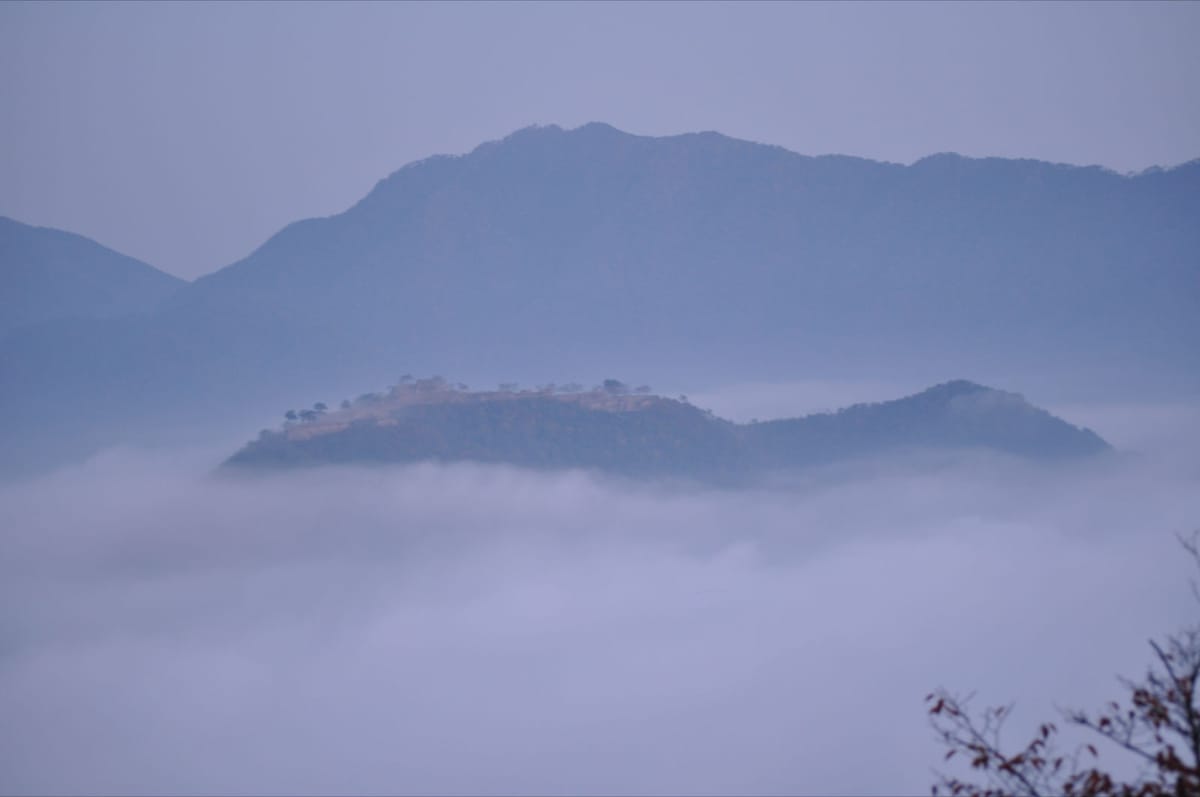
There are two ways to see the unkai. From the ruins themselves, you stand in the castle and look down on the cloud filling the valley, with only the mountain tops showing. From Ritsuunkyō, 立雲峡, a wooded park on the slopes of Mount Asago on the opposite side of the valley, you see the famous picture: the whole castle ridge floating above the white. You cannot see both on the same morning, so decide which one you want.
Ritsuunkyō has no public transport. Most people drive or take a taxi from Takeda Station to the car park, about five minutes by road, or walk there in about forty-five minutes, and then climb in the dark to one of the numbered viewpoints, between ten and forty minutes up the trail. The sea of clouds forms most often in October and November on clear mornings with little wind after a cold night, usually around sunrise, and fades as the sun warms the valley. Dress warmly and bring a torch.
| Japanese | Romaji | Meaning |
|---|---|---|
| 立雲峡の駐車場までお願いします。 | Ritsuunkyō no chūshajō made onegai shimasu. | To the Ritsuunkyō car park, please. |
| 明日の朝五時に迎えに来てもらえますか。 | Ashita no asa goji ni mukae ni kite moraemasu ka. | Could you pick me up at five tomorrow morning? |
| 雲海はどこから一番よく見えますか。 | Unkai wa doko kara ichiban yoku miemasu ka. | Where is the best place to see the sea of clouds? |
| 今朝は雲海が出ましたか。 | Kesa wa unkai ga demashita ka. | Was there a sea of clouds this morning? |
On the ridge: what you will walk through
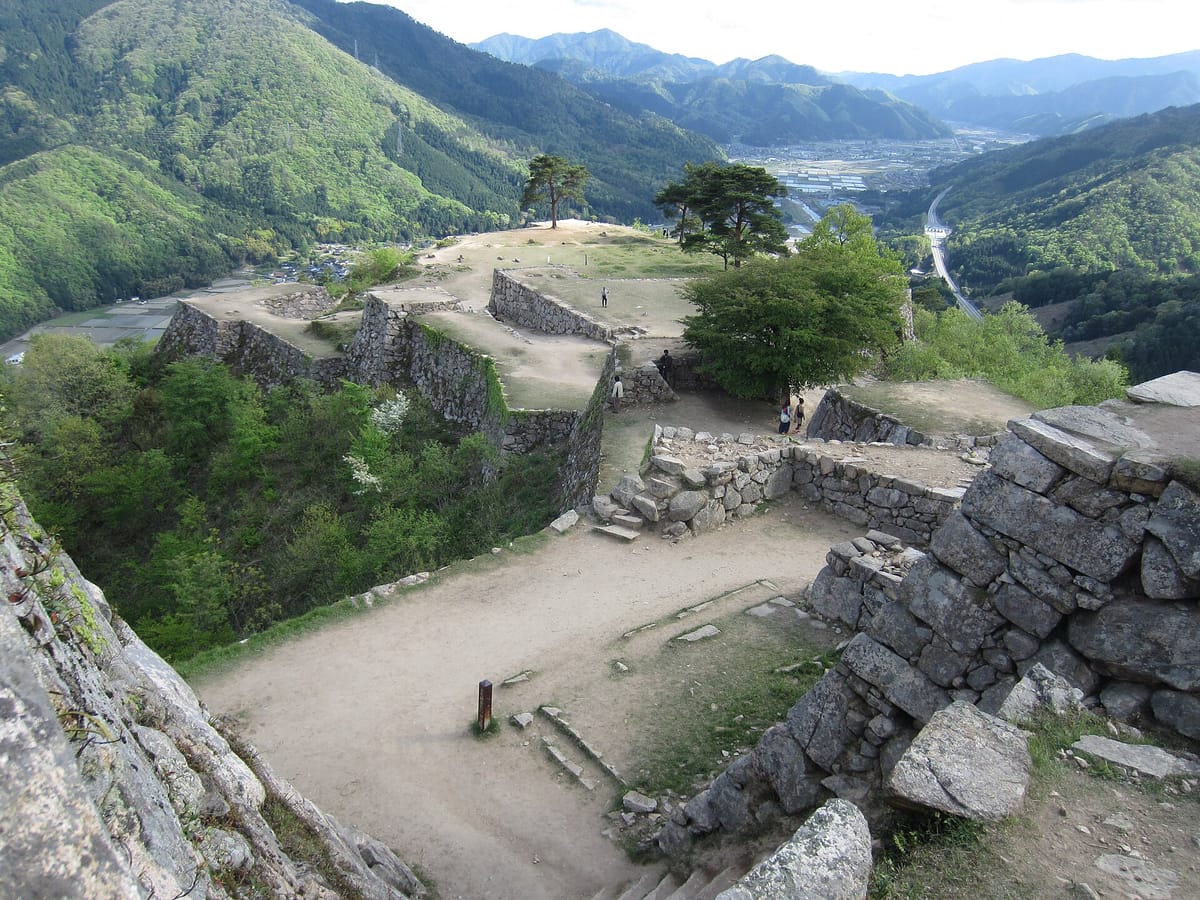
Inside the entrance, a set route leads you along the ridge through the castle's enclosures, called kuruwa, each a flat terrace held up by stone walls. The walls were built by stacking natural, barely cut stones at an angle, a technique often linked to the Anō masons of Ōmi, and they have stood without mortar for over four hundred years.
At the centre is the honmaru, the main enclosure, and the tenshudai, the stone platform where a keep once stood and now the highest point of the ruins. From here enclosures run out to the north, the Kita-senjō, and to the south, the Minami-senjō, the long terrace at the tip of the ridge. The views stretch over the town, the river and the folded mountains of Tajima. The Asago City site also announced a new viewing path, opened in August 2026, that brings visitors closer to the stone walls.
- The entrance: where you pay the entry fee before walking the ridge.
- Kita-senjō: the northern enclosure, a broad terrace on the ridge.
- Honmaru: the central enclosure at the top of the ridge.
- Tenshudai: the keep platform, the highest point, with views in every direction.
- Minami-senjō: the long southern terrace at the tip of the ridge.
- Ishigaki: the stone walls themselves, the reason the ruins are famous.
Words on the signs at Takeda Castle
The key kanji here is 跡, ato, which means remains or traces. It turns 竹田城, Takeda Castle, into 竹田城跡, the site of Takeda Castle, and you will see it at every Japanese castle where no buildings stand. 丸, maru, round, is the old word for an enclosure in a castle, so 本丸 is the main enclosure.
On the way up, trails are marked 登山道, tozandō, mountain path, and the notices by the gate list the rules. The table covers the words you will meet from the station to the keep platform.
| Word | Reading | Meaning |
|---|---|---|
| 竹田城跡 | Takeda-jō ato | The ruins, literally the site of Takeda Castle |
| 本丸 | honmaru | Main enclosure |
| 天守台 | tenshudai | Stone platform where the keep stood |
| 北千畳 | Kita-senjō | Northern enclosure |
| 南千畳 | Minami-senjō | Southern enclosure at the tip of the ridge |
| 石垣 | ishigaki | Stone wall |
| 登山道 | tozandō | Mountain trail |
| 雲海 | unkai | Sea of clouds |
| 立雲峡 | Ritsuunkyō | The viewpoint park across the valley |
| 天空の城 | tenkū no shiro | Castle in the sky, the ruins' nickname |
Etiquette, safety and timing
The ruins are a protected historic site on a steep hill, and the walls have no railings in many places. A few habits keep you and the site safe.
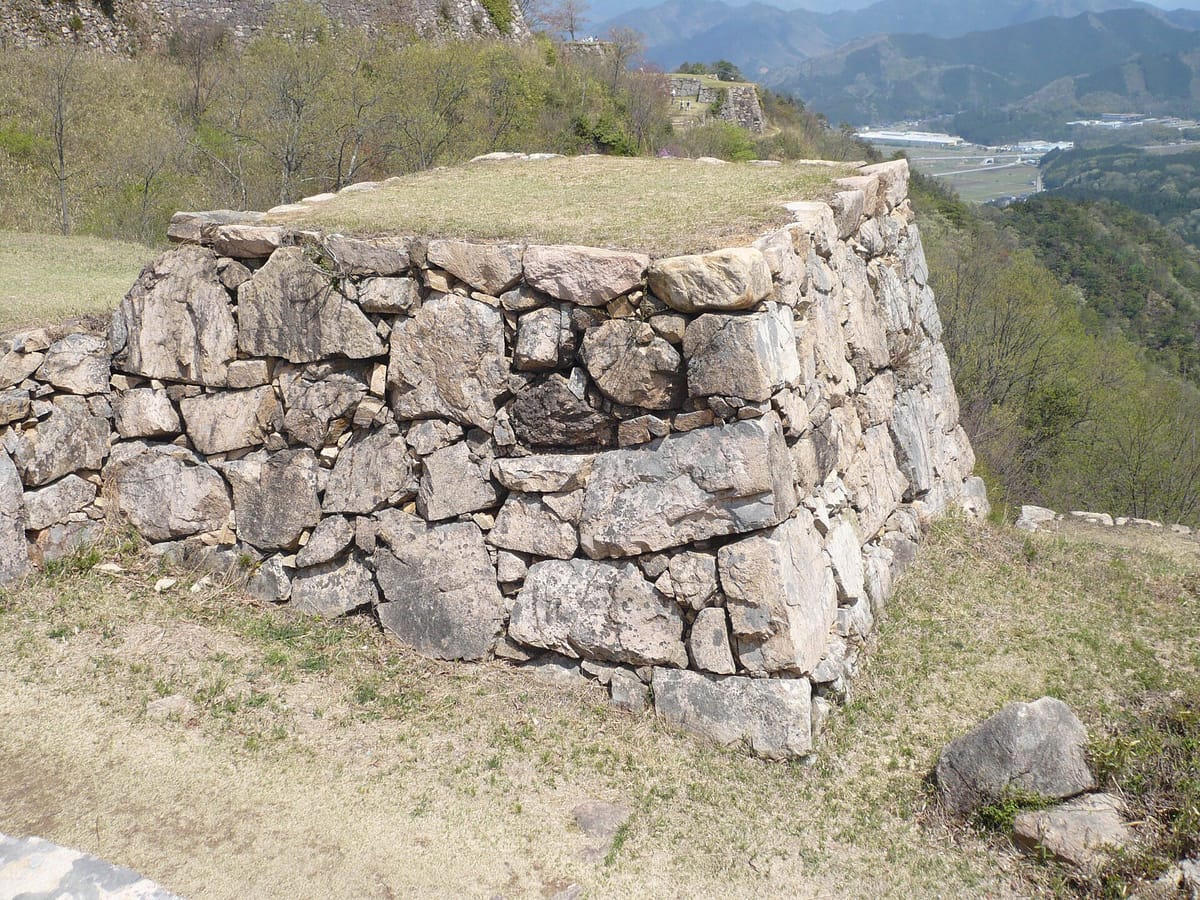
- Stay on the marked route and never climb on or lean over the stone walls; the drops are high.
- The whole site is non-smoking.
- Wear shoes with grip. The trails are unpaved mountain paths and uneven stone steps, slippery when wet or icy.
- For a dawn visit, bring a torch and warm clothes; autumn mornings on the hill are cold.
- The ruins close from 4 January to the end of February, and can close in bad weather at any time; check the official site on the day.
- Opening hours change by season, with early openings in the sea-of-clouds season; confirm them before you set an alarm.
- Leave the car behind in the cloud season: parking near the ruins is limited and the last road is closed to private cars.
Practise the morning before you go
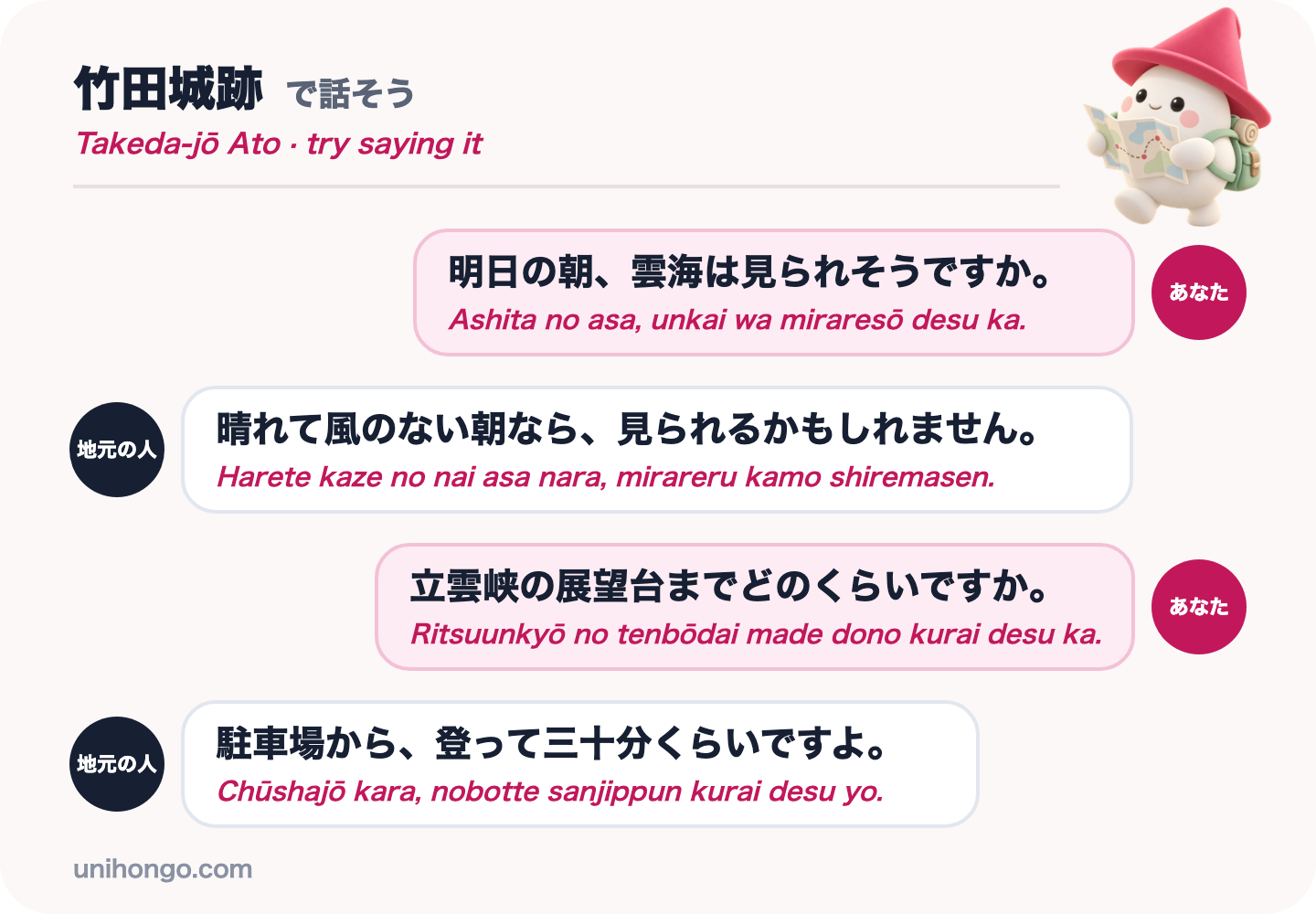
The conversation you are most likely to have in Takeda is with your innkeeper or a shopkeeper the evening before: what are the chances, and how early do I need to go? Practise the four lines below until you can say them without reading, and listen for the weather words in the reply: harete, if it is clear, and kaze no nai, without wind.
Then practise with someone who answers back. In Unihongo, choose the Sightseeing topic and ask your AI Sensei to play a local in Takeda, or the Train Tickets topic to rehearse the change at Teramae on the Bantan Line. Speaking the lines once before you go is what makes them come out on the day.
| Japanese | Romaji | Meaning |
|---|---|---|
| 明日の朝、雲海は見られそうですか。 | Ashita no asa, unkai wa miraresō desu ka. | Tomorrow morning, is there likely to be a sea of clouds? |
| 晴れて風のない朝なら、見られるかもしれません。 | Harete kaze no nai asa nara, mirareru kamo shiremasen. | If it's a clear morning without wind, you might see one. |
| 立雲峡の展望台までどのくらいですか。 | Ritsuunkyō no tenbōdai made dono kurai desu ka. | How far is it to the Ritsuunkyō viewpoint? |
| 駐車場から、登って三十分くらいですよ。 | Chūshajō kara, nobotte sanjippun kurai desu yo. | From the car park, it's about a thirty-minute climb. |
Official information
Asago City runs the official Takeda Castle site, with this season's viewing hours, the winter closure, notices about access in the sea-of-clouds season and trail information. The Tenkū bus timetable is published by Zentan Bus. Check both before you go.