

Why Yokohama Chinatown is worth the trip
When Yokohama opened to foreign trade in 1859, Chinese merchants, interpreters and craftsmen came with the Western trading houses, and settled in the district next to the foreign settlement. Their neighbourhood, known for decades as Nankinmachi, was rebuilt after the 1923 earthquake and again after the Second World War, and has grown into Japan's largest Chinatown. Today there are more restaurants and shops than residents, but the temples remain places of real worship.
What visitors notice first is the colour: red and gold gates, lanterns, shop signs in dense Chinese characters, and steam rising from bamboo baskets on the pavement. The food ranges from street snacks to formal banquet halls, and much of it has been adapted to Japanese tastes over a century and a half, which is part of its charm.
For a Japanese learner, Chinatown is a gift. Menus use kanji you may know from Japanese, but with Chinese dish names in katakana beside them, so every sign is a small puzzle. And because so much food is sold at open counters, you will order out loud many times in one visit.
Getting there: Motomachi-Chūkagai and Ishikawachō
The easiest station is Motomachi-Chūkagai, the last stop on the Minato Mirai Line, which is shown on maps as Motomachi-Chūkagai and whose exits lead up towards Yamashita Park and Chinatown's eastern side. Walking from there you enter through the Chōyōmon, the gate of the rising sun, which is the largest of Chinatown's gates. Most Tōkyū Tōyoko Line trains from Shibuya run straight through, so you can reach Chinatown from Shibuya without changing.
On JR, Ishikawachō Station on the Negishi Line is a few minutes' walk from the western side. Leave by the north side, and you pass under the Seiyōmon and then the white Enpeimon on the way into the main street, Chūkagai Ōdōri, with the Zenrinmon gate at its entrance. Chinatown also makes a natural continuation of a walk from Minato Mirai, Ōsanbashi Pier or Yamashita Park.
| Japanese | Romaji | Meaning |
|---|---|---|
| 中華街へはどの出口ですか。 | Chūkagai e wa dono deguchi desu ka. | Which exit is for Chinatown? |
| 元町・中華街駅に行きたいんですが。 | Motomachi Chūkagai-eki ni ikitai n desu ga. | I would like to go to Motomachi-Chūkagai Station. |
| 関帝廟はどちらですか。 | Kanteibyō wa dochira desu ka. | Which way is Kanteibyō? |
| 山下公園までどのくらいですか。 | Yamashita Kōen made dono kurai desu ka. | How far is it to Yamashita Park? |
| この近くにお手洗いはありますか。 | Kono chikaku ni o-tearai wa arimasu ka. | Is there a toilet near here? |
Gates, temples and streets: what you will see
Chinatown has ten gates. The four at the edges face the four compass points and are painted in the colours of the guardian beasts that watch over them: the blue Chōyōmon in the east with the Azure Dragon, the red Suzakumon in the south with the Vermilion Bird, the white Enpeimon in the west with the White Tiger, and the black Genbumon in the north with the Black Tortoise. The Zenrinmon, on the main street, is the gate that appears in most photos; its central panel reads 中華街.
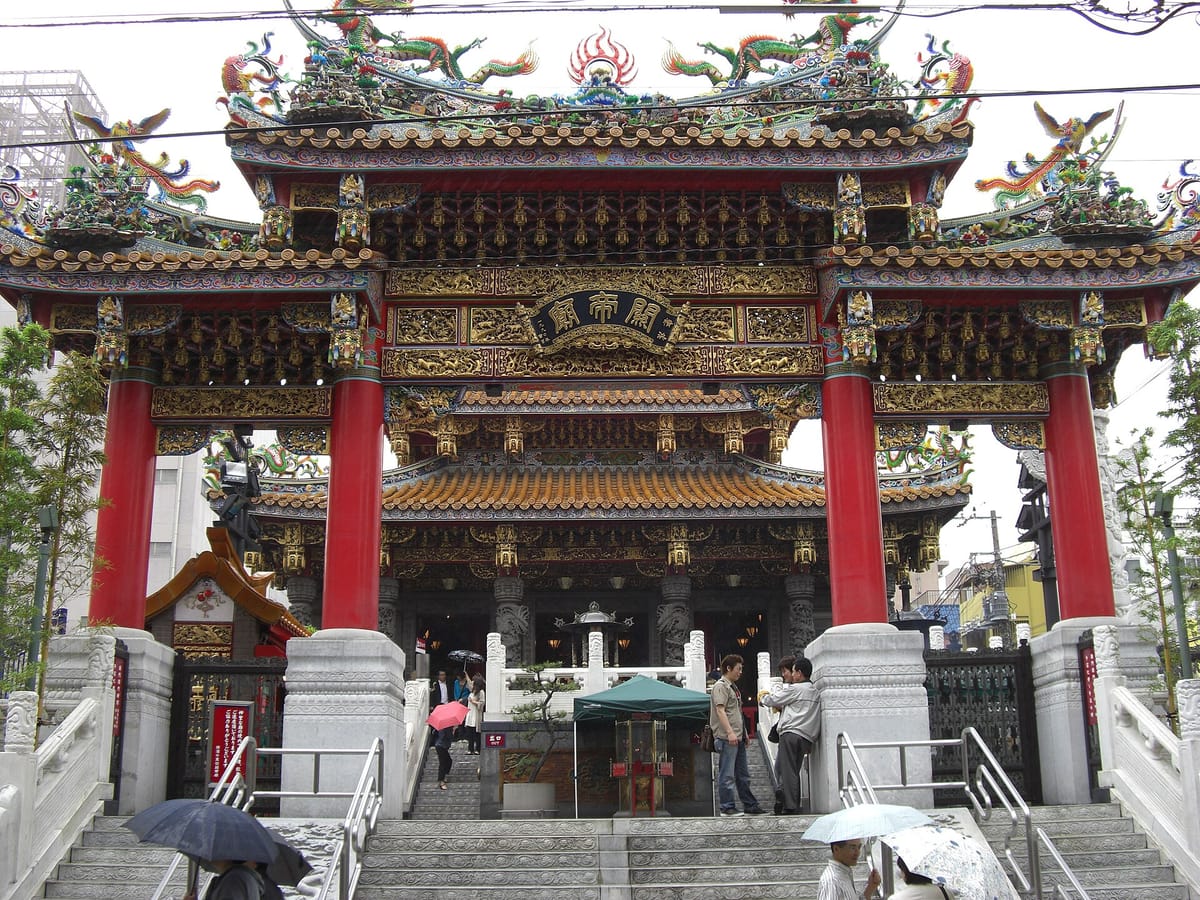
Kanteibyō, on a street marked by its own pair of gates, is dedicated to Guan Yu, a general of the Three Kingdoms period who is worshipped as a god of loyalty and of business. The temple has been rebuilt several times since the nineteenth century, and its present hall dates from 1990. Masobyō, completed in 2006, honours Mazu, the goddess who protects sailors and travellers by sea. Both are covered in carved dragons, painted beams and gold.
Between them, the main street Chūkagai Ōdōri, the narrower Ichiba-dōri market street and the side lanes hold restaurants, bakeries, tea shops, grocers and fortune tellers. Motomachi's shopping street, the hilltop Yamate district of old Western houses and the waterfront of Yamashita Park are all within a short walk.
- Zenrinmon: the gate on the main street, symbol of Chinatown.
- Chōyōmon: the large blue east gate by Motomachi-Chūkagai Station.
- Kanteibyō: the temple of Guan Yu, a patron of business, with its carved roof and stone stairs.
- Masobyō: the temple of Mazu, the sea goddess, completed in 2006.
- Chūkagai Ōdōri and Ichiba-dōri: the main street and the market street, lined with food.
- Yamashita-chō Park: a small square inside Chinatown to sit down and eat.
- Yamashita Park: the harbourside park a few minutes away.
Words on the gates, menus and shop boards
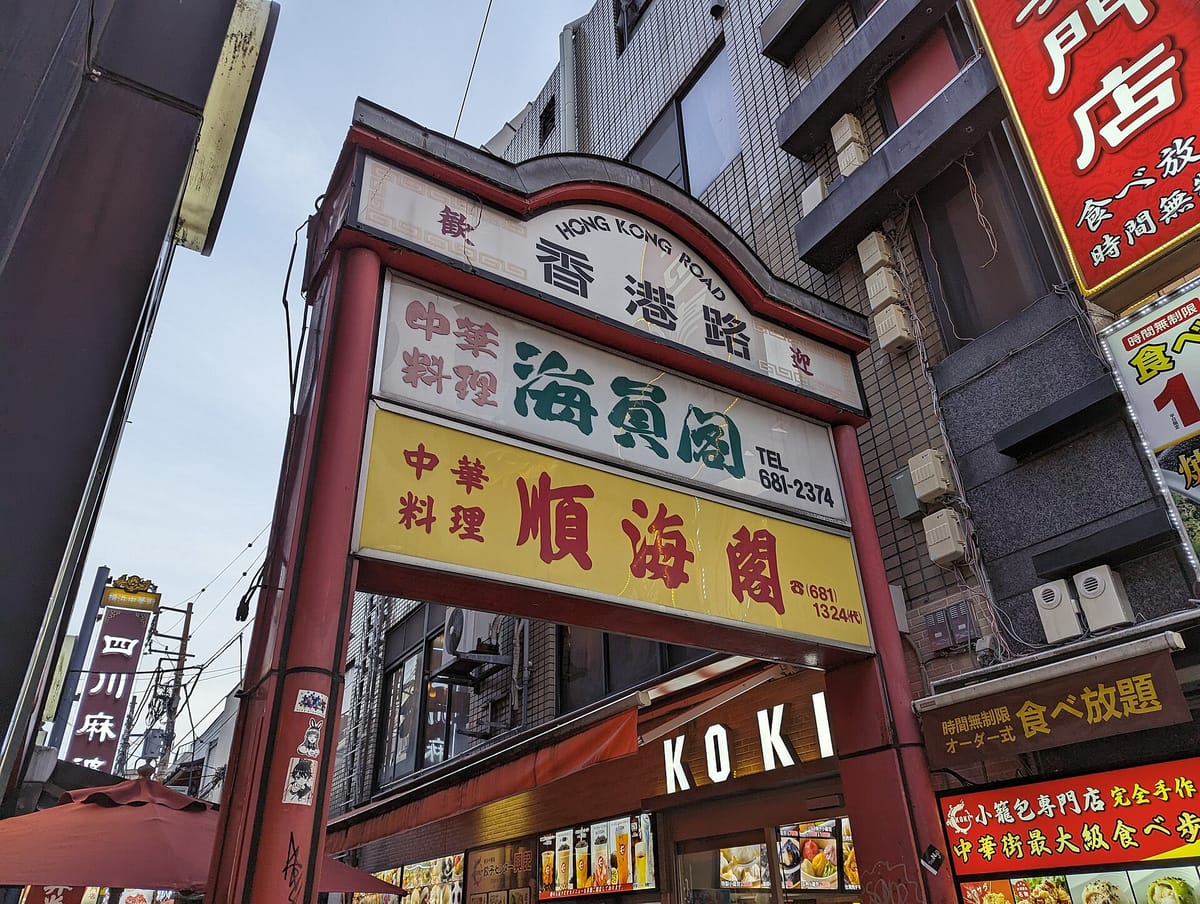
Chinatown's signs mix Japanese readings of Chinese words with katakana for dish names that are said the Chinese way. Temples end in 廟, byō, a word for a Chinese-style shrine, and gates end in 門, mon. On the food boards, the words you will see most are the names of the snacks and the promise of all you can eat.
The table below lists the words on the gates and the menus that you will meet in the first ten minutes.
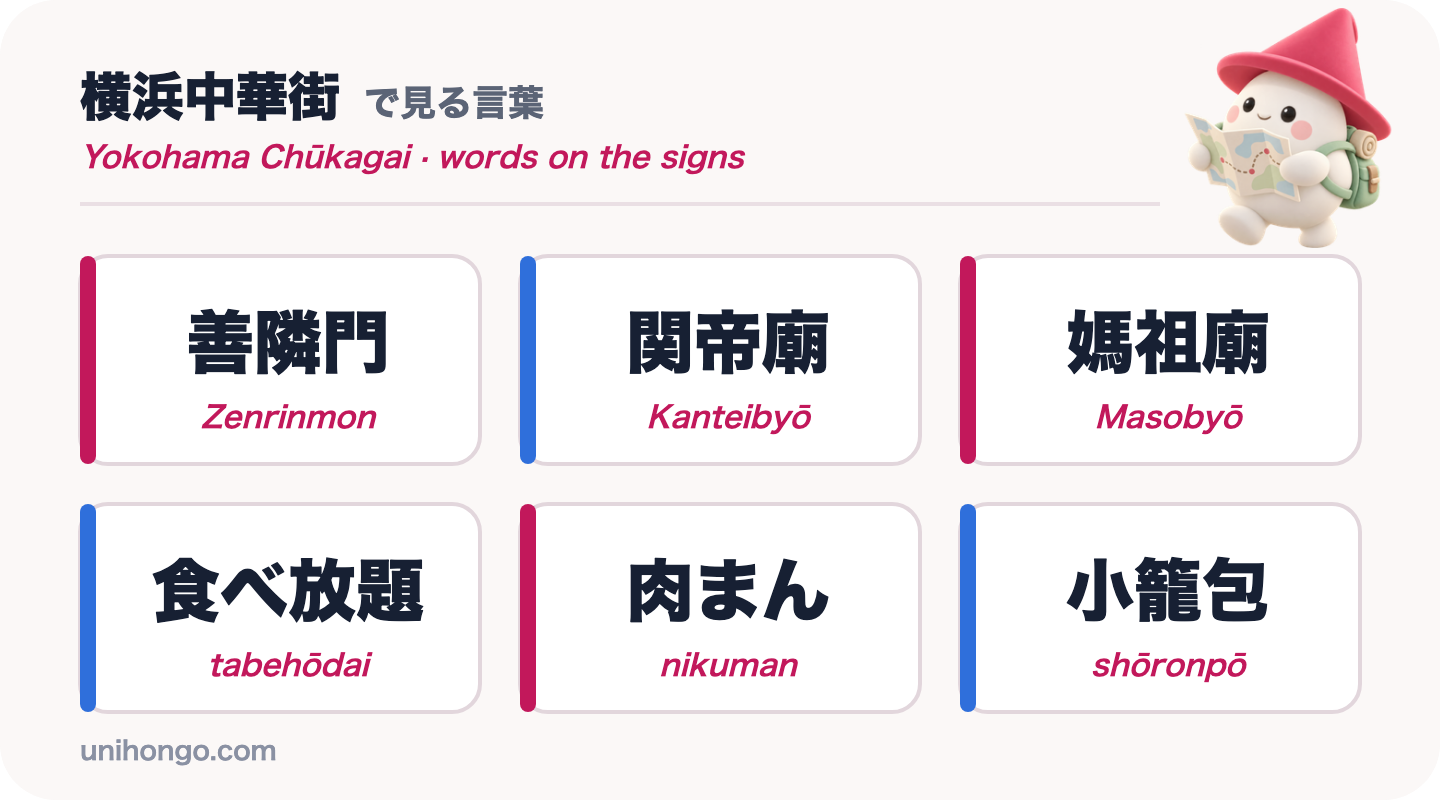
| Word | Reading | Meaning |
|---|---|---|
| 中華街 | Chūkagai | Chinatown |
| 善隣門 | Zenrinmon | Main street gate, the gate of good neighbours |
| 朝陽門 | Chōyōmon | East gate, the gate of the rising sun |
| 関帝廟 | Kanteibyō | Temple of Guan Yu |
| 媽祖廟 | Masobyō | Temple of Mazu, the sea goddess |
| 食べ放題 | tabehōdai | All you can eat |
| 肉まん | nikuman | Steamed pork bun |
| 小籠包 | shōronpō | Soup dumplings, xiaolongbao |
| 焼き小籠包 | yaki-shōronpō | Pan-fried soup dumplings |
| ごま団子 | goma dango | Fried sesame balls |
| 甘栗 | amaguri | Roasted sweet chestnuts |
| 持ち帰り | mochikaeri | Takeaway |
Japanese for ordering at stalls and restaurants
At a street stall the exchange is short: name the food, add a counter and kudasai. Staff may ask whether you want a bag, fukuro, or whether you will eat now, and they will usually warn you that soup dumplings are hot inside. Bite a small hole and let the soup cool before you eat the rest.
In a sit-down restaurant, you will be asked how many people, nanmei-sama, and offered a menu, often with a set lunch or an all-you-can-eat course where dishes are ordered from a list rather than taken from a buffet. Sharing plates, torizara, are normal, and it is fine to ask which dishes are spicy.
| Japanese | Romaji | Meaning |
|---|---|---|
| 焼き小籠包をひとつください。 | Yaki-shōronpō o hitotsu kudasai. | One portion of pan-fried soup dumplings, please. |
| おすすめは何ですか。 | Osusume wa nan desu ka. | What do you recommend? |
| 辛くない料理はどれですか。 | Karakunai ryōri wa dore desu ka. | Which dishes are not spicy? |
| 食べ放題は時間制限がありますか。 | Tabehōdai wa jikan seigen ga arimasu ka. | Is there a time limit on the all-you-can-eat course? |
| 取り皿をもらえますか。 | Torizara o moraemasu ka. | Could we have some sharing plates? |
| 残りを持ち帰りできますか。 | Nokori o mochikaeri dekimasu ka. | Can I take the rest away? |
| お会計をお願いします。 | O-kaikei o onegai shimasu. | The bill, please. |
Food manners and practical tips
The Chinatown association has published requests for visitors, and following them keeps the busy streets pleasant for everyone.
- Stop in a safe spot to eat rather than eating while walking, and take extra care with food on skewers in crowded streets.
- Do not sit or stand eating in front of another shop's entrance; Yamashita-chō Park inside Chinatown has space to sit.
- Return takeaway rubbish to the Chinatown association's bins, or carry it with you.
- Chestnut sellers often offer samples; a polite kekkō desu, no thank you, is enough if you do not want to buy.
- Come at a weekday lunchtime for shorter queues; weekend afternoons are very crowded.
Practise ordering before you go
The most common conversation in Chinatown lasts about ten seconds: you order, the stall worker asks if you want a bag, and you say you will eat here. Practise the four lines below until they come out without thinking, including the polite o-ire shimasu ka, shall I put them in, which you will hear at shop counters all over Japan.
Then practise with a partner who answers back. In Unihongo, choose the Restaurant topic and ask your AI Sensei to play a stall worker in Chinatown, or try the Order at a Café mission for more counter practice. Saying the lines aloud once makes the real exchange quick and relaxed.
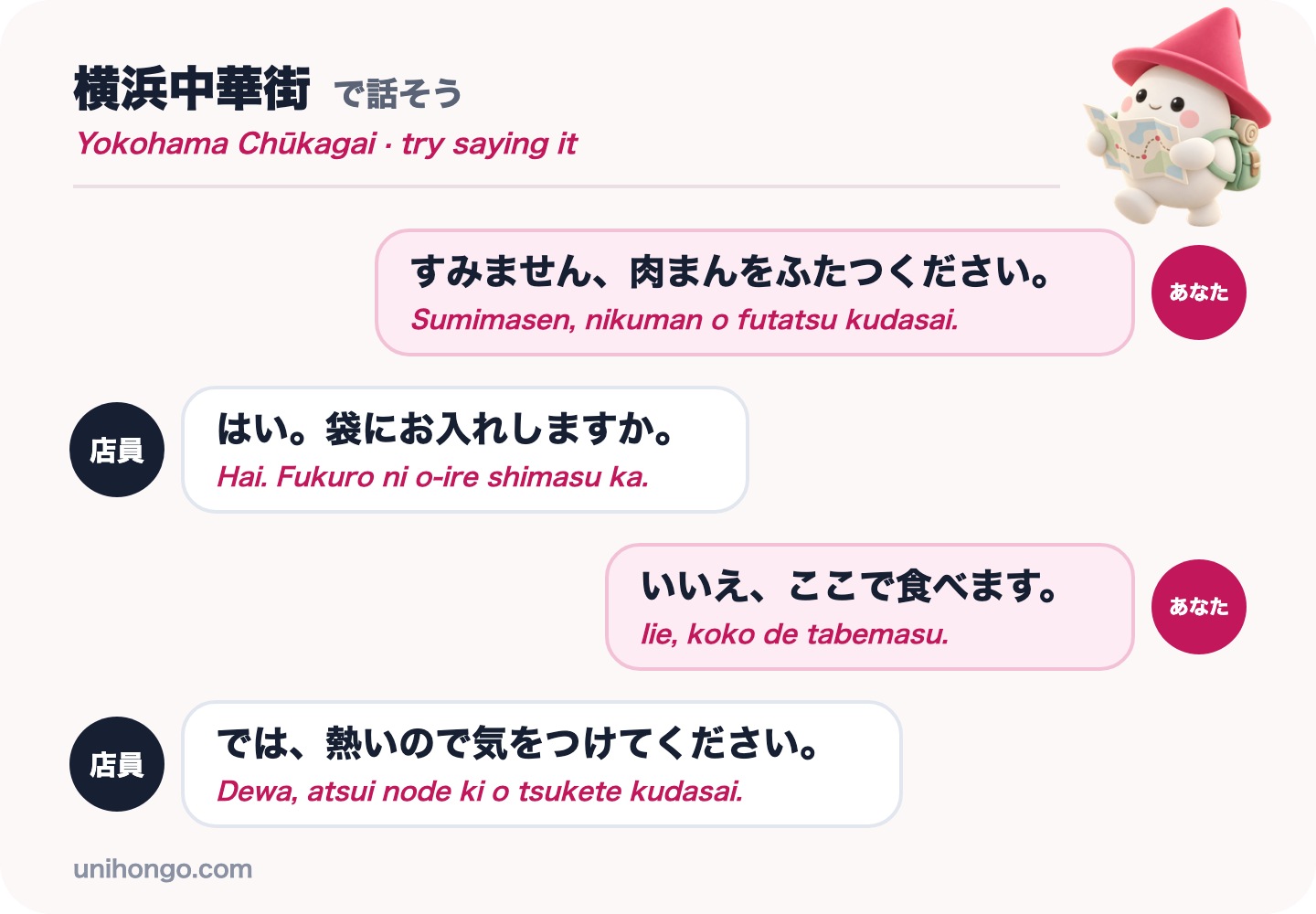
| Japanese | Romaji | Meaning |
|---|---|---|
| すみません、肉まんをふたつください。 | Sumimasen, nikuman o futatsu kudasai. | Excuse me, two pork buns, please. |
| はい。袋にお入れしますか。 | Hai. Fukuro ni o-ire shimasu ka. | Certainly. Shall I put them in a bag? |
| いいえ、ここで食べます。 | Iie, koko de tabemasu. | No, I will eat them here. |
| では、熱いので気をつけてください。 | Dewa, atsui node ki o tsukete kudasai. | Then please be careful, they are hot. |
Official information
The Chinatown association's site lists restaurants and shops, festival dates and its current requests about eating in the street, and the city's visitor site covers the wider Yokohama waterfront. Check them for Lunar New Year and other event dates.