

Why a night at the Takarazuka Revue is unforgettable
Ichizō Kobayashi, who built up the Hankyū railway, opened a hot spring resort in Takarazuka in 1911 to bring passengers out along his line. When part of the resort, an indoor pool, failed to attract visitors, it was turned into a theatre, and a troupe of young women gave the first performance there on 1 April 1914. Kobayashi wanted popular theatre that whole families could enjoy together, and his motto for the company, kiyoku, tadashiku, utsukushiku, is translated by the revue as modesty, fairness and grace.
The company grew quickly. Flower and Moon troupes were formed in 1921, Snow in 1924, Star in 1933 and Cosmos in 1998, and each has its own colour and style. Around eighty actresses belong to each troupe, and every one of them has trained for two years at the Takarazuka Music School before making her debut on the Grand Theater stage. The repertoire ranges from original works to adaptations of Western musicals, novels and manga, with The Rose of Versailles the best-known title of all.
For a learner, a Takarazuka performance is an immersion in stage Japanese: clear, beautifully projected, often formal, and full of dramatic phrases. Even if you follow only the outline of the story, the songs and the finale carry the evening, and the theatre, shops and fans around you give you plenty of real Japanese to hear.
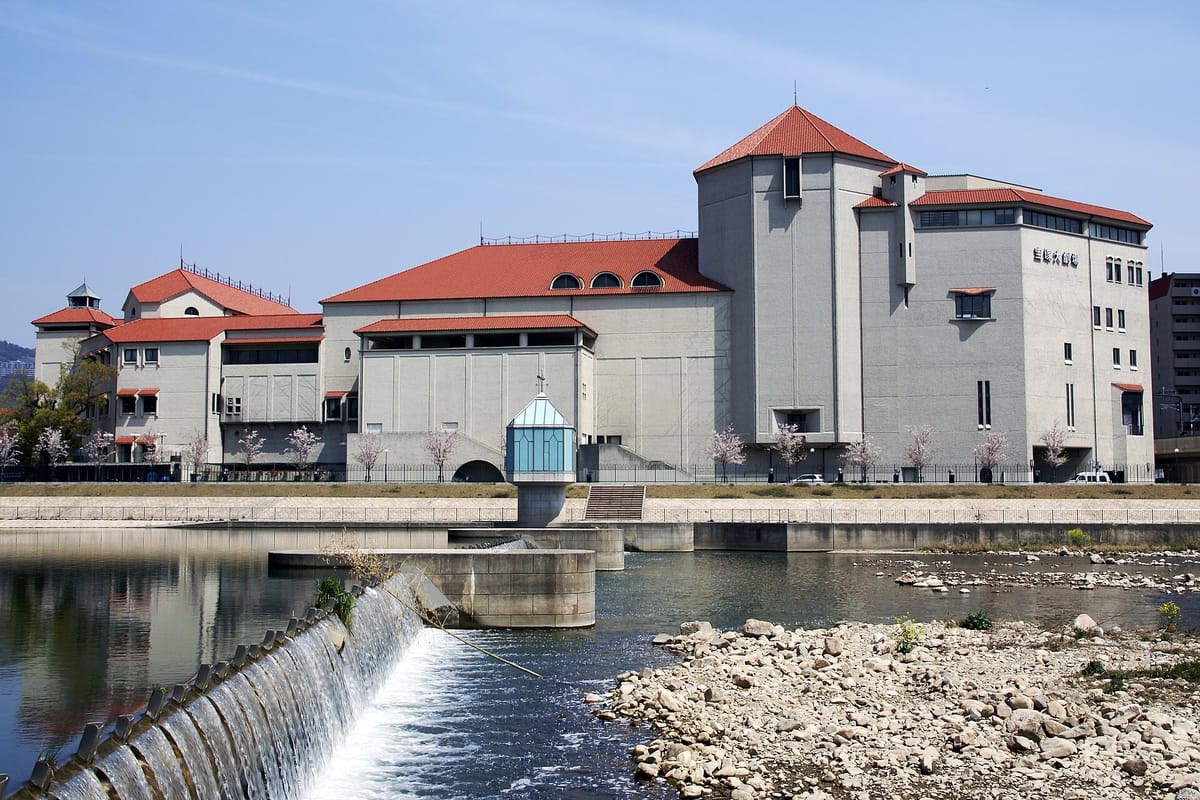
Getting there: Takarazuka Station and the Hana no Michi
Takarazuka is in Hyōgo Prefecture, between Osaka and Kobe. Both Hankyū Takarazuka Station, the terminus of the Hankyū Takarazuka Line from Osaka-Umeda, and JR Takarazuka Station are close together, and the official site says the Grand Theater is about ten minutes on foot from Takarazuka Station. From Kobe, you can change to the Hankyū Imazu Line at Nishinomiya-Kitaguchi.
The walk from the stations follows the Hana no Michi, the flower path, a promenade lined with trees and shops that leads towards the theatre along the Muko River. On performance days it is busy with fans before and after the show, and it is part of the ritual of the visit.
| Japanese | Romaji | Meaning |
|---|---|---|
| 宝塚大劇場へはどう行けばいいですか。 | Takarazuka Dai Gekijō e wa dō ikeba ii desu ka. | How do I get to the Takarazuka Grand Theater? |
| 宝塚行きの急行はどのホームですか。 | Takarazuka-yuki no kyūkō wa dono hōmu desu ka. | Which platform is the express to Takarazuka? |
| 花のみちはこの先ですか。 | Hana no Michi wa kono saki desu ka. | Is the Hana no Michi ahead of here? |
| 駅から劇場まで歩いて何分ですか。 | Eki kara gekijō made aruite nanpun desu ka. | How many minutes' walk from the station to the theatre? |
| 帰りの電車は何時が最終ですか。 | Kaeri no densha wa nanji ga saishū desu ka. | What time is the last train back? |
The show: a play, a revue and the grand staircase
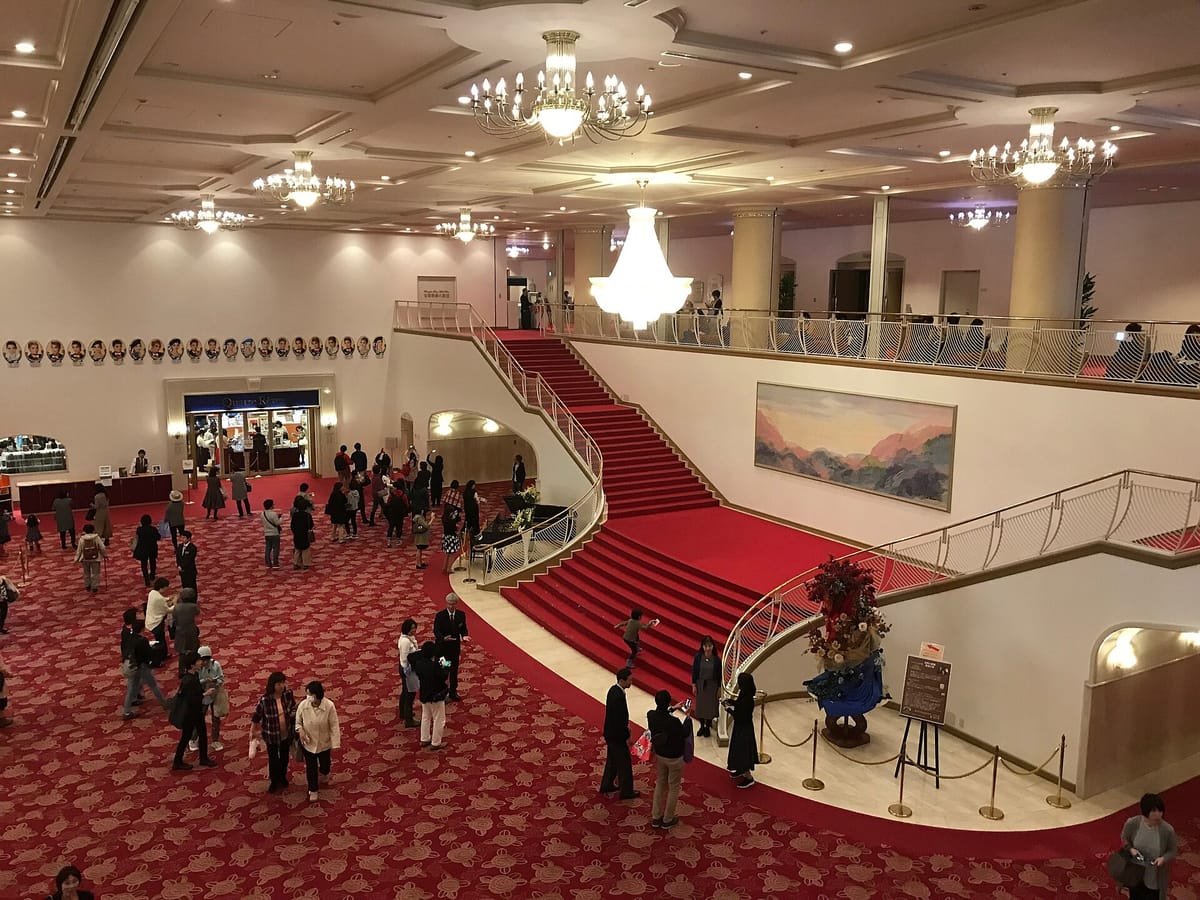
Most performances come in two parts: a play or musical first, then, after an interval, a show or revue of songs and dances. Some programmes have three sections, and some are a single long musical. The revue builds to a finale in which the whole troupe descends a huge staircase, the ōkaidan, in sequins and feathers, with the top star last and wearing the largest plume of feathers on her back.
The Grand Theater is a large, plush house on several floors, and there is more to it than the stage. Inside the building you can find the official shops, a small museum about the revue, and Salon de Takarazuka, where you can try on stage costumes. Arrive early to explore, and stay a little after the show to watch the audience spill out, many of them long-time fans.
- The play: the first half, a drama or musical, often with a period or foreign setting.
- Makuai: the interval between the two halves.
- The revue: songs, dance and costume changes, ending in the finale.
- The ōkaidan: the grand staircase used for the finale.
- Top star: the leading otokoyaku of the troupe, the last to come down the stairs.
- Salon de Takarazuka: a studio in the building where you can try on costumes.
- Hana no Michi: the promenade from the stations to the theatre.
Theatre words on tickets and signs
Tickets and schedules use a small set of theatre words. The curtain-up time is 開演, kaien, and the end is 終演, shūen, so the printed times on a ticket or poster usually read 開演 followed by a time. The interval is 幕間, makuai, literally between the curtains.
Seats are described by floor and seat class. 一階席, ikkaiseki, is the ground floor and 二階席, nikaiseki, the upper floor, and the classes are marked with letters such as S. The table below covers the words you will meet.
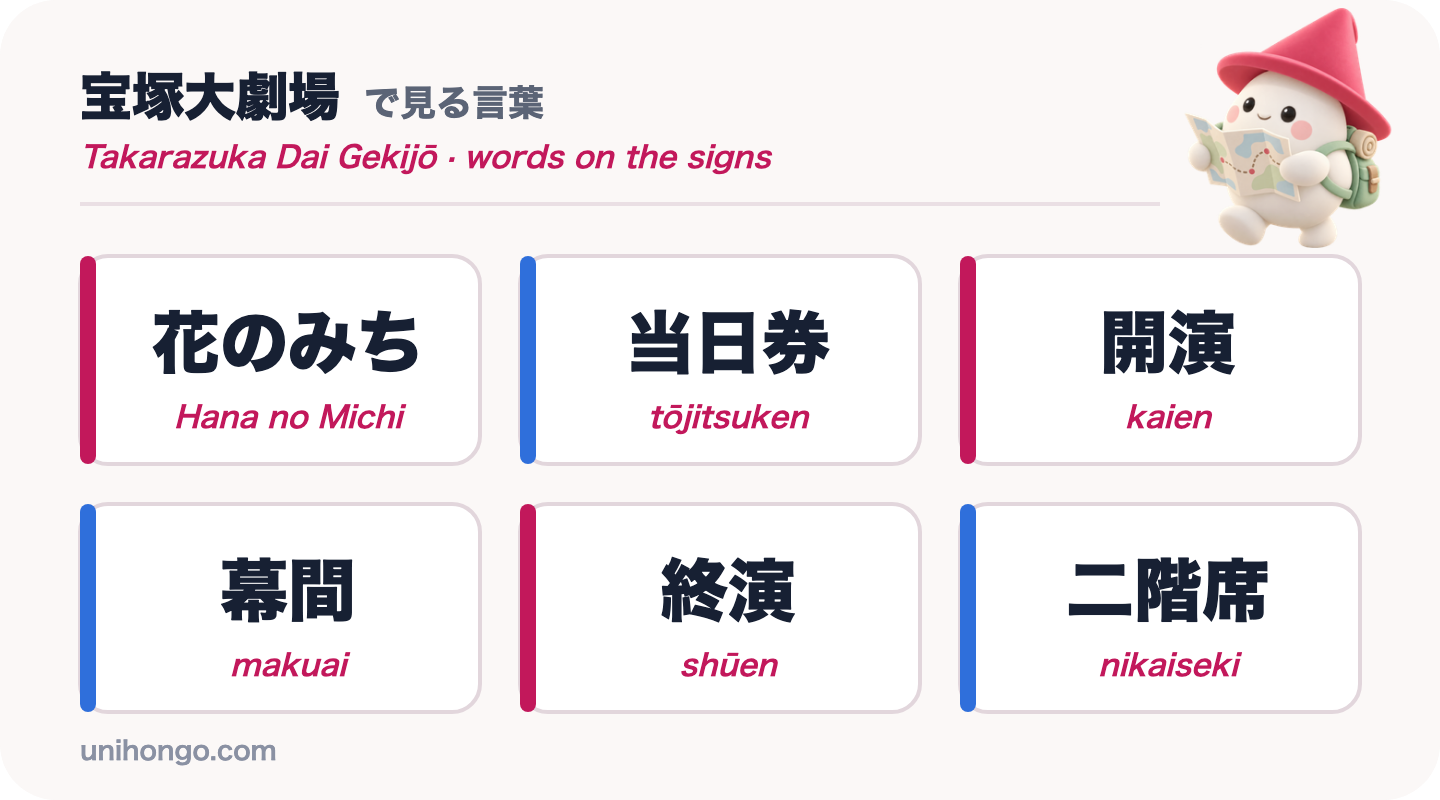
| Word | Reading | Meaning |
|---|---|---|
| 花のみち | Hana no Michi | The promenade to the theatre |
| 当日券 | tōjitsuken | Same-day ticket |
| 開演 | kaien | Curtain up, start of the performance |
| 幕間 | makuai | Interval |
| 終演 | shūen | End of the performance |
| 二階席 | nikaiseki | Upper-floor seats |
| 男役 | otokoyaku | Actress who plays male roles |
| 娘役 | musumeyaku | Actress who plays female roles |
| 組 | kumi | Troupe, as in 花組, Hanagumi, Flower Troupe |
Japanese at the box office and in the interval
If you are hoping for a same-day ticket, the box office is the place for your Japanese. Ask whether tickets remain, which seats are left, and whether you can see the stage well from them. Staff will show you a seating chart; pointing and a few words work well.
In the interval, the lobbies fill with people buying programmes, photos and snacks. The phrases below cover the box office, the seats and the interval.
| Japanese | Romaji | Meaning |
|---|---|---|
| 今日の公演のチケットはまだありますか。 | Kyō no kōen no chiketto wa mada arimasu ka. | Are there still tickets for today's performance? |
| 一番安い席はどこですか。 | Ichiban yasui seki wa doko desu ka. | Where are the cheapest seats? |
| 二階席から舞台はよく見えますか。 | Nikaiseki kara butai wa yoku miemasu ka. | Can you see the stage well from the upper floor? |
| 開演は何時ですか。 | Kaien wa nanji desu ka. | What time does the performance start? |
| プログラムはどこで買えますか。 | Puroguramu wa doko de kaemasu ka. | Where can I buy a programme? |
| 終演は何時ごろですか。 | Shūen wa nanji goro desu ka. | About what time does it finish? |
Theatre manners and practical tips
Takarazuka audiences are attentive and well-mannered, and the theatre publishes its own etiquette guidelines. A few habits help you fit in.
- Buy tickets as early as possible, through the English ticket service, and keep same-day tickets as a backup.
- Read the English performance information on the official site before the show; there are no subtitles.
- Switch off your phone and do not take photos or recordings during the performance.
- Keep hats off and sit back in your seat so the people behind can see.
- Applaud with the audience; fans know when to clap, and following them is the easiest way to join in.
- Check the performance schedule for days without shows, and allow time for the shops and the museum.
Practise the box office before you go
The two questions to rehearse are whether same-day tickets remain and how long the interval is. Practise the four lines below until you can say them without looking, and listen for nikaiseki, upper-floor seats, and the length of the interval in the replies.
Then practise with a partner who answers back. In Unihongo, choose the Shopping topic and ask your AI Sensei to play the box office clerk, or use the Cultural Etiquette topic to rehearse theatre manners. Saying the lines once before you go is what makes them easy at the window.
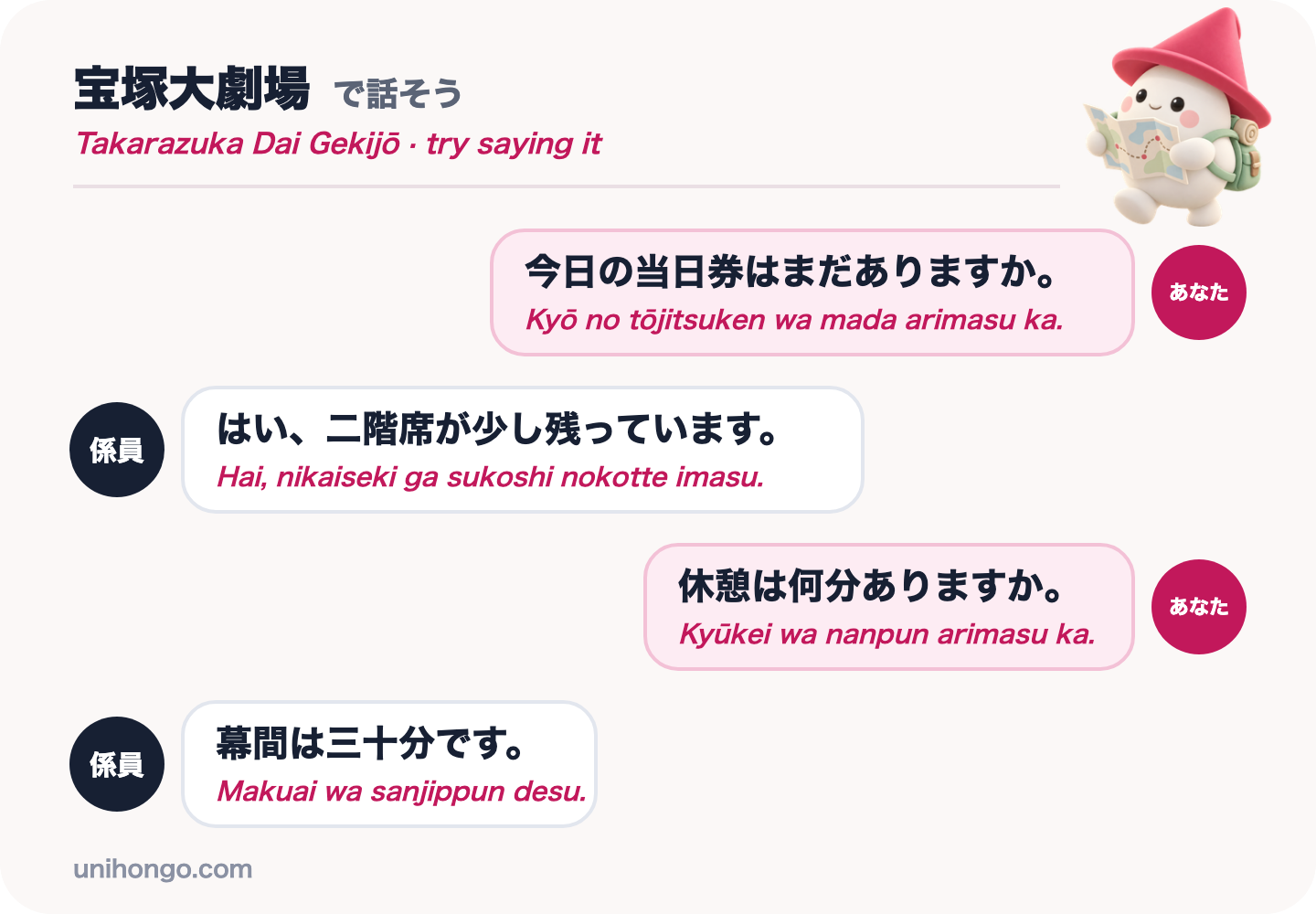
| Japanese | Romaji | Meaning |
|---|---|---|
| 今日の当日券はまだありますか。 | Kyō no tōjitsuken wa mada arimasu ka. | Are there still same-day tickets for today? |
| はい、二階席が少し残っています。 | Hai, nikaiseki ga sukoshi nokotte imasu. | Yes, there are a few upper-floor seats left. |
| 休憩は何分ありますか。 | Kyūkei wa nanpun arimasu ka. | How many minutes is the break? |
| 幕間は三十分です。 | Makuai wa sanjippun desu. | The interval is thirty minutes. |
Official information
The Takarazuka Revue's English website lists current performances, ticket sales for overseas visitors and theatre information. Check the performance page for your date before you travel.