
Yaki, sui, age: three ways gyoza arrive
The word in front of gyōza tells you the cooking method. Yaki (焼き) is grilled or pan-fried, sui (水) is water, and age (揚げ) is deep-fried. Pan-fried is so standard in Japan that menus often drop the yaki.
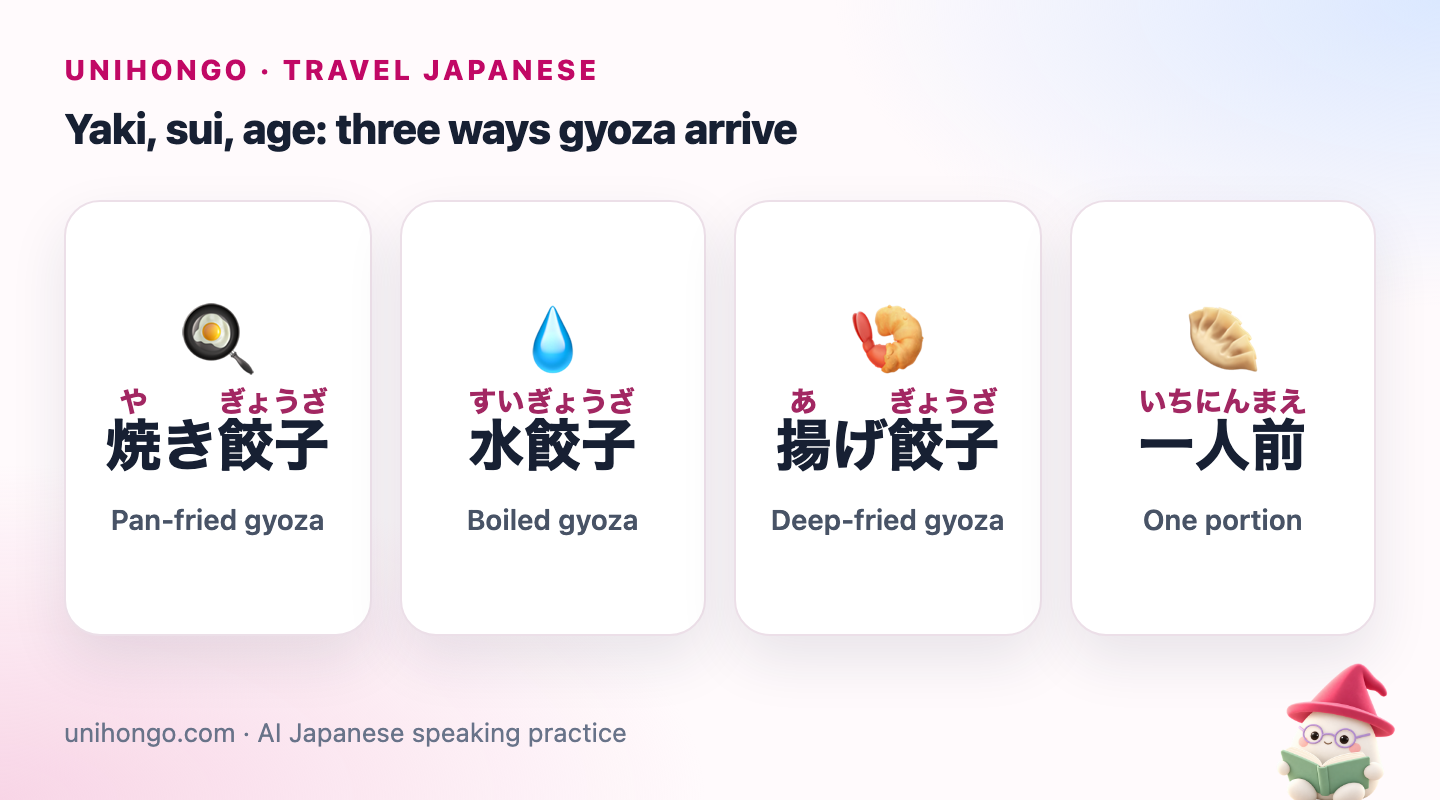
| Japanese | Romaji | Meaning |
|---|---|---|
| 焼き餃子 | Yaki gyōza | Pan-fried gyoza |
| 水餃子 | Sui gyōza | Boiled gyoza |
| 揚げ餃子 | Age gyōza | Deep-fried gyoza |
| 一人前 | Ichinin-mae | One portion |
| 蒸し餃子 | Mushi gyōza | Steamed gyoza |
| 羽根つき | Hanetsuki | With a crisp wing |
Pan-fried gyoza are served browned side up. The wrapper is the kawa (皮) and the filling, usually minced pork, cabbage and garlic chives, is the an (あん).
Portions and pieces: ninmae and ko
Gyoza is ordered by the portion, with the counter ninmae (人前), literally a serving for that many people. One person can happily order two portions; the word counts plates, not diners. Single dumplings are counted with ko (個).
| Japanese | Romaji | Meaning |
|---|---|---|
| 二人前 | Ninin-mae | Two portions |
| 三人前 | Sannin-mae | Three portions |
| 一人前は何個ですか。 | Ichinin-mae wa nanko desu ka. | How many pieces are in one portion? |
| 6個です。 | Rokko desu. | Six pieces. |
The order, in the order it happens
Gyoza is cooked after you order, so staff often warn you about the wait. The second plate is ordered the same way as the first, with mō, more, in front.
| Japanese | Romaji | Meaning |
|---|---|---|
| ご注文はお決まりですか。 | Gochūmon wa okimari desu ka. | Staff: Have you decided on your order? |
| 焼き餃子を二人前お願いします。 | Yaki gyōza o ninin-mae onegai shimasu. | You: Two portions of pan-fried gyoza, please. |
| 少しお時間をいただきます。 | Sukoshi ojikan o itadakimasu. | Staff: It will take a little time. |
| はい、大丈夫です。 | Hai, daijōbu desu. | You: That is fine. |
| もう一人前お願いします。 | Mō ichinin-mae onegai shimasu. | You: One more portion, please. |
| 持ち帰りはできますか。 | Mochikaeri wa dekimasu ka. | You: Can I get some to take away? |
Many gyoza shops sell boxes to take home, cooked or raw. Raw ones for frying at home are nama gyōza (生餃子).
Mix your own dipping sauce
No sauce comes with the plate. Instead, a small empty dish, a kozara (小皿), and a row of bottles sit on the table, and you mix your own. There is no correct ratio; regulars argue about it happily.
| Japanese | Romaji | Meaning |
|---|---|---|
| 醤油 | Shōyu | Soy sauce |
| 酢 | Su | Vinegar |
| ラー油 | Rāyu | Chili oil |
| 酢こしょう | Su koshō | Vinegar with black pepper |
| 小皿をもう一枚ください。 | Kozara o mō ichimai kudasai. | One more small dish, please. |
Some shops also put out a ready-mixed bottle labelled gyōza no tare (餃子のたれ). If the bottles are unlabelled, the dark one is soy sauce, the pale one is vinegar and the red oil with sediment is rāyu. Chili oil is strong, so start with a few drops.
Garlic or no garlic
Garlic, ninniku (にんにく), is a normal part of the filling, and its smell lingers. Shops near offices know this, so many offer a garlic-less version or state clearly which kind they serve. Iri (入り) means containing and nashi (なし) means without.
| Japanese | Romaji | Meaning |
|---|---|---|
| にんにく入り | Ninniku iri | With garlic |
| にんにくなし | Ninniku nashi | Without garlic |
| にんにくは入っていますか。 | Ninniku wa haitte imasu ka. | Does it contain garlic? |
| にんにくなしでお願いします。 | Ninniku nashi de onegai shimasu. | Without garlic, please. |
Sets: gyōza teishoku and the ramen pair
In Japan gyoza is usually a side dish, eaten with rice or next to a bowl of ramen. A gyōza teishoku (餃子定食) is a set meal of gyoza, rice, soup and pickles. Ramen shops sell sets that add a plate of gyoza, sometimes with a half portion of fried rice.
| Japanese | Romaji | Meaning |
|---|---|---|
| 餃子定食 | Gyōza teishoku | Gyoza set meal |
| ラーメンと餃子のセット | Rāmen to gyōza no setto | Ramen and gyoza set |
| 半チャーハン | Han chāhan | Half portion of fried rice |
| ライス | Raisu | Plain rice, as a side order |
Utsunomiya and Hamamatsu: the rival gyoza cities
Utsunomiya (宇都宮) in Tochigi and Hamamatsu (浜松) in Shizuoka both claim the title of gyoza city, and each year their standing in a household spending ranking makes the news. Miyazaki has recently joined the race.
The styles differ a little. Hamamatsu gyoza are typically fried in a ring and served with boiled bean sprouts in the middle. Utsunomiya is known for its many specialist shops, where people order pan-fried, boiled and deep-fried plates side by side. These are tendencies, not rules, and every shop has its own recipe.