

Why Kōenji is worth a stop west of Shinjuku
Kōenji takes its name from Kōenji, a temple in the area, and for centuries it was a village on the western edge of Edo. The railway arrived in the 1920s, and after the war the district filled with small shops and wooden houses. It avoided the large-scale redevelopment of the 1980s, which is why the streets around the station still feel like an older, smaller Tokyo.
From the 1960s onwards, folk singers and rock musicians moved in, and from the 1970s small live music venues, raibu hausu, opened all over the neighbourhood. Used record shops, second-hand clothing stores and cheap bars followed. Today Kōenji is known as a relaxed, slightly scruffy place where students, musicians and older residents share the same shopping streets.
For a learner, Kōenji is an easy place to talk. Shops are small, owners are chatty, and vintage shopping involves real questions: size, era, fabric, fitting rooms. In the evening, the izakaya under the railway tracks are full of people happy to hear a visitor try some Japanese.
Getting there: the Chūō Line and the weekend trap
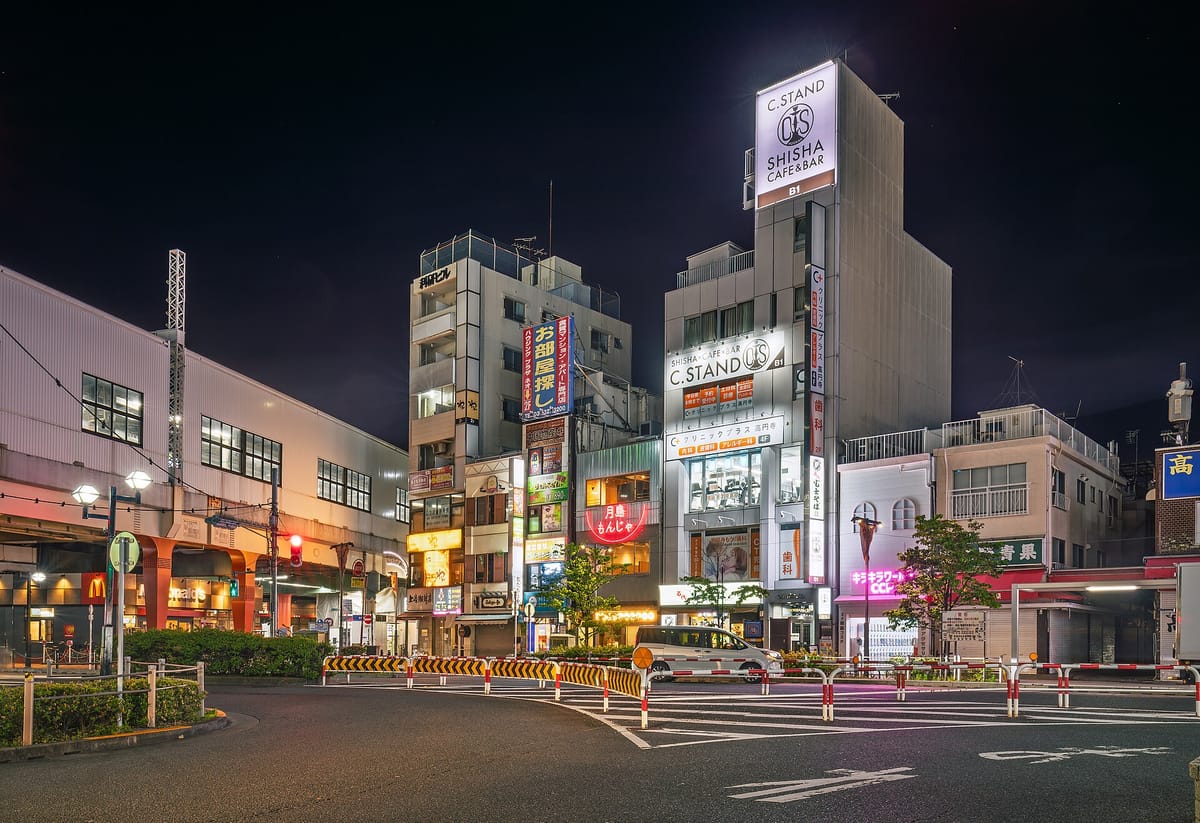
Kōenji Station is on the JR Chūō Line, one or two stops west of Shinjuku depending on the train. Two services share the line. The orange Chūō Line rapid stops at Kōenji only on weekdays; on Saturdays, Sundays and national holidays it runs straight through. The yellow Chūō-Sōbu local stops at every station, kakueki teisha, every day. At weekends, take the local from Shinjuku, or take the rapid to Nakano and change there.
The station has a north exit, kitaguchi, and a south exit, minamiguchi. Most vintage shops are to the south; the Junjō shopping street and more shops lie to the north. The Tokyo Metro Marunouchi Line's Shin-Kōenji Station is a walk of around ten to fifteen minutes to the south, at the far end of the shopping streets.
| Japanese | Romaji | Meaning |
|---|---|---|
| この電車は高円寺に止まりますか。 | Kono densha wa Kōenji ni tomarimasu ka. | Does this train stop at Kōenji? |
| 各駅停車は何番線ですか。 | Kakueki teisha wa nanbansen desu ka. | Which platform is the local train on? |
| 中野で乗り換えればいいですか。 | Nakano de norikaereba ii desu ka. | Should I change at Nakano? |
| 南口はどちらですか。 | Minamiguchi wa dochira desu ka. | Which way is the south exit? |
| 古着屋が多いのはどのあたりですか。 | Furugiya ga ōi no wa dono atari desu ka. | Which area has lots of vintage shops? |
What you will find: shopping streets, shrine and festival
Kōenji does not have one big sight. It is a neighbourhood to wander, drifting from one covered shopping street into the next and down side alleys where a record shop, a curry counter and a vintage store may share one small building. Start at the south exit for clothes, then cross under the tracks to the north side for cafés and more shops.
The shopping streets, shōtengai, are the backbone of the area, and each has its own name and character.
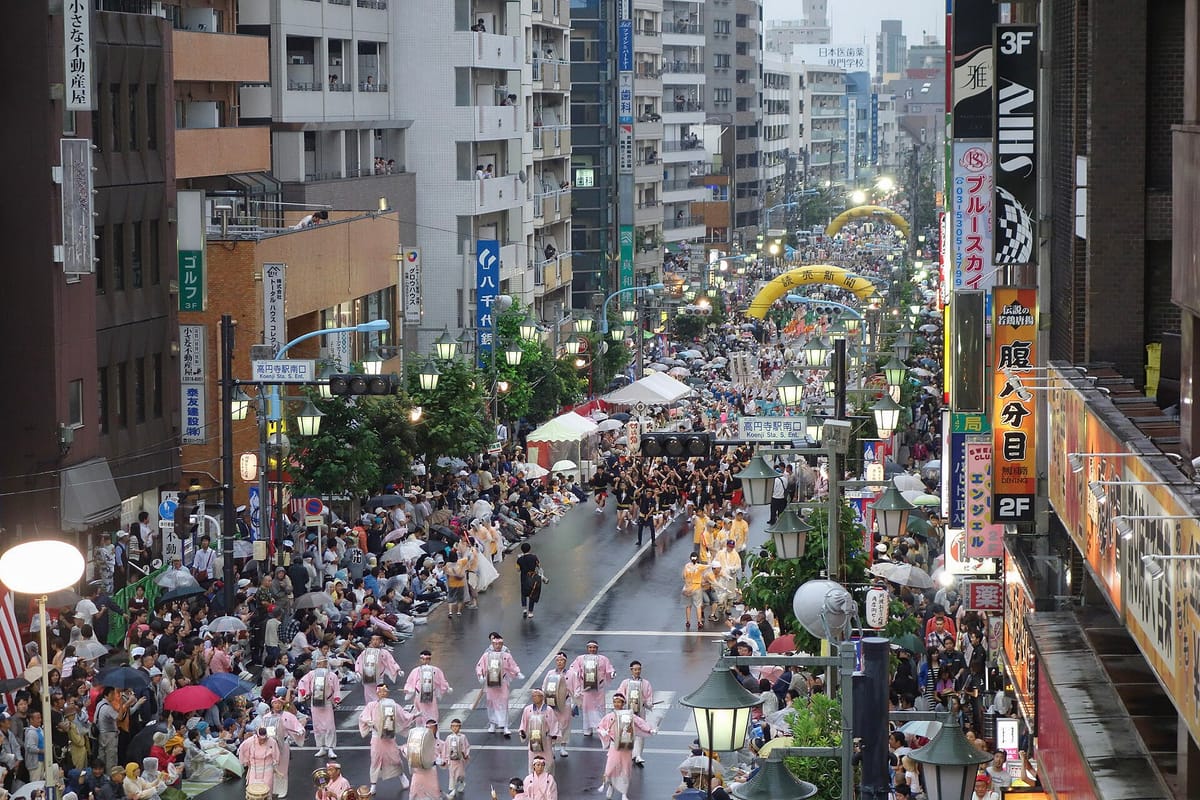
- Pal shōtengai: the covered arcade leading south from the station, with food shops, cafés, clothing and discount stores.
- Look shōtengai: the continuation south towards Shin-Kōenji, with many of the area's vintage clothing shops.
- Junjō shōtengai: the shopping street north of the station, named after the novel Kōenji Junjō Shōtengai by Nejime Shōichi, set in the area.
- Under the tracks: small yakitori stalls, izakaya and bars packed into the spaces beneath and beside the elevated railway.
- Kishō Jinja: a small shrine in the grounds of Kōenji Hikawa Jinja, a few minutes from the station, said to be the only shrine in Japan dedicated to the weather.
- Live houses and record shops: small music venues and used record stores scattered across both sides of the station.
- Tokyo Kōenji Awa Odori: the dance festival in late August, with thousands of dancers from Tokyo and beyond.
Words on the signs around the station
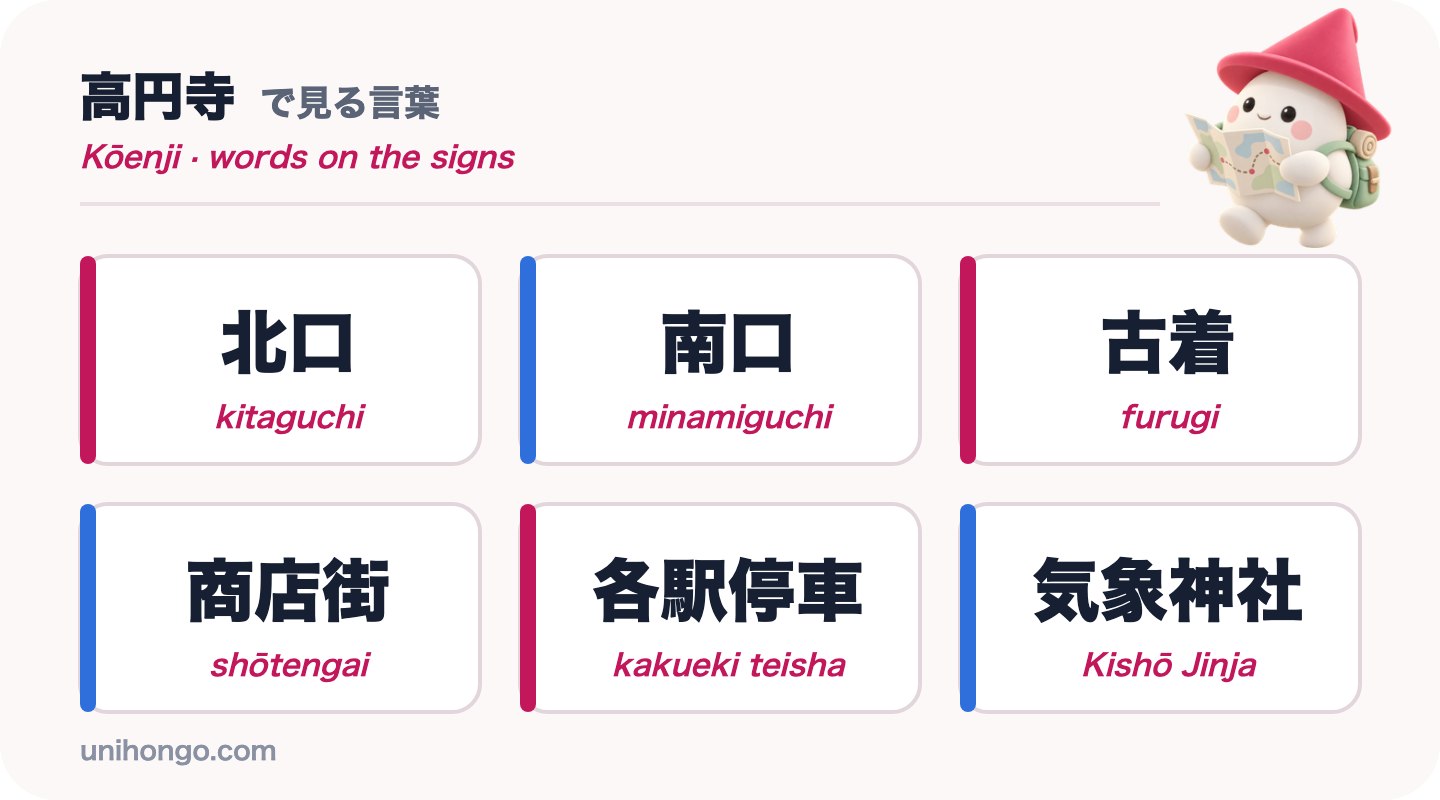
At the station, 各駅停車, kakueki teisha, is the train you want at weekends, and the exits are 北口 and 南口, north and south. On the streets, 商店街, shōtengai, is a shopping street, usually marked by a gate or an arch with its name. Shop signs saying 古着 mark vintage and second-hand clothing.
Inside the shops you will see 試着室, shichakushitsu, the fitting room, and sometimes a notice about how many items you may take in. Price tags may show a size, a measurement in centimetres or the word 一点もの, itten-mono, one of a kind.
| Word | Reading | Meaning |
|---|---|---|
| 北口 | kitaguchi | North exit |
| 南口 | minamiguchi | South exit |
| 各駅停車 | kakueki teisha | Local train, stopping at every station |
| 快速 | kaisoku | Rapid train, skips Kōenji at weekends |
| 商店街 | shōtengai | Shopping street |
| 古着 | furugi | Vintage or second-hand clothing |
| 試着室 | shichakushitsu | Fitting room |
| 気象神社 | Kishō Jinja | Weather shrine |
Japanese for vintage shopping
Vintage shops in Kōenji are small and personal, and the staff often choose every piece themselves. Ask before you try something on, since some shops limit the number of items you can take into the fitting room. Sizes can be confusing: Japanese sizes run small, and older American and European pieces use their own sizes, so ask for measurements if you are unsure.
Because each piece is usually the only one, a request for another size is often answered with itten-mono, one of a kind. It is still worth asking whether something similar is on another rail.
| Japanese | Romaji | Meaning |
|---|---|---|
| これ、試着してもいいですか。 | Kore, shichaku shite mo ii desu ka. | May I try this on? |
| 試着室はどこですか。 | Shichakushitsu wa doko desu ka. | Where is the fitting room? |
| もう少し大きいサイズはありますか。 | Mō sukoshi ōkii saizu wa arimasu ka. | Do you have a slightly bigger size? |
| これは何年代のものですか。 | Kore wa nan-nendai no mono desu ka. | Which decade is this from? |
| 着丈は何センチですか。 | Kitake wa nansenchi desu ka. | How long is it, in centimetres? |
| 似たようなものはありますか。 | Nita yō na mono wa arimasu ka. | Do you have anything similar? |
| カードは使えますか。 | Kādo wa tsukaemasu ka. | Can I pay by card? |
| 袋はいりません。 | Fukuro wa irimasen. | I don't need a bag. |
Etiquette, timing and practical tips
Kōenji is a residential neighbourhood as well as a shopping area, and a little care keeps it pleasant for everyone.
- Come after lunch. Many vintage and record shops open around midday, and the bars fill up from the evening.
- Check your train at weekends: the rapid does not stop at Kōenji on Saturdays, Sundays or national holidays.
- Ask before trying clothes on, and before photographing inside shops or photographing shop owners.
- Keep your voice down in the residential side streets, especially late at night.
- During the Awa Odori weekend, expect road closures and very crowded trains, and arrive early to find a place to watch.
- The grounds of Hikawa Jinja and the weather shrine close at night, so visit in the daytime.
- Carry some cash for small shops and izakaya, although many take cards and IC payments.
Practise the fitting room before you go
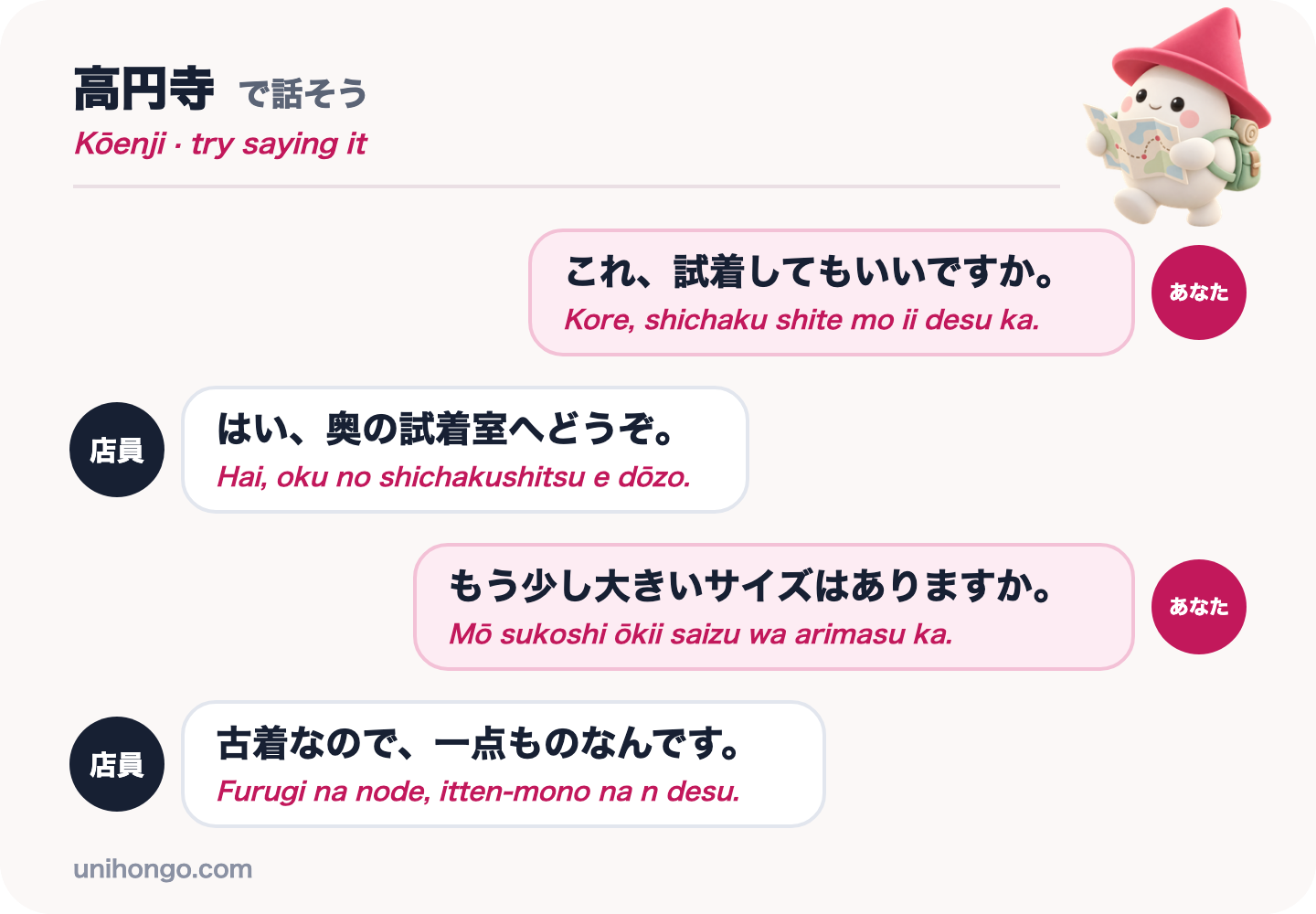
The conversation you will have most in Kōenji happens at the fitting room. The assistant's answer to the second question uses na n desu, which gives a reason gently: it is vintage, so each piece is one of a kind. It is a very common pattern for polite explanations, and worth recognising.
Practise the four lines aloud until you can say them without reading, then rehearse with a partner who answers back. In Unihongo, choose the Shopping topic and ask your AI Sensei to play a vintage shop assistant, then try the Izakaya topic for the evening.
| Japanese | Romaji | Meaning |
|---|---|---|
| これ、試着してもいいですか。 | Kore, shichaku shite mo ii desu ka. | May I try this on? |
| はい、奥の試着室へどうぞ。 | Hai, oku no shichakushitsu e dōzo. | Yes, please use the fitting room at the back. |
| もう少し大きいサイズはありますか。 | Mō sukoshi ōkii saizu wa arimasu ka. | Do you have a slightly bigger size? |
| 古着なので、一点ものなんです。 | Furugi na node, itten-mono na n desu. | It's vintage, so each piece is one of a kind. |
Official information
Kōenji has no single official site, but the Tokyo Kōenji Awa Odori association publishes each year's festival dates, road closures and seating, and Kōenji Hikawa Jinja has its own website with information about the weather shrine. Shops set their own hours, so check the ones you most want to visit.