

Why Pontochō is Kyoto's best evening alley
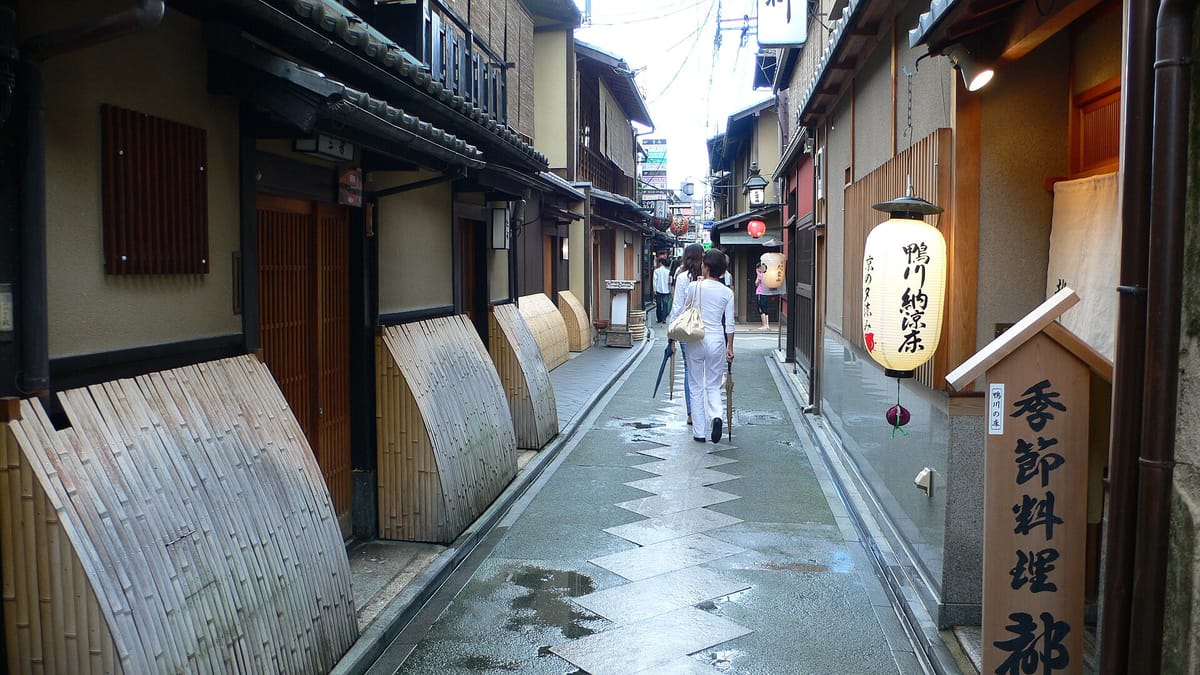
Teahouses first opened on this strip of land in the early eighteenth century, serving the boatmen and passengers of the Takase canal. In 1859 the district received permission for geiko to work here, and it grew into one of Kyoto's kagai, its geiko districts, alongside Gion. The houses with red lattice fronts, narrow side lanes and lanterns marked with a small plover still give it the feel of that world.
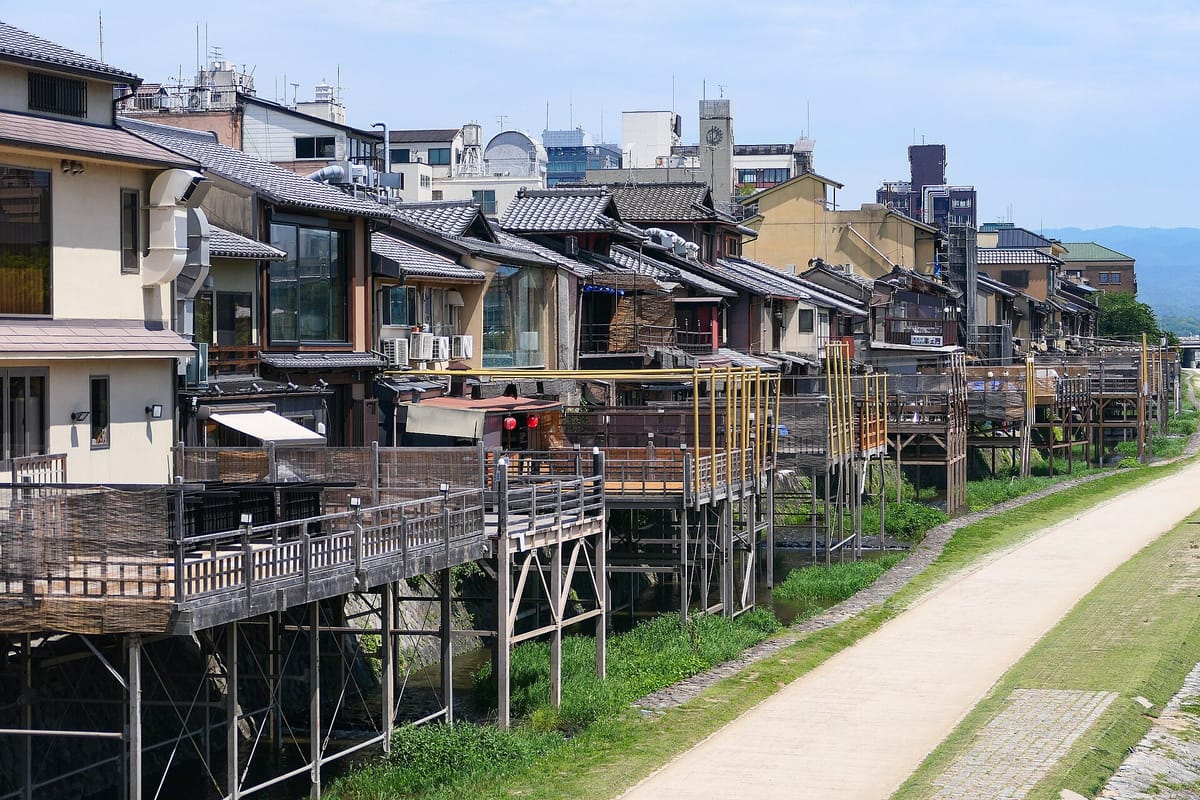
Today Pontochō is above all a place to eat and drink. The local shop association lists dozens of members along the single street, from Kyoto cuisine and tofu to Italian, okonomiyaki and late-night bars. On the east side, the backs of the restaurants face the Kamo River, and in summer they build their wooden yuka decks over the small Misosogi channel beside it, so diners sit in the evening breeze with the river and the eastern hills in front of them.
For a learner, Pontochō is a lesson in reading menus at the door, asking about seats and following polite restaurant Japanese. Hosts in the smaller places are often happy to chat once you sit at the counter.
Getting there: Shijō, Kawaramachi and Sanjō
Pontochō has two ends. The south end opens onto Shijō-dōri just west of Shijō Bridge, a few minutes from Keihan Gion-Shijō Station across the river and Hankyū Kyoto-Kawaramachi Station to the west. The north end is near Sanjō-dōri, a short walk from Keihan Sanjō Station and the Kyōto Shiyakusho-mae subway station. City buses stop at Shijō-Kawaramachi and Kawaramachi-Sanjō.
The entrance from Shijō is easy to miss: walking east towards the river, look for a narrow opening on your left, on the north side of the street, just before the bridge, marked by a sign with the name. Walking the full length takes ten minutes, and side alleys, roji, branch off to the east towards the river and to the west towards Kiyamachi and the Takase canal.
| Japanese | Romaji | Meaning |
|---|---|---|
| 先斗町の入口はどこですか。 | Pontochō no iriguchi wa doko desu ka. | Where is the entrance to Pontochō? |
| 四条大橋の手前を左ですか。 | Shijō Ōhashi no temae o hidari desu ka. | Do I turn left just before Shijō Bridge? |
| 歌舞練場は三条側ですか。 | Kaburenjō wa Sanjō-gawa desu ka. | Is the theatre on the Sanjō side? |
| この路地は川に出られますか。 | Kono roji wa kawa ni deraremasu ka. | Does this alley lead out to the river? |
| 近くに祇園四条駅はありますか。 | Chikaku ni Gion-Shijō-eki wa arimasu ka. | Is Gion-Shijō Station nearby? |
From Shijō to the Kaburenjō: what you will see
Walk Pontochō from south to north in the early evening, when the lanterns come on and the restaurants put out their menus. The street bends gently, so you never see more than a short stretch at once. Look for the bengara-gōshi, red-brown lattice fronts, the inuyarai bamboo screens at the base of the walls, and the small plover on the lanterns, the chidori that is Pontochō's crest.
To see the yuka from outside, go down to the riverbank path at Shijō Bridge and walk north: the platforms run in a long line above you, lit and full of diners on summer evenings. At the north end of the alley stands the Pontochō Kaburenjō, the theatre where the geiko and maiko perform the Kamogawa Odori each spring.
- The Shijō entrance: a narrow opening by Shijō Bridge, the usual starting point.
- Roji: numbered side alleys running towards the river and the canal.
- Chidori lanterns: the plover crest of Pontochō on lanterns and signs.
- Nōryō yuka: summer dining platforms behind the riverside restaurants.
- The Kamo riverbank: the path below the platforms, popular for evening strolls.
- Pontochō Kaburenjō: the district's theatre, home of the Kamogawa Odori.
Words on the signs and lanterns in Pontochō
Restaurant signs in Pontochō are often vertical wooden boards or lanterns with a few kanji. 床, yuka, on a board means the restaurant has a summer platform, and 納涼床, nōryō yuka, is the full name: a platform for enjoying the cool. おばんざい, obanzai, Kyoto home-style side dishes, appears on many counters, often with the day's dishes chalked on a board.
鴨川をどり is written with an old spelling: をどり instead of the modern おどり. Theatres and kagai keep the older kana for traditional performances, so you will also see 都をどり in Gion.
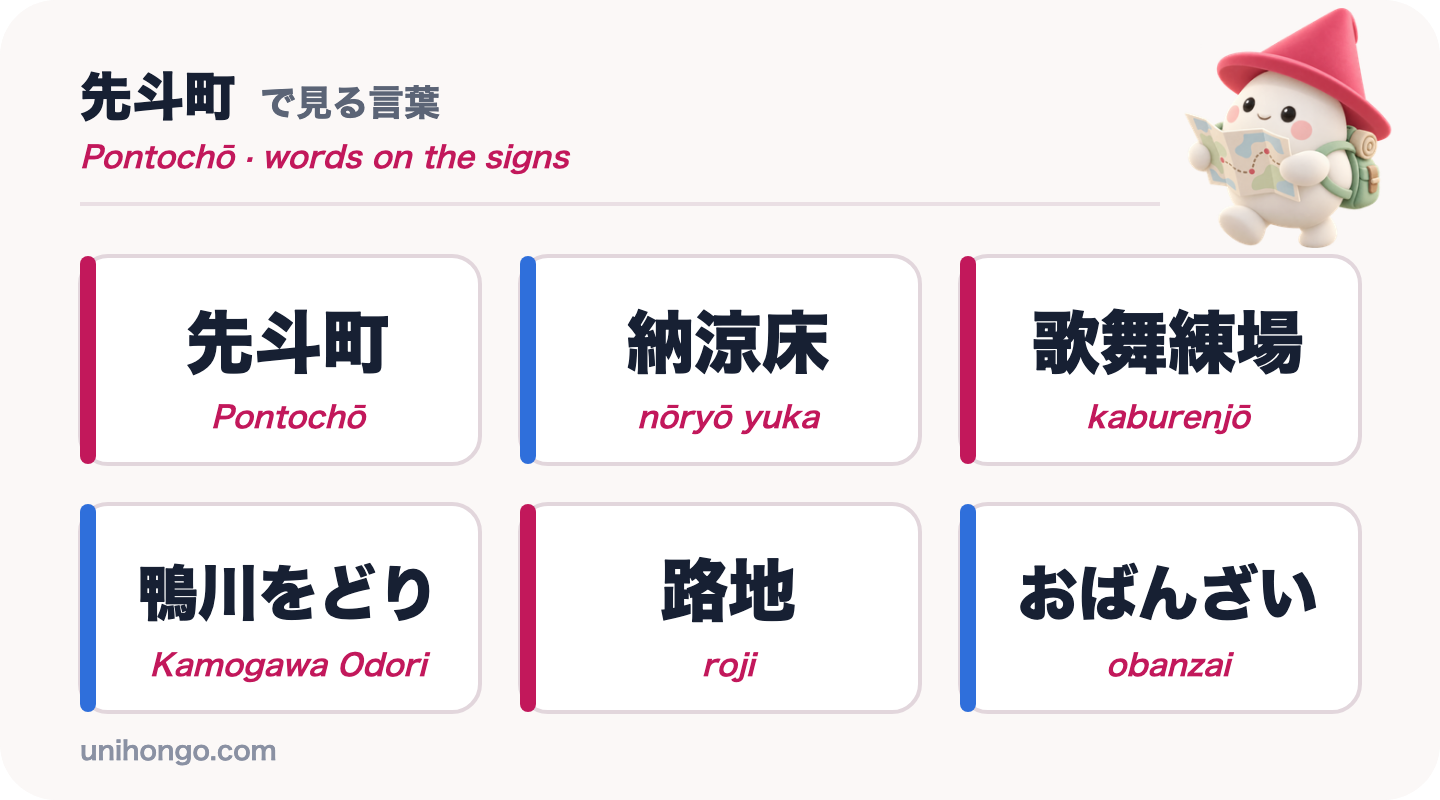
| Word | Reading | Meaning |
|---|---|---|
| 先斗町 | Pontochō | The alley and geiko district |
| 納涼床 | nōryō yuka | Summer dining platform over the river |
| 歌舞練場 | kaburenjō | Theatre where geiko and maiko perform |
| 鴨川をどり | Kamogawa Odori | Pontochō's annual dance performance |
| 路地 | roji | Narrow side alley |
| おばんざい | obanzai | Kyoto home-style side dishes |
| 千鳥 | chidori | Plover, the crest of Pontochō |
| 満席 | manseki | Full, no seats available |
| お品書き | o-shinagaki | Menu, in traditional restaurants |
Japanese for yuka seats, menus and the counter
At the door, the questions are about seats. Yuka platforms have either low tables with floor cushions or ordinary tables and chairs, depending on the restaurant, and it is worth asking if kneeling for two hours is not for you. Ask too about rain: most restaurants move platform guests indoors if the weather turns.
Inside small restaurants and bars, ordering is relaxed. At an obanzai counter the dishes are on display or written up, and pointing with a polite phrase works well. Keep your voice down on the platform, where there are no partitions between tables, and enjoy the slower pace.
| Japanese | Romaji | Meaning |
|---|---|---|
| 床の席は空いていますか。 | Yuka no seki wa aite imasu ka. | Is there a table free on the platform? |
| 床は何時まで使えますか。 | Yuka wa nanji made tsukaemasu ka. | Until what time can we use the platform? |
| 英語のお品書きはありますか。 | Eigo no o-shinagaki wa arimasu ka. | Do you have an English menu? |
| 今日のおばんざいはどれですか。 | Kyō no obanzai wa dore desu ka. | Which are today's obanzai? |
| これとこれを一つずつお願いします。 | Kore to kore o hitotsu zutsu onegai shimasu. | One each of this and this, please. |
| 京都のお酒はありますか。 | Kyōto no o-sake wa arimasu ka. | Do you have sake from Kyoto? |
Etiquette in the alley and on the river
Pontochō is a narrow, living geiko district and residential street as well as a restaurant row. A few manners keep it pleasant.
- Keep to one side and do not stop in the middle of the alley; it is too narrow for groups to block.
- Do not follow, crowd or photograph geiko and maiko without permission; they are usually on their way to work.
- Do not wander into private side alleys or doorways for photos.
- On the yuka platform, dine quietly: singing and musical instruments are not allowed, and tables are close together.
- Do not cancel a yuka booking on the day; the cooperative describes it as bad manners.
- Most restaurants open in the evening, from around five; a few serve lunch.
Practise the restaurant door before you go
The two questions in this exchange are the ones most visitors ask at a Pontochō restaurant in summer: what kind of seating the platform has, and what happens if it rains. The host answers in polite service Japanese, with natte orimasu and go-annai itashimasu, which you will hear in every restaurant in Japan.
Say the four lines aloud until you can do it without reading, then practise with a partner who can give different answers. In Unihongo, choose the Restaurant topic and ask your AI Sensei to play a Pontochō host, or try the Reserve a Restaurant by Phone mission to book your yuka table in advance. Polite service Japanese is easy to understand once you have heard it a few times.
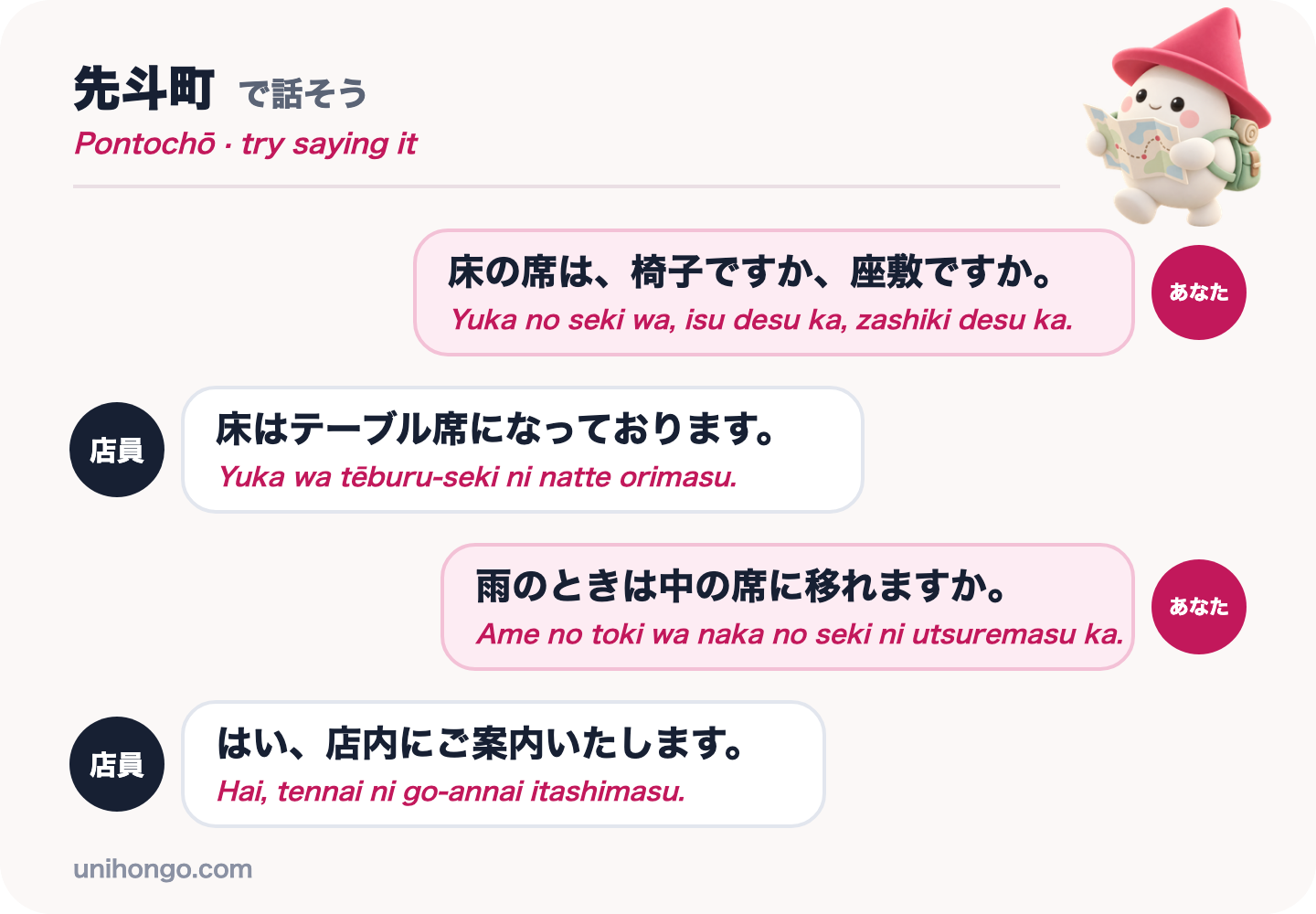
| Japanese | Romaji | Meaning |
|---|---|---|
| 床の席は、椅子ですか、座敷ですか。 | Yuka no seki wa, isu desu ka, zashiki desu ka. | Does the platform have chairs or floor seating? |
| 床はテーブル席になっております。 | Yuka wa tēburu-seki ni natte orimasu. | The platform has tables and chairs. |
| 雨のときは中の席に移れますか。 | Ame no toki wa naka no seki ni utsuremasu ka. | If it rains, can we move to a seat inside? |
| はい、店内にご案内いたします。 | Hai, tennai ni go-annai itashimasu. | Yes, we will show you to a table inside. |
Official information
The Kyoto Kamogawa Nōryō Yuka cooperative lists the season, the restaurants with platforms and the manners for diners, and the Pontochō shop association lists its members, the district's history and access. Both are in Japanese; restaurants publish their own hours and bookings.