

Why Sanjūsangen-dō is unlike any other temple
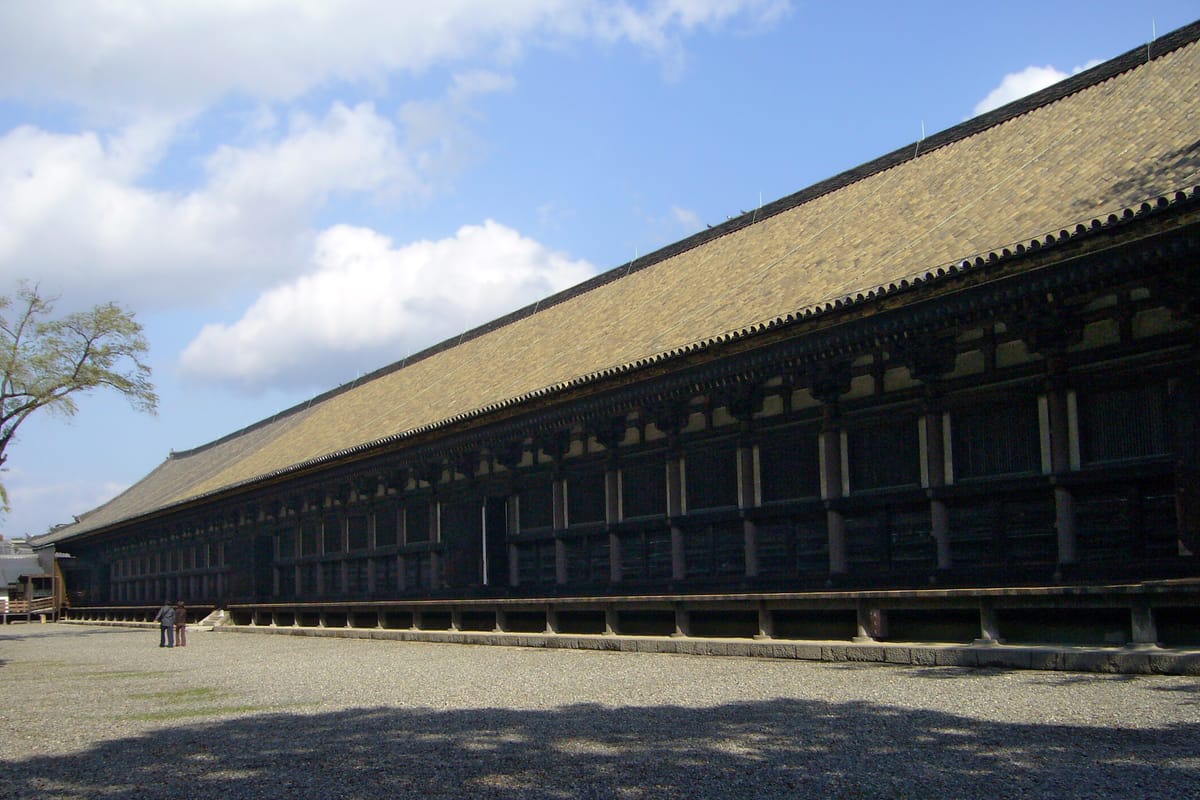
Sanjūsangen-dō was built in 1164 within the palace of the retired emperor Go-Shirakawa, one of the most powerful figures of the late Heian period. The original hall burned about eighty years later and was rebuilt under the retired emperor Go-Saga; that rebuilt hall, completed in the mid-thirteenth century, is the one that stands today, a National Treasure that has survived earthquakes and centuries of Kyoto's fires.
From outside it is a long, low wooden building of great simplicity. Inside, it is one of the most extraordinary sights in Japan. In the dim light, a thousand standing statues of Kannon, each carved from Japanese cypress and covered in gold leaf, stand in ten rising rows either side of a great seated Kannon. Each has many arms and a small crown of faces, and no two faces are exactly alike.
In 2018 all thousand standing statues were designated National Treasures and the last of them returned to the hall from museums, so the full set of 1,001 is together again. The same year, the guardian deities were rearranged into the order they are thought to have originally stood in.
Getting there: Shichijō Station and the museum bus stop
Sanjūsangen-dō is one of the easiest temples to reach from Kyoto Station. City buses 100, 206 and 208 take about ten minutes to the Hakubutsukan Sanjūsangendō-mae stop, the museum and Sanjūsangen-dō stop, right outside. By train, Keihan Shichijō Station is about seven minutes' walk east along Shichijō-dōri from exit 2.
From Kyoto Station you can also walk there in around twenty minutes. The temple is on the way to Kiyomizu-dera, so many visitors see it first thing in the morning and then continue north up the hill.
| Japanese | Romaji | Meaning |
|---|---|---|
| 博物館三十三間堂前で降ります。 | Hakubutsukan Sanjūsangendō-mae de orimasu. | I am getting off at Hakubutsukan Sanjūsangendō-mae. |
| 七条駅は何番出口が近いですか。 | Shichijō-eki wa nanban deguchi ga chikai desu ka. | Which exit of Shichijō Station is closest? |
| 三十三間堂の入口はどこですか。 | Sanjūsangen-dō no iriguchi wa doko desu ka. | Where is the entrance to Sanjūsangen-dō? |
| 京都駅まで歩けますか。 | Kyōto-eki made arukemasu ka. | Can I walk to Kyoto Station? |
Inside the hall: Kannon, guardians, wind and thunder
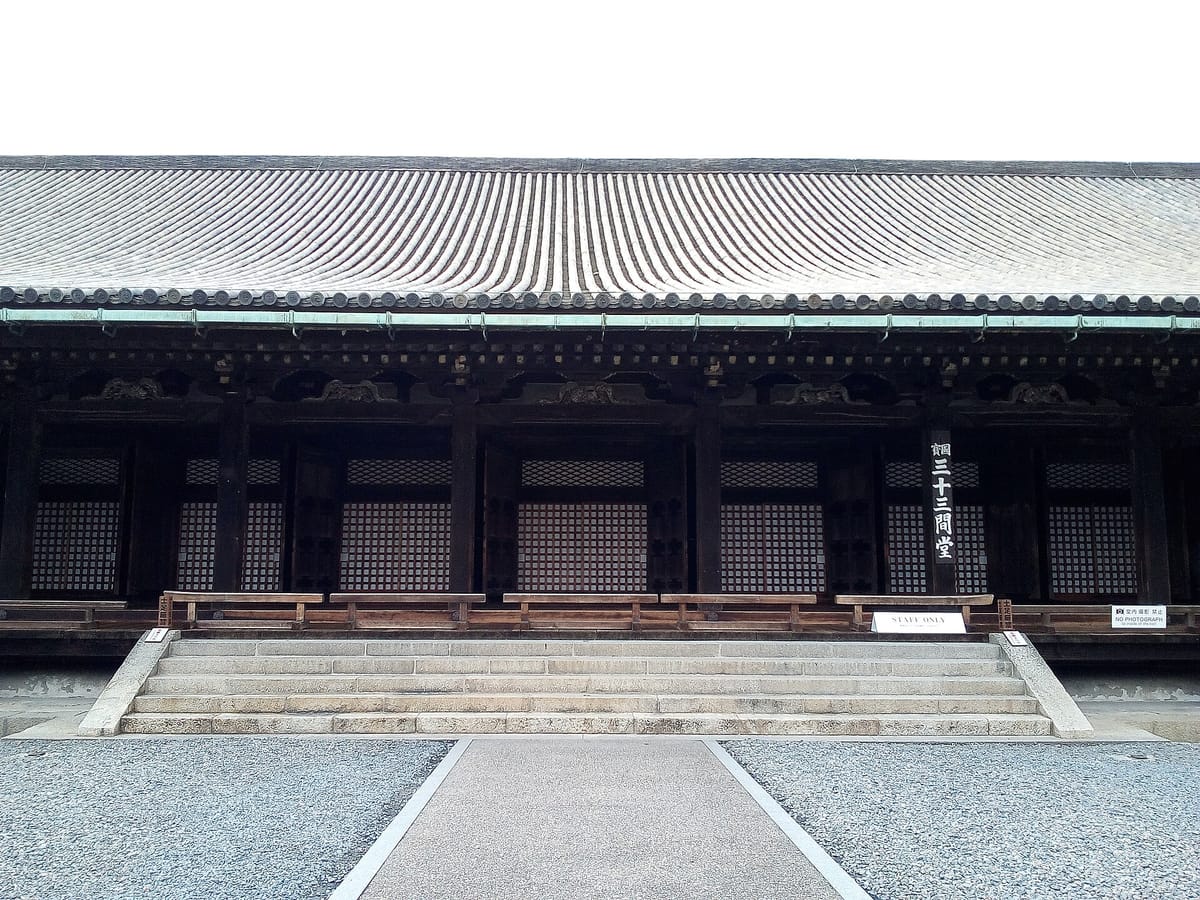
You enter at one end, take off your shoes and walk the length of the hall along a wooden corridor in front of the statues. At the start stands Fūjin, the wind god, with his bag of wind, and at the far end Raijin, the thunder god, ringed by drums. Between them, the twenty-eight attendant deities stand in a line in front of the thousand Kannon, each with a different weapon or expression.
In the centre sits the great seated Kannon, carved in the thirteenth century by the sculptor Tankei. After walking the front of the hall, you come out along the back and round to the grounds. A touch-screen search system inside the hall lets you look up the name and face of every one of the thousand statues.
- Senju Kannon zazō: the great seated thousand-armed Kannon at the centre.
- Senju Kannon ryūzō: the thousand standing Kannon, five hundred each side.
- Nijūhachi-bushū: the twenty-eight guardian deities in front of the Kannon.
- Fūjin and Raijin: the gods of wind and thunder at the two ends.
- The west veranda: the long outer corridor where Edo-period archers shot arrows the length of the hall.
- Nandaimon and Taikō-bei: the south gate and earthen wall from the time of Toyotomi Hideyoshi.
- The garden: a pond garden opened in 2021 in the grounds.
Words on the signs at Sanjūsangen-dō
The first two signs you meet are practical: 下駄箱, the shoe cupboards at the entrance, and 堂内撮影禁止, no photography inside the hall. After that, the labels in front of the statues give each one's name, starting with the wind and thunder gods, whose names are easy to read once you know 風, wind, and 雷, thunder.
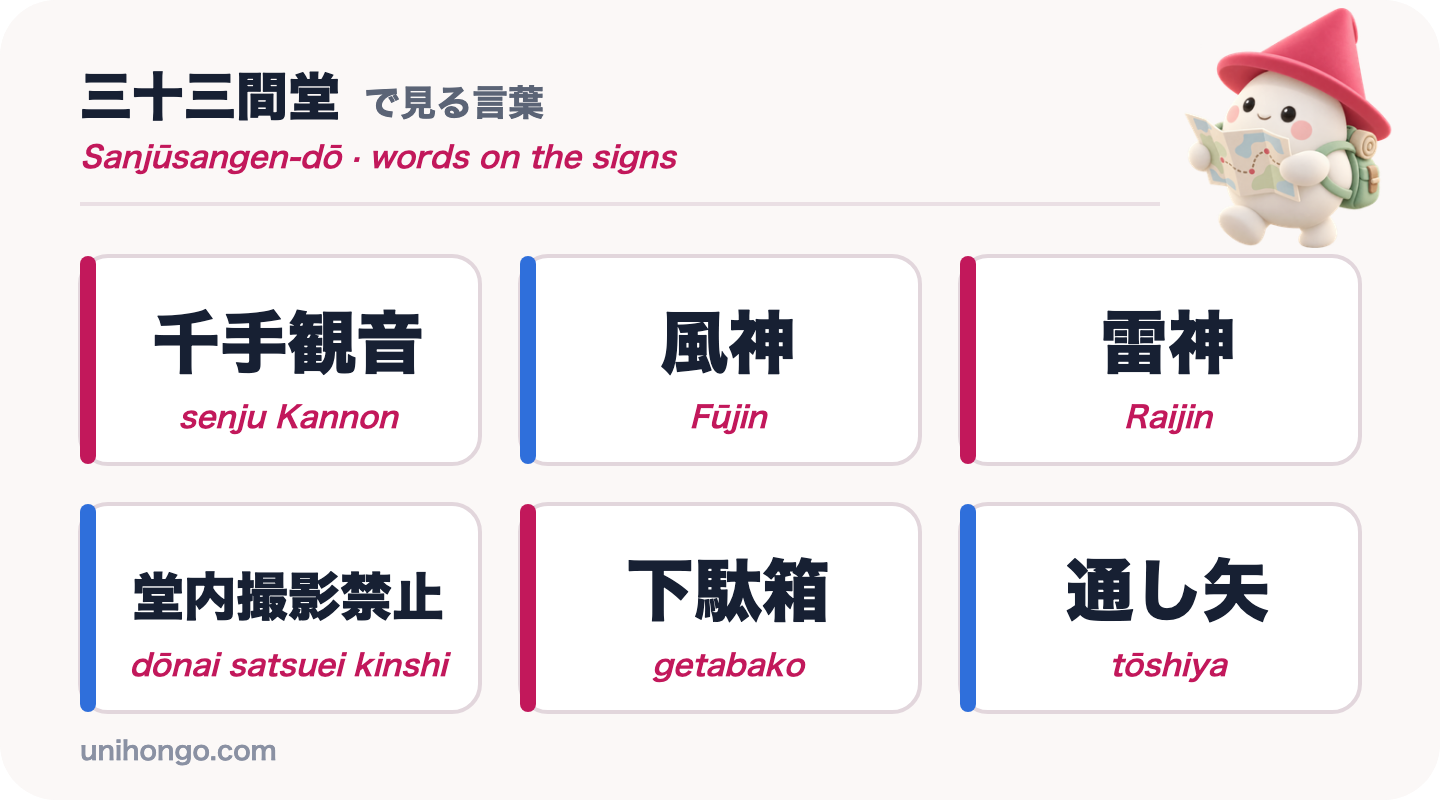
Kannon's name is written 観音, see and sound, often explained as the one who perceives the cries of the world. 千手 is a thousand hands. The table covers the words on the labels and notices.
| Word | Reading | Meaning |
|---|---|---|
| 千手観音 | senju Kannon | Thousand-armed Kannon |
| 風神 | Fūjin | God of wind |
| 雷神 | Raijin | God of thunder |
| 二十八部衆 | nijūhachi-bushū | The twenty-eight guardian deities |
| 堂内撮影禁止 | dōnai satsuei kinshi | No photography inside the hall |
| 下駄箱 | getabako | Shoe cupboard at the entrance |
| 国宝 | kokuhō | National Treasure |
| 通し矢 | tōshiya | Edo-period archery along the veranda |
| 蓮華王院 | Rengeō-in | The temple's formal name |
Japanese for shoes, statues and charms
Inside the hall you are asked to keep your voice down, so questions happen at the entrance, the charm counter and on the way out. The attendants are used to visitors asking where things are and what the statues mean.
Sanjūsangen-dō is linked with a charm against headaches. Go-Shirakawa is said to have suffered from them, and the temple's most important annual rite, the yanagi no okaji in January, in which blessed water is sprinkled on worshippers with a willow branch, is said to be especially good for headaches.
| Japanese | Romaji | Meaning |
|---|---|---|
| 靴はこの下駄箱に入れればいいですか。 | Kutsu wa kono getabako ni irereba ii desu ka. | Should I put my shoes in this cupboard? |
| 中では写真を撮れませんよね。 | Naka de wa shashin o toremasen yo ne. | I cannot take photos inside, can I? |
| 風神と雷神はどこにありますか。 | Fūjin to Raijin wa doko ni arimasu ka. | Where are Fūjin and Raijin? |
| 仏像を検索できる機械はどこですか。 | Butsuzō o kensaku dekiru kikai wa doko desu ka. | Where is the machine to search the statues? |
| 頭痛封じのお守りはありますか。 | Zutsū fūji no o-mamori wa arimasu ka. | Do you have a charm against headaches? |
| 大的大会は今年いつですか。 | Ōmato Taikai wa kotoshi itsu desu ka. | When is the archery contest this year? |
Etiquette and timing
The hall is a place of worship with the statues as its focus, and the corridor in front of them is narrow, so a few habits help everyone.
- Take your shoes off at the entrance and wear socks; the wooden floor is cold in winter.
- Put your phone and camera away inside the hall; photography and filming are not allowed.
- Keep your voice low and do not lean over the railings towards the statues.
- Walk slowly and step aside to let people pass if you stop for a long look.
- Come soon after opening, before the tour groups arrive, for the quietest hall.
- Visit in mid-January for the archery contest, or on 3 March for the Haru no Momo-e, when entry is free.
Practise the hall before you go
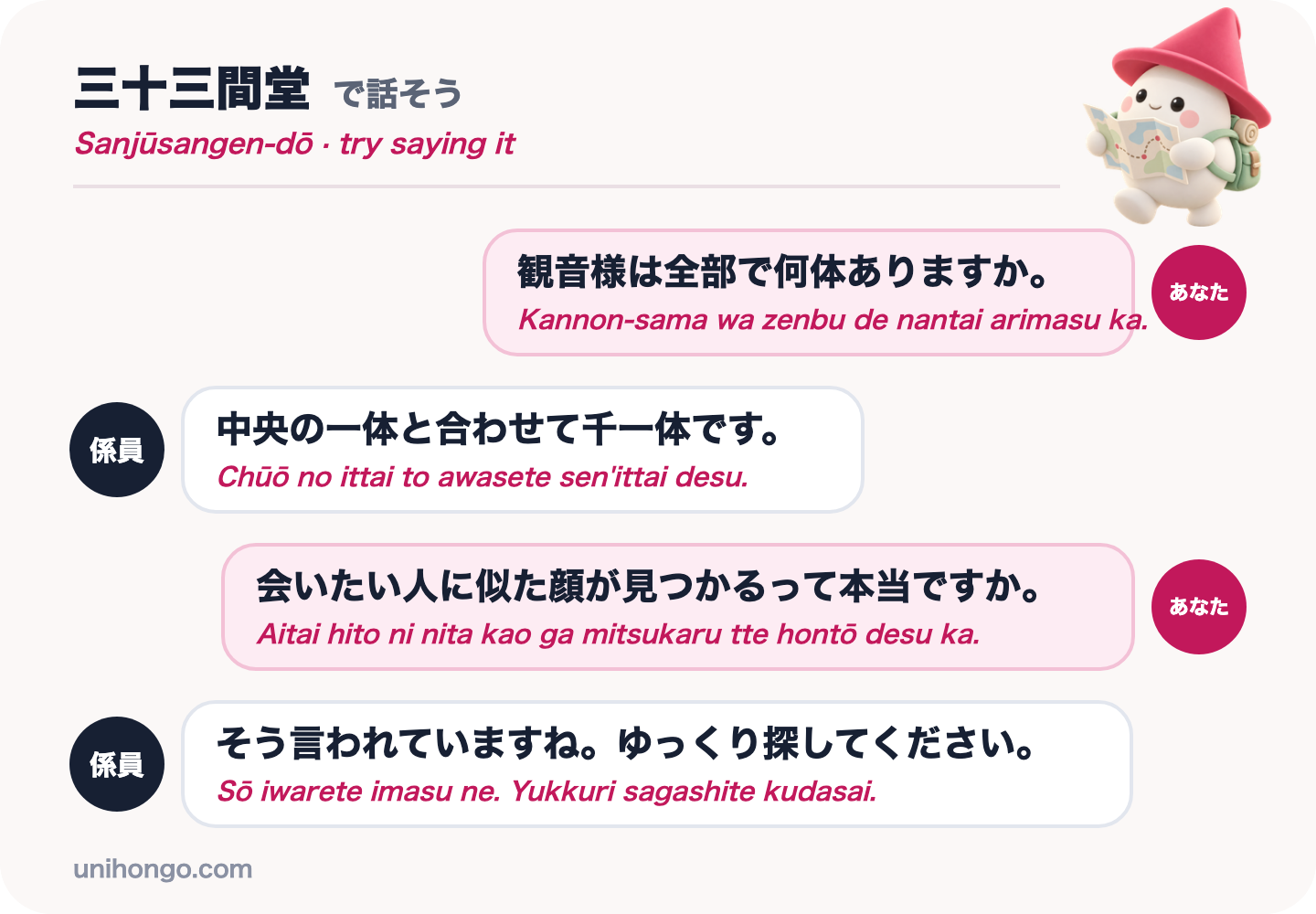
The number of statues and the legend of the familiar face are the two things visitors ask about most. Practise the four lines below until you can say them without reading, and listen for sen'ittai, one thousand and one, and sō iwarete imasu, so they say.
Then practise with someone who answers back. In Unihongo, choose the Sightseeing topic and ask your AI Sensei to play an attendant at Sanjūsangen-dō, or use the Cultural Etiquette topic to rehearse shoes, silence and photography rules. Speaking the lines once before you go is what makes them easy on the day.
| Japanese | Romaji | Meaning |
|---|---|---|
| 観音様は全部で何体ありますか。 | Kannon-sama wa zenbu de nantai arimasu ka. | How many Kannon statues are there in all? |
| 中央の一体と合わせて千一体です。 | Chūō no ittai to awasete sen'ittai desu. | With the one in the centre, one thousand and one. |
| 会いたい人に似た顔が見つかるって本当ですか。 | Aitai hito ni nita kao ga mitsukaru tte hontō desu ka. | Is it true you can find a face like someone you want to meet? |
| そう言われていますね。ゆっくり探してください。 | Sō iwarete imasu ne. Yukkuri sagashite kudasai. | So they say. Take your time looking. |
Official information
Sanjūsangen-dō publishes its hours, access, events such as the January archery contest and news on its official website, in Japanese. Check the visiting page before you go.