

Which kind of shop you are walking into
The word on the noren curtain tells you a lot. A shop with soba in the name usually serves udon too, and vice versa, but the speciality is the one on the sign. A tachigui, standing-and-eating stand, is found inside or beside stations and works on a ticket machine, with no seats and no table service. A neighbourhood soba-ya has tables, a paper menu and staff who take your order. A te-uchi, hand-made, sign means the noodles are made on the premises and the menu may be shorter and pricier. Udon specialists in the Sanuki style often run cafeteria-style: you slide a tray along, tell the cook the noodle and size, add tempura from a shelf, and pay at the end.
Whatever the format, the greeting is the usual irasshaimase, and you do not need to reply. At a seated shop, say the number of people with mei; at a stand, go straight to the machine.
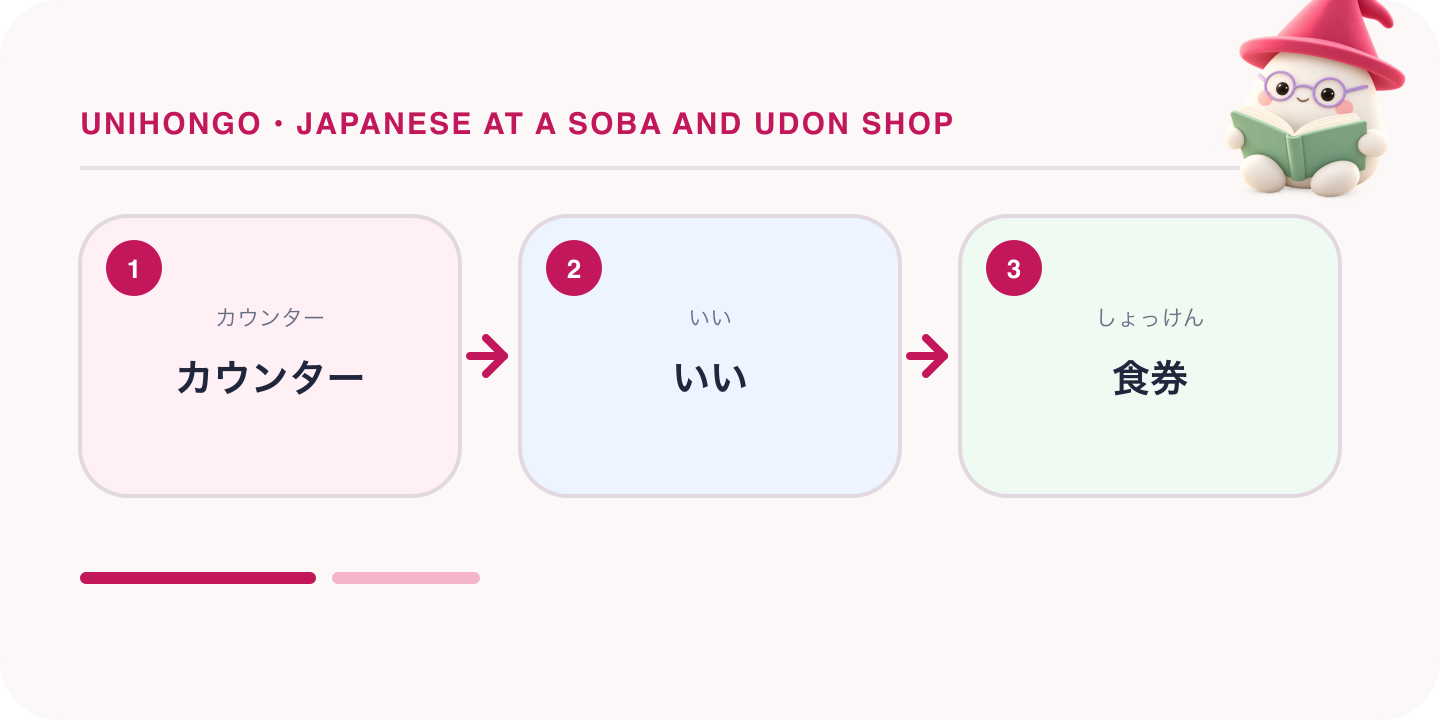
| Japanese | Romaji | Meaning |
|---|---|---|
| 二名です。 | Ni-mei desu. | Two people. |
| カウンターでいいです。 | Kauntā de ii desu. | The counter is fine. |
| 食券はどこで買いますか。 | Shokken wa doko de kaimasu ka. | Where do I buy the meal ticket? |
| おすすめは何ですか。 | Osusume wa nan desu ka. | What do you recommend? |
| 手打ちですか。 | Te-uchi desu ka. | Are the noodles hand-made? |
The ticket machine at a station stand
Station stands almost always use a shokkenki, a meal ticket machine, by the entrance. Put money in first, then press the button; many newer machines also take a transport IC card, and a few take QR payments, but this varies by shop. The buttons are grouped by noodle and temperature. Look for the words soba and udon, then atatakai or the kanji for hot, and tsumetai or hiyashi for cold. Toppings such as kakiage, a fried vegetable fritter, and tempura are sold either as a full dish or as an add-on ticket called toppingu.
Some machines put the noodle choice on the button and some leave it to the counter. If the button only says kake or tempura, hand the ticket over and staff will ask soba ka udon ka. A ticket for ōmori, a large portion, is usually sold separately. Hand the ticket across the counter, say the noodle if asked, and stay close: the bowl is usually ready in about a minute.
| Japanese | Romaji | Meaning |
|---|---|---|
| そばかうどんか、どちらにしますか。 | Soba ka udon ka, dochira ni shimasu ka. | Soba or udon, which would you like? |
| そばでお願いします。 | Soba de onegai shimasu. | Soba, please. |
| 温かいのと冷たいの、どちらですか。 | Atatakai no to tsumetai no, dochira desu ka. | Hot or cold? |
| 温かいのでお願いします。 | Atatakai no de onegai shimasu. | Hot, please. |
| 大盛りにできますか。 | Ōmori ni dekimasu ka. | Can I have a large portion? |
| ICカードは使えますか。 | Ai-shī kādo wa tsukaemasu ka. | Can I use an IC card? |
| ボタンを間違えました。 | Botan o machigaemashita. | I pressed the wrong button. |
Hot or cold, and the names of the styles
The menu looks long, but it is built from a few words. Kake means noodles in hot broth with almost nothing on top. Mori and zaru are cold noodles on a bamboo tray with a cup of tsuyu to dip in; zaru traditionally has nori on top. Hiyashi or bukkake means cold noodles with a little concentrated sauce poured over rather than served separately. Everything else is a topping added to one of these bases: tempura, a whole prawn or vegetables; kakiage, a fritter of small prawns and onion; kitsune, a slab of sweet fried tofu; tanuki, crunchy tempura batter bits; tsukimi, a raw egg dropped in the hot broth; sansai, mountain vegetables; tororo, grated yam; and niku, thin sliced beef or pork.
A few names are regional traps. In Tokyo, tanuki means batter bits, while in Osaka it means udon with fried tofu. In winter, nabeyaki udon comes bubbling in its own iron pot. Kamo nanban is duck and leek in hot broth. Seiro is another word for the bamboo tray of cold soba. Curry udon is exactly what it sounds like.
If you want cold noodles with a hot dipping sauce, ask for tsuke, such as kamo tsuke soba. If you are unsure, kake with a topping is the safest order on a cold day; on a hot day, zaru with tempura is the classic.
| Japanese | Romaji | Meaning |
|---|---|---|
| ざるそばと天ぷらの盛り合わせをください。 | Zaru soba to tempura no moriawase o kudasai. | Cold zaru soba and a tempura assortment, please. |
| きつねうどんを一つ。 | Kitsune udon o hitotsu. | One kitsune udon. |
| たぬきは天かすのことですか。 | Tanuki wa tenkasu no koto desu ka. | Does tanuki mean tempura batter bits here? |
| 月見にしてください。 | Tsukimi ni shite kudasai. | Please add a raw egg. |
| つゆは温かいのにできますか。 | Tsuyu wa atatakai no ni dekimasu ka. | Can the dipping sauce be hot? |
| 麺は少なめでお願いします。 | Men wa sukuname de onegai shimasu. | A smaller portion of noodles, please. |
Condiments, tsuyu and how to eat cold soba
Cold soba arrives with a cup of tsuyu, a small dish of yakumi, condiments, and a pot of sobayu later. The usual yakumi are negi, chopped spring onion, and wasabi; udon shops add shōga, grated ginger, and some put out tenkasu for free. Add the condiments to the tsuyu, not to the noodles, and do not empty the whole wasabi mound in at once. Pick up a bite of noodles, dip the lower third in the tsuyu, and eat. Purists say soaking the whole strand drowns the flavour, but nobody will correct you.
On the table you may also find shichimi, seven-spice pepper, for hot bowls. Cold udon in the bukkake style is eaten with the sauce poured over and stirred in.
When the noodles are finished, the sobayu comes. Pour it into the leftover tsuyu until it is as weak as you like and drink it. This is where the shop expects you to slow down.
| Japanese | Romaji | Meaning |
|---|---|---|
| 薬味はこちらです。 | Yakumi wa kochira desu. | The condiments are here. |
| わさびは抜いてください。 | Wasabi wa nuite kudasai. | Please leave out the wasabi. |
| ねぎを多めにもらえますか。 | Negi o ōme ni moraemasu ka. | Could I have extra spring onion? |
| そば湯をお願いします。 | Sobayu o onegai shimasu. | The sobayu, please. |
| 七味はありますか。 | Shichimi wa arimasu ka. | Do you have seven-spice pepper? |
| つゆのおかわりはできますか。 | Tsuyu no okawari wa dekimasu ka. | Can I have more dipping sauce? |
Menu and counter vocabulary
These are the words that appear on ticket machine buttons, wall menus and paper menus across the country. Most are written in kanji or hiragana rather than katakana, so it helps to recognise the shapes as well as the sounds.
| Word | Reading | Meaning |
|---|---|---|
| かけ | kake | Noodles in hot broth, no topping |
| もり | mori | Cold noodles on a tray with dipping sauce |
| ざる | zaru | Cold noodles on a tray, usually with nori |
| 冷やし | hiyashi | Cold, served with sauce poured over |
| 天ぷら | tempura | Prawn or vegetable tempura topping |
| かき揚げ | kakiage | Mixed fritter of small prawns and onion |
| きつね | kitsune | Sweet fried tofu topping |
| たぬき | tanuki | Tempura batter bits, Tokyo usage |
| 月見 | tsukimi | Raw egg in hot broth |
| 大盛り | ōmori | Large portion |
| 薬味 | yakumi | Condiments such as spring onion and wasabi |
| そば湯 | sobayu | Hot water the soba was boiled in |
You may also see the phrase juwari soba, one hundred percent buckwheat, and nihachi, eighty percent buckwheat with twenty percent wheat flour. Nihachi is the standard blend and is easier to make and slurp; juwari is stronger in flavour and a little more fragile.
Etiquette that regulars follow
Soba and udon shops move fast, and the etiquette mostly comes from that. A standing stand is not a place to linger; eat, return the bowl to the counter or the shelf marked kaeshiguchi, say gochisōsama and leave. At a seated shop you can take your time, but lunch at a soba shop is still a quick meal. Ordering only a drink is not usual.
Slurping is normal and expected; it pulls air across the noodles and cools them. Do not bite noodles off halfway and let them drop back into the bowl. Lift the bowl to drink hot broth, and lift the tsuyu cup to your mouth for cold soba rather than bending over it. Chopstick manners are the usual ones.
- Buy the ticket before you sit down at a stand, and hand it across straight away
- Eat cold soba promptly; the noodles lose their bite within a few minutes
- Return your bowl to the counter or return shelf at a standing shop
- Say gochisōsama deshita on the way out; it is the expected thank-you
- Do not add condiments to the sobayu pot; season your own cup instead
- At a cafeteria udon shop, pay for tempura by the piece on the tray at the till
If you want to look like a regular, order in a few words rather than a full sentence at a stand: kake soba, ōmori, kakiage nose de, meaning hot soba, large, with a fritter on top. Staff reply in the same short style.
Allergies and dietary questions
Buckwheat allergy is well known in Japan and taken seriously, but shops handle it differently. Some boil soba and udon in separate pots; many small shops use one pot, and the tempura oil may be shared with items dusted in buckwheat flour. Tell staff clearly and ask specifically about shared water. If the answer is unclear, do not risk it. Tsuyu is usually made with soy sauce and bonito flakes, so it contains wheat and fish; vegetarians and people with a soy allergy should ask what the dashi is made from. Vegetable dashi exists but is not common.
Chains may print allergen icons on the menu, but independent shops rarely do. A written card in Japanese listing your allergy is the most reliable tool.
| Japanese | Romaji | Meaning |
|---|---|---|
| そばアレルギーがあります。 | Soba arerugī ga arimasu. | I have a buckwheat allergy. |
| そばとうどんは同じお湯で茹でていますか。 | Soba to udon wa onaji o-yu de yudete imasu ka. | Do you boil soba and udon in the same water? |
| だしは何で取っていますか。 | Dashi wa nani de totte imasu ka. | What is the stock made from? |
| 小麦が入っていないものはありますか。 | Komugi ga haitte inai mono wa arimasu ka. | Is there anything without wheat? |
| 卵抜きでお願いできますか。 | Tamago-nuki de onegai dekimasu ka. | Could you make it without the egg? |
When something goes wrong
Most problems at a soba shop are small. You bought the wrong ticket, the bowl is hot when you wanted cold, or the sobayu has not appeared. Fix each with a short apology and a request. Ticket mistakes are best raised before the ticket is handed over; if you already gave it in, staff will usually swap it if the dish has not been cooked. If the bowl is not what you ordered, say so straight away.
At cafeteria udon shops you pay at the end for what is on your tray, so if you change your mind about a piece of tempura, put it back before the till. If you drop a bowl or spill, a quick sumimasen is enough; staff will clean up.
| Japanese | Romaji | Meaning |
|---|---|---|
| すみません、間違えて買ってしまいました。 | Sumimasen, machigaete katte shimaimashita. | Sorry, I bought the wrong ticket. |
| 冷たいので頼んだんですが。 | Tsumetai no de tanonda n desu ga. | I ordered the cold one, actually. |
| まだそば湯が来ていません。 | Mada sobayu ga kite imasen. | The sobayu hasn't come yet. |
| これは頼んでいません。 | Kore wa tanonde imasen. | I didn't order this. |
| お会計はどこでしますか。 | O-kaikei wa doko de shimasu ka. | Where do I pay? |
| ごちそうさまでした。 | Gochisōsama deshita. | Thank you for the meal. |