

Why Shinsekai feels like old Osaka
In 1903 Osaka hosted the fifth National Industrial Exhibition, which drew millions of visitors. The site was redeveloped as an amusement district, and in 1912 Shinsekai, the New World, opened with a Paris-style north half, a Coney Island-style amusement park called Luna Park to the south, and a tower modelled loosely on the Eiffel Tower. That first Tsūtenkaku was damaged by fire and dismantled during the Second World War.
The present tower went up in 1956, designed by Naitō Tachū, the engineer behind Tokyo Tower, and it is now registered as a tangible cultural property. The district around it never modernised in the way Umeda or Namba did, and that is its charm: old-style games arcades, shōgi parlours, cheap bars, giant dragon and Billiken signs, and dozens of kushikatsu restaurants competing for your attention with lights and costumed statues.
For a learner, Shinsekai is the loudest dialect classroom in Osaka. Staff call out in Kansai-ben, menus are in big, simple characters, and the rules of the kushikatsu counter are written on the wall.
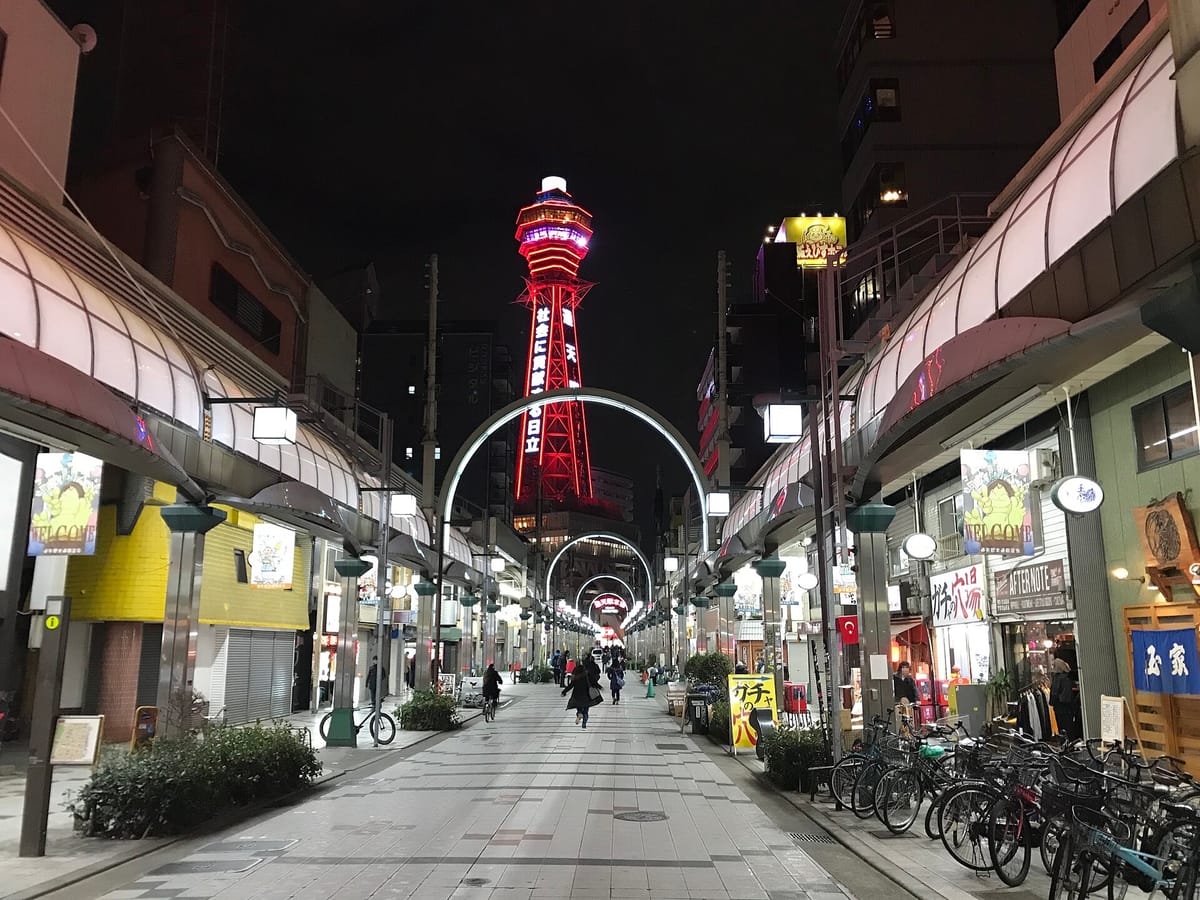
Getting there: Ebisuchō, Dōbutsuen-mae and Shin-Imamiya
Three stations surround Shinsekai. Ebisuchō Station on the Osaka Metro Sakaisuji Line is closest to the tower, a few minutes' walk to the north end of the district. Dōbutsuen-mae Station, on the Midōsuji and Sakaisuji lines, is at the south-east, next to Janjan Yokochō; the name means in front of the zoo, since Tennōji Zoo is just beside it.
Shin-Imamiya Station, served by the JR Osaka Loop Line and Nankai trains, is on the south-west side, about five or six minutes' walk from the tower. From Namba, the Sakaisuji Line or a couple of stops on the Midōsuji Line gets you there in minutes; from Tennōji it is a walk of about fifteen minutes through or around Tennōji Park.
| Japanese | Romaji | Meaning |
|---|---|---|
| 通天閣はどちらですか。 | Tsūtenkaku wa dochira desu ka. | Which way is Tsūtenkaku? |
| 恵美須町駅はどこですか。 | Ebisuchō-eki wa doko desu ka. | Where is Ebisuchō Station? |
| 動物園前駅から歩けますか。 | Dōbutsuen-mae-eki kara arukemasu ka. | Can I walk from Dōbutsuen-mae Station? |
| 新世界まで歩いて何分くらいですか。 | Shinsekai made aruite nanpun kurai desu ka. | About how many minutes' walk is it to Shinsekai? |
| 天王寺駅へはどう行けばいいですか。 | Tennōji-eki e wa dō ikeba ii desu ka. | How do I get to Tennōji Station? |
Tsūtenkaku, Billiken and the streets around them
The tower's main observation deck is the golden deck, decorated in gold in homage to the golden tea room of Toyotomi Hideyoshi. Here sits Billiken, the grinning good-luck figure, whose feet have been rubbed smooth by visitors. Above it, the open-air Tenbō Paradise deck lets you stand outside at the top of the tower for an extra fee. Tsūtenkaku also has the Tower Slider, a long tube slide from the tower down to the basement, and an outdoor walking attraction on the structure, each with its own ticket.
Back on the ground, the main streets run out from the tower's base. Janjan Yokochō, a narrow covered alley to the south, has old-style kushikatsu counters and shōgi and go clubs. Spa World, a large hot-spring bath complex with European- and Asian-themed floors, is at the south-west corner, and Tennōji Zoo and Tennōji Park are next door.
- Tsūtenkaku: the tower, with the golden observation deck and Billiken.
- Tenbō Paradise: the open-air deck at the top, for a separate fee.
- Tower Slider: the long tube slide down from the tower.
- Tsūtenkaku Hondōri: the shopping street leading straight to the tower.
- Janjan Yokochō: a narrow alley of counters and board-game clubs.
- Spa World: a large bath complex on the edge of the district.
- Tennōji Zoo and Tennōji Park: green space next door.
Words on the shop signs
The sign you will see most in Shinsekai is 二度づけ禁止, nidozuke kinshi, no double-dipping, often painted on the wall or printed on the menu of every kushikatsu shop. Next to it, 串カツ, kushikatsu, fried skewers, and the names of the fillings: 牛, gyū, beef; 豚, buta, pork; 海老, ebi, prawn; うずら, uzura, quail egg; and レンコン, renkon, lotus root.
Billiken's name is written in katakana, ビリケン, Biriken, and is often followed by さん, san, as if he were a friend: Biriken-san.
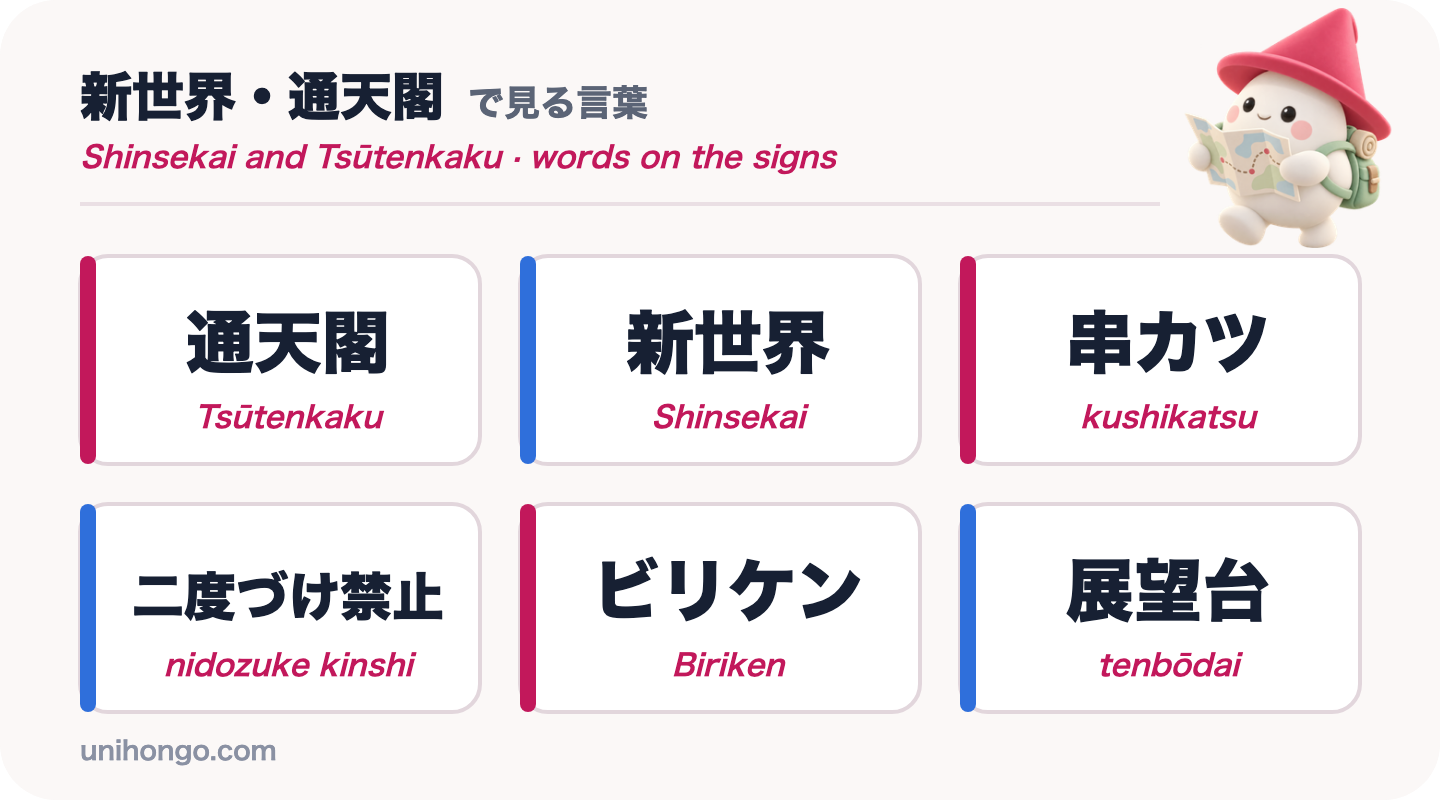
| Word | Reading | Meaning |
|---|---|---|
| 通天閣 | Tsūtenkaku | The tower at the centre of Shinsekai |
| 新世界 | Shinsekai | The New World district |
| 串カツ | kushikatsu | Deep-fried breaded skewers |
| 二度づけ禁止 | nidozuke kinshi | No double-dipping in the shared sauce |
| ビリケン | Biriken | Billiken, the good-luck figure |
| 展望台 | tenbōdai | Observation deck |
| 盛り合わせ | moriawase | Assorted set |
| ソース | sōsu | Sauce |
Japanese for the kushikatsu counter, with a little Kansai dialect
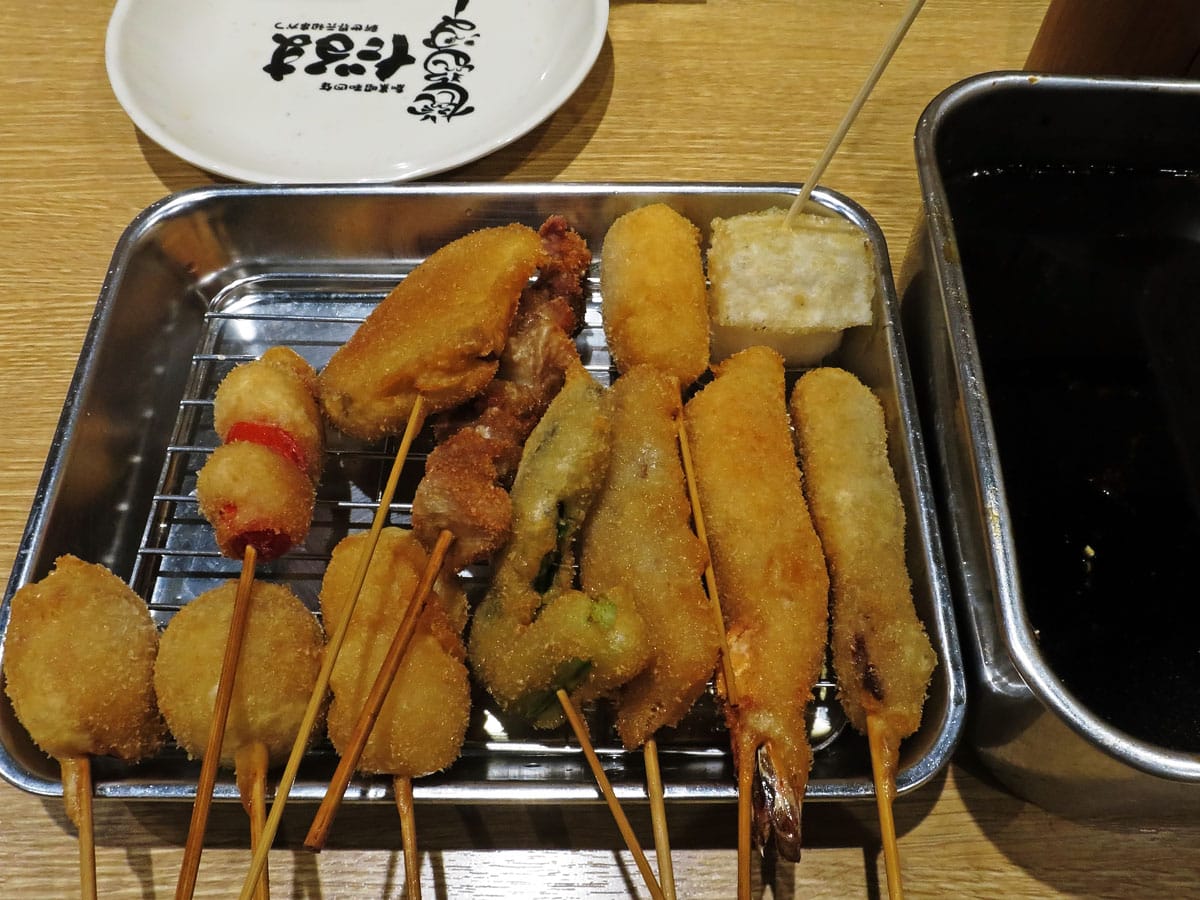
Kushikatsu shops are fast and informal. You order skewers one by one from the menu or pick an assorted set, moriawase, and they arrive hot from the fryer, often on a wire rack. Each skewer is dipped once in the shared sauce before you eat it. Raw cabbage is usually served on the side, and it has a job: use a leaf to scoop sauce over a skewer you have already bitten.
The cook will probably speak Kansai dialect, so the rows below mix standard phrases you can say with dialect lines you are likely to hear. Each dialect line is marked, with its standard equivalent in the English.
| Japanese | Romaji | Meaning |
|---|---|---|
| 牛と海老を二本ずつください。 | Gyū to ebi o nihon zutsu kudasai. | Two beef and two prawn skewers, please. |
| おすすめの串はどれですか。 | Osusume no kushi wa dore desu ka. | Which skewer do you recommend? |
| ソースはどうやってつけますか。 | Sōsu wa dō yatte tsukemasu ka. | How do I use the sauce? |
| 生ビールをひとつお願いします。 | Nama bīru o hitotsu onegai shimasu. | One draught beer, please. |
| お会計お願いします。 | O-kaikei onegai shimasu. | The bill, please. |
| めっちゃうまいで! | Meccha umai de! | It's really good! (Kansai dialect; standard: totemo oishii desu yo) |
| ほな、またな。 | Hona, mata na. | Well then, see you. (Kansai dialect; standard: ja, mata ne) |
Etiquette, timing and practical tips
Shinsekai is informal, and a few simple habits make it more fun.
- Never double-dip in the shared sauce; use the cabbage to add more.
- Put finished skewers in the container provided rather than back on the tray.
- Come in the evening for the neon, but visit the tower in daylight too if you want clear views.
- Some counters are tiny; if the place is full, wait outside and do not crowd the doorway.
- Ask before photographing shop staff or the people at the counters.
- Keep your belongings with you in crowded arcades, as you would anywhere in a big city.
Practise the kushikatsu counter before you go
The cook's lines here are Osaka dialect. Kinshi ya de is Kansai for kinshi desu yo, it's forbidden, you know: ya replaces da or desu, and de adds emphasis like yo. Ee yo is Kansai for ii yo, that's fine, and aru n ya is Kansai for aru n da, it's there for that. You say your lines in standard Japanese; you only need to understand theirs.
Then practise with someone who answers in dialect. In Unihongo, choose the Regional Dialects topic and ask your AI Sensei to play a Shinsekai cook who speaks Osaka dialect, then ask the Sensei to restate each line in standard Japanese. Hearing ya de and ee yo once before you go makes the real counter easy to follow.
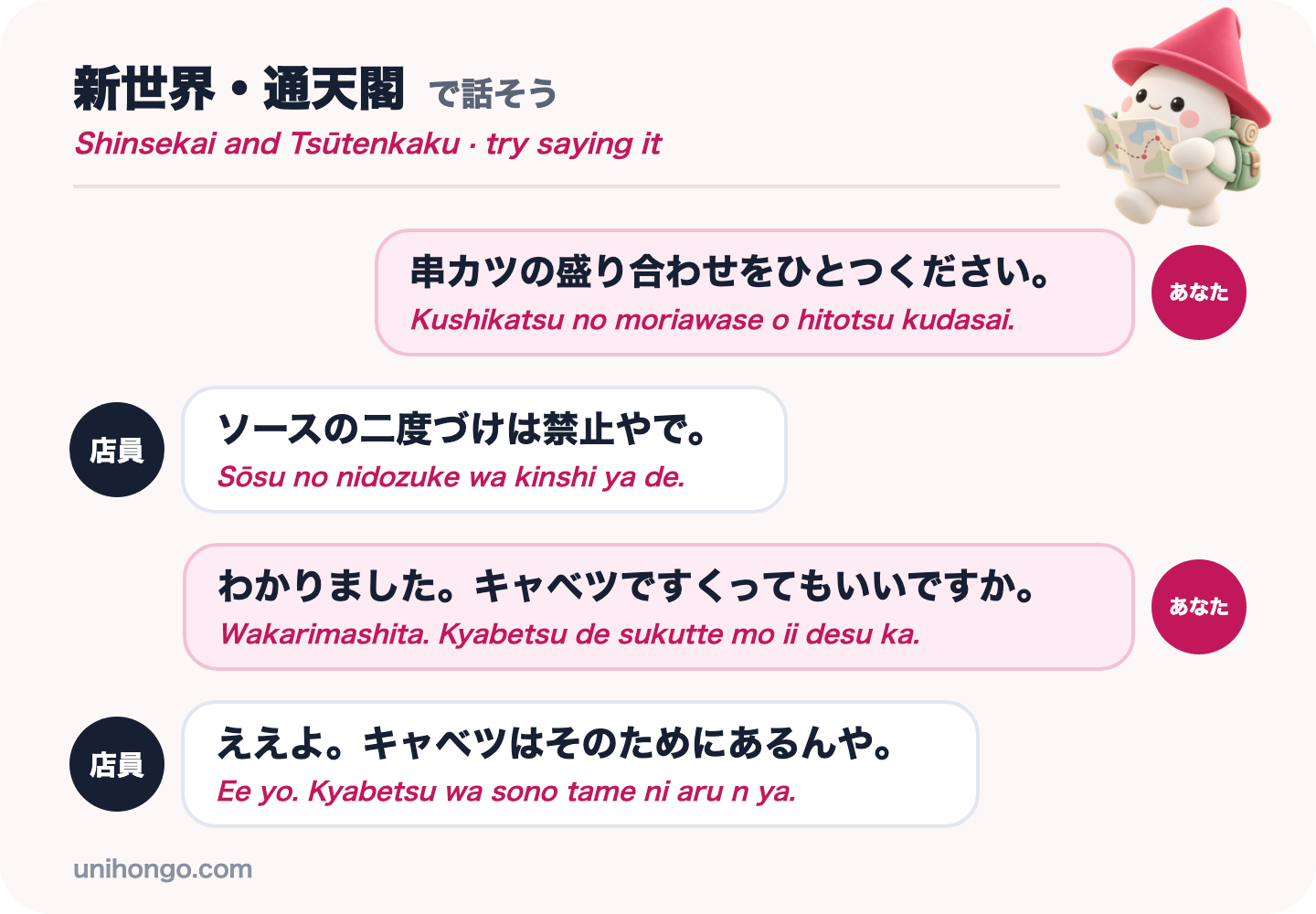
| Japanese | Romaji | Meaning |
|---|---|---|
| 串カツの盛り合わせをひとつください。 | Kushikatsu no moriawase o hitotsu kudasai. | One assorted kushikatsu set, please. |
| ソースの二度づけは禁止やで。 | Sōsu no nidozuke wa kinshi ya de. | No double-dipping in the sauce, you know. (Kansai dialect) |
| わかりました。キャベツですくってもいいですか。 | Wakarimashita. Kyabetsu de sukutte mo ii desu ka. | Understood. Can I scoop it with the cabbage? |
| ええよ。キャベツはそのためにあるんや。 | Ee yo. Kyabetsu wa sono tame ni aru n ya. | Sure. That's what the cabbage is for. (Kansai dialect) |
Official information
Tsūtenkaku's official site lists observation deck fees, hours and the Tower Slider, and Osaka's official tourism site covers the tower and the district. Check before you go, especially on holidays.