

At the ferry terminal: signs to look for
Ferry terminals are called ferī tāminaru or, in smaller ports, simply the port building. The first thing to find is the ticket window, usually signed jōsenken uriba, where jōsenken means boarding ticket. Larger terminals may also have ticket machines, and some operators let you book online and pick up or show the ticket at the counter.
Some routes ask you to fill in a short passenger form, historically called jōsen meibo, the passenger list, with your name, age and contact details. The form is often in Japanese only, but the fields are simple and the staff will point to where each item goes. Whether you need one depends on the route and operator.
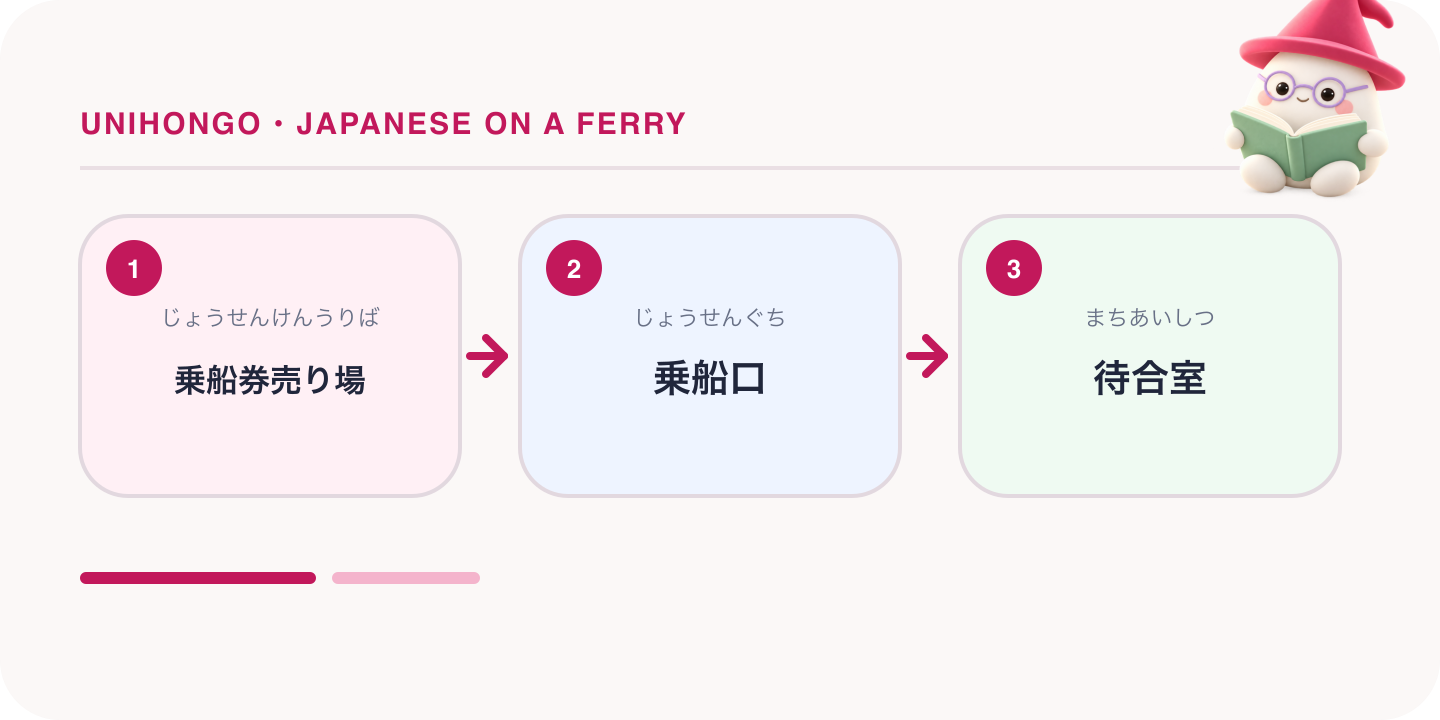
| Sign | Reading | Meaning |
|---|---|---|
| 乗船券売り場 | jōsenken uriba | Ticket window |
| 乗船口 | jōsenguchi | Boarding gate |
| 待合室 | machiaishitsu | Waiting room |
| 乗船名簿 | jōsen meibo | Passenger form |
| 出航時刻 | shukkō jikoku | Departure time |
| 到着予定 | tōchaku yotei | Scheduled arrival |
| 欠航 | kekkō | Cancelled sailing |
| 運航状況 | unkō jōkyō | Service status |
Buying a ticket and choosing a class
At the window, say where you are going and how many people are travelling. Tickets can be one way, katamichi, or return, ōfuku, and some routes offer a discount for a return ticket. If there are several sailings, the clerk may ask which departure, nanji no bin, you want. Bin is the word used for a scheduled sailing or flight.
Longer routes sell different classes. Common labels are tokutō, special class, ittō, first class, and nitō, second class, and some operators use their own names such as suīto or sutandādo. What these mean in practice varies widely: on one ship nitō is a large shared carpeted room, on another it is a bunk in a shared cabin. Ask what the class includes if the price difference is not obvious.
| Japanese | Romaji | Meaning |
|---|---|---|
| 高松まで大人二人お願いします。 | Takamatsu made otona futari onegai shimasu. | Two adults to Takamatsu, please. |
| 片道ですか、往復ですか。 | Katamichi desu ka, ōfuku desu ka. | One way or return? |
| 往復でお願いします。 | Ōfuku de onegai shimasu. | Return, please. |
| 次の便は何時ですか。 | Tsugi no bin wa nanji desu ka. | What time is the next sailing? |
| 二等はどんな部屋ですか。 | Nitō wa donna heya desu ka. | What kind of room is second class? |
| 個室は空いていますか。 | Koshitsu wa aite imasu ka. | Is there a private cabin available? |
| 乗船は何時からですか。 | Jōsen wa nanji kara desu ka. | What time does boarding start? |
Cabin and seating words
Knowing a few room words helps you read the booking page or the plan of the ship. A shared carpeted area where everyone lies on the floor is traditionally called zakone, and many ships describe it as a washitsu, a Japanese-style room, or a kāpetto, carpet, area. Blankets and pillows may be provided or rented. A bunk bed area is often labelled shindai or beddo.
On short routes there may be no classes at all, just an open seating area, kyakushitsu, with chairs or benches. On overnight routes you may find facilities such as a shop, a restaurant, showers or a large bath, but these depend entirely on the ship.
| Word | Reading | Meaning |
|---|---|---|
| 特等 | tokutō | Special class (premium) |
| 一等 | ittō | First class |
| 二等 | nitō | Second class |
| 個室 | koshitsu | Private cabin |
| 和室 | washitsu | Japanese-style room (tatami or carpet) |
| 寝台 | shindai | Bunk, berth |
| 客室 | kyakushitsu | Passenger cabin, seating area |
| 毛布 | mōfu | Blanket |
| 売店 | baiten | Shop, kiosk |
| 展望デッキ | tenbō dekki | Observation deck |
Boarding with a car or motorbike
Taking a vehicle on board is called sharyō kōsō, vehicle transport. The fare is usually based on the length of the vehicle, so the ticket window may ask for its length or your vehicle registration certificate, shakenshō. The fare often includes the driver, while other passengers pay separately; check how your operator does it.
At many ports the driver queues in a marked lane and drives on when directed, while other passengers board on foot through the terminal. Staff on the vehicle deck guide you with hand signals and a few short commands. Once parked, set the handbrake, take what you need for the voyage and go up to the passenger areas, because the vehicle deck, sharyō kanpan, is usually closed during the crossing.
| Japanese | Romaji | Meaning |
|---|---|---|
| 車で乗ります。 | Kuruma de norimasu. | I'm boarding with a car. |
| 車の長さは4メートルくらいです。 | Kuruma no nagasa wa yon mētoru kurai desu. | The car is about four metres long. |
| 車検証をお持ちですか。 | Shakenshō o omochi desu ka. | Do you have the vehicle registration? |
| 運転手以外の方は徒歩で乗船してください。 | Untenshu igai no kata wa toho de jōsen shite kudasai. | Passengers other than the driver, please board on foot. |
| こちらのレーンでお待ちください。 | Kochira no rēn de omachi kudasai. | Please wait in this lane. |
| サイドブレーキをかけてください。 | Saido burēki o kakete kudasai. | Please put the handbrake on. |
| エンジンを切ってください。 | Enjin o kitte kudasai. | Please turn off the engine. |
Announcements you will hear on board
Ship announcements use polite keigo, but they repeat the same structures on every route. Mamonaku means shortly, shukkō itashimasu means we will depart, and nyūkō means entering port. Listen for the destination name, a time, and whether the message is for passengers on foot or passengers with vehicles.
Before arrival you will hear a call for drivers to return to the vehicle deck, and then a separate message for foot passengers about which exit to use. If you miss it, watch other passengers: when people with car keys start moving to the stairs, it is time.
| Japanese | Romaji | Meaning |
|---|---|---|
| まもなく出航いたします。 | Mamonaku shukkō itashimasu. | We will be departing shortly. |
| お見送りの方は下船してください。 | Omiokuri no kata wa gesen shite kudasai. | Anyone seeing passengers off, please leave the ship. |
| 航海中は車両甲板への立ち入りはご遠慮ください。 | Kōkaichū wa sharyō kanpan e no tachiiri wa goenryo kudasai. | Please do not enter the vehicle deck during the voyage. |
| 本船はまもなく入港いたします。 | Honsen wa mamonaku nyūkō itashimasu. | This ship will soon be entering port. |
| お車でご乗船のお客様は車両甲板へお戻りください。 | Okuruma de gojōsen no okyakusama wa sharyō kanpan e omodori kudasai. | Passengers with vehicles, please return to the vehicle deck. |
| 徒歩のお客様は案内があるまで客室でお待ちください。 | Toho no okyakusama wa annai ga aru made kyakushitsu de omachi kudasai. | Foot passengers, please wait in the cabin until you are called. |
| お忘れ物のないようご注意ください。 | Owasuremono no nai yō gochūi kudasai. | Please make sure you have all your belongings. |
Seasickness and feeling unwell
The word for seasickness is funayoi, literally boat drunkenness, and motion sickness in general is norimono-yoi. The verb you use is you, to get sick from motion, so funayoi shita means I got seasick. Medicine to prevent it is yoidome, and it usually needs to be taken before the ship starts moving, so read the packet.
If you feel unwell, a crew member, jōmuin, can often point you to a spot where the motion is gentler or to a place to lie down. Staying in the middle of the ship, on a lower deck and looking at the horizon helps many people. Crew know these situations well, so a short, clear sentence is all you need.
| Japanese | Romaji | Meaning |
|---|---|---|
| 船酔いしました。 | Funayoi shimashita. | I've got seasick. |
| 気持ちが悪いです。 | Kimochi ga warui desu. | I feel sick. |
| 酔い止めはありますか。 | Yoidome wa arimasu ka. | Do you have motion sickness medicine? |
| 揺れが少ない場所はどこですか。 | Yure ga sukunai basho wa doko desu ka. | Where is the steadiest place on the ship? |
| 横になれる場所はありますか。 | Yoko ni nareru basho wa arimasu ka. | Is there somewhere I can lie down? |
| エチケット袋をください。 | Echiketto bukuro o kudasai. | Could I have a sick bag, please? |
Weather, delays and cancellations
Ferries are more sensitive to weather than trains. When waves are high, takanami, a sailing may be delayed, chien, or cancelled, kekkō. You may also see jōken-tsuki shukkō, conditional departure, which means the ship leaves but may return to port or be unable to dock at a stop if conditions worsen. Operators post the status, unkō jōkyō, at the terminal and online.
If your sailing is cancelled, ask at the window about the next sailing and about a refund, haraimodoshi. How refunds work depends on the operator and the reason for the cancellation. If you booked online, ask whether you need to do anything yourself.
| Japanese | Romaji | Meaning |
|---|---|---|
| 今日の便は運航していますか。 | Kyō no bin wa unkō shite imasu ka. | Are today's sailings running? |
| 欠航になりました。 | Kekkō ni narimashita. | The sailing has been cancelled. |
| 条件付き出航です。 | Jōken-tsuki shukkō desu. | It is a conditional departure. |
| 次の便に変更できますか。 | Tsugi no bin ni henkō dekimasu ka. | Can I change to the next sailing? |
| 払い戻しはできますか。 | Haraimodoshi wa dekimasu ka. | Can I get a refund? |
| どのくらい遅れますか。 | Dono kurai okuremasu ka. | How long is the delay? |
Etiquette on board and at arrival
In shared carpeted rooms, take your shoes off where others do and keep your belongings in your own space. On overnight routes people sleep early, so keep voices and phone calls low after the lights dim. If you want to know whether a spot is free, point and ask koko, ii desu ka.
When the ship docks, follow the staff's directions rather than rushing to the exit, especially on ships where foot passengers and cars leave by different routes. Once off the ship you are gesen shita, disembarked, and the arrival hall usually has buses and taxis signed nearby.
- Koko, ii desu ka? Is this spot free?
- Kutsu wa doko ni okeba ii desu ka? Where should I leave my shoes?
- Mōfu o karitai desu. I'd like to borrow or rent a blanket.
- Gesenguchi wa dochira desu ka? Which way is the exit for disembarking?
- Kuruma no kagi o wasuremashita. I forgot my car key (tell a crew member straight away).
Ferry travel is slower than the shinkansen, but it is one of the few places where you hear announcements, read signs and talk to staff in a relaxed setting. Use the crossing to listen closely: the keigo you hear on board is the same polite style used at stations and airports across Japan.