

Why Heian Jingū is more than a big red gate
When the emperor moved to Tokyo after 1868, Kyoto lost its court and much of its population, and the city looked for ways to show that it still mattered. Heian Jingū was one answer. Built in 1895 to mark 1,100 years since the founding of Heiankyō, it opened alongside a national industrial exhibition in the Okazaki district, and its halls were designed to recall the Chōdōin, the government compound of the ancient palace. The shrine enshrines Emperor Kanmu, who moved the capital here in 794, and, since 1940, Emperor Kōmei, the last emperor to reign from Kyoto.
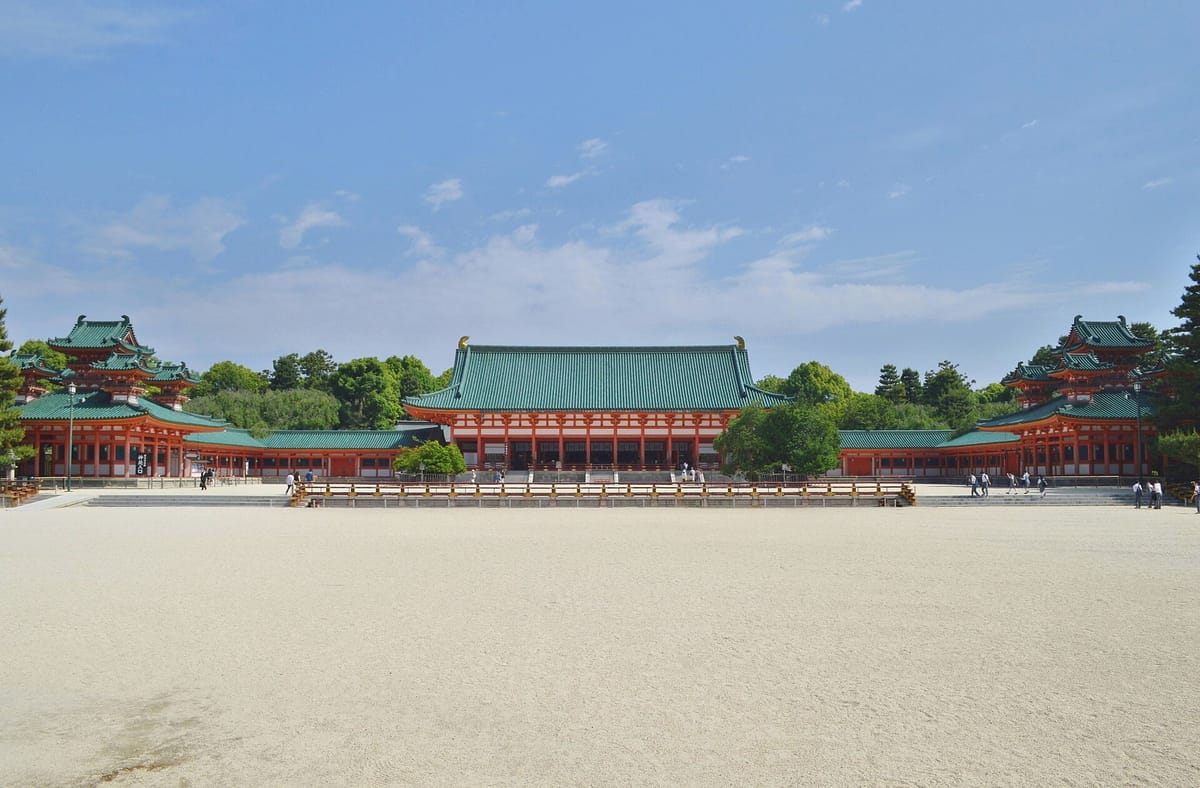
The result is unlike most shrines you will visit. Instead of a wooded hillside, you find a vast courtyard of white gravel framed by vermilion corridors, with the green-tiled roofs of the Daigokuden at the far end and two towers, the Sōryūrō and the Byakkorō, at the corners, named after the blue dragon of the east and the white tiger of the west. Several of these buildings are Important Cultural Properties.
For a Japanese learner it is a chance to connect the words you meet in history and literature, Heian, dairi, the palace, and Kanmu-tennō, with real buildings, and the calm garden behind the halls is one of the best places in Kyoto to practise talking about the seasons.
Getting there: Higashiyama Station and the Okazaki bus stops
The easiest route is the Tōzai subway line to Higashiyama Station, then about ten minutes' walk north through the Okazaki area. Jingū-Marutamachi Station on the Keihan line is about fifteen minutes to the west. Several city buses stop along the avenues around Okazaki Park, a few minutes from the great torii.
The great torii, the ōtorii, stands over the road on the approach, and beyond it the Ōtenmon gate opens into the courtyard. Okazaki is a district of museums and parks as well as the shrine, with the Kyoto City KYOCERA Museum of Art and the National Museum of Modern Art beside the torii, so it is easy to spend a whole afternoon in the area. Nanzen-ji and the lower end of the Philosopher's Path are within walking distance to the east.
| Japanese | Romaji | Meaning |
|---|---|---|
| 東山駅から平安神宮まで歩けますか。 | Higashiyama-eki kara Heian Jingū made arukemasu ka. | Can I walk from Higashiyama Station to Heian Jingū? |
| 大鳥居はこの先ですか。 | Ōtorii wa kono saki desu ka. | Is the great torii up ahead? |
| 岡崎公園行きのバスはどれですか。 | Okazaki Kōen-yuki no basu wa dore desu ka. | Which bus goes to Okazaki Park? |
| 美術館は鳥居の近くですか。 | Bijutsukan wa torii no chikaku desu ka. | Is the art museum near the torii? |
| ここから南禅寺まで歩いて行けますか。 | Koko kara Nanzen-ji made aruite ikemasu ka. | Can I walk to Nanzen-ji from here? |
From the Ōtenmon to the Shin'en garden
Pass through the two-storey Ōtenmon gate and the courtyard opens before you. The Daigokuden at the far end is the outer worship hall, where you make your prayer; the main sanctuary lies behind it and is not open. Look for the cherry tree and the mandarin orange tree planted on either side of the steps, echoing the trees that stood before the throne hall of the old palace. Cast-metal lanterns decorated with the four guardian beasts of the directions hang in the corridors.
The Shin'en garden wraps around the main halls on the south, west, middle and east sides, and together its four parts form a large pond-and-stroll garden designated a Place of Scenic Beauty. It was laid out from 1895 onwards, mostly by the celebrated gardener Ogawa Jihei VII, and filled with water from the new Lake Biwa Canal. A walk through all four takes about forty minutes at a gentle pace, longer if you sit.
- Minami Shin'en: the south garden, where the weeping cherries meet you at the entrance, planted with flowers named in classical Heian literature.
- Nishi Shin'en: the west garden, with a pond of irises in June and water lilies in summer.
- Naka Shin'en: the middle garden, where the Garyūkyō stepping stones cross the pond; they are made from pillars of the old Sanjō and Gojō bridges.
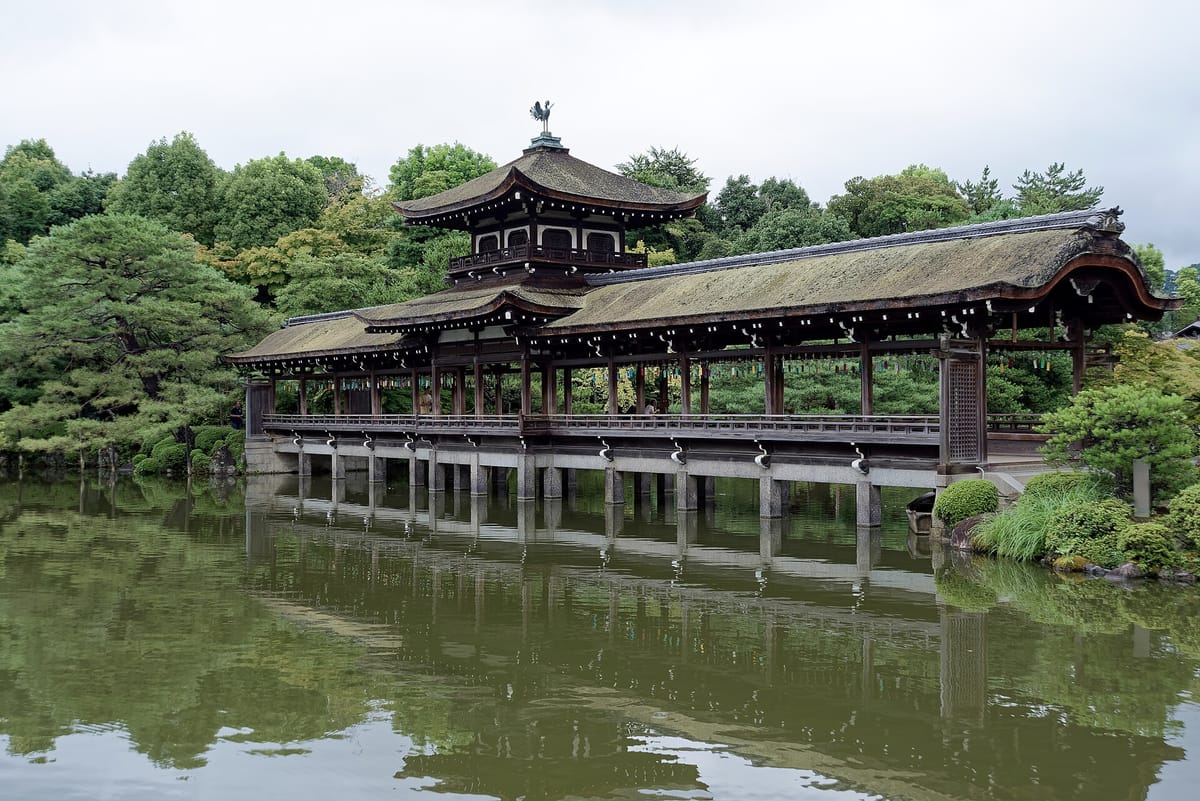
- Higashi Shin'en: the largest pond, with the Taiheikaku covered bridge and a view borrowed from the Higashiyama hills.
- Ōtorii: the great torii on the approach, built in 1929 and among the largest vermilion torii in Japan.
Words on the signs at Heian Jingū
The names at Heian Jingū come straight from the language of the Heian court, so they are a little grander than usual. 殿, den, is a hall of state; 楼, rō, a tower; 閣, kaku, a pavilion. The garden is 神苑, shin'en, literally the garden of the gods, a word used for shrine gardens across Japan.
Two animals appear again and again. 龍, ryū, the dragon, and 虎, ko or tora, the tiger, stand for east and west in the old four-directions scheme, and 臥龍橋 means a bridge like a reclining dragon, which is how the stepping stones look when you see them from the bank.
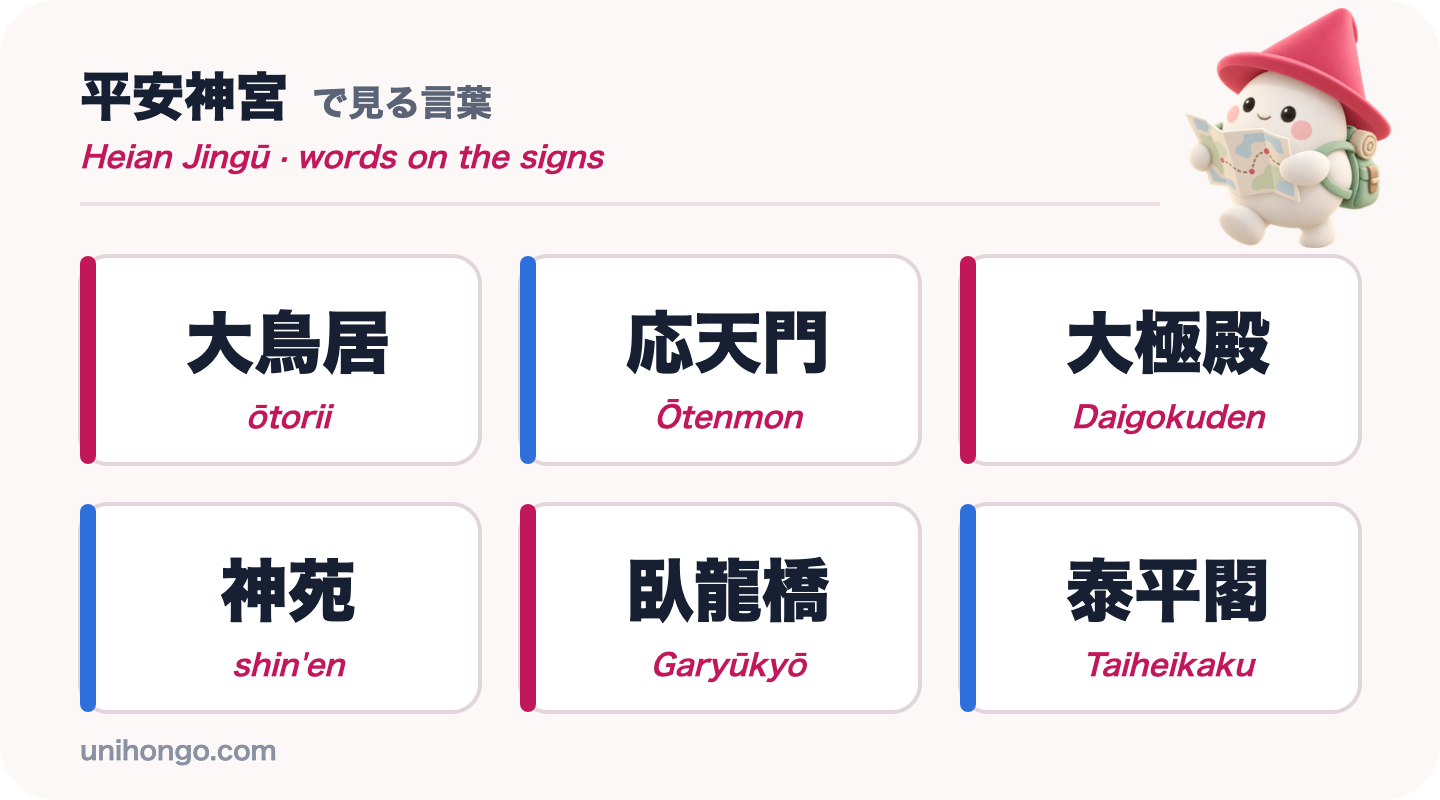
| Word | Reading | Meaning |
|---|---|---|
| 大鳥居 | ōtorii | The great torii over the approach road |
| 応天門 | Ōtenmon | The two-storey main gate of the shrine |
| 大極殿 | Daigokuden | The outer worship hall, modelled on the palace's state hall |
| 蒼龍楼 | Sōryūrō | Tower of the blue dragon, on the east side |
| 白虎楼 | Byakkorō | Tower of the white tiger, on the west side |
| 神苑 | shin'en | The shrine's stroll garden, entered with a ticket |
| 臥龍橋 | Garyūkyō | The stepping stones across the middle pond |
| 泰平閣 | Taiheikaku | The covered bridge pavilion in the east garden |
| 紅しだれ桜 | beni-shidarezakura | Pink weeping cherry trees |
Japanese for the garden and the shrine counter
The garden has its own ticket window, and the attendants field the same questions all spring: where to go in, whether the flowers are out, and whether you can use a tripod. Tripods and monopods need a separate fee and are not allowed at all during the cherry season or on free-entry days, so it is worth asking first.
At the charm counter, Heian Jingū is known for prayers for good relationships and happy marriages, and it holds many weddings in its halls. Charms for couples and seasonal goshuin designs appear during the year, so a question about what is new is a good way to start a conversation.
| Japanese | Romaji | Meaning |
|---|---|---|
| 神苑の拝観券を一枚ください。 | Shin'en no haikanken o ichimai kudasai. | One ticket for the garden, please. |
| 三脚は使えますか。 | Sankyaku wa tsukaemasu ka. | Can I use a tripod? |
| 全部回るとどのくらいかかりますか。 | Zenbu mawaru to dono kurai kakarimasu ka. | How long does it take to go all the way round? |
| 縁結びのお守りはどれですか。 | Enmusubi no o-mamori wa dore desu ka. | Which charm is for finding a good match? |
| 季節限定の御朱印はありますか。 | Kisetsu gentei no goshuin wa arimasu ka. | Is there a limited seasonal goshuin? |
| 出口はどちらですか。 | Deguchi wa dochira desu ka. | Which way is the exit? |
Etiquette, seasons and timing
Heian Jingū is a large, open shrine and an easy place to visit, but it is also a busy wedding venue and a place of worship.
- Bow before passing through the Ōtenmon and purify your hands at the temizuya before praying at the Daigokuden.
- Give wedding processions space and do not photograph the couple without asking; they are often in the courtyard at weekends.
- Stay on the paths in the garden and do not step off the Garyūkyō stones into the pond for photos.
- Come early in the morning in early to mid April; the weeping cherries draw long queues at the garden gate.
- On 22 October the Jidai Matsuri procession ends at the shrine and the garden closes early.
- The garden closes earlier in autumn and winter than in spring and summer; check the official hours before an afternoon visit.
Practise the garden gate before you go
The garden entrance is not obvious from the courtyard, and in April everyone wants to know about the cherries. The four lines below cover both questions. Listen for mukatte hidarite, on the left as you face it, and for migoro, the best time to see the flowers, in the answer.
Say the lines aloud until you can do it without reading, then practise with a partner who can change the answer. In Unihongo, choose the Shrine Visit topic and ask your AI Sensei to play an attendant at Heian Jingū, or choose Seasonal Events to talk about hanami and the autumn festival. Rehearsing once makes it much easier to catch a real answer at natural speed.
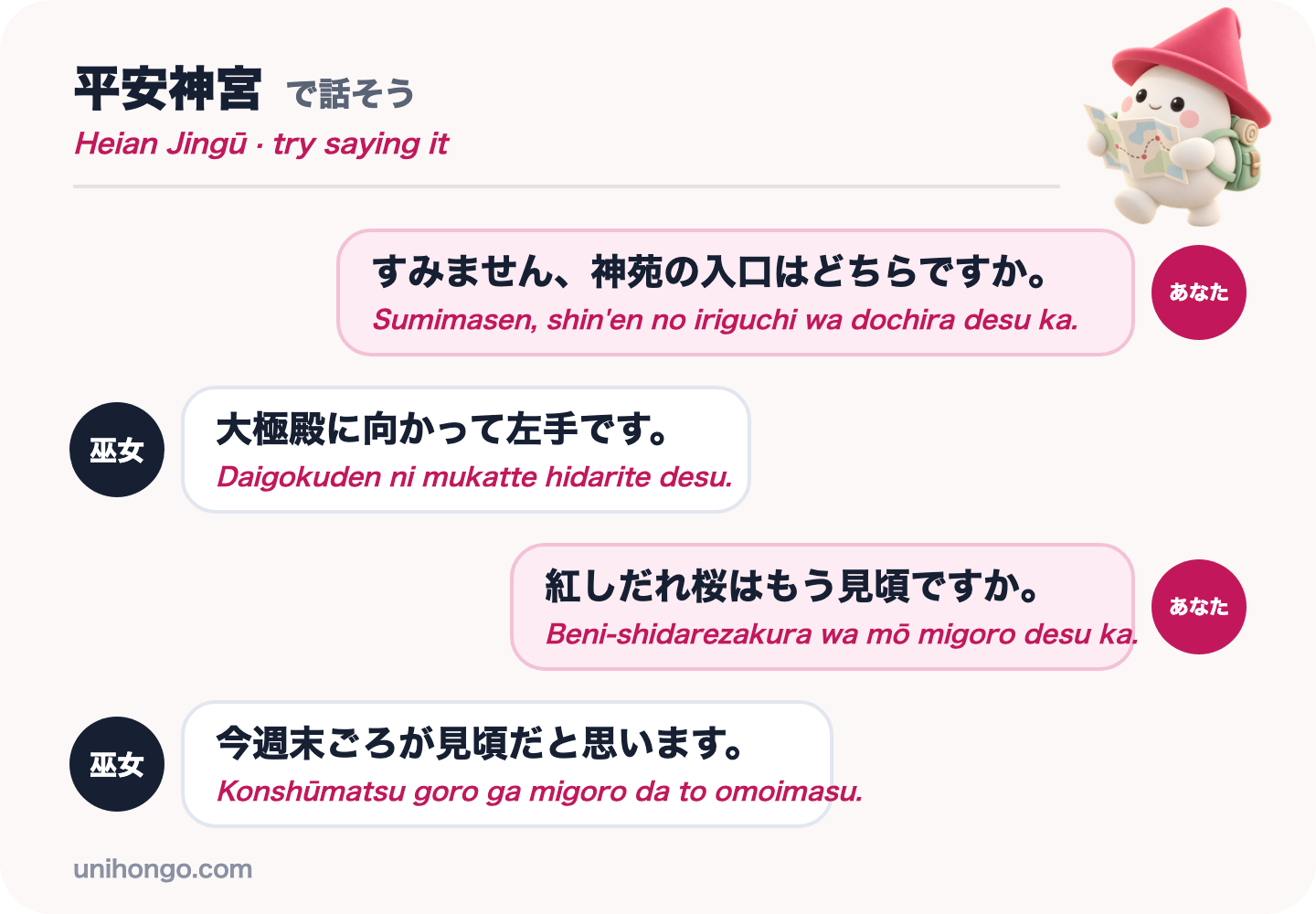
| Japanese | Romaji | Meaning |
|---|---|---|
| すみません、神苑の入口はどちらですか。 | Sumimasen, shin'en no iriguchi wa dochira desu ka. | Excuse me, which way is the garden entrance? |
| 大極殿に向かって左手です。 | Daigokuden ni mukatte hidarite desu. | It is on the left as you face the Daigokuden. |
| 紅しだれ桜はもう見頃ですか。 | Beni-shidarezakura wa mō migoro desu ka. | Are the weeping cherries at their best yet? |
| 今週末ごろが見頃だと思います。 | Konshūmatsu goro ga migoro da to omoimasu. | I think they will be at their best around this weekend. |
Official information
Heian Jingū publishes garden hours, fees, free-entry days, festival dates and notices about the repainting works on its website, with an English page. Check it before you go, especially in April and October.