

Why Nagatoro is worth a day on the river
Nagatoro is the name of both a town and a stretch of river. The Arakawa, the river that later flows through Tokyo to the sea, runs here through a gorge of layered rock, and the six kilometres from Oyahana Bridge down to Takasago Bridge were designated a national Place of Scenic Beauty and Natural Monument in 1924. The town has welcomed visitors since the Meiji era, and it still has the feel of an old-fashioned day out: a boat ride, a walk on the rocks, grilled snacks and a shrine.
The rocks are the real star. The Iwadatami, rock tatami, is a broad terrace of crystalline schist about eighty metres wide and six hundred metres long, formed deep underground and pushed up to the surface. Because rock that was made so deep can be seen here so easily, Nagatoro is called a window on the earth, chikyū no mado, and it is known as the birthplace of Japanese geology, after the German geologist Edmund Naumann surveyed it in 1878.
For a learner, Nagatoro is relaxed practice. The town is used to day-trippers from Tokyo, the signs are short and clear, and the boat office, the ropeway and the shrine each give you a real exchange with staff who speak ordinary, friendly Japanese.
Getting there: the Chichibu Railway to Nagatoro Station
All routes into Nagatoro end on the Chichibu Railway, Chichibu Tetsudō, a local line that runs along the Arakawa valley. From Ikebukuro, the fastest option is the Seibu Laview limited express to Seibu-Chichibu, about eighty minutes, then a five-minute walk to Ohanabatake Station and about twenty minutes on the Chichibu Railway to Nagatoro. You can also take the Tōbu Tōjō Line from Ikebukuro to Yorii, or JR from Ueno to Kumagaya, and change to the Chichibu Railway there. Note that the Chichibu Railway is a private line not covered by the Japan Rail Pass.
Three stations serve the town: Nagatoro, closest to the Iwadatami, the boat office and the approach to Hodosan Shrine; Kami-Nagatoro, one stop towards Chichibu and near the Saitama Museum of Natural History; and Nogami, one stop towards Kumagaya. The boat office is a few minutes' walk from Nagatoro Station, and the start of the lower boat course at the Iwadatami is just beyond it.
| Japanese | Romaji | Meaning |
|---|---|---|
| 長瀞に行きたいんですが、何番線ですか。 | Nagatoro ni ikitai n desu ga, nanbansen desu ka. | I want to go to Nagatoro. Which platform is it? |
| この電車は長瀞に止まりますか。 | Kono densha wa Nagatoro ni tomarimasu ka. | Does this train stop at Nagatoro? |
| ICカードは使えますか。 | IC kādo wa tsukaemasu ka. | Can I use an IC card? |
| 岩畳はどちらですか。 | Iwadatami wa dochira desu ka. | Which way is the Iwadatami? |
| ライン下りの受付はどこですか。 | Rain kudari no uketsuke wa doko desu ka. | Where is the reception for the river boats? |
What you will see: the Iwadatami, the boats and Mount Hōdo
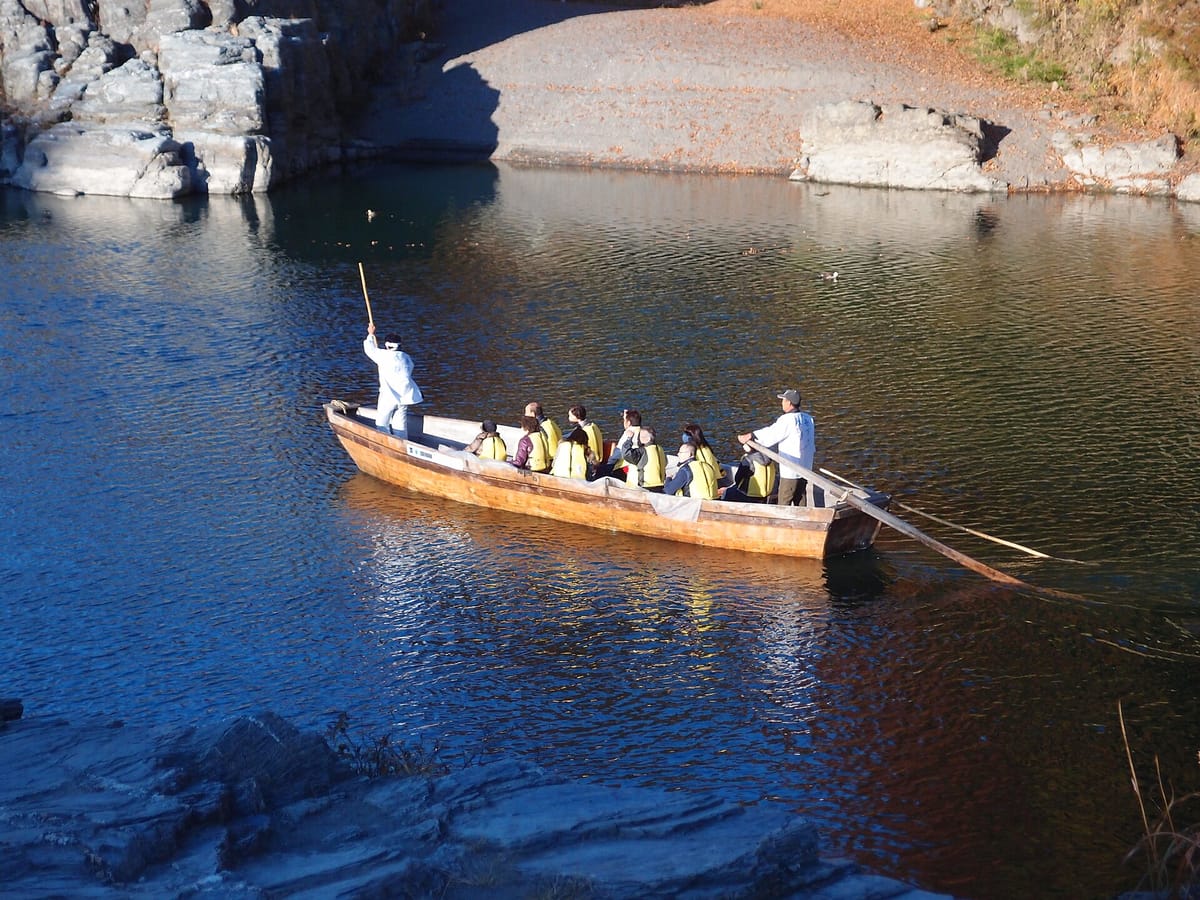
The river boats, run by the Chichibu Railway, split the gorge into two courses. The upper course, often called course A, starts at Oyahana Bridge, reached by a free bus from the boat office, and floats about three kilometres down to the Iwadatami, through the Kotaki no se rapids that appear on so many posters. The lower course, course B, starts at the Iwadatami and runs about three kilometres to Takasago Bridge, through wider rapids such as the Ōkawase, and a free bus brings you back. Each takes around twenty minutes, a little less when the water is high. The boats have no engines: two boatmen steer with poles and oars and keep up a running commentary in Japanese.
After the boat, walk on the Iwadatami itself. The flat rock steps down to the water, and across the river are the steep cliffs known as the Chichibu Red Wall, Chichibu Sekiheki. Then follow the road up to Hodosan Shrine and the ropeway to the summit of Mount Hōdo, which is covered in flowers in winter.
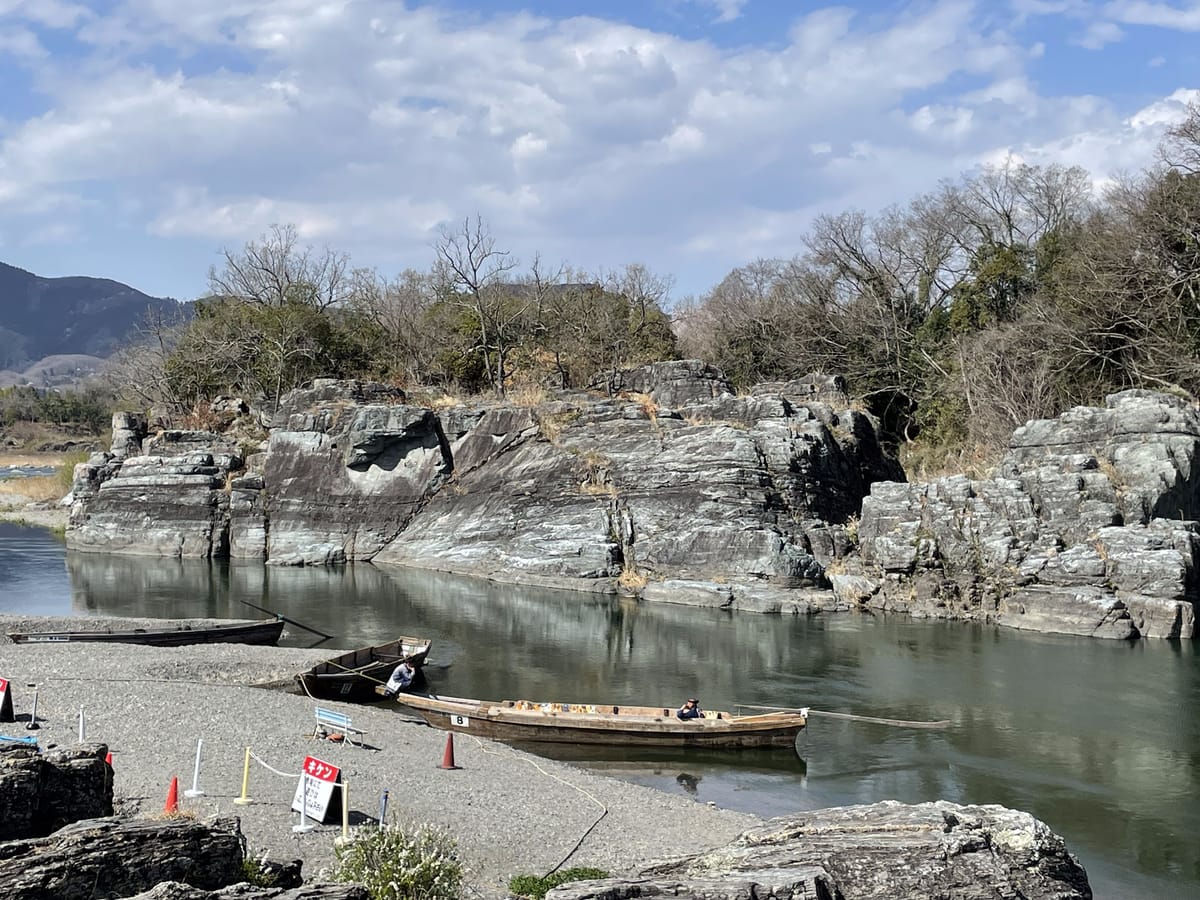
- Iwadatami: the rock terraces by the river, free to walk on at any time.
- Nagatoro Line Kudari: the traditional boat ride, in two courses of about three kilometres each.
- Hodosan Jinja: a richly carved shrine about fifteen minutes' walk from Nagatoro Station.
- Hodosan Ropeway and the summit: wintersweet from late December to late February, and around 170 kinds of plum from February to March.
- Hodosan Okumiya: the inner shrine near the summit, a short walk from the ropeway.
- Saitama Museum of Natural History: rocks and fossils of the Chichibu area, near Kami-Nagatoro Station.
- Rafting: several companies run guided white-water trips on the same river in the warmer months.
Words on the signs in Nagatoro
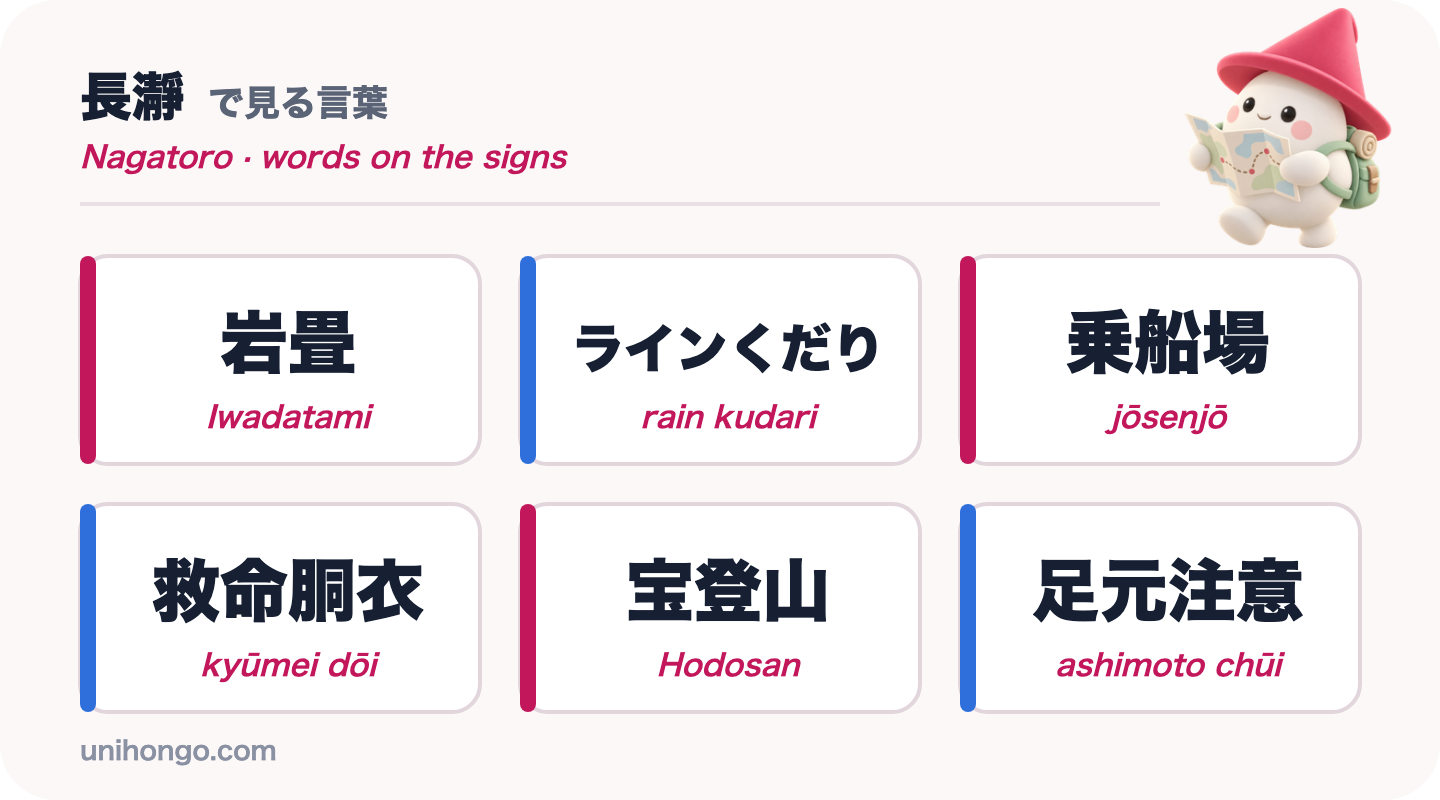
Nagatoro's signs are mostly about water and safety. The boat piers are 乗船場, jōsenjō, boarding places, and the life jackets you are handed are 救命胴衣, kyūmei dōi, literally life-saving vests. On the rocks you will see 足元注意, ashimoto chūi, watch your step, and warnings about the river's depth and current.
The mountain name 宝登山, Hodosan, is worth a closer look. The shrine's legend says it was once 火止山, fire-stopping mountain, and the characters were later changed to the lucky 宝登, treasure climbing, while the sound stayed the same. It is a good example of how Japanese place names keep their sound and swap their kanji.
| Word | Reading | Meaning |
|---|---|---|
| 岩畳 | Iwadatami | The rock terraces beside the river |
| ラインくだり | rain kudari | River boat ride down the gorge |
| 乗船場 | jōsenjō | Boat boarding pier |
| 救命胴衣 | kyūmei dōi | Life jacket |
| 宝登山 | Hodosan | Mount Hōdo, with the shrine and ropeway |
| 足元注意 | ashimoto chūi | Watch your step |
| 急流 | kyūryū | Rapids, fast-flowing water |
| 遊泳禁止 | yūei kinshi | No swimming |
| 臘梅 | rōbai | Wintersweet, the yellow winter flower on Mount Hōdo |
Japanese for the river boats
At the boat office you choose a course, pay and receive a ticket with a departure time. On busy days staff simply put you on the earliest boat with space, so the useful questions are about the course, the time and where to go. Before boarding you put on a life jacket, and on the water the boatmen may ask where you are from, doko kara desu ka, which is your cue to answer in Japanese.
If you want the whole gorge, ask about riding both courses one after the other, changing boats at the Iwadatami; staff will tell you how the connection works on the day.
| Japanese | Romaji | Meaning |
|---|---|---|
| 大人二人、お願いします。 | Otona futari, onegai shimasu. | Two adults, please. |
| 両方のコースに乗れますか。 | Ryōhō no kōsu ni noremasu ka. | Can we ride both courses? |
| 次の舟は何時に出ますか。 | Tsugi no fune wa nanji ni demasu ka. | What time does the next boat leave? |
| 乗船場はどこですか。 | Jōsenjō wa doko desu ka. | Where is the boarding pier? |
| 無料バスはどこから乗りますか。 | Muryō basu wa doko kara norimasu ka. | Where do I catch the free bus? |
| 荷物はどこに置けばいいですか。 | Nimotsu wa doko ni okeba ii desu ka. | Where should I put my bag? |
| イギリスから来ました。 | Igirisu kara kimashita. | I've come from the UK. |
Safety, etiquette and timing
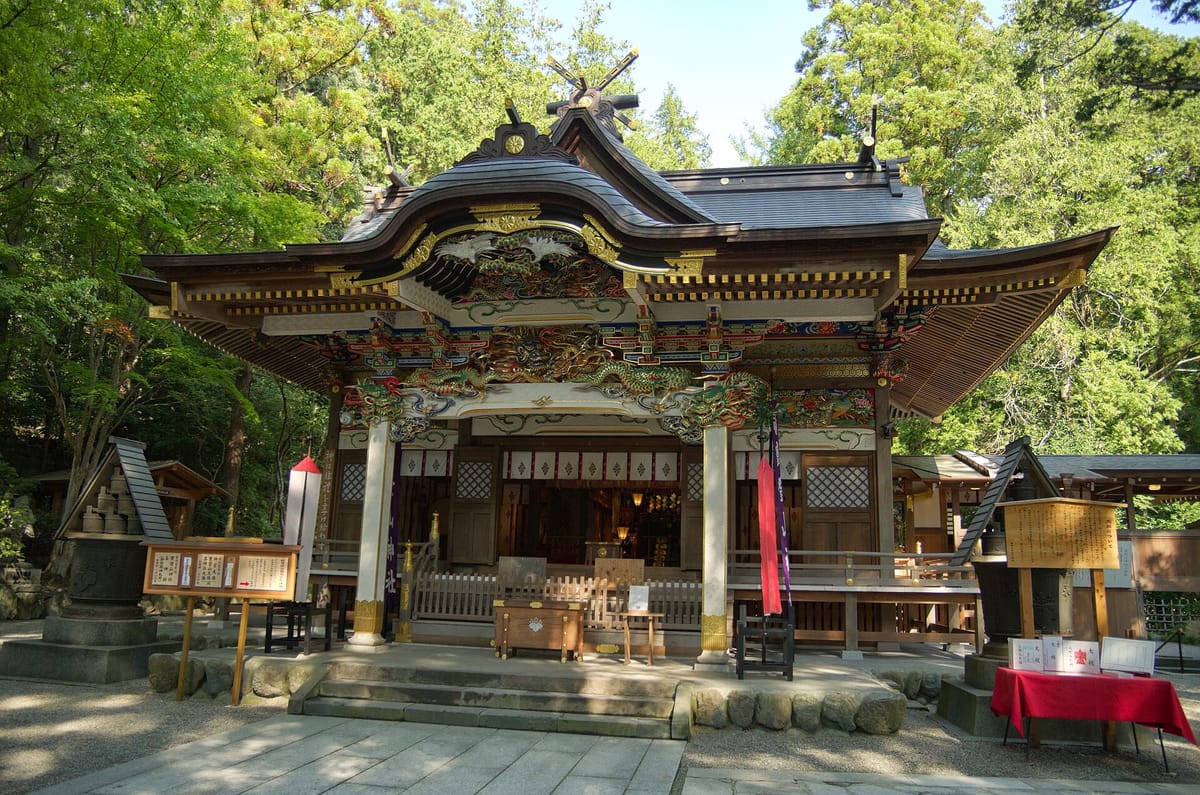
Hodosan Shrine is worth the walk up from the station. Its legend tells of Prince Yamato Takeru, trapped by a wildfire on the mountain, who was saved when giant dogs appeared and put out the flames; the shrine is still visited for protection from fire and theft. Its main hall is covered in colourful carvings, and the inner shrine sits near the summit by the ropeway.
- Always wear the life jacket you are given on the boat and stay seated while moving through the rapids.
- The Iwadatami is slippery when wet and has no railings in places; keep children close and stay away from the edge after rain.
- Do not swim near the boat routes. The river looks calm between rapids but is deep and fast in places.
- Boats stop in bad weather, when the river is too high or too low, and during a winter break; check before you go.
- Come on a weekday or early in the day in November, when the autumn leaves draw long queues for the boats.
- At Hodosan Shrine, bow at the torii, rinse your hands, then bow twice, clap twice, pray and bow once more.
Practise the boat office before you go
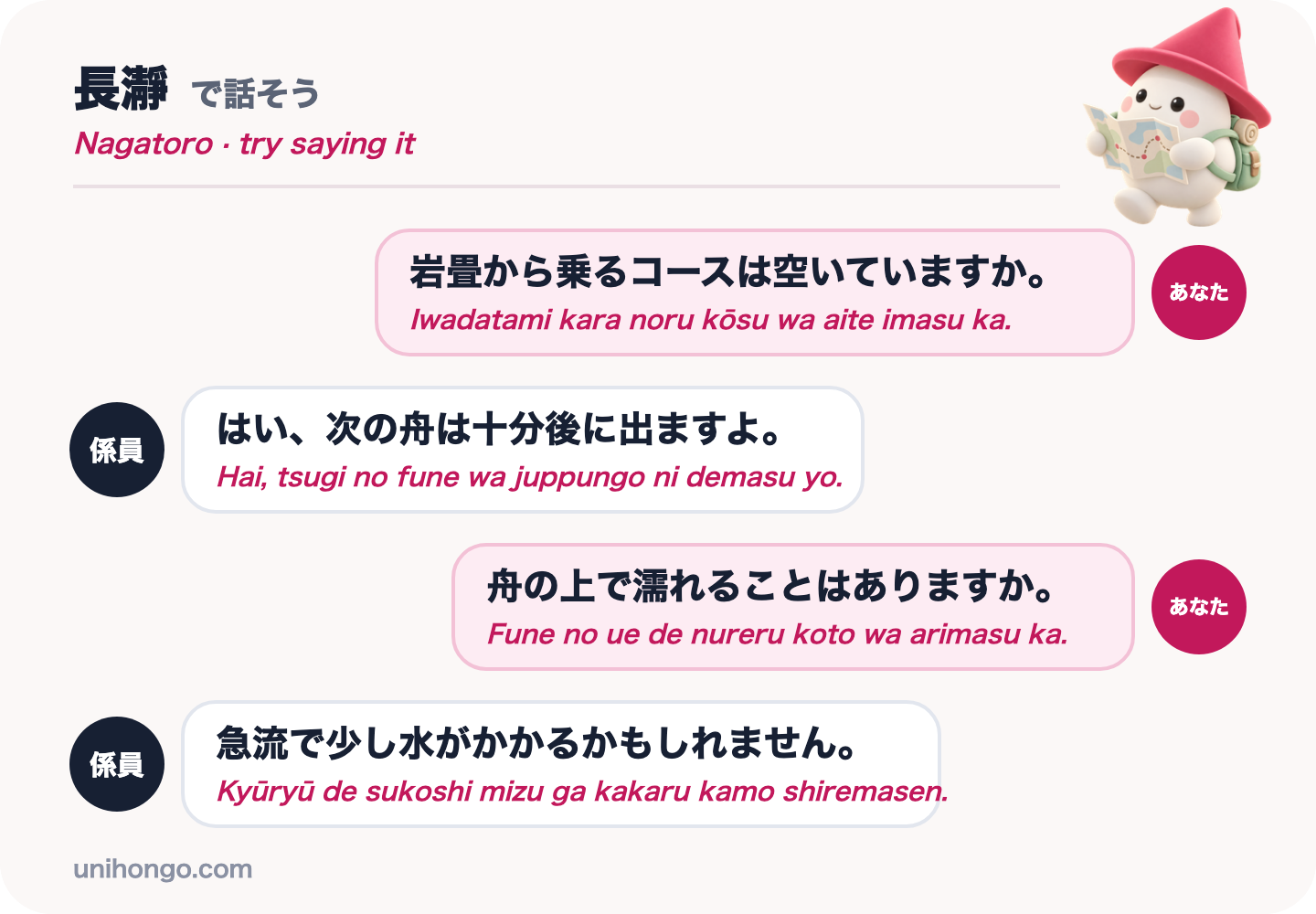
This short exchange is exactly what happens at the counter: you ask which course has space, hear when the next boat leaves, and check whether you will get wet. Practise the four lines below until they come out without reading, and listen for the key words in the replies: juppungo, in ten minutes, and kyūryū, the rapids.
Then practise with a partner who answers back. In Unihongo, choose the Sightseeing topic and ask your AI Sensei to play the staff at the Nagatoro boat office, or try the Ask the Way to the Station mission to rehearse finding your way back to the Chichibu Railway afterwards. Saying the lines once before your trip is what makes them easy on the day.
| Japanese | Romaji | Meaning |
|---|---|---|
| 岩畳から乗るコースは空いていますか。 | Iwadatami kara noru kōsu wa aite imasu ka. | Is there space on the course that starts at the Iwadatami? |
| はい、次の舟は十分後に出ますよ。 | Hai, tsugi no fune wa juppungo ni demasu yo. | Yes, the next boat leaves in ten minutes. |
| 舟の上で濡れることはありますか。 | Fune no ue de nureru koto wa arimasu ka. | Do you ever get wet on the boat? |
| 急流で少し水がかかるかもしれません。 | Kyūryū de sukoshi mizu ga kakaru kamo shiremasen. | You might get a little splashed in the rapids. |
Official information
The Nagatoro Tourism Association publishes the boat information, access, flower calendar and events, and the Chichibu Railway explains the boat courses. The Hodosan Ropeway site lists the seasonal flowers on the summit. Check operating days and river conditions before you go.