

Why the Ryōan-ji rock garden rewards sitting still
The land Ryōan-ji stands on was an aristocrat's estate in the Heian period. In 1450 Hosokawa Katsumoto, one of the most powerful lords of his day, turned it into a Zen temple. It was burned in the Ōnin War, which Katsumoto himself helped to start, and rebuilt by his son. The rock garden is usually dated to the late fifteenth century, but its maker is unknown.
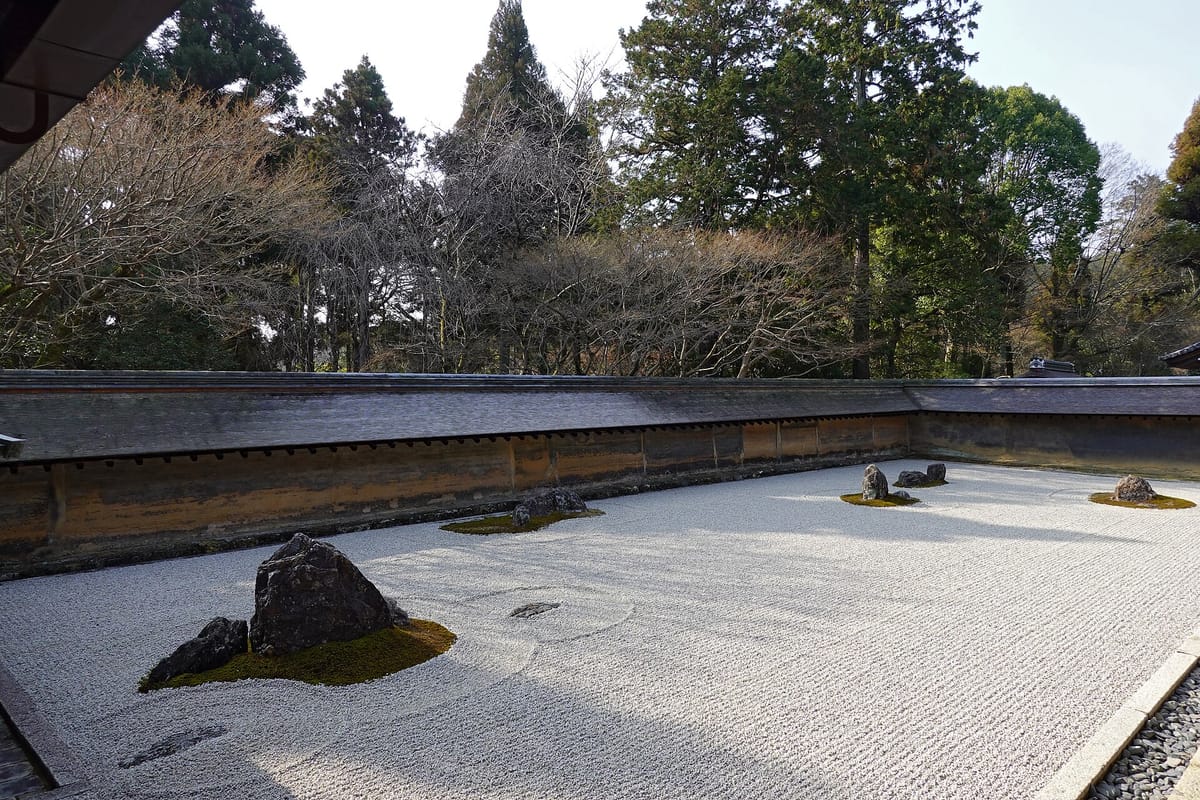
The garden is a rectangle of white gravel, raked into straight lines and into rings around each group of stones, and enclosed on two sides by a low wall made of clay mixed with oil, whose stains have become part of its beauty. There are no plants other than moss, no water and no path. You look at it from the veranda of the hōjō, the abbot's hall, and it changes with the light and your own mood.
For a learner, Ryōan-ji is the place to meet Zen vocabulary: karesansui, dry landscape, zazen, seated meditation, and the four characters of the stone basin, which are among the most quoted words in Japanese Buddhism.
Getting there: Randen Ryōanji Station and bus 59
The Randen's Kitano Line, the small Keifuku tram, stops at Ryōanji Station; from there it is a walk of under ten minutes north up a quiet road to the temple gate. The line runs from Kitano Hakubaichō, near Kitano Tenmangū, towards Arashiyama, so it is a handy way to combine Ryōan-ji with the bamboo grove.
City bus 59 stops at Ryōanji-mae, directly outside, and connects to Kinkaku-ji in a few minutes; JR buses from Kyoto Station also stop nearby. On foot, Ryōan-ji is about twenty minutes from Kinkaku-ji along the Kinukake-no-michi, the road that links Kinkaku-ji, Ryōan-ji and Ninna-ji along the foot of the hills.
| Japanese | Romaji | Meaning |
|---|---|---|
| 龍安寺駅で降りればいいですか。 | Ryōanji-eki de orireba ii desu ka. | Should I get off at Ryōanji Station? |
| 龍安寺前に止まるバスはどれですか。 | Ryōanji-mae ni tomaru basu wa dore desu ka. | Which bus stops at Ryōanji-mae? |
| 金閣寺から歩いて何分くらいですか。 | Kinkaku-ji kara aruite nanpun kurai desu ka. | About how many minutes' walk is it from Kinkaku-ji? |
| きぬかけの路はこの道ですか。 | Kinukake no michi wa kono michi desu ka. | Is this road the Kinukake-no-michi? |
| 仁和寺へはどう行けばいいですか。 | Ninna-ji e wa dō ikeba ii desu ka. | How do I get to Ninna-ji? |
The route: the pond, the hōjō and the stone basin
After the ticket gate, the path leads round the Kyōyōchi, a large pond that was once the heart of the aristocratic estate, and up a stone stairway to the hōjō. There you take off your shoes and walk through to the veranda on the south side, which faces the rock garden. Find a spot, sit down and give it time.
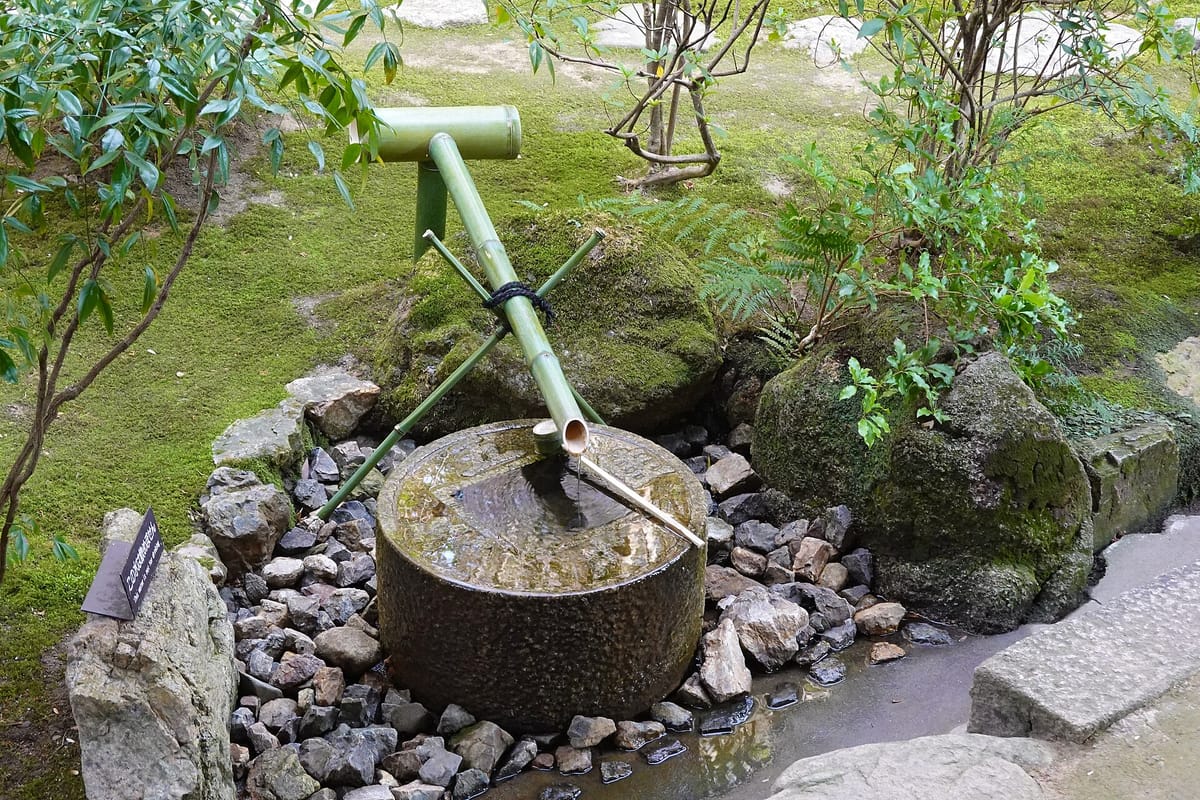
Continue round the hōjō to the back, where the tsukubai, the stone water basin, sits in a small moss garden. Afterwards, the path back to the gate passes the other side of the pond, with a small island shrine reached by a bridge.
- Kyōyōchi: the large pond in front of the temple, beautiful with water lilies in summer.
- Hōjō: the abbot's hall, with painted sliding doors and the veranda facing the garden.
- Sekitei: the rock garden, fifteen stones in five groups on raked white gravel.
- Aburadobei: the clay and oil wall around the garden, stained into soft patterns by time.
- Tsukubai: the stone basin behind the hōjō with the four-character inscription.
- Benten island: a small shrine on an island in the pond, reached by a bridge.
Words on the signs at Ryōan-ji
The signs at Ryōan-ji are few and useful. 拝観順路, the visitors' route, points the way round the pond and into the hall; 土足厳禁, no outdoor shoes, marks where you take your shoes off at the hōjō. Name boards give the pond and the garden.
The most famous inscription is on the tsukubai: 吾唯足知. Each character uses the square water hole in the centre as its 口 part, so the four kanji share one square. It is read ware tada taru o shiru and teaches contentment with what you already have.
| Word | Reading | Meaning |
|---|---|---|
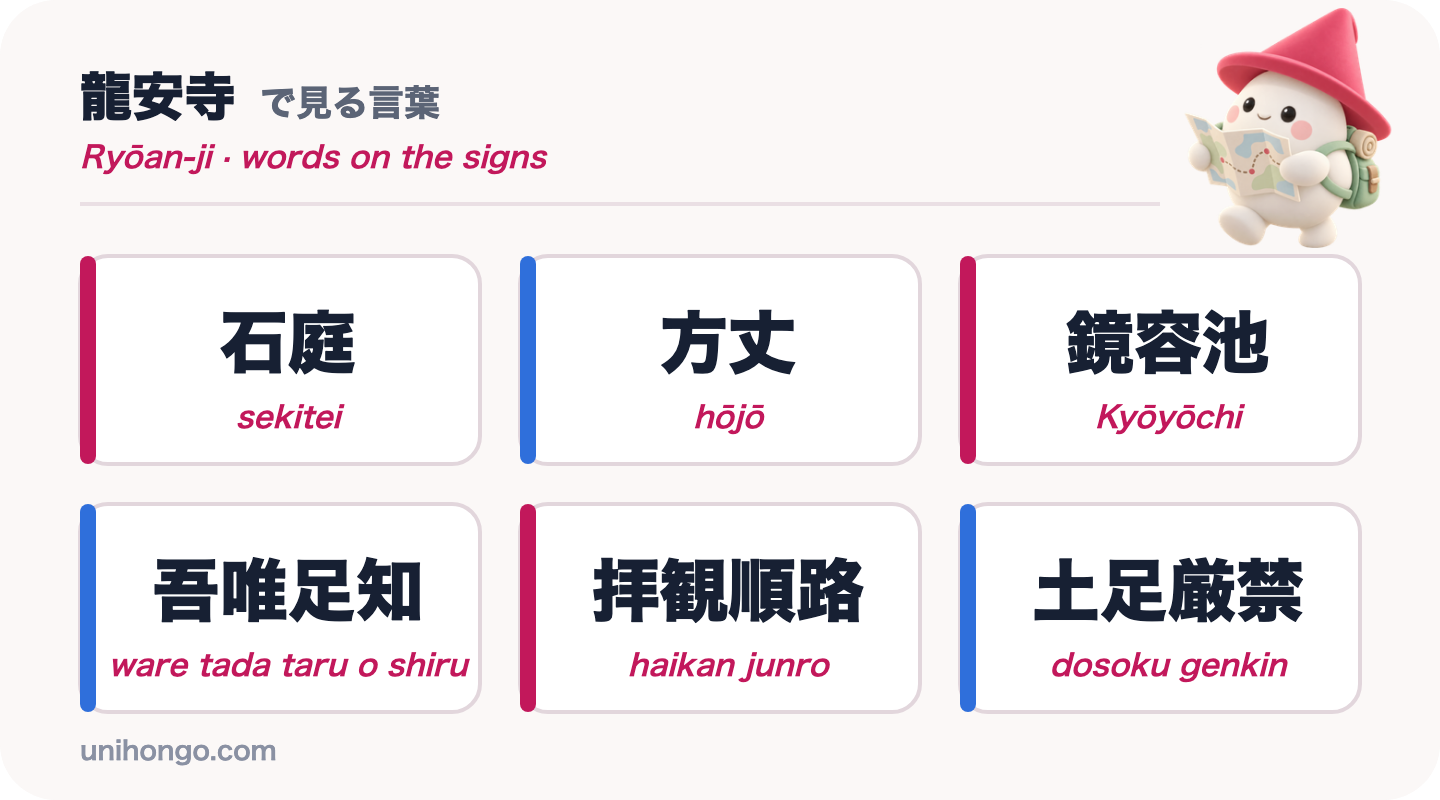
| 石庭 | sekitei | Rock garden |
| 枯山水 | karesansui | Dry landscape garden, without water |
| 方丈 | hōjō | The abbot's hall facing the garden |
| 鏡容池 | Kyōyōchi | The large pond in front of the temple |
| つくばい | tsukubai | Low stone water basin |
| 吾唯足知 | ware tada taru o shiru | I know only contentment, the basin's inscription |
| 拝観順路 | haikan junro | The visitors' route |
| 土足厳禁 | dosoku genkin | Strictly no outdoor shoes |
| 坐禅 | zazen | Seated Zen meditation |
Japanese for the hall, the garden and the goshuin
Ryōan-ji is a quiet place, and most of the Japanese you use is in low voices: asking where to leave your shoes, whether you may sit on the veranda, and a question or two about the garden. Temple staff are used to curious visitors, and a short, polite question is always welcome.
The temple also offers goshuin, and its shop sells souvenirs with the tsukubai's four characters, a popular gift for anyone who likes a bit of Zen at home.
| Japanese | Romaji | Meaning |
|---|---|---|
| 靴はどこに入れればいいですか。 | Kutsu wa doko ni irereba ii desu ka. | Where should I put my shoes? |
| 縁側に座ってもいいですか。 | Engawa ni suwatte mo ii desu ka. | May I sit on the veranda? |
| 石庭はいつごろ作られたんですか。 | Sekitei wa itsu goro tsukurareta n desu ka. | Around when was the rock garden made? |
| どこから見るのがおすすめですか。 | Doko kara miru no ga osusume desu ka. | Where do you recommend viewing it from? |
| つくばいはどこにありますか。 | Tsukubai wa doko ni arimasu ka. | Where is the stone basin? |
| 御朱印をお願いしたいんですが。 | Goshuin o onegai shitai n desu ga. | I would like a goshuin, please. |
Zen temple manners and timing
Ryōan-ji's garden is enjoyed in silence by people sitting side by side on a single veranda, so the etiquette is mostly about sharing that space.
- Speak quietly on the veranda, and keep phone calls and video for outside.
- Do not step down onto the gravel or touch the stones or the wall.
- Sit, look, then give up your place near the centre to others after a while.
- Take your shoes off where the sign says 土足厳禁 and carry nothing wet or dirty onto the wooden floors.
- Come at opening time for the calmest veranda; tour groups arrive later in the morning.
- Visit on a grey or rainy day for fewer people and a darker, moodier garden.
Practise with a guide before you go
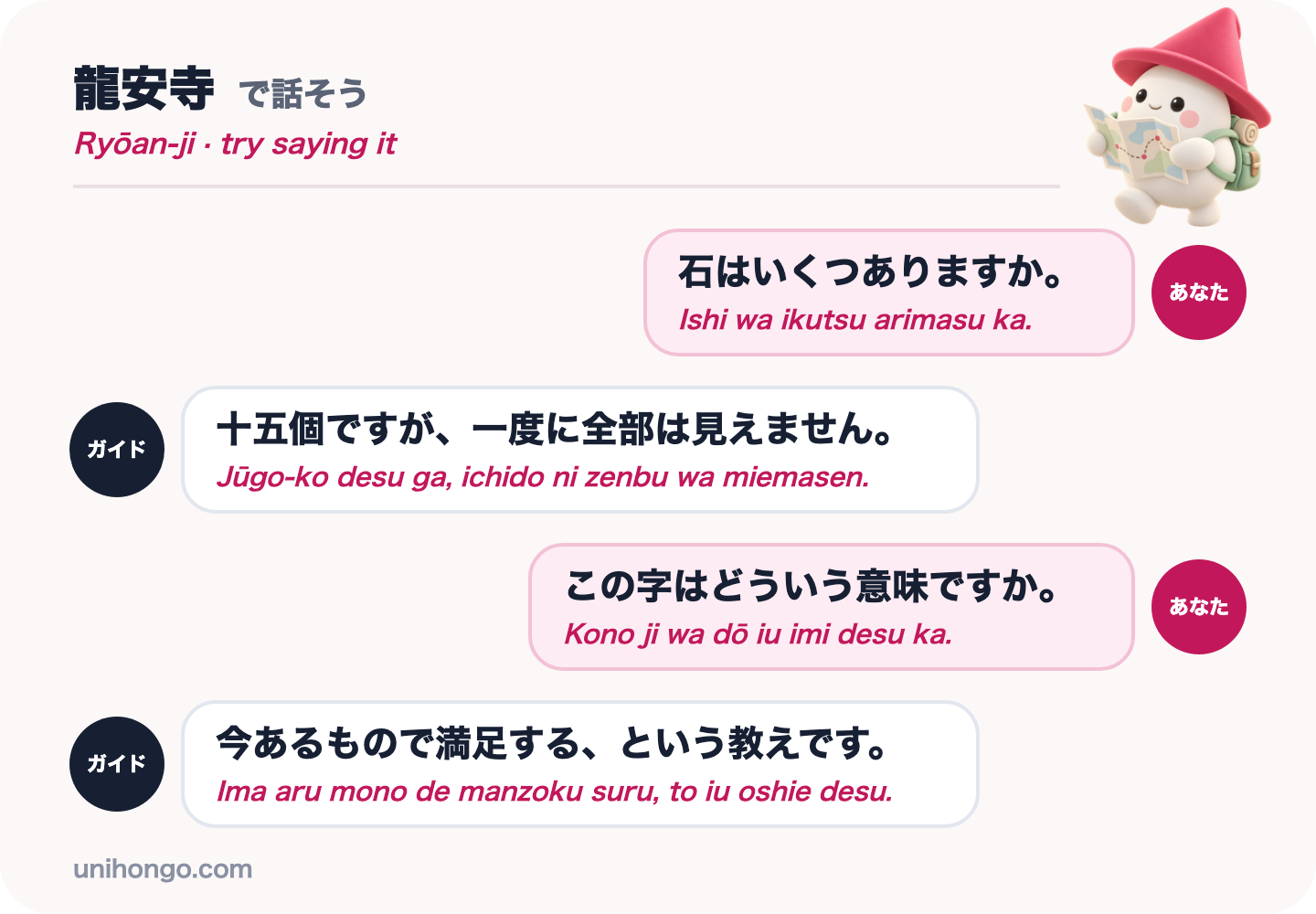
The two questions every visitor has at Ryōan-ji are the number of stones and the meaning of the basin. Practise the four lines below until you can say them without reading. Listen for miemasen, cannot be seen, in the first answer and oshie, teaching, in the second.
Then practise with someone who answers back. In Unihongo, choose the Sightseeing topic and ask your AI Sensei to play a guide at Ryōan-ji, and ask about the garden's history and meaning. Speaking the lines once before you go is what makes them come out naturally on the veranda.
| Japanese | Romaji | Meaning |
|---|---|---|
| 石はいくつありますか。 | Ishi wa ikutsu arimasu ka. | How many stones are there? |
| 十五個ですが、一度に全部は見えません。 | Jūgo-ko desu ga, ichido ni zenbu wa miemasen. | Fifteen, but you cannot see them all at once. |
| この字はどういう意味ですか。 | Kono ji wa dō iu imi desu ka. | What do these characters mean? |
| 今あるもので満足する、という教えです。 | Ima aru mono de manzoku suru, to iu oshie desu. | It is a teaching: be content with what you have. |
Official information
Ryōan-ji's own website lists its hours and fee, but it is not served over a secure connection, so we link to Kyoto City's official travel guide instead, which covers the temple and the area. Check the latest hours before you go.