

Why a silk mill is worth the trip
Silk was Japan's great export in the late nineteenth century, and the Meiji government wanted to raise its quality to compete in Europe. In 1872 it opened a model factory at Tomioka, designed with the help of the French engineer Paul Brunat and equipped with reeling machines brought from France. It was one of the largest mechanical silk-reeling mills in the world at the time.
The workers were young women, called kōjo, many of them the daughters of former samurai families, who came from all over Japan to learn the new methods and then carry them back to mills in their home regions. One of them, Wada Ei, kept a diary of her time there that is still read today. The mill later passed to private owners, the last of them Katakura, and closed in 1987. Katakura kept the buildings standing, and in 2005 they passed to the city of Tomioka.
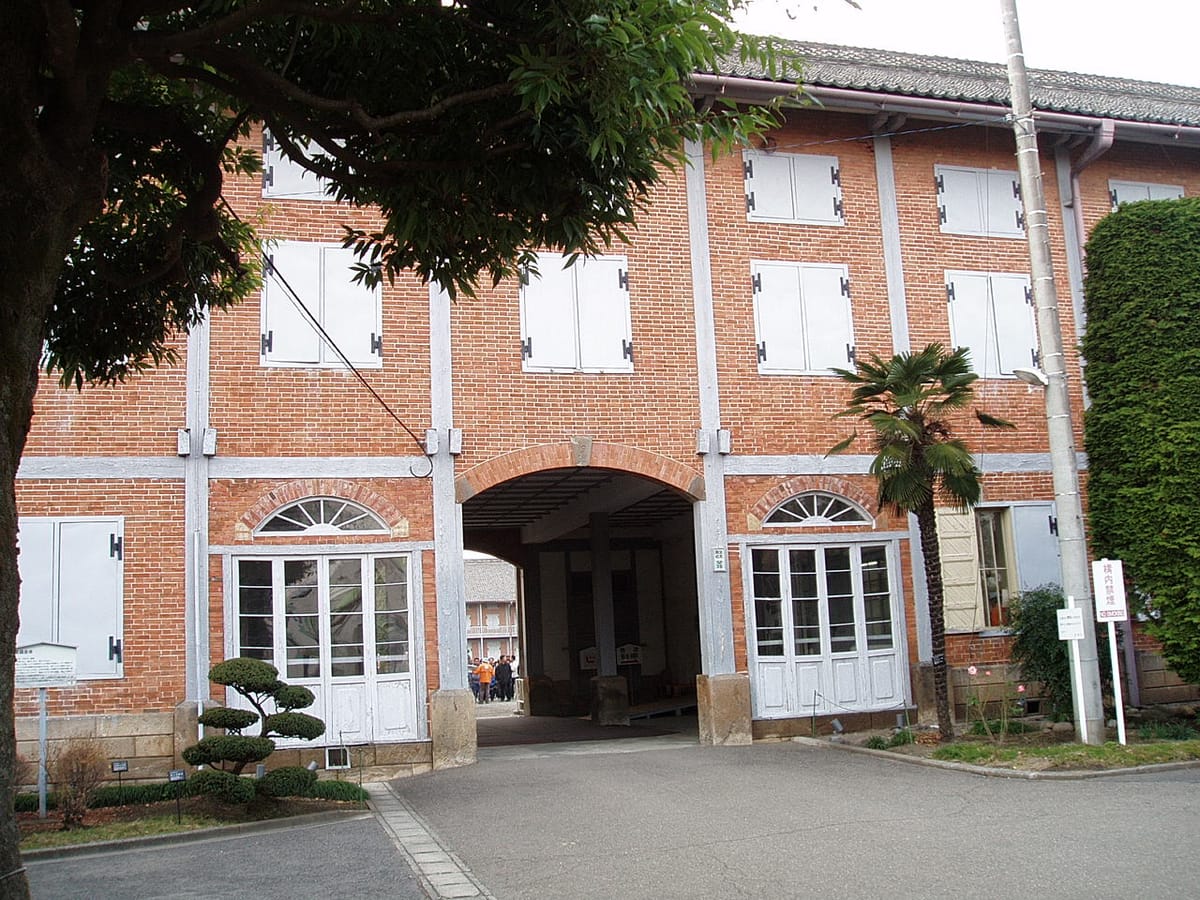
In 2014 the site was inscribed on the UNESCO World Heritage list as Tomioka Silk Mill and Related Sites, and three of its buildings were made National Treasures. For a visitor, the attraction is how complete it is: the scale of the brick warehouses, the light in the reeling hall and the houses of the French staff tell the story of Japan's industrial revolution in one short walk.
Getting there: Takasaki and the Jōshin line
Start at Takasaki, about an hour from Tokyo on the Jōetsu or Hokuriku Shinkansen. From there the Jōshin Electric Railway, Jōshin Dentetsu, a small local line, runs to Jōshū-Tomioka in about forty minutes. Trains are not very frequent, so check the timetable for your return before you set out.
From Jōshū-Tomioka Station, the mill is about fifteen minutes on foot through the old town, and the route is signposted. Cars cannot enter the mill itself; if you drive, use one of the municipal car parks about five hundred metres away.
| Japanese | Romaji | Meaning |
|---|---|---|
| 上州富岡までの切符をください。 | Jōshū-Tomioka made no kippu o kudasai. | A ticket to Jōshū-Tomioka, please. |
| 上信電鉄の乗り場はどこですか。 | Jōshin Dentetsu no noriba wa doko desu ka. | Where is the platform for the Jōshin line? |
| 次の電車は何時ですか。 | Tsugi no densha wa nanji desu ka. | What time is the next train? |
| 富岡製糸場はどちらですか。 | Tomioka Seishijō wa dochira desu ka. | Which way is Tomioka Silk Mill? |
| 帰りの電車の時刻表はありますか。 | Kaeri no densha no jikokuhyō wa arimasu ka. | Do you have a timetable for trains back? |
Warehouses, reeling hall and staff houses: what you will see
You enter through the arch of the East Cocoon Warehouse, a building about a hundred metres long. Look up at the keystone of the arch: it is carved with 明治五年, the fifth year of Meiji, 1872. The walls are a timber frame filled with brick laid in the Flemish pattern, a mix of Japanese carpentry and European masonry. Dried cocoons were stored on the upper floor, and the ground floor held offices and workrooms.
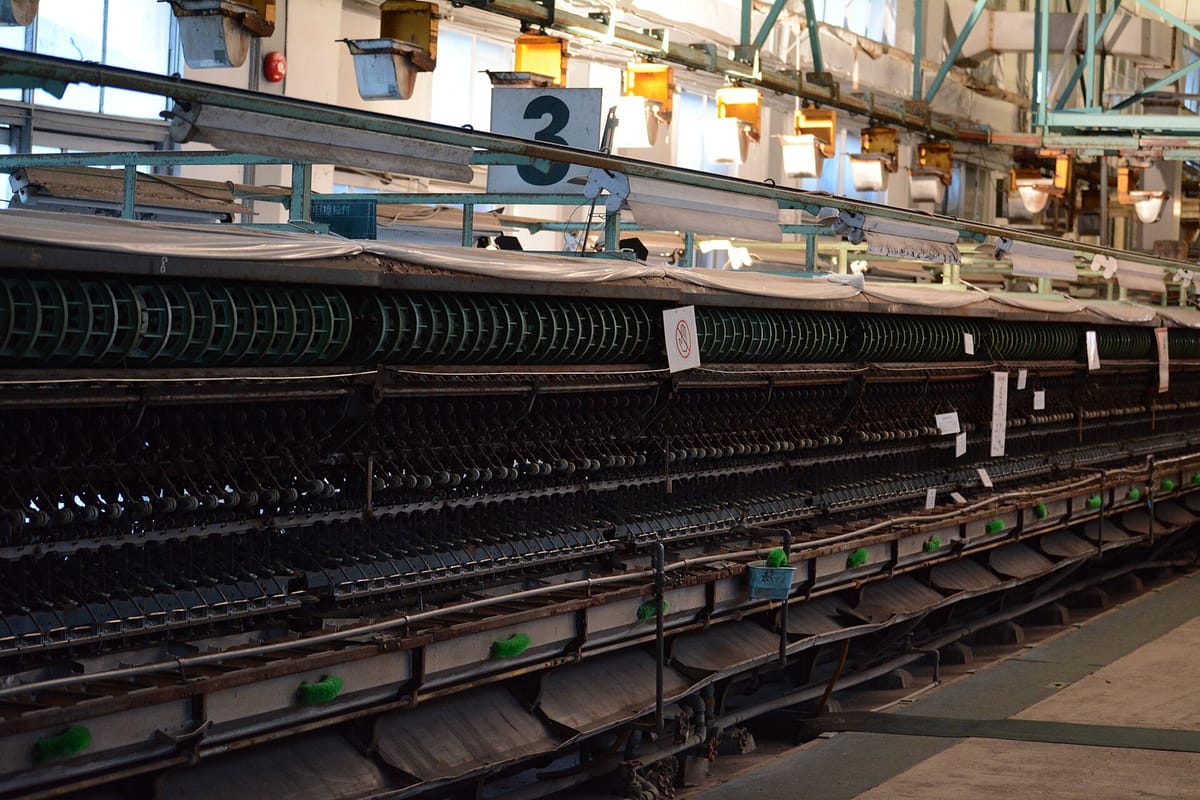
Across the courtyard, the Silk-reeling Mill is about 140 metres long, and its roof is held up by wooden trusses so that no pillars break the floor. Big windows let in the light the reelers needed. It once held around three hundred French reeling machines; today it holds the automatic machines of the mill's last decades, preserved where they stopped.
- Higashi Okimayujo: the East Cocoon Warehouse, with its dated arch and exhibitions.
- Sōshijo: the Silk-reeling Mill, the long, bright hall at the heart of the site.
- Nishi Okimayujo: the West Cocoon Warehouse, restored and reopened in 2020 with exhibition spaces.
- Brunat House: the residence built for Paul Brunat and his family.
- Workers' dormitories and the infirmary, telling the story of the women who worked here.
- The chimney and boiler area, which powered the machines.
Words on the signs at the mill
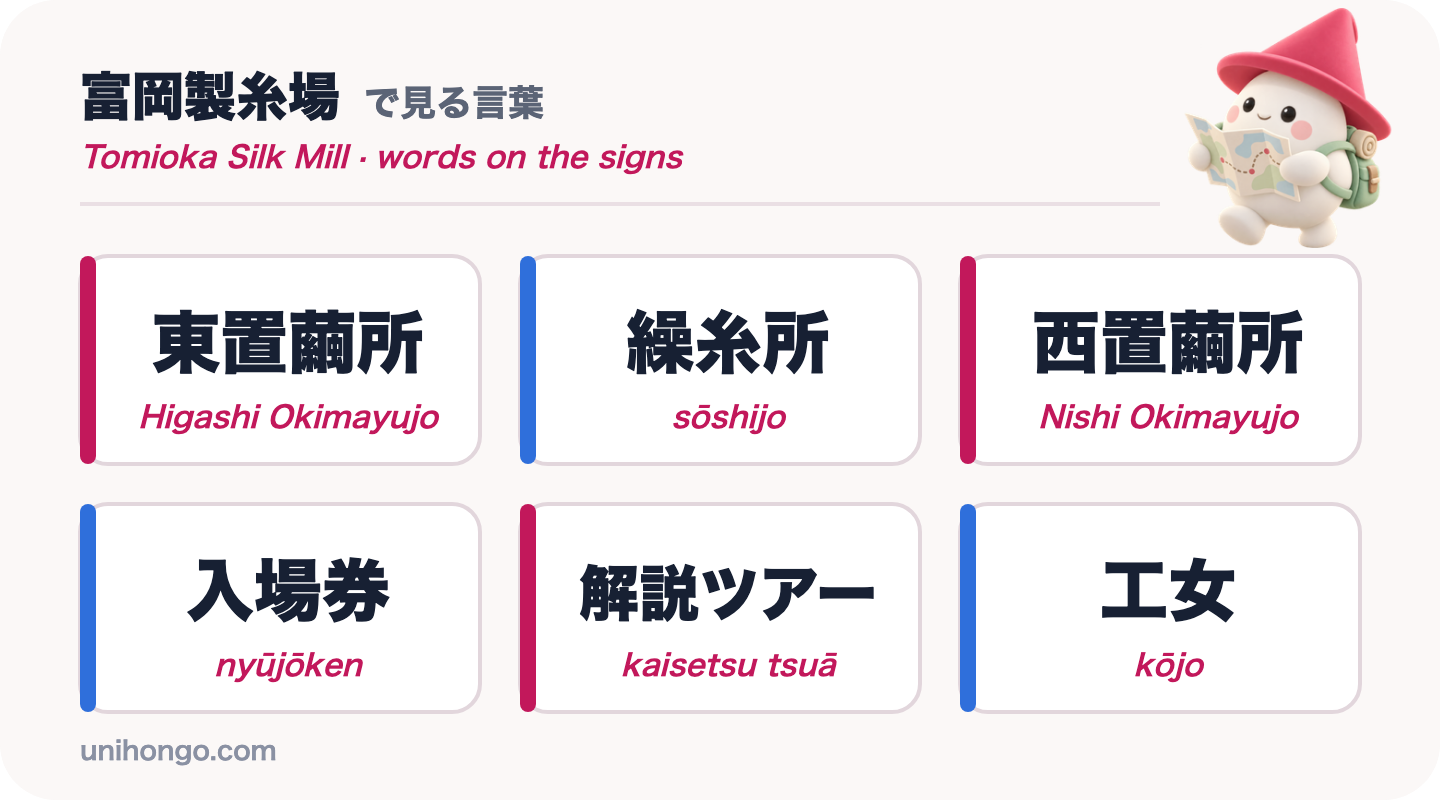
The building names at Tomioka are long but built from a few kanji you can learn in a minute. 繭 is cocoon, 糸 is thread, 置 is to place or store, and 所 is a place. Put them together and 置繭所 is a place for storing cocoons and 繰糸所 is a place for reeling thread. 東 and 西, east and west, tell the two warehouses apart.
The ticket is a 入場券, nyūjōken, an admission ticket, since this is a heritage site and not a temple. The guided tours are led by the mill's own guides, kaisetsu-in, whose job title means explainer.
| Word | Reading | Meaning |
|---|---|---|
| 富岡製糸場 | Tomioka Seishijō | Tomioka Silk Mill |
| 東置繭所 | Higashi Okimayujo | East Cocoon Warehouse |
| 西置繭所 | Nishi Okimayujo | West Cocoon Warehouse |
| 繰糸所 | sōshijo | The Silk-reeling Mill |
| 入場券 | nyūjōken | Admission ticket |
| 解説ツアー | kaisetsu tsuā | Guided tour with an explanation |
| 工女 | kōjo | Woman factory worker of the Meiji era |
| 国宝 | kokuhō | National Treasure |
| 世界遺産 | sekai isan | World Heritage Site |
Japanese for the guided tour and the silk shops
A guided tour in Japanese is a stretch for most learners, but it is also the best listening practice you will get: the guide speaks clearly, points at everything and repeats key words. Ask at reception for the next time and whether there is room, and stand near the front where you can hear.
Afterwards, the town around the mill sells silk goods, from scarves to soaps and cosmetics made with silk proteins. Gunma is also known for konnyaku, and you will see it on local menus and in souvenir shops.
| Japanese | Romaji | Meaning |
|---|---|---|
| 大人一枚お願いします。 | Otona ichimai onegai shimasu. | One adult ticket, please. |
| 解説ツアーに参加したいです。 | Kaisetsu tsuā ni sanka shitai desu. | I would like to join the guided tour. |
| ツアーは何分くらいですか。 | Tsuā wa nanpun kurai desu ka. | About how long is the tour? |
| もう少しゆっくり話していただけますか。 | Mō sukoshi yukkuri hanashite itadakemasu ka. | Could you speak a little more slowly? |
| この建物は何に使われていましたか。 | Kono tatemono wa nani ni tsukawarete imashita ka. | What was this building used for? |
| これは絹ですか。 | Kore wa kinu desu ka. | Is this silk? |
Timing and practical tips
Tomioka is quiet on weekdays and rarely crowded, but a little planning around the trains makes the day smooth.
- Check Jōshin line times for both directions before you leave Takasaki; trains are not frequent.
- Arrive in the morning so you can join an early guided tour and eat lunch in the old town.
- The buildings are unheated and open to the air in places; dress for the weather, especially in winter.
- Photography is generally fine; follow any signs inside the exhibition rooms.
- Combine the mill with the sights around it, such as the jagged Mount Myōgi, if you have a car.
- Buy a Jōshin line ticket at the station before boarding if the train does not take IC cards; ask the staff.
Practise joining the tour before you go
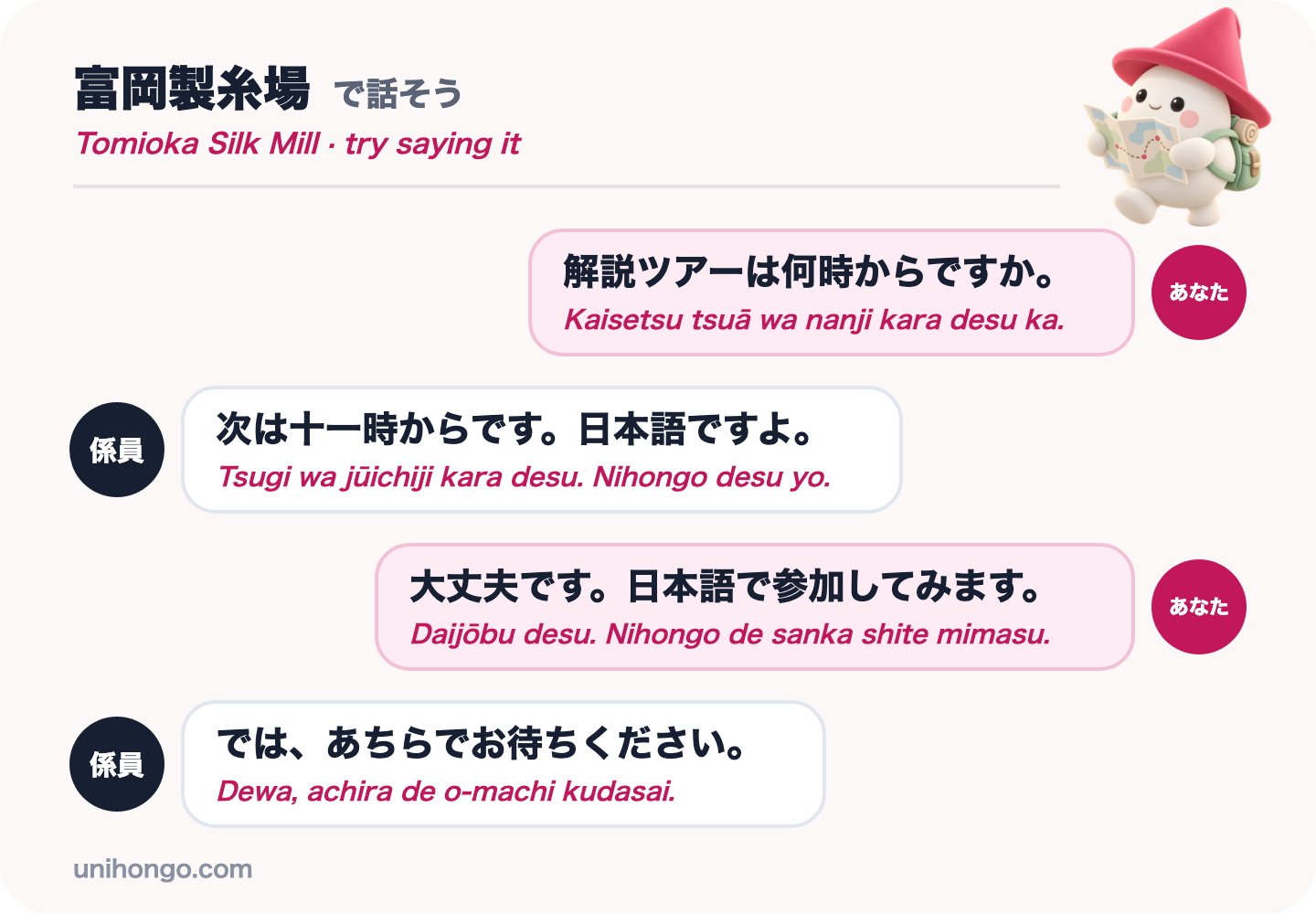
The staff member's warning, Nihongo desu yo, it's in Japanese, is kindly meant, and the answer daijōbu desu, that's fine, followed by sanka shite mimasu, I'll give it a try, shows that you mean it. Practise the four lines below until you can say them without reading.
Then practise with a partner. In Unihongo, choose the Sightseeing topic and ask your AI Sensei to play a guide at the mill, and ask the Sensei to give you a short tour in simple Japanese. Hearing the words once before the real tour makes a big difference to how much you catch.
| Japanese | Romaji | Meaning |
|---|---|---|
| 解説ツアーは何時からですか。 | Kaisetsu tsuā wa nanji kara desu ka. | What time does the guided tour start? |
| 次は十一時からです。日本語ですよ。 | Tsugi wa jūichiji kara desu. Nihongo desu yo. | The next one is at eleven. It's in Japanese. |
| 大丈夫です。日本語で参加してみます。 | Daijōbu desu. Nihongo de sanka shite mimasu. | That's fine. I'll try it in Japanese. |
| では、あちらでお待ちください。 | Dewa, achira de o-machi kudasai. | Then please wait over there. |
Official information
Tomioka city's tourism site publishes the mill's hours, fees, tour details and access, with English and other language versions. Check it before you go.