

Why Ginza is worth a day of slow shopping
In 1612 the Tokugawa shogunate moved its silver mint, the ginza, to a patch of land between Edo Castle and the sea. The mint moved on, but the name stayed. After a fire destroyed the area in 1872, the new Meiji government rebuilt it with brick buildings and gas lamps as a showcase of modern Japan, and Ginza became the place where Tokyo came to shop, stroll and see the latest things from abroad.
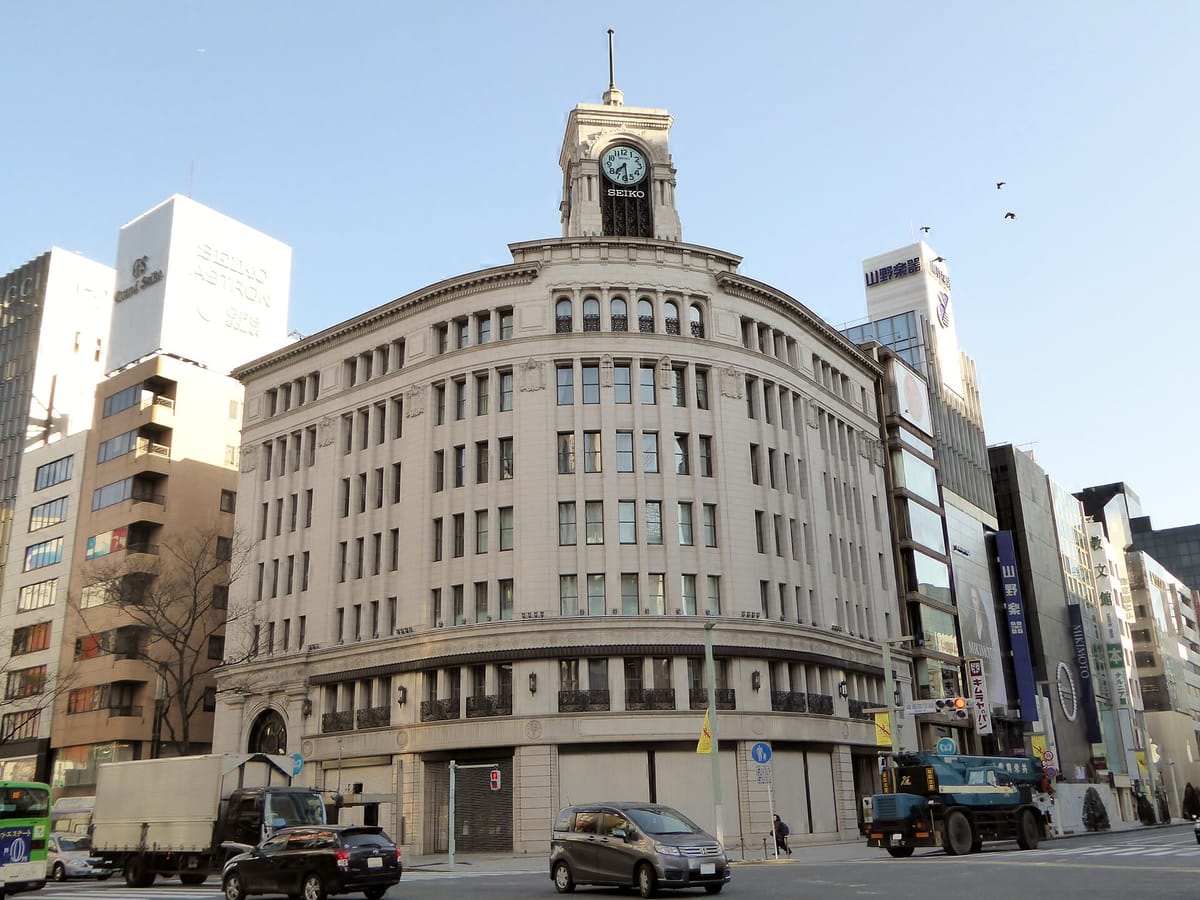
It still has that role. Along Chūō-dōri, century-old department stores stand beside global fashion flagships and new shopping complexes, and the Wakō building with its clock tower, on the corner of the 4-chōme crossing, is one of Tokyo's most recognisable landmarks. In the side streets you find specialist shops, from stationery and tea to knives and kimono fabric, and in the basements, the food halls that make gift-giving an art.
For a learner, Ginza is where you hear the most polite shop Japanese in Tokyo. Department store staff use full keigo, and the phrases for gift wrapping, bags and keeping food cold come up at almost every purchase. Learning to recognise them is a small lesson in how Japanese service works.
Getting there: Ginza, Higashi-Ginza and Yūrakuchō
Ginza Station is served by three Tokyo Metro lines, the Ginza, Marunouchi and Hibiya lines, and its exits come up around the Ginza 4-chōme crossing, the centre of the district. Ginza-itchōme Station on the Yūrakuchō Line serves the north end. For the Kabukiza theatre, Higashi-Ginza Station on the Hibiya and Toei Asakusa lines connects directly to the building.
From JR lines, Yūrakuchō Station on the Yamanote and Keihin-Tōhoku lines is a few minutes' walk from the north-west side of Ginza, and Shimbashi Station is at the southern end. Ginza is compact: walking the length of Chūō-dōri takes about fifteen minutes, and Tsukiji Outer Market is an easy walk to the east.
| Japanese | Romaji | Meaning |
|---|---|---|
| 銀座四丁目の交差点はどちらですか。 | Ginza yon-chōme no kōsaten wa dochira desu ka. | Which way is the Ginza 4-chōme crossing? |
| 歌舞伎座へは何番出口が近いですか。 | Kabukiza e wa nanban deguchi ga chikai desu ka. | Which exit number is closest to Kabukiza? |
| 有楽町駅まで歩いて何分くらいですか。 | Yūrakuchō-eki made aruite nanpun kurai desu ka. | About how many minutes on foot to Yūrakuchō Station? |
| デパ地下は何階ですか。 | Depachika wa nankai desu ka. | Which floor is the food hall on? |
| このビルに免税カウンターはありますか。 | Kono biru ni menzei kauntā wa arimasu ka. | Is there a tax-free counter in this building? |
From the Wakō clock to Kabukiza: what you will see
Start at the 4-chōme crossing, with the Wakō clock tower on one corner and the Mitsukoshi department store on another. Walk Chūō-dōri in either direction for department stores and flagship shops; on weekend and holiday afternoons the avenue is closed to cars, and you can walk down the middle. Ginza Six, a large complex a few minutes south, has a rooftop garden and a Noh theatre in its basement, and Itoya, a many-floored stationery shop, is a favourite for pens, paper and cards.
Head down into any department store basement for the depachika, where counters of wagashi, Western-style cakes, bentō and fruit are arranged like jewellery. Then walk east along Harumi-dōri to Kabukiza, the home of kabuki in Tokyo, whose current building opened in 2013 behind a traditional facade. Even if you do not see a show, the building's front and its shops are worth a look.
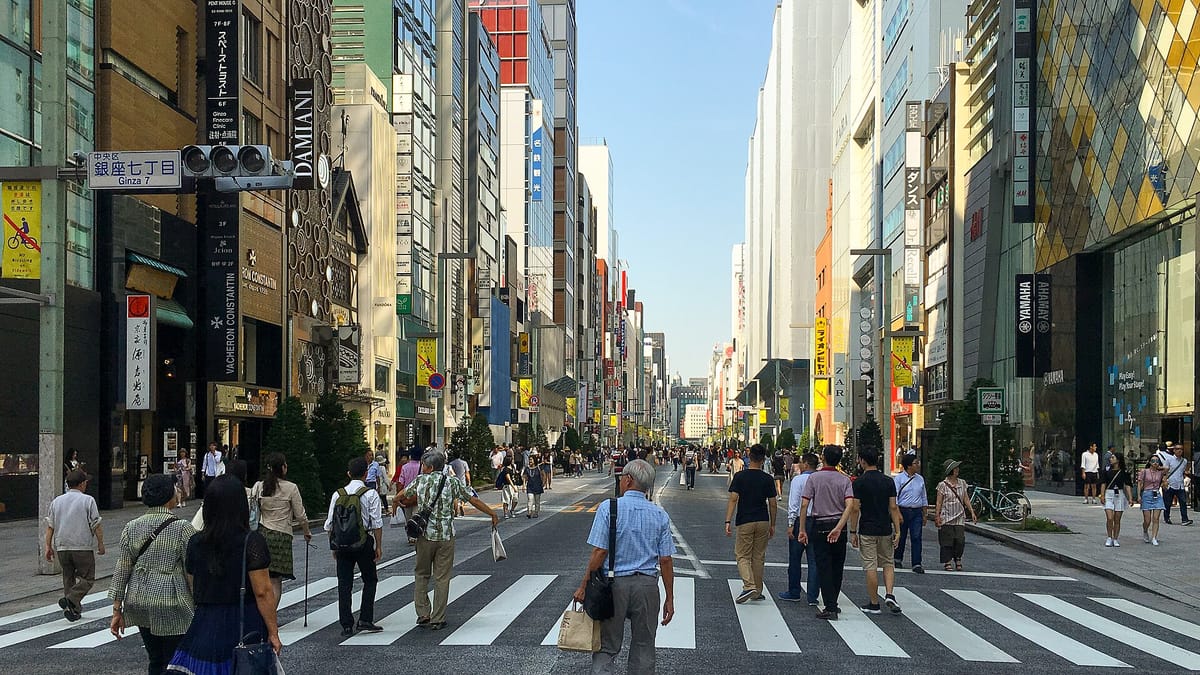
- Ginza yon-chōme (銀座四丁目): the central crossing, with the Wakō clock tower.
- Chūō-dōri (中央通り): the main avenue, a pedestrian street at weekends.
- Depachika (デパ地下): the food halls in department store basements.
- Ginza Six (ギンザシックス): a shopping complex with a rooftop garden and a Noh theatre.
- Itoya (伊東屋): the famous stationery shop.
- Kabukiza (歌舞伎座): the kabuki theatre on Harumi-dōri.
The words on Ginza's signs
Ginza's signs are elegant but readable. Department store floor guides use a few recurring words: 地下, chika, basement; 階, kai, floor; 食品, shokuhin, food; and 贈答, zōtō, gifts. The theatre has its own vocabulary, and 一幕見席, hitomakumi-seki, is the one to know if you want a short, inexpensive taste of kabuki.
The words in the table cover the streets, the shops and the theatre.
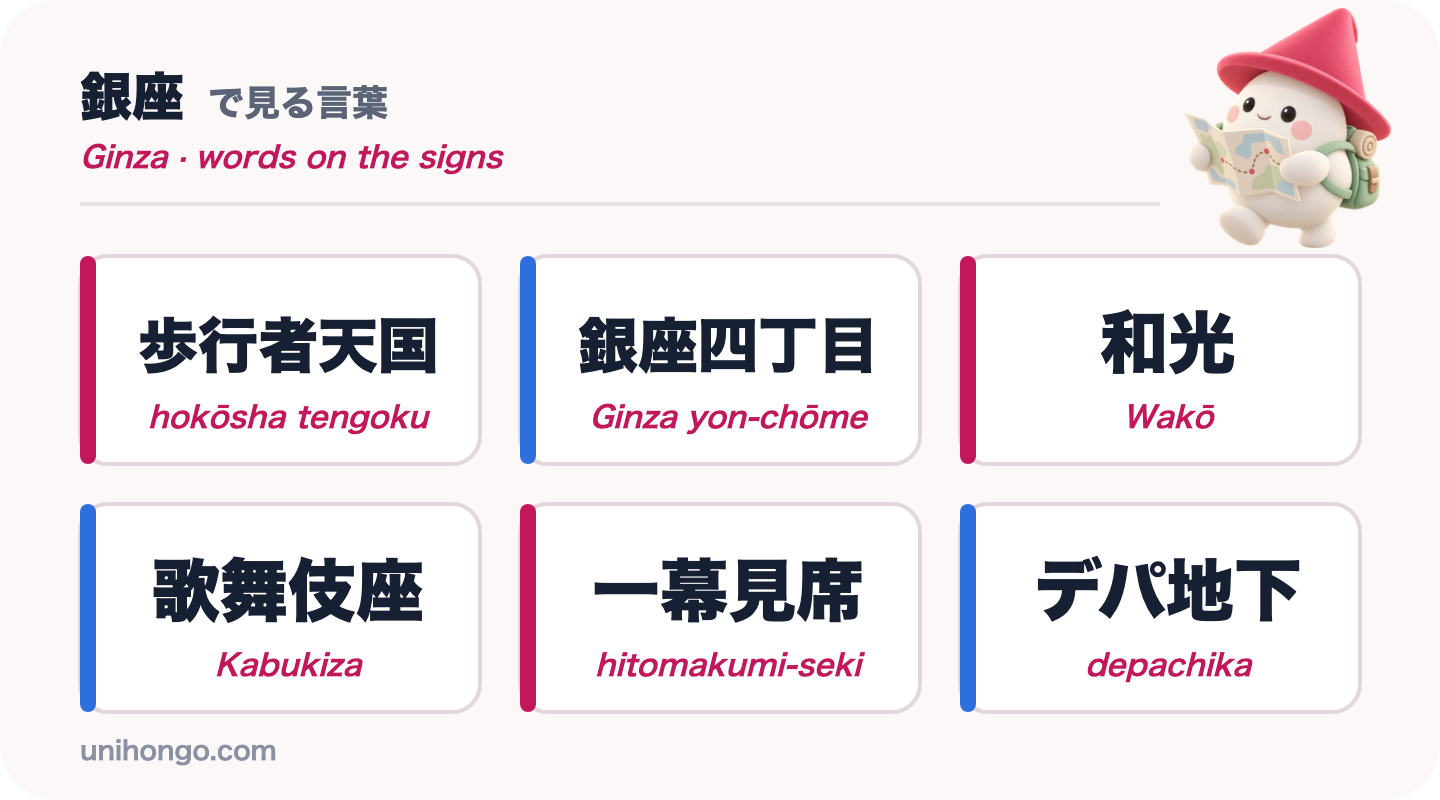
| Word | Reading | Meaning |
|---|---|---|
| 歩行者天国 | hokōsha tengoku | Street closed to cars |
| 銀座四丁目 | Ginza yon-chōme | The central crossing of Ginza |
| 和光 | Wakō | The building with the clock tower |
| 歌舞伎座 | Kabukiza | The kabuki theatre |
| 一幕見席 | hitomakumi-seki | Single-act seats at Kabukiza |
| デパ地下 | depachika | Department store food hall |
| 贈答品 | zōtōhin | Gifts |
| 保冷剤 | horeizai | Ice pack for keeping food cool |
| 免税カウンター | menzei kauntā | Tax-free counter |
Japanese for gifts, food halls and theatre tickets
Buying a gift in Ginza is a small ritual. The clerk will ask whether it is for yourself or a present, whether you want it wrapped, whether you need extra paper bags to hand the gifts over, and, for anything perishable, how long you will be carrying it, so they can add an ice pack. The questions come in keigo, such as o-mochiaruki and o-tsuke shimasu ka, but the answers can be short.
At Kabukiza, single-act tickets are for one act of a programme, with seats on the upper level. Ask for the act you want to see, and rent a subtitle guide if you want the story explained in English.
| Japanese | Romaji | Meaning |
|---|---|---|
| プレゼント用に包んでいただけますか。 | Purezento-yō ni tsutsunde itadakemasu ka. | Could you wrap it as a gift? |
| 自宅用なので、包装はいりません。 | Jitaku-yō na node, hōsō wa irimasen. | It's for myself, so I don't need wrapping. |
| 小分けの袋をいただけますか。 | Kowake no fukuro o itadakemasu ka. | Could I have separate small bags? |
| 日持ちはどのくらいですか。 | Himochi wa dono kurai desu ka. | How long does it keep? |
| 一幕見席はまだありますか。 | Hitomakumi-seki wa mada arimasu ka. | Are there still single-act seats? |
| 英語の字幕ガイドはありますか。 | Eigo no jimaku gaido wa arimasu ka. | Is there an English subtitle guide? |
Department store etiquette and practical tips
Ginza's shops are formal but welcoming, and a few habits fit in easily.
- Staff bow and greet you with irasshaimase; no reply is needed, but a nod is friendly.
- Place cash or your card on the small tray at the till rather than handing it over.
- Do not eat food-hall purchases in the store; look for a bench outside or take them back to your hotel.
- Come on a Saturday, Sunday or holiday afternoon to walk the car-free avenue.
- Ask about tax-free shopping at the dedicated counters in the department stores, and carry your passport.
- Check Kabukiza's programme and ticket information in advance; popular acts can sell out.
Practise the visit before you go
The dialogue below is a typical depachika exchange. The clerk's o-mochiaruki wa nanpun hodo desu ka, how long will you be carrying it, sounds complicated but is asked at almost every counter selling fresh food; answer with a time and kurai desu, and the clerk adds ice packs to match.
Then practise with someone who answers back. In Unihongo, choose the Shopping topic and ask your AI Sensei to play a Ginza department store clerk using full keigo. Hearing the polite forms once before you go makes them much easier to follow at the counter.
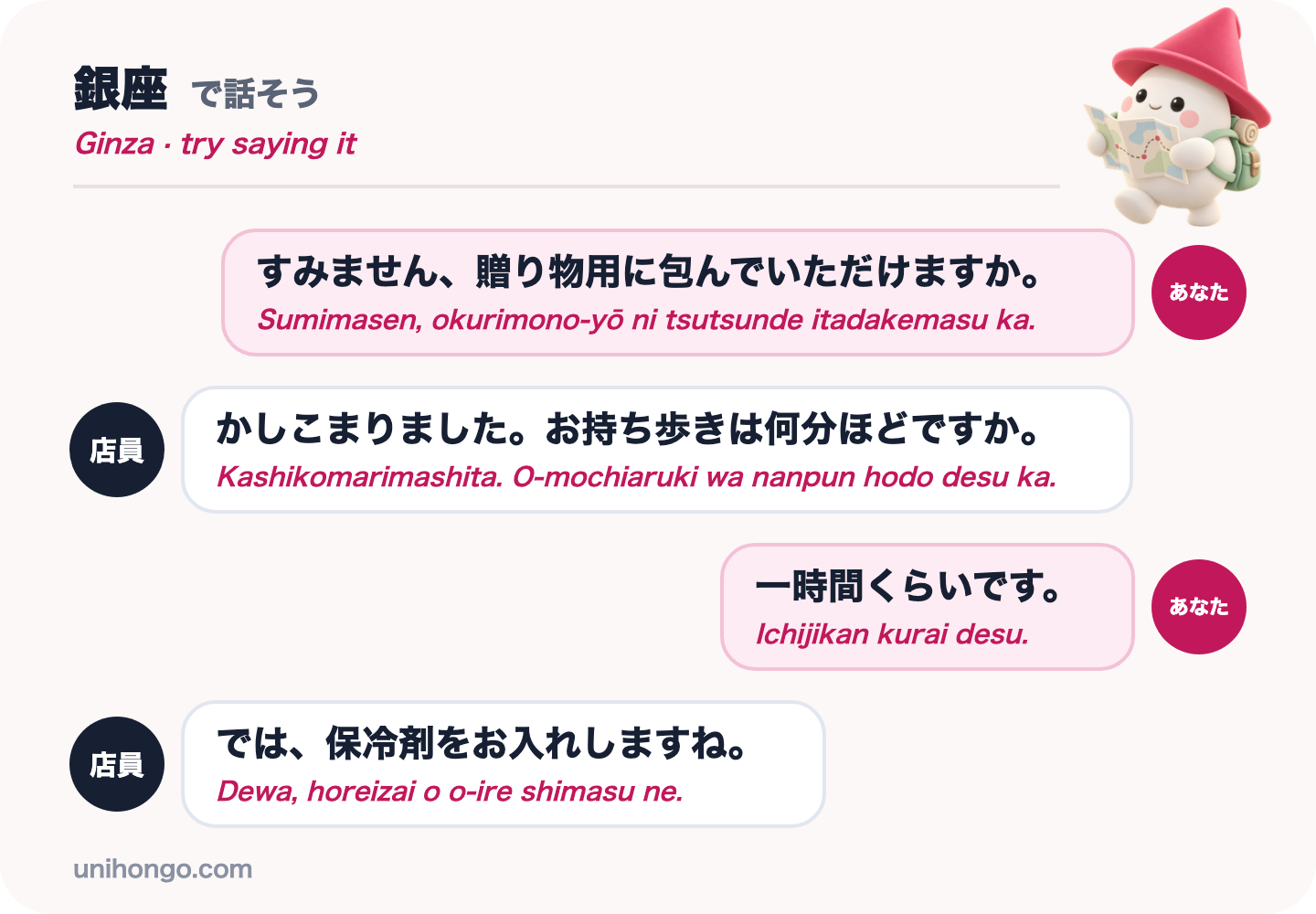
| Japanese | Romaji | Meaning |
|---|---|---|
| すみません、贈り物用に包んでいただけますか。 | Sumimasen, okurimono-yō ni tsutsunde itadakemasu ka. | Excuse me, could you wrap this as a gift? |
| かしこまりました。お持ち歩きは何分ほどですか。 | Kashikomarimashita. O-mochiaruki wa nanpun hodo desu ka. | Certainly. How many minutes will you be carrying it? |
| 一時間くらいです。 | Ichijikan kurai desu. | About an hour. |
| では、保冷剤をお入れしますね。 | Dewa, horeizai o o-ire shimasu ne. | Then I'll put in an ice pack. |
Official information
The Ginza street association publishes news about the district and the pedestrian street, and Kabukiza's official site lists the programme, ticket types and subtitle guides. The Tokyo tourism board covers the wider area.