

Why Toyosu Market is worth the early alarm
For more than eighty years Tokyo's fish was traded at Tsukiji, near Ginza. In October 2018 the wholesale market moved across the bay to Toyosu, into a modern complex almost twice the size of the old one, with closed, temperature-controlled trading floors. The Tsukiji Outer Market stayed behind, and the two are now different experiences: Tsukiji is a street of shops and stalls, while Toyosu is the working market where the auctions happen.
That makes Toyosu the place to see the trade itself. Before most of the city is awake, frozen and fresh tuna are laid out in rows on the auction floor, buyers inspect cuts of tail flesh with torches and hooks, and the auctioneers sell fish after fish in a few seconds each. Visitors watch all of this from above, through glass, and then walk on through the market buildings to breakfast.
It is also a good place to listen. The market has its own vocabulary, from seri, auction, and nakaoroshi, intermediate wholesaler, to the cuts of tuna you will order an hour later: akami, chūtoro and ōtoro. Knowing them turns the walkway and the sushi counter into one long lesson.
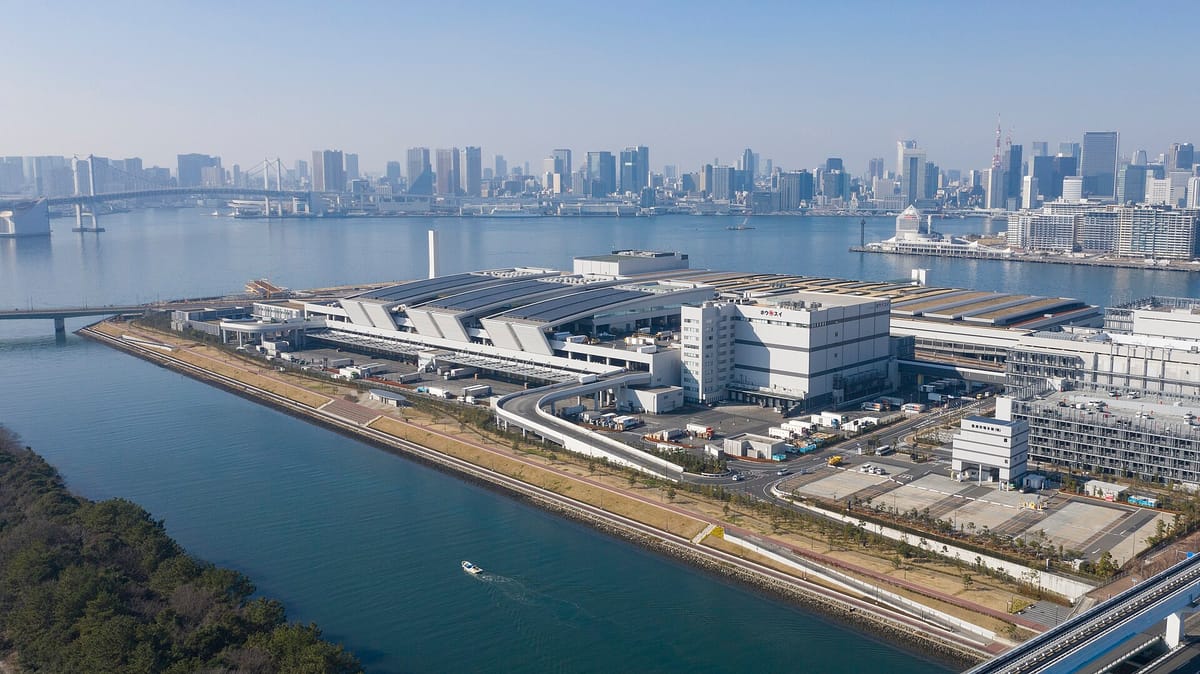
Getting there: Shijō-mae Station on the Yurikamome
The market has its own station: Shijō-mae, literally in front of the market, on the Yurikamome waterfront line from Shimbashi. The station opens straight onto a pedestrian deck that leads into the market buildings, and visitors enter from this deck at one entrance for each of the three blocks. The Tokyo Metro Yūrakuchō Line to Toyosu Station is the alternative, with a longer walk or a change to the Yurikamome.
There is no parking and no bicycle parking for the general public, so come by train or taxi. If you want to watch the auction, remember that the Yurikamome's first trains run early but not all night; many visitors arrive by taxi or stay at a hotel near Toyosu or Shimbashi.
| Japanese | Romaji | Meaning |
|---|---|---|
| 市場前駅までお願いします。 | Shijō-mae-eki made onegai shimasu. | To Shijō-mae Station, please. |
| 豊洲市場の入口はどこですか。 | Toyosu Shijō no iriguchi wa doko desu ka. | Where is the entrance to Toyosu Market? |
| 見学者通路はどちらですか。 | Kengakusha tsūro wa dochira desu ka. | Which way is the visitor walkway? |
| 水産卸売場棟はどこですか。 | Suisan oroshiuriba-tō wa doko desu ka. | Where is the fish wholesale building? |
| 今日は市場は開いていますか。 | Kyō wa shijō wa aite imasu ka. | Is the market open today? |
What you will see: auction, stalls and the roof garden
The market is split into three blocks linked by walkways, and the visitor route runs through all of them on the upper floors. The tuna auction is in the fish wholesale building, and it is over in the first hours of the morning, so go there first. The windows look down on the rows of fish and the buyers moving between them.
By mid-morning the trading floors quieten down and the restaurants take over. Many of the best-known sushi and seafood restaurants have long queues from before dawn, and some close in the early afternoon, well before the visitor walkway itself does.
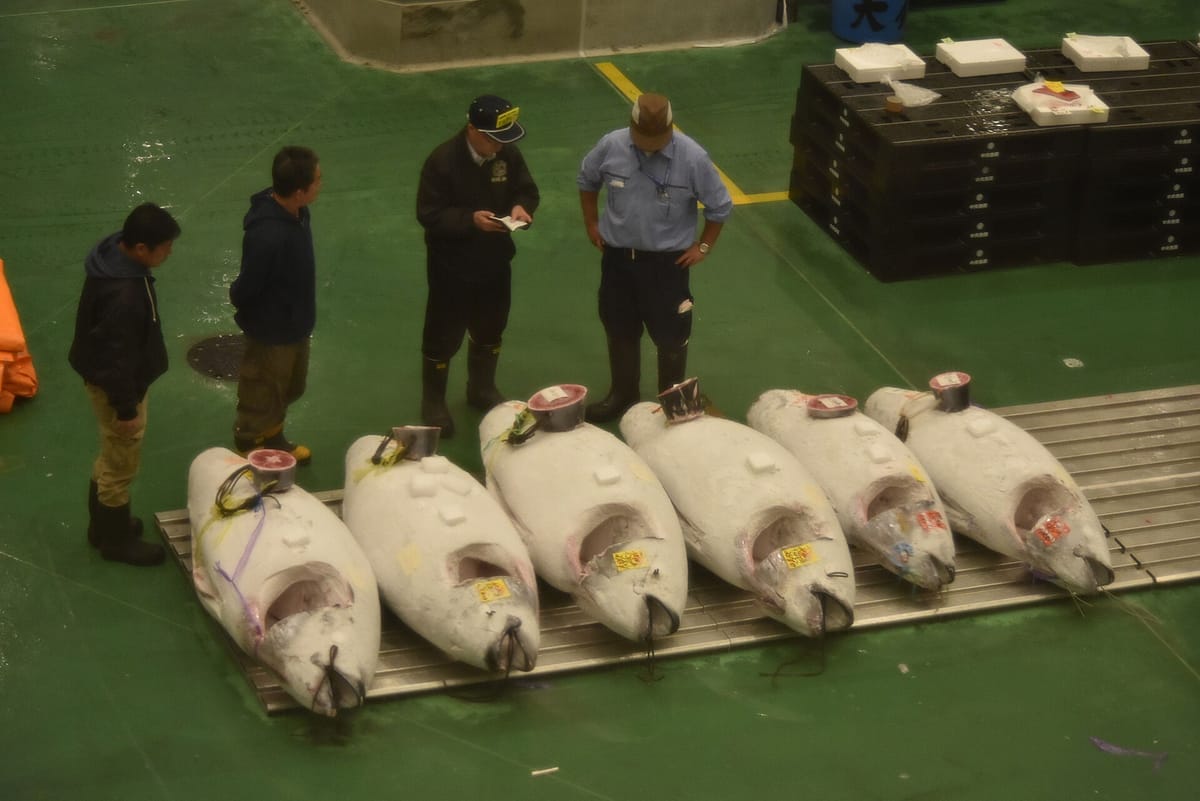
- Suisan oroshiuriba-tō, the fish wholesale building: the tuna auction, watched from the second-floor walkway or the lottery-only observation deck.
- Suisan nakaoroshi uriba-tō, the intermediate wholesale building: the stalls where wholesalers cut and sell fish to the trade, seen through windows, plus restaurants and the Uogashi Yokochō shops.
- Seika-tō, the fruit and vegetable building: the produce auctions and more restaurants, usually much quieter than the fish buildings.
- Uogashi Yokochō: a row of shops selling knives, tableware, dried fish, tea, pickles and snacks to anyone.
- Okujō ryokka hiroba, the roof garden: a lawn with views over the bay and the city, open even on market holidays.
- The Toyosu Market PR corner: displays on how the market works, useful if you arrive after the auction.
Words on the market signs
The building names at Toyosu are long but logical. 水産 is marine products, 卸売場 is the wholesale floor, 仲卸 is the intermediate wholesaler, and 棟 is a building or block. Put them together and 水産卸売場棟 is simply the fish wholesale building. 青果 is fruit and vegetables, so 青果棟 is the produce building.
Two other words matter for planning. 休市日, kyūshibi, is a day when the market is closed, printed in red on the market calendar, and 見学者通路, kengakusha tsūro, is the visitor walkway you will follow all morning.
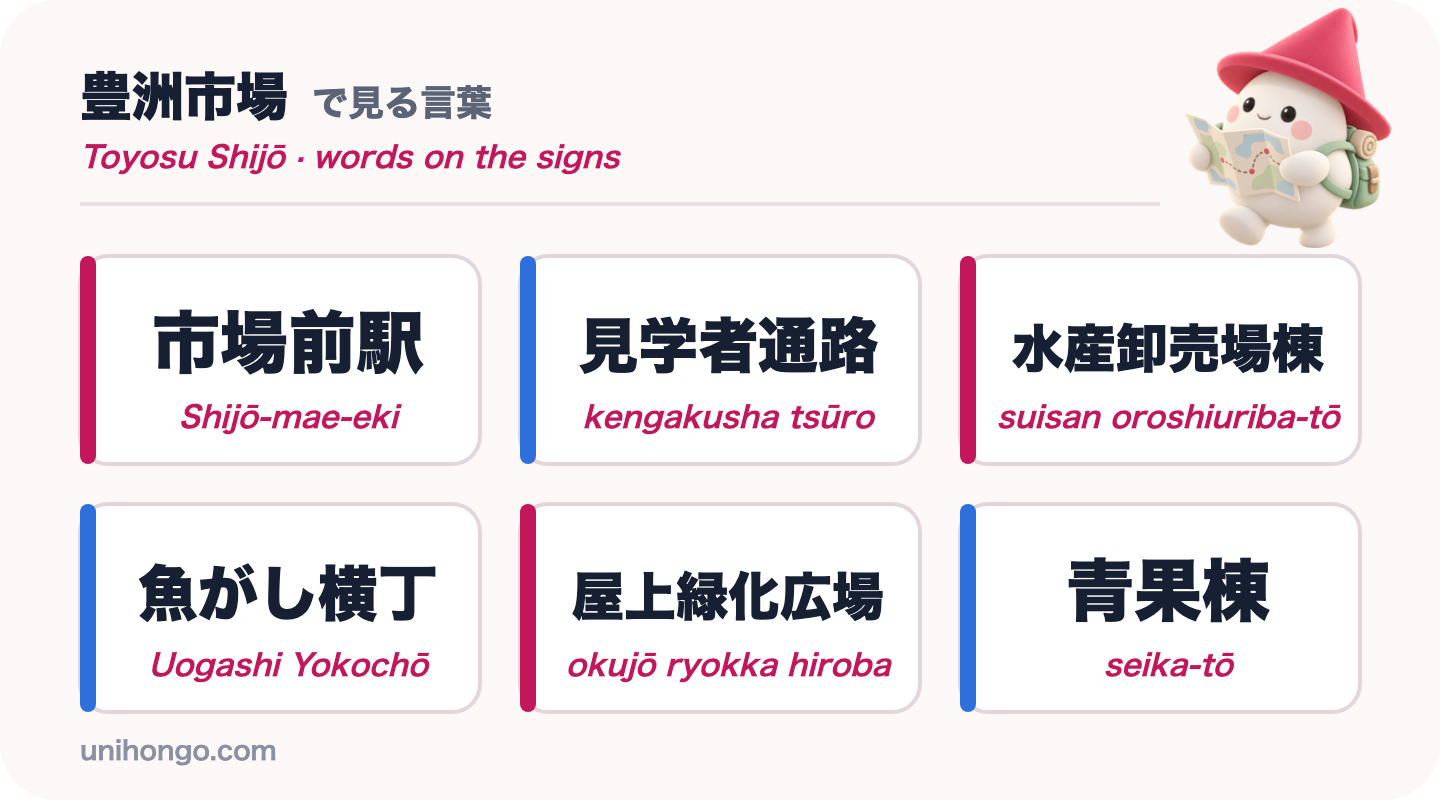
| Word | Reading | Meaning |
|---|---|---|
| 市場前駅 | Shijō-mae-eki | Shijō-mae Station, beside the market |
| 見学者通路 | kengakusha tsūro | Visitor walkway |
| 水産卸売場棟 | suisan oroshiuriba-tō | Fish wholesale building, where the tuna auction is |
| 水産仲卸売場棟 | suisan nakaoroshi uriba-tō | Intermediate wholesale building |
| 青果棟 | seika-tō | Fruit and vegetable building |
| 魚がし横丁 | Uogashi Yokochō | Row of shops open to the public |
| 屋上緑化広場 | okujō ryokka hiroba | Roof garden |
| 競り | seri | Auction |
| 休市日 | kyūshibi | Market closed day |
Japanese at a market sushi counter
Most visitors end the morning at one of the sushi counters in the market buildings. The restaurants are small, the queues are long, and the chefs work fast, so decide before you sit down. Many offer a set, often called omakase, chef's choice, or a fixed number of pieces, and staff will ask how many you are and whether you can eat everything.
The key words are the cuts of tuna. Akami is the lean red meat, chūtoro the medium-fatty belly and ōtoro the richest, fattiest belly. Sabi-nuki means without wasabi, and agari is the counter word for green tea at a sushi shop.
| Japanese | Romaji | Meaning |
|---|---|---|
| 何分くらい待ちますか。 | Nanpun kurai machimasu ka. | About how many minutes is the wait? |
| 二人です。 | Futari desu. | Two people. |
| おまかせを一人前お願いします。 | Omakase o ichininmae onegai shimasu. | One chef's choice set, please. |
| 今日のおすすめは何ですか。 | Kyō no osusume wa nan desu ka. | What do you recommend today? |
| 中トロを一貫お願いします。 | Chūtoro o ikkan onegai shimasu. | One piece of medium-fatty tuna, please. |
| さび抜きでお願いします。 | Sabi-nuki de onegai shimasu. | Without wasabi, please. |
| 生の貝が苦手です。 | Nama no kai ga nigate desu. | I don't do well with raw shellfish. |
| お会計をお願いします。 | O-kaikei o onegai shimasu. | The bill, please. |
Etiquette and timing at a working market
Toyosu is a place of work, and the visitor rules exist so that trade can carry on around you. Keep to them and staff are friendly and helpful.
- Stay on the visitor walkway; the trading floors are for market workers only, and vehicles move fast around the buildings.
- Eating and drinking are not allowed in the walkways, including on the benches. Eat in the restaurants or leave it until you are outside.
- Arrive very early for the auction, and check the market calendar first: on Sundays, national holidays and closed days, kyūshibi, nothing inside is open.
- Apply online about a month ahead if you want the lower observation deck; if there are too many applicants, places are decided by lottery.
- Expect some restaurants to close before the walkway does, and check the official site for this season's hours.
- Do not use flash when photographing the auction through the windows, and keep out of the way of groups at the glass.
- On special occasions access can change; for example, entry was restricted on the afternoon of 24 October 2026 for the Tokyo Bay fireworks.
Practise the auction question before you go
The question every first-time visitor asks is where to see the tuna. The attendant's answer uses miraremasu, can be seen, a form worth recognising because it comes up at every viewpoint in Japan. The follow-up about timing gets a practical answer: come early.
Practise these four lines aloud, then rehearse with a partner who answers back. In Unihongo, choose the Sightseeing topic and ask your AI Sensei to play a market attendant, then switch to the Sushi Counter topic to practise ordering your breakfast afterwards.
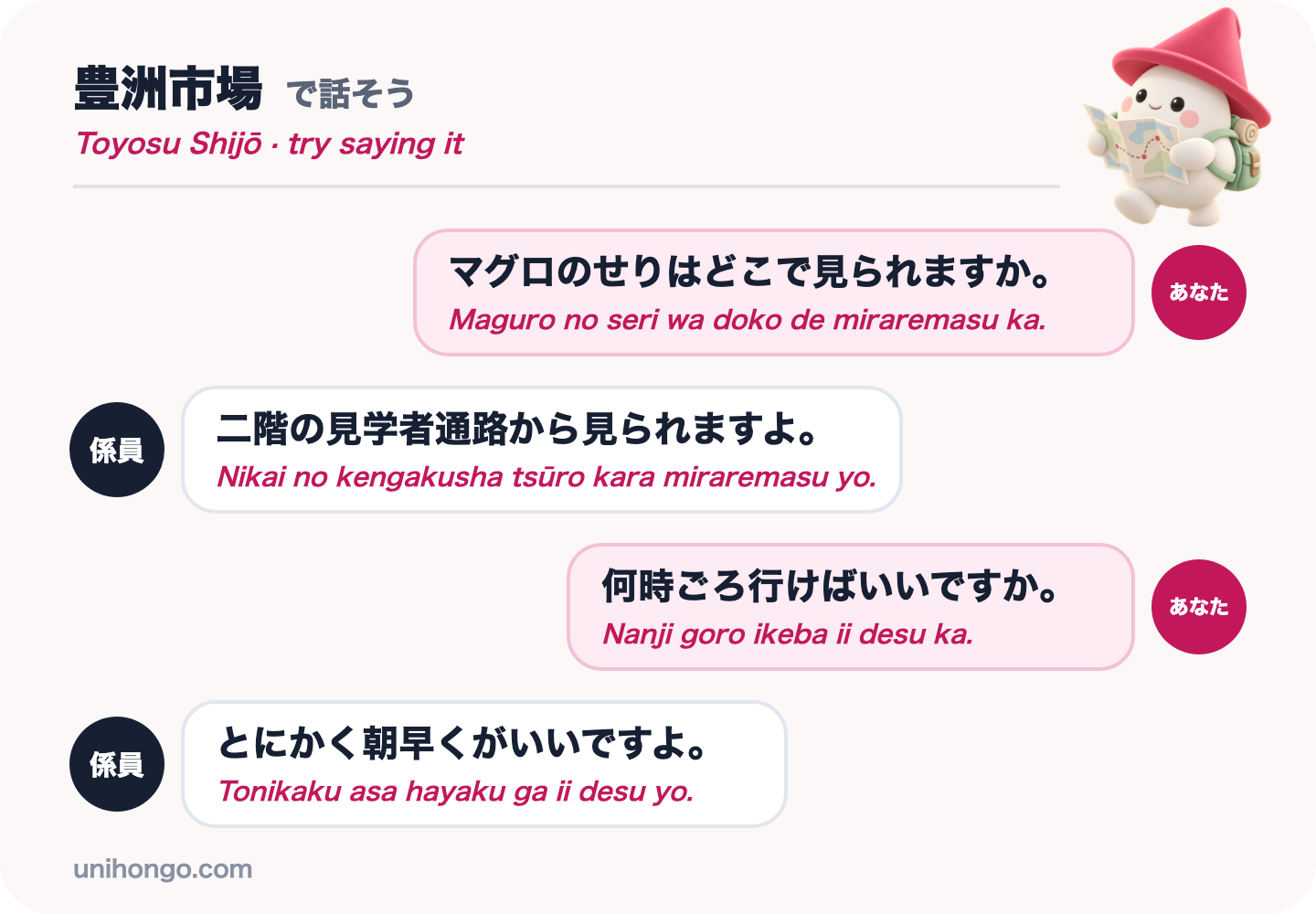
| Japanese | Romaji | Meaning |
|---|---|---|
| マグロのせりはどこで見られますか。 | Maguro no seri wa doko de miraremasu ka. | Where can I watch the tuna auction? |
| 二階の見学者通路から見られますよ。 | Nikai no kengakusha tsūro kara miraremasu yo. | You can watch it from the second-floor visitor walkway. |
| 何時ごろ行けばいいですか。 | Nanji goro ikeba ii desu ka. | About what time should I go? |
| とにかく朝早くがいいですよ。 | Tonikaku asa hayaku ga ii desu yo. | The earlier in the morning, the better. |
Official information
The Tokyo Metropolitan Government runs Toyosu Market and publishes its visitor hours, the market calendar and the tuna auction application schedule. Check them before you set an early alarm, since closed days vary from month to month.