

Why Oze is worth the long journey
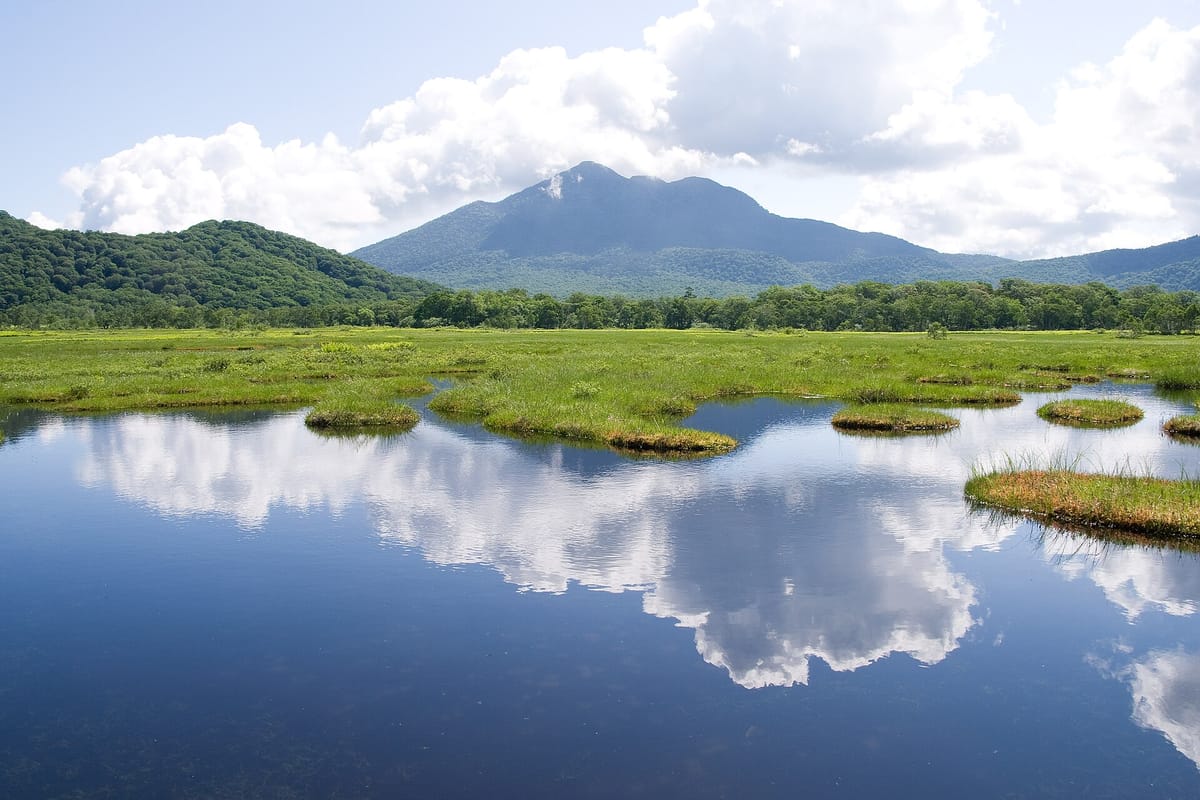
Oze is a basin in the mountains about 150 kilometres north of Tokyo, where four prefectures, Gunma, Fukushima, Niigata and Tochigi, meet. Its heart is Ozegahara, a moorland about six kilometres long and a kilometre or so wide at around 1,400 metres above sea level. Peat has built up here for thousands of years, and the surface is scattered with small pools, ikesu, where the sky and the surrounding peaks are reflected on a still day.
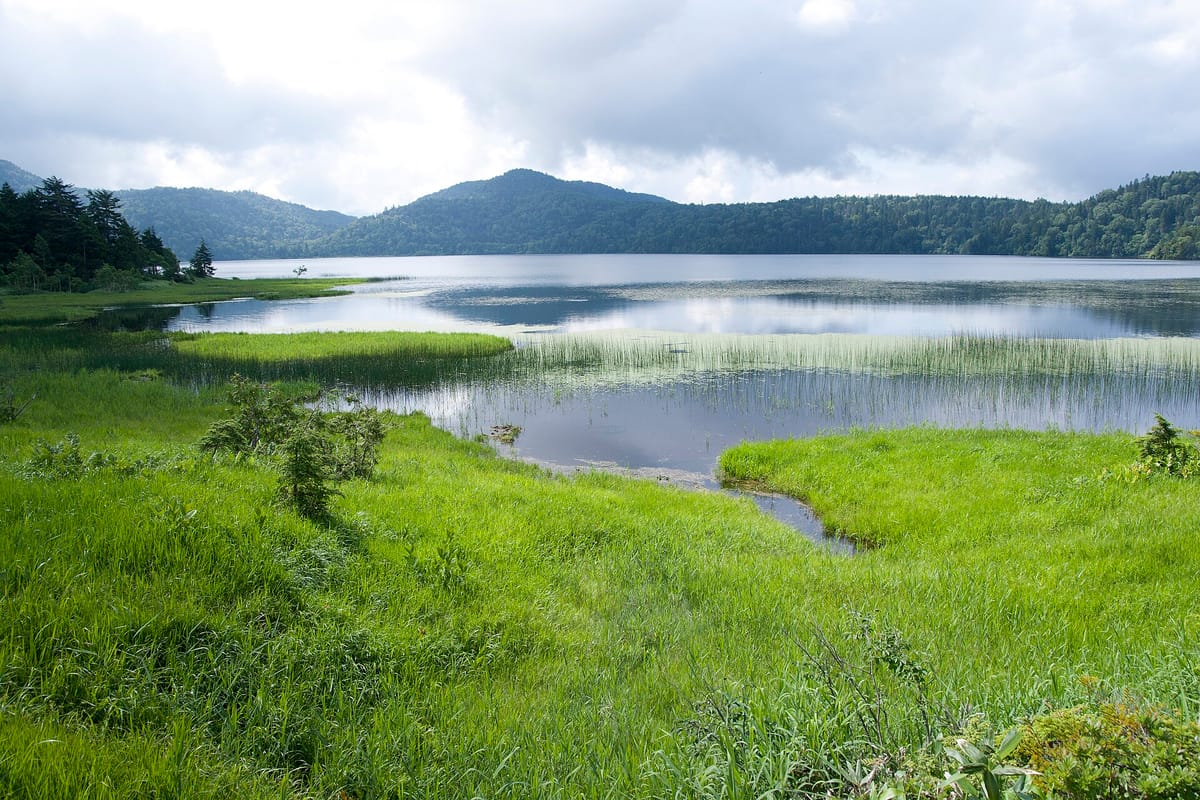
Two mountains stand guard. To the west is Shibutsu-san, at the Hatomachi-tōge end, and to the east Hiuchigatake, a volcano that is the highest peak in the Tōhoku region and whose old lava flows dammed the valley to form Ozenuma, the lake at the eastern end of the park. Oze was part of Nikkō National Park until 2007, when it became a national park of its own, and the marsh is also a Ramsar-listed wetland.
For a Japanese learner, Oze offers something different from the cities: a small, repeated vocabulary on wooden signposts, conversations with hut staff and rangers who speak at a relaxed pace, and plenty of walkers who greet you with konnichiwa as you pass. The words you learn here, from mokudō, boardwalk, to migigawa tsūkō, keep right, turn up on every nature trail in Japan.
Getting there: Jōmō-Kōgen, Oze Tokura and Hatomachi-tōge
The main gateway is on the Gunma side. From Tokyo, take the Jōetsu Shinkansen to Jōmō-Kōgen Station, 上毛高原駅, about seventy minutes, then a Kan-etsu Kōtsū bus bound for Oze Tokura, 尾瀬戸倉, which takes around two hours. The mountain road beyond Tokura is closed to private cars in the season, so from there you change to a shuttle bus or shared taxi for the last half hour up to Hatomachi-tōge, 鳩待峠, the pass where the trail begins. Drivers leave their cars in the large car parks at Tokura. In the season, direct buses also run from Shinjuku and other cities, some overnight.
Other trailheads serve other walks. Ōshimizu, also reached from Tokura, is the start of the climb to Ozenuma from the south, and on the Fukushima side Numayama-tōge, reached by bus from Aizu-Kōgen, is the closest trailhead to Ozenuma, about an hour's walk away. The shuttle buses run from spring into early November; check this season's dates and timetable before you go, because the last buses down in the afternoon decide how long you can stay on the marsh.
| Japanese | Romaji | Meaning |
|---|---|---|
| 尾瀬戸倉行きのバス乗り場はどこですか。 | Oze Tokura-yuki no basu noriba wa doko desu ka. | Where is the stop for the bus to Oze Tokura? |
| 鳩待峠までのシャトルバスはどこから乗りますか。 | Hatomachi-tōge made no shatoru basu wa doko kara norimasu ka. | Where do I catch the shuttle bus to Hatomachi-tōge? |
| 次のバスは何時ですか。 | Tsugi no basu wa nanji desu ka. | What time is the next bus? |
| 帰りの最終バスは何時ですか。 | Kaeri no saishū basu wa nanji desu ka. | What time is the last bus back? |
| 乗り合いタクシーはありますか。 | Noriai takushī wa arimasu ka. | Is there a shared taxi? |
On the boardwalk: from Yamanohana to Ozenuma
From Hatomachi-tōge the trail drops through beech forest on stone steps and boardwalk to Yamanohana, 山ノ鼻, at the western edge of the marsh, which takes about an hour downhill and rather longer on the way back up. Yamanohana has a visitor centre, mountain huts, toilets and a campsite, and it is the place to check the day's conditions and flower news before you walk out onto the open moor.
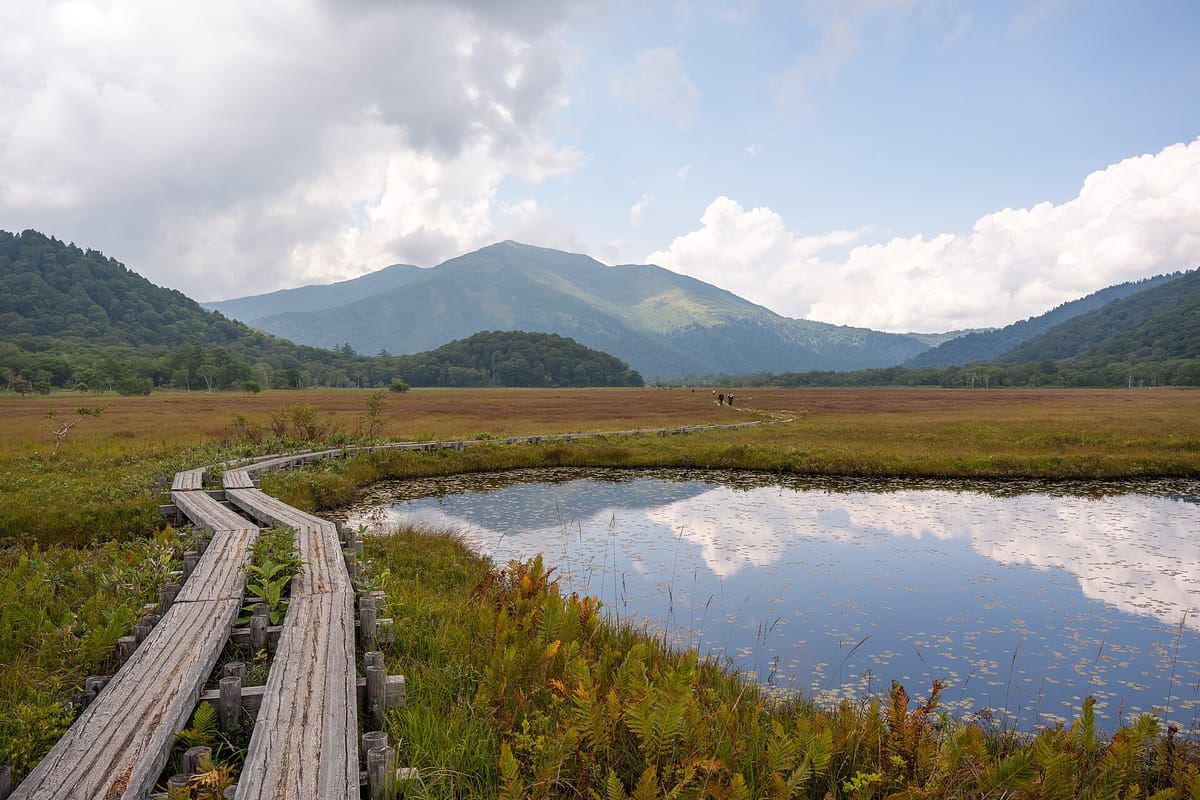
From Yamanohana the boardwalk runs straight across Ozegahara, with Hiuchigatake ahead of you. A popular day loop goes out to Ushikubi, 牛首, and on to the Ryūgū crossroads, 竜宮, where a stream disappears into the peat and comes out again, then back to Yamanohana and up to Hatomachi-tōge. Stronger walkers continue east to Miharashi, 見晴, the cluster of huts at the far side of the marsh, and over a low pass to Ozenuma, whose shoreline trail runs past another visitor centre and more huts.
- Hatomachi-tōge: the pass and main trailhead, with a rest house, toilets and the last shuttle stop.
- Yamanohana: the western gateway to the marsh, with a visitor centre, huts and a small botanical area.
- Ozegahara: the open moorland, with pools, boardwalks and views of both mountains.
- Ushikubi and Ryūgū: junctions in the middle of the marsh, the turning points of the classic day loop.
- Miharashi: the group of mountain huts at the eastern end of the marsh.
- Ozenuma: the mountain lake below Hiuchigatake, with the Ōe marsh on its eastern shore.
- Shibutsu-san and Hiuchigatake: the two peaks, both full-day climbs for experienced hikers.
Words on the signposts at Oze
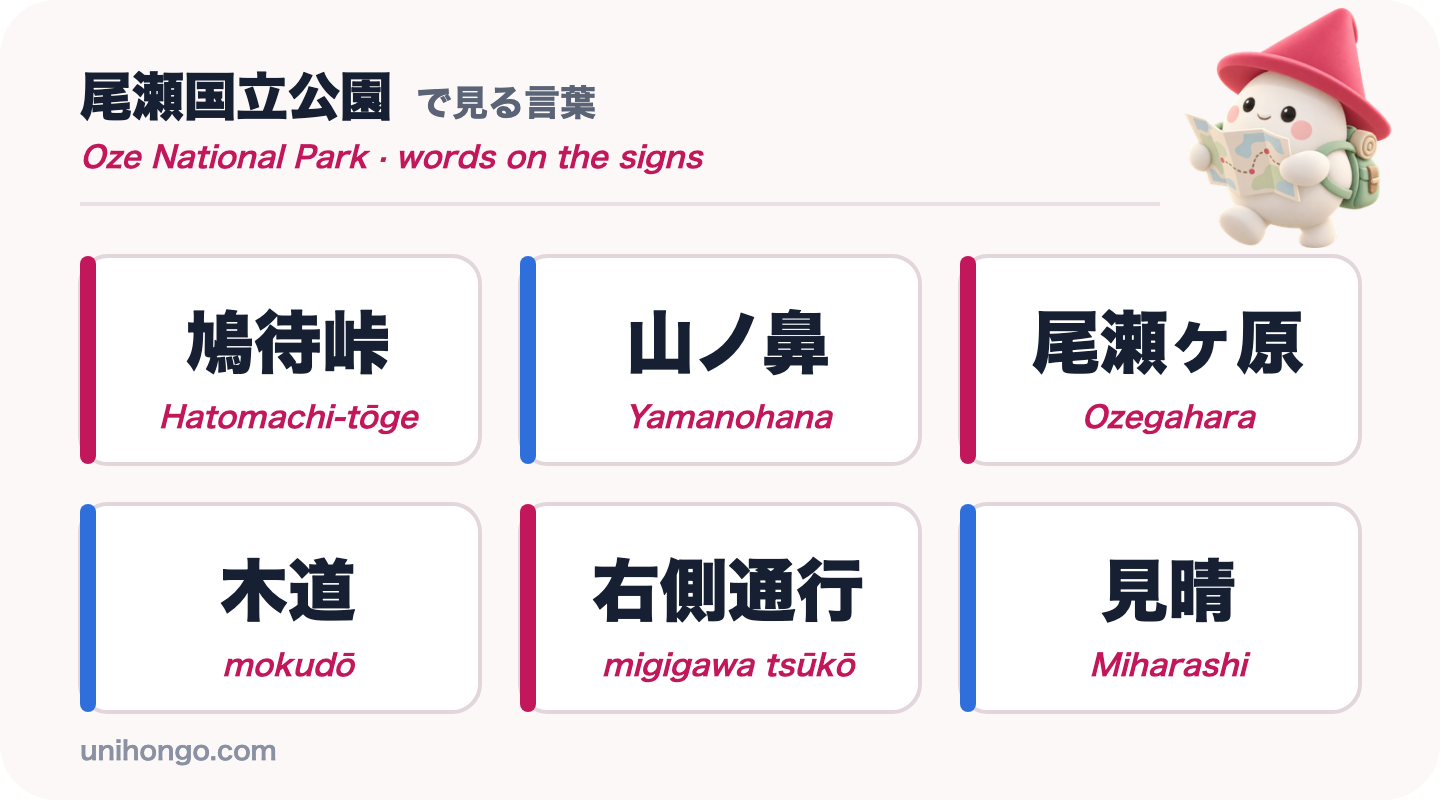
The signposts at Oze are wooden boards with arrows, place names and walking times in minutes or kilometres. Most place names are made of simple, readable kanji: 山ノ鼻 is literally the nose of the mountain, the point where the slope meets the marsh, and 見晴 means a clear view. The rules are posted as short notices at trailheads and junctions.
Look out too for the mats at the trailheads where you are asked to clean your boots, so that seeds from outside do not get carried into the marsh, and for the notices about bears. The table below covers the words you will meet most often.
| Word | Reading | Meaning |
|---|---|---|
| 鳩待峠 | Hatomachi-tōge | The pass and main trailhead on the Gunma side |
| 山ノ鼻 | Yamanohana | Western gateway to the marsh, with a visitor centre |
| 尾瀬ヶ原 | Ozegahara | The high moorland at the centre of the park |
| 尾瀬沼 | Ozenuma | The mountain lake at the eastern end |
| 見晴 | Miharashi | Cluster of huts at the eastern edge of the marsh |
| 木道 | mokudō | Wooden boardwalk |
| 右側通行 | migigawa tsūkō | Keep to the right |
| 山小屋 | yamagoya | Mountain hut where you can sleep and eat |
| 熊出没注意 | kuma shutsubotsu chūi | Beware of bears |
Japanese at the mountain hut and on the trail
A night in a yamagoya, mountain hut, is the most Japanese part of an Oze trip. Huts at Yamanohana, Miharashi and Ozenuma serve dinner and breakfast, often at fixed times, and many will make a packed lunch, obentō, for the next day's walk. Rooms are usually shared tatami rooms with futons, and it is a place where hut staff explain the house rules in Japanese, so a few phrases make check-in smooth. Book ahead, especially at weekends in the flower seasons.
On the trail, the most useful questions are about time, conditions and the flowers. Hut staff and rangers know which peaks are open and where the skunk cabbage or lilies are at their best that week.
| Japanese | Romaji | Meaning |
|---|---|---|
| 今夜予約しているスミスです。 | Kon'ya yoyaku shite iru Sumisu desu. | I'm Smith; I have a reservation for tonight. |
| 夕食は何時からですか。 | Yūshoku wa nanji kara desu ka. | What time is dinner? |
| 明日のお弁当をお願いできますか。 | Ashita no o-bentō o onegai dekimasu ka. | Could I order a packed lunch for tomorrow? |
| トイレの協力金はここに入れればいいですか。 | Toire no kyōryokukin wa koko ni irereba ii desu ka. | Do I put the toilet contribution in here? |
| 熊よけの鈴はどこで買えますか。 | Kuma-yoke no suzu wa doko de kaemasu ka. | Where can I buy a bear bell? |
| 至仏山は今、登れますか。 | Shibutsu-san wa ima, noboremasu ka. | Can I climb Shibutsu-san at the moment? |
| ゴミは全部持ち帰りですよね。 | Gomi wa zenbu mochikaeri desu yo ne. | All rubbish has to be taken home, right? |
Rules, flower seasons and timing
The marsh is fragile, and the rules published by the Oze Preservation Foundation are simple and strictly kept by Japanese walkers. Following them is part of the experience.
- Stay on the boardwalk. Do not step onto the marsh, sit with your feet on it, or stand a tripod on the peat.
- Keep to the right. On a double boardwalk each line has its own direction, and on narrow trails people walking uphill have right of way.
- There are no bins anywhere in Oze. Carry every piece of rubbish home, including food wrappers and tissues.
- Do not pick plants or take animals, and no pets are allowed. Clean your boots on the mats at the trailhead.
- Fit rubber caps on trekking poles so they do not scar the planks.
- Bears live in the area. Many walkers carry a bell, and it is wise to avoid walking alone at dawn and dusk.
- Check the last shuttle bus time from Hatomachi-tōge before you set out; the climb back from Yamanohana takes longer than the walk down.
- Plan by season: skunk cabbage from late May, day lilies from late July, autumn grasses from late September. Snow can linger on the trail into May.
Practise the trail before you go
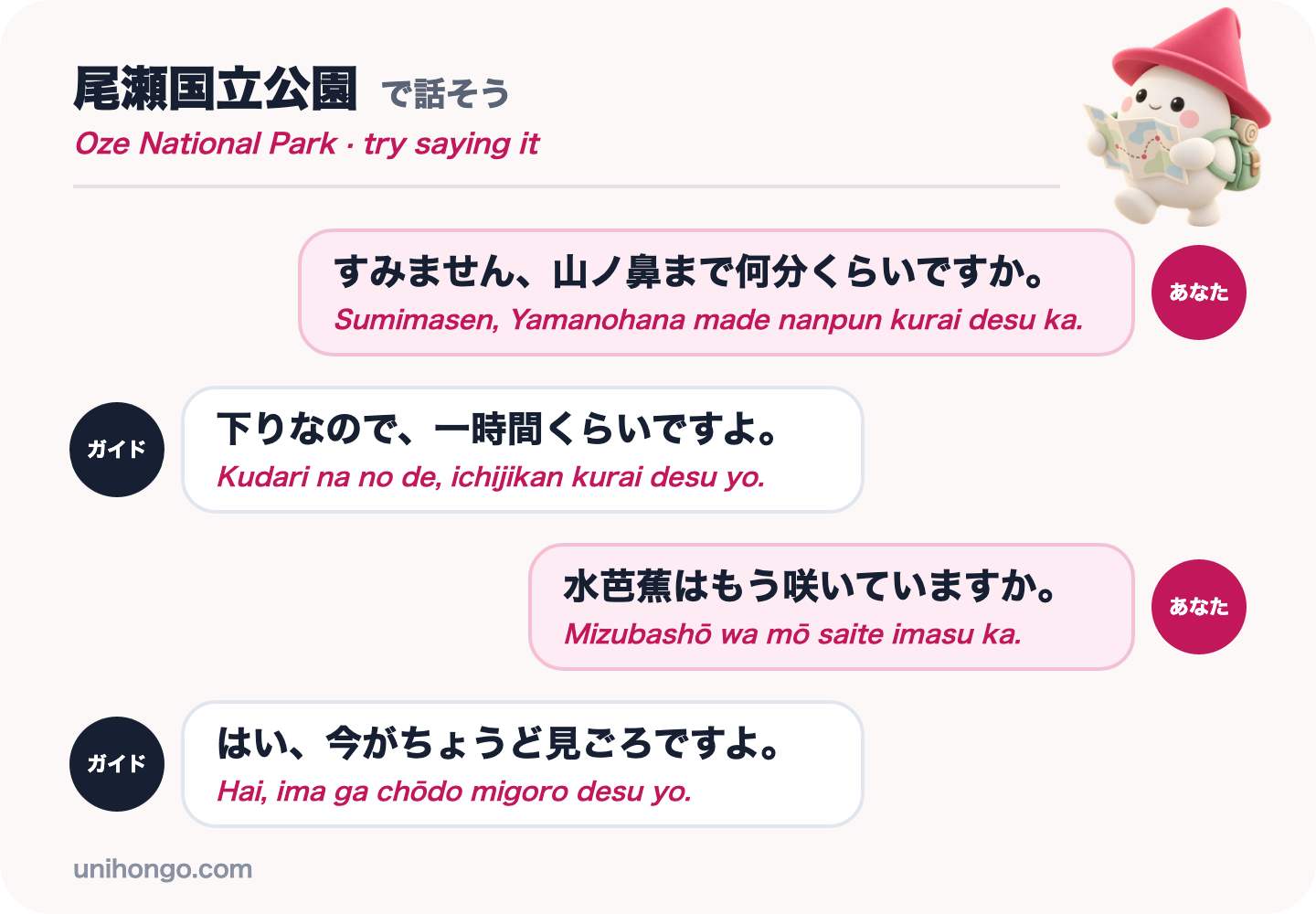
At Hatomachi-tōge the two questions on everyone's mind are how far it is and whether the flowers are out. Practise the four lines below until you can say them without reading, and listen for two words in the replies: kudari, the way down, and migoro, the best time to see something.
Then practise with someone who answers back. In Unihongo, choose the Sightseeing topic and ask your AI Sensei to play a guide at the trailhead, or the Directions topic to rehearse catching the shuttle bus and asking the way at a junction. Saying the lines once before you arrive is what makes them easy on the boardwalk.
| Japanese | Romaji | Meaning |
|---|---|---|
| すみません、山ノ鼻まで何分くらいですか。 | Sumimasen, Yamanohana made nanpun kurai desu ka. | Excuse me, about how many minutes to Yamanohana? |
| 下りなので、一時間くらいですよ。 | Kudari na no de, ichijikan kurai desu yo. | It's downhill, so about an hour. |
| 水芭蕉はもう咲いていますか。 | Mizubashō wa mō saite imasu ka. | Are the skunk cabbages in bloom yet? |
| はい、今がちょうど見ごろですよ。 | Hai, ima ga chōdo migoro desu yo. | Yes, right now is the best time to see them. |
Official information
The Oze Preservation Foundation publishes trail conditions, the visitor rules, flower news and the opening of huts and visitor centres, and the Ministry of the Environment runs the national park pages. Check both for this season's shuttle bus dates and any trail closures before you go.