

Why the Ghibli Museum is worth the planning
The Ghibli Museum is less a museum than a building to get lost in. Hayao Miyazaki set out what he wanted in a short manifesto: a place that relaxes the soul, where visitors are not steered along a fixed route and small children are treated as grown-ups. The result is a house of spiral staircases, bridges, stained glass and hidden corners, full of drawings, models and working machines that show how animation is made.
Its biggest draw is something you cannot see anywhere else: the Saturn Theater, 土星座, Dosei-za, a small basement cinema of about eighty seats that shows original Ghibli short films made only for the museum. The films change through the year, and each visitor may watch once, with the film-strip ticket handed to you at the door.
For a Japanese learner, the museum is a gentle challenge. Many labels are in Japanese only, the staff speak polite service Japanese, and the short films are made to be understood by children. It is a good place to notice how much you understand from pictures and context.
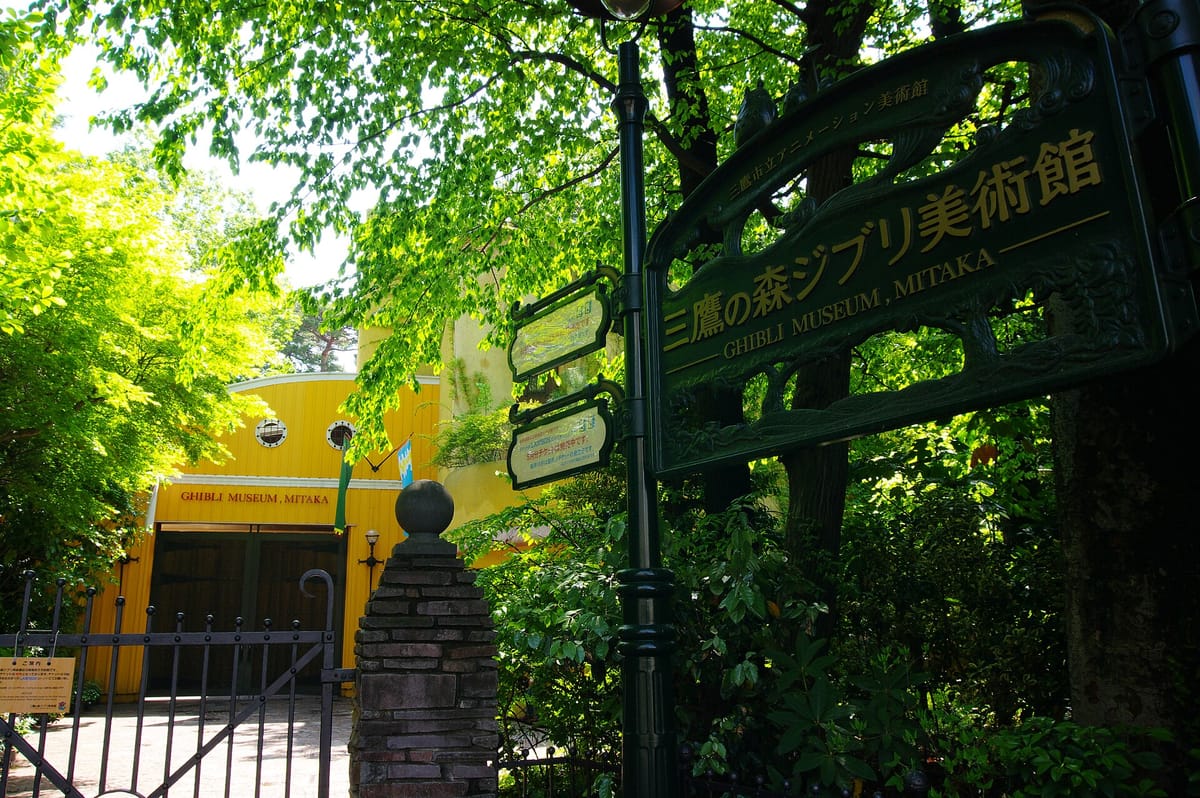
Getting there: Mitaka Station, the community bus and the park walk
The museum is in the western part of Inokashira Park, in Mitaka city. The official route is the JR Chūō Line to Mitaka Station, about twenty minutes from Shinjuku. From the south exit, 南口, minami-guchi, the museum is about fifteen minutes on foot along a path beside the Tamagawa Aqueduct, or you can take the community bus, which runs from Mitaka Station to the museum about every fifteen minutes while the museum is open.
You can also come from Kichijōji, one stop east on the Chūō Line, and walk through Inokashira Park, past the pond and into the woods; allow at least fifteen minutes. This is the most enjoyable route if you are not short of time, and it lets you combine the museum with the pond, the swan boats and the Kichijōji shops. Whichever way you come, leave plenty of margin, because you must enter within one hour of your ticket time.
| Japanese | Romaji | Meaning |
|---|---|---|
| 三鷹駅の南口はどちらですか。 | Mitaka-eki no minami-guchi wa dochira desu ka. | Which way is the south exit of Mitaka Station? |
| ジブリ美術館行きのバスはどこから出ますか。 | Jiburi Bijutsukan-yuki no basu wa doko kara demasu ka. | Where does the bus to the Ghibli Museum leave from? |
| このバスはジブリ美術館に行きますか。 | Kono basu wa Jiburi Bijutsukan ni ikimasu ka. | Does this bus go to the Ghibli Museum? |
| 美術館まで歩いて何分くらいですか。 | Bijutsukan made aruite nanpun kurai desu ka. | About how many minutes' walk to the museum? |
| 吉祥寺から公園を通って行けますか。 | Kichijōji kara kōen o tōtte ikemasu ka. | Can I walk there from Kichijōji through the park? |
What you will see inside: from the Central Hall to the rooftop
There is no set route: the museum asks you to wander. Most visitors start in the Central Hall and drift between floors, but it is worth making sure you do not miss the highlights below.
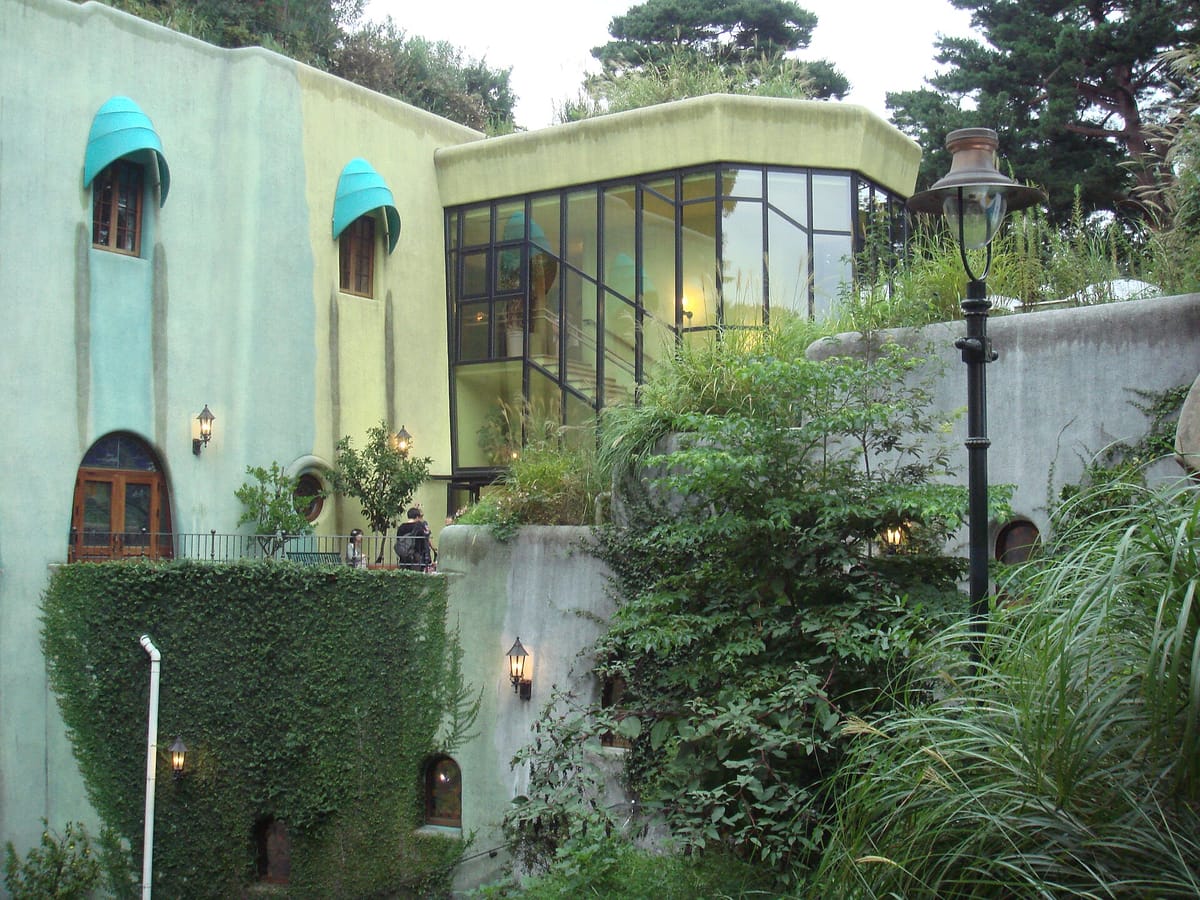
- The entrance: a large Totoro welcomes you, but it is not the real entrance; Totoro shows you where that is.
- The Central Hall: a tall open space of spiral stairs, bridges and terraces under a glass dome.
- Where a Film is Born: five rooms on the first floor set up like the studio of an animator, full of sketches, books and models.
- The exhibition room: a changing exhibition; from November 2025 it has been devoted to the illustrator Yuriko Yamawaki.
- Saturn Theater, 土星座: the small basement cinema showing museum-only short films, with Japanese subtitles at some screenings.
- The Cat Bus room: a soft, furry Cat Bus that children aged twelve and under may climb on.
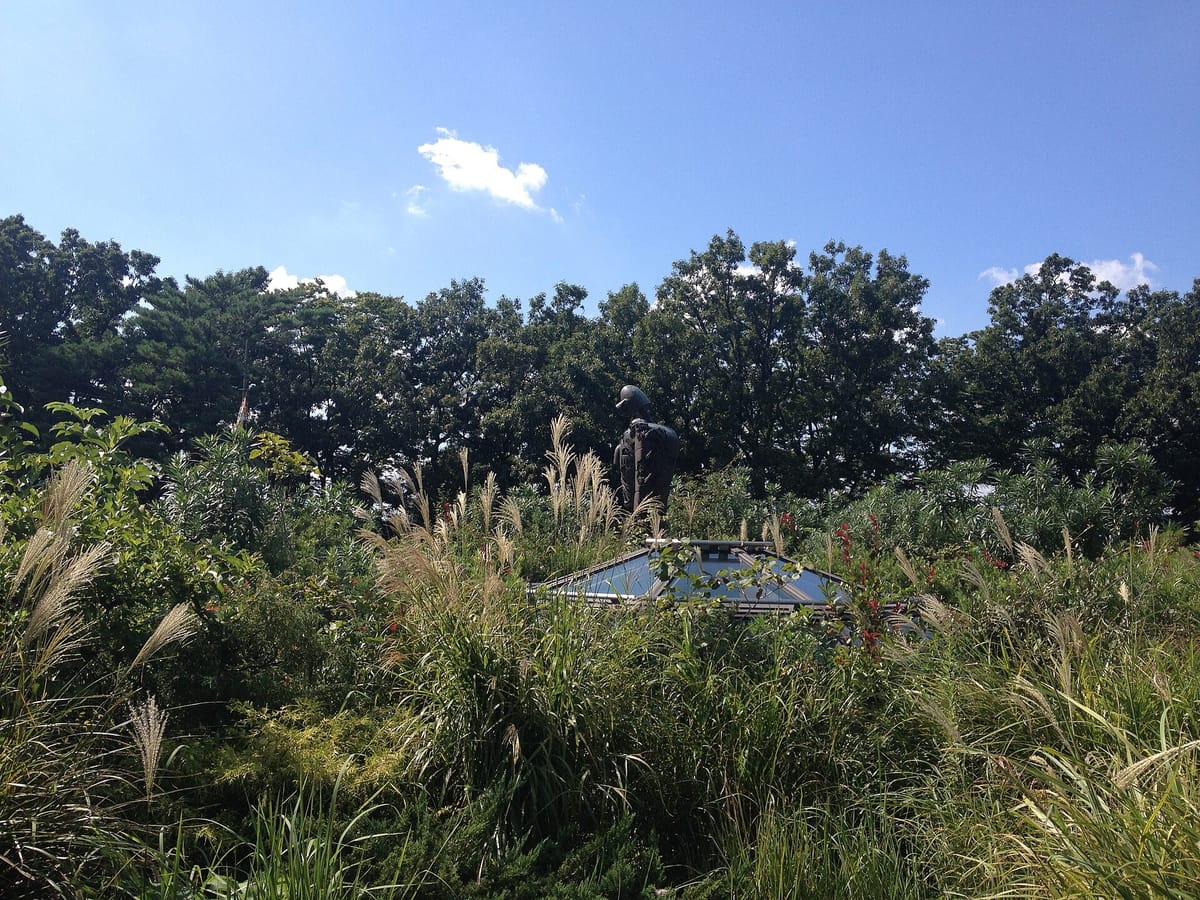
- The rooftop garden, 屋上: reached by a spiral stair, where a five-metre Robot Soldier from Castle in the Sky stands among the grasses.
- Tri Hawks reading room, the Straw Hat Café and the Mamma Aiuto shop, named after the sky pirates in Porco Rosso.
Station, reception and the words on the signs
Your day revolves around a few words. At the station you need 三鷹駅, Mitaka-eki, and 南口, minami-guchi, the south exit. At the museum you exchange your reservation at 受付, uketsuke, reception, where you receive your film-strip ticket, and the key rule is your 入場時間, nyūjō jikan, entry time.
Inside, look for 土星座, Dosei-za, the Saturn Theater, and 屋上, okujō, the roof. You will also see polite notices asking you not to take photos inside, using the soft request go-enryo kudasai, please refrain.
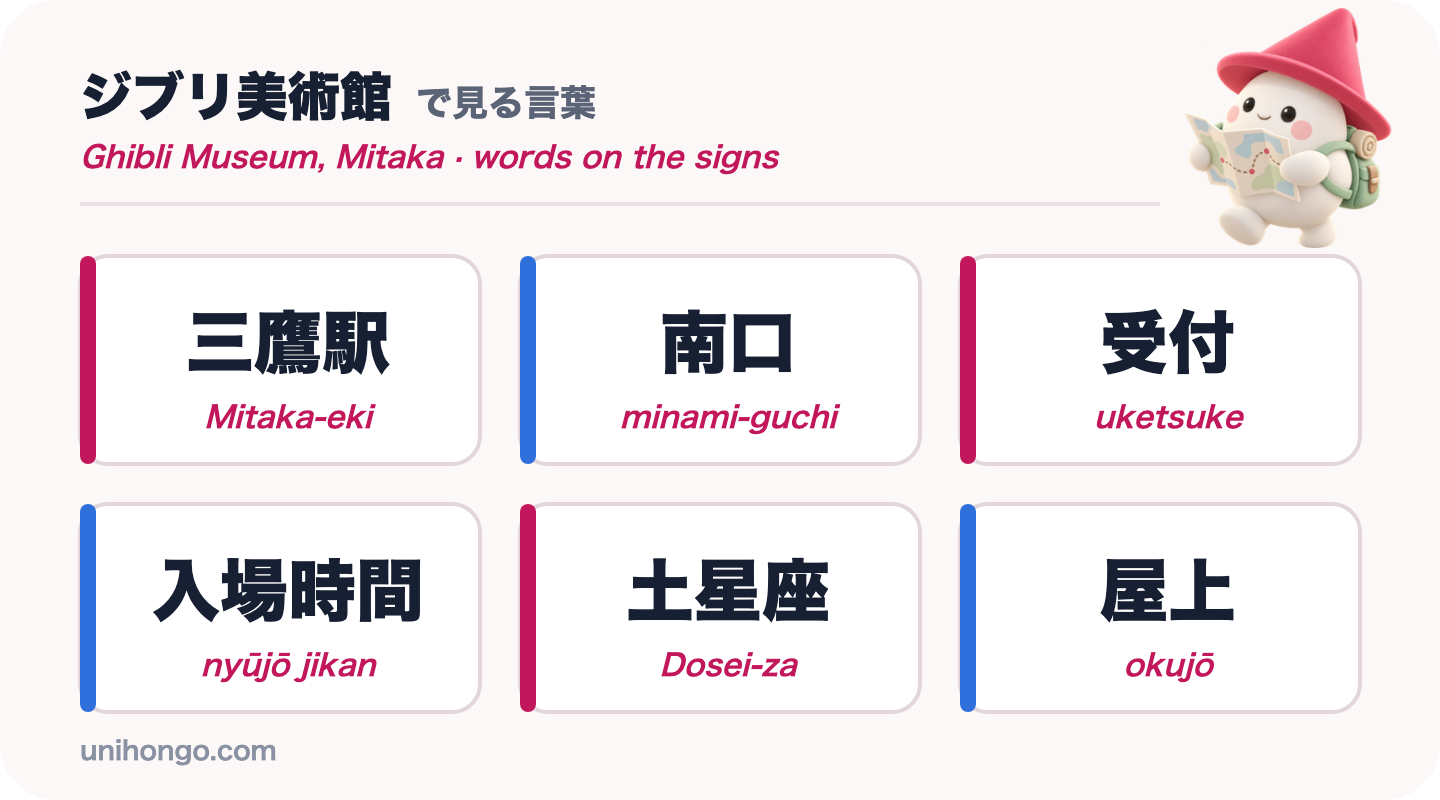
| Word | Reading | Meaning |
|---|---|---|
| 三鷹駅 | Mitaka-eki | Mitaka Station on the JR Chūō Line |
| 南口 | minami-guchi | South exit |
| 受付 | uketsuke | Reception |
| 入場時間 | nyūjō jikan | Entry time on your ticket |
| 土星座 | Dosei-za | The Saturn Theater, the museum's cinema |
| 屋上 | okujō | Rooftop |
| 撮影 | satsuei | Taking photos or filming |
| 休館日 | kyūkanbi | Days the museum is closed |
| 美術館 | bijutsukan | Art museum |
Japanese for tickets, entry and the cinema
Tickets go on sale at 10 a.m. Japan time on the 10th of each month for the whole of the following month, and popular dates, weekends and holidays sell out quickly. Decide your date and entry time before the sale opens, have the ticket site ready, and read its conditions carefully: they explain how you show your ticket and what you may need to bring. Tickets bought for resale are not accepted.
On the day, show your reservation at reception, collect your film-strip ticket, a real piece of 35 mm film, and keep it as a souvenir. Each visitor may watch the Saturn Theater film once. The museum lends audio-assist earphones and runs some screenings with Japanese subtitles; ask at the theatre if you want one of these.
| Japanese | Romaji | Meaning |
|---|---|---|
| 二時に予約している者です。 | Niji ni yoyaku shite iru mono desu. | I have a reservation for two o'clock. |
| チケットはどこで受け取りますか。 | Chiketto wa doko de uketorimasu ka. | Where do I collect my ticket? |
| 土星座はどこですか。 | Dosei-za wa doko desu ka. | Where is the Saturn Theater? |
| 次の上映は何時からですか。 | Tsugi no jōei wa nanji kara desu ka. | When does the next screening start? |
| 屋上へはどうやって行きますか。 | Okujō e wa dō yatte ikimasu ka. | How do I get to the rooftop? |
| コインロッカーはありますか。 | Koin rokkā wa arimasu ka. | Are there coin lockers? |
Museum manners, timing and practical tips
The museum is designed to be calm and personal, and a few habits help keep it that way.
- Buy tickets as soon as sales open for your month; there is no way in without one.
- Check the calendar: the museum is closed on Tuesdays and on other dates that change each year.
- Arrive within one hour of your entry time, and allow for the walk or the bus from Mitaka Station.
- Put the camera away inside the building; outdoor areas such as the rooftop are where visitors take photos.
- Let children go first at the Cat Bus, which is for ages twelve and under only.
- The Straw Hat Café can have a queue at busy times; eat early or late if you can.
- Combine the visit with Inokashira Park and Kichijōji for a full, easy day in west Tokyo.
Practise the visit before you go
The two questions visitors ask most at the Ghibli Museum are about timing and photos. Staff answer politely and firmly, using expressions such as ichijikan inai, within one hour, and go-enryo kudasai, please refrain. Practise both lines until you can say them without reading, and listen for the time in the reply.
Then practise with a partner who answers back. In Unihongo, choose the Sightseeing topic and ask your AI Sensei to play reception staff at the museum, or the Directions topic to rehearse finding the bus at Mitaka Station. Saying the lines aloud once before you go makes them come out at the desk.
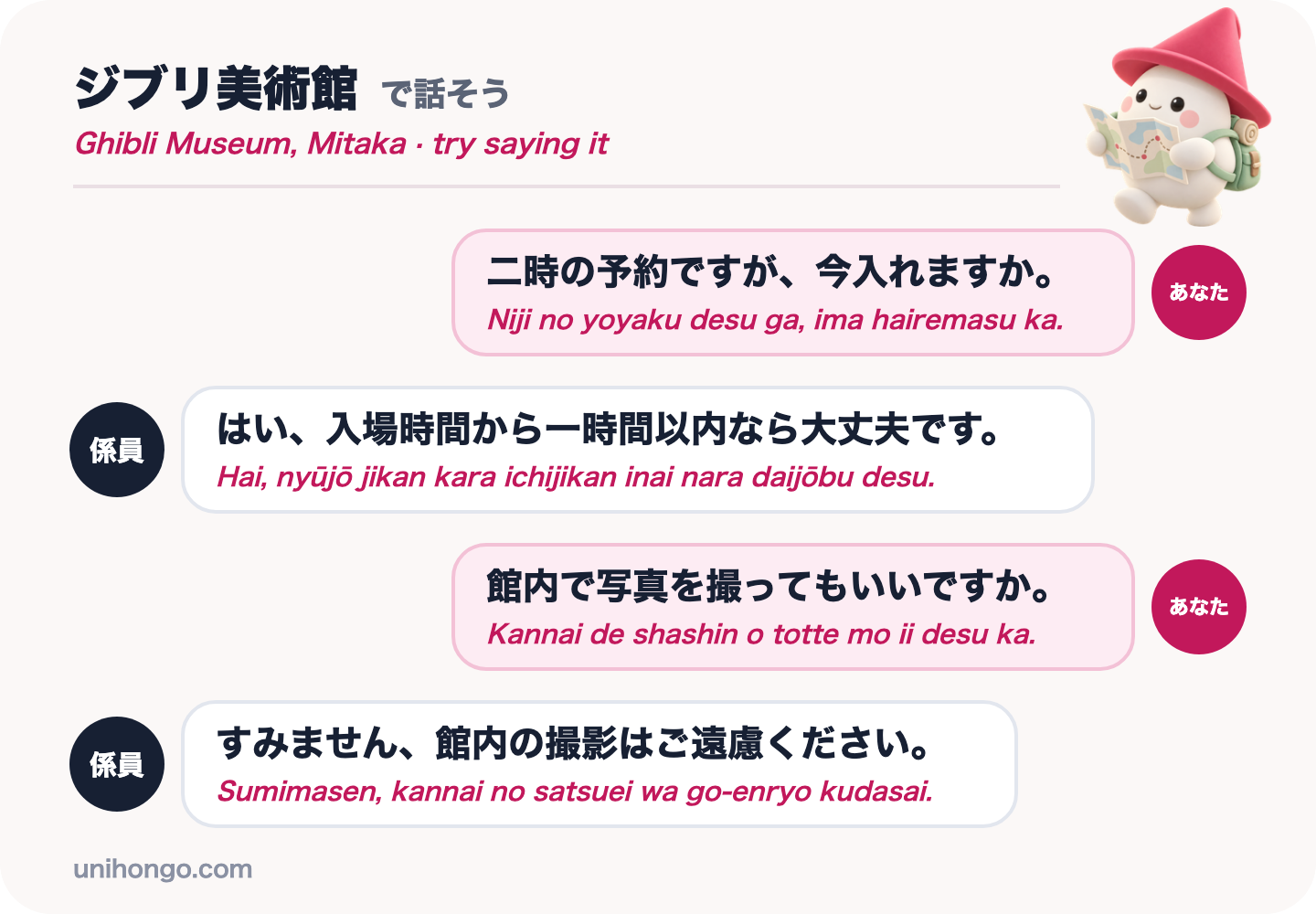
| Japanese | Romaji | Meaning |
|---|---|---|
| 二時の予約ですが、今入れますか。 | Niji no yoyaku desu ga, ima hairemasu ka. | My reservation is for two o'clock. Can I go in now? |
| はい、入場時間から一時間以内なら大丈夫です。 | Hai, nyūjō jikan kara ichijikan inai nara daijōbu desu. | Yes, that's fine within one hour of your entry time. |
| 館内で写真を撮ってもいいですか。 | Kannai de shashin o totte mo ii desu ka. | May I take photos inside? |
| すみません、館内の撮影はご遠慮ください。 | Sumimasen, kannai no satsuei wa go-enryo kudasai. | I'm sorry, please don't take photos inside the museum. |
Official information
Ticket sales, the monthly calendar, closing days, the current exhibition and the film schedule are all published by the museum. Always book through the channels the museum lists on its own ticket page.