
What to have with you
The passport is the requirement people most often get wrong. It has to be the physical document, because the staff scan it and record the purchase against your entry record.
The minimum spend applies per shop per day, and consumables and general goods are counted separately in some shops and together in others, which is worth asking about if you are close to the threshold.
- Your physical passport, not a copy or a photo.
- The card or cash you will pay with, in the same name where possible.
- Awareness of the minimum spend, which applies per shop per day.
- Space in your luggage for a sealed bag you cannot open.
- The paperwork kept with your passport until departure.
Finding the right counter
The main practical difficulty is procedural rather than linguistic: some shops deduct the tax at the register, and others require you to pay in full and then take the receipt to a separate tax-free counter, often on another floor.
Asking at the start saves a second trip, and it is the single most useful question in this guide.
| Japanese | Romaji | Meaning |
|---|---|---|
| 免税はできますか。 | Menzei wa dekimasu ka. | Is tax-free available? |
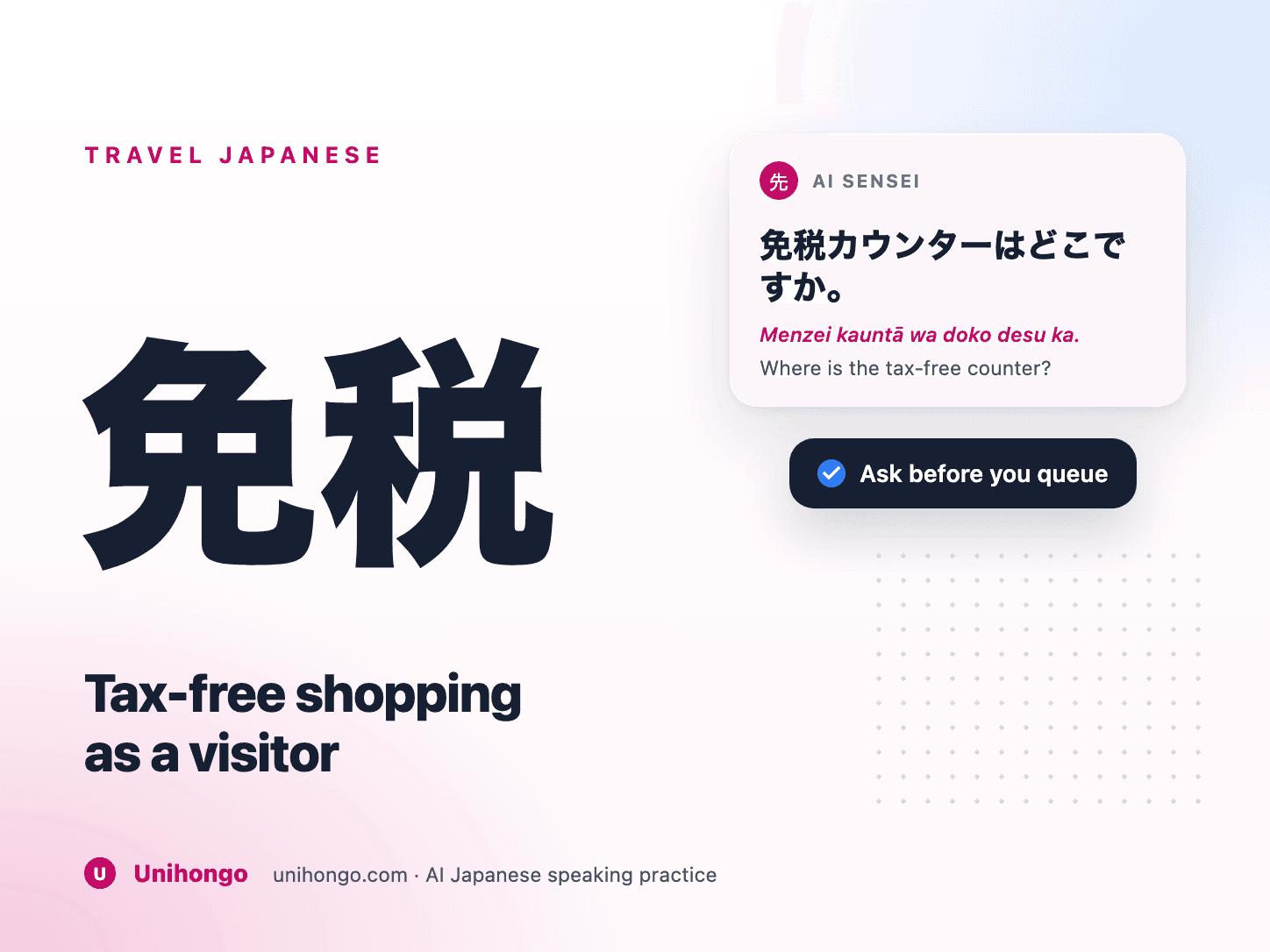
| 免税カウンターはどこですか。 | Menzei kauntā wa doko desu ka. | Where is the tax-free counter? |
| レジで手続きできますか。 | Reji de tetsuzuki dekimasu ka. | Can it be processed at the register? |
| パスポートを持っています。 | Pasupōto o motte imasu. | I have my passport. |
| いくらから免税になりますか。 | Ikura kara menzei ni narimasu ka. | From what amount does tax-free apply? |
| 合計で足りますか。 | Gōkei de tarimasu ka. | Does the total qualify? |
At the counter
The exchange itself is short and largely non-verbal: passport, receipt, a signature, and the goods sealed if they are consumables. Staff at tax-free counters deal with foreign customers constantly and will guide you.
The paperwork is now usually electronic and linked to your passport record rather than stapled into it, but you may still be given a copy.
| Japanese | Romaji | Meaning |
|---|---|---|
| これも一緒にお願いします。 | Kore mo issho ni onegai shimasu. | These as well, please. |
| サインはここですか。 | Sain wa koko desu ka. | Do I sign here? |
| この袋は開けてはいけませんか。 | Kono fukuro wa akete wa ikemasen ka. | Must I not open this bag? |
| いつまで開けられませんか。 | Itsu made akeraremasen ka. | Until when can I not open it? |
| スーツケースに入れても大丈夫ですか。 | Sūtsukēsu ni irete mo daijōbu desu ka. | Is it all right to put it in my suitcase? |
| 書類はどうすればいいですか。 | Shorui wa dō sureba ii desu ka. | What should I do with the paperwork? |
Ask what to do with the paperwork rather than guessing. Practice varies, and keeping it with your passport is the safe default.
Consumables and the sealed bag
Consumables are sealed in a transparent bag that must remain closed until you have left the country. This catches out visitors who buy snacks or cosmetics intending to use them during the trip.
If you intend to use something in Japan, buy it without the exemption. The saving is small and the alternative is either a broken seal or an item you cannot touch for a fortnight.
| Category | Examples | Sealed? | Use in Japan? |
|---|---|---|---|
| Consumables | Food, drink, cosmetics | Yes | No |
| General goods | Clothing, electronics | No | Yes |
| Mixed purchase | Both together | Partly | Goods only |
If you want to use it here, pay the tax. It is a small amount and it avoids the whole problem.
At the airport
On departure the record is checked against your passport, and customs may ask to see the goods, particularly the sealed consumables. Keeping them accessible rather than deep in checked luggage is sensible.
A broken seal, or goods you no longer have, can mean paying the tax at the counter before you fly.
| Japanese | Romaji | Meaning |
|---|---|---|
| 免税品はこちらです。 | Menzeihin wa kochira desu. | The tax-free goods are here. |
| まだ開けていません。 | Mada akete imasen. | I have not opened it. |
| 書類はこれです。 | Shorui wa kore desu. | This is the paperwork. |
| スーツケースの中にあります。 | Sūtsukēsu no naka ni arimasu. | It is inside my suitcase. |
| 確認をお願いします。 | Kakunin o onegai shimasu. | Please check it. |
| これは免税ではありません。 | Kore wa menzei de wa arimasen. | This one is not tax-free. |
A five-minute rehearsal
The whole procedure comes down to two questions at the start and one at the counter, which makes it one of the smallest useful pieces of travel Japanese there is.
Rehearsing the exchange with an AI Sensei in Unihongo's immersive 3D classroom takes five minutes and covers most shops, since the counter script barely varies. The value is being able to ask about the counter before queueing rather than after paying.
The rest is procedural rather than linguistic, and the staff will lead. Knowing what will be asked is most of what makes it comfortable.
Rules and thresholds change from time to time, so confirm the current requirements at the shop rather than relying on an older guide.