

Why the Golden Pavilion deserves an early start
Kinkaku-ji is the popular name of Rokuon-ji, a temple of the Shōkoku-ji branch of Rinzai Zen. It started life at the end of the fourteenth century as Kitayama-den, the hillside retreat of Ashikaga Yoshimitsu, the third Ashikaga shogun, who used it to receive guests and display his wealth. After his death in 1408 his son turned it into a Zen temple, as he had wished.
The pavilion survived centuries of war, including the Ōnin War that burned much of Kyoto, only to be set on fire in 1950 by a young monk of the temple. The event inspired Yukio Mishima's novel The Temple of the Golden Pavilion. The building was reconstructed in 1955, and its gold leaf was later renewed, so what you see is a faithful copy that shines brighter than the original probably ever did.
It is also part of the Historic Monuments of Ancient Kyoto, a UNESCO World Heritage Site. For a learner, the draw is how compact it is: one ticket window, one path, one exit, and a small set of signs you can read in a single visit. Start early and you get both the view and the quiet to read them.
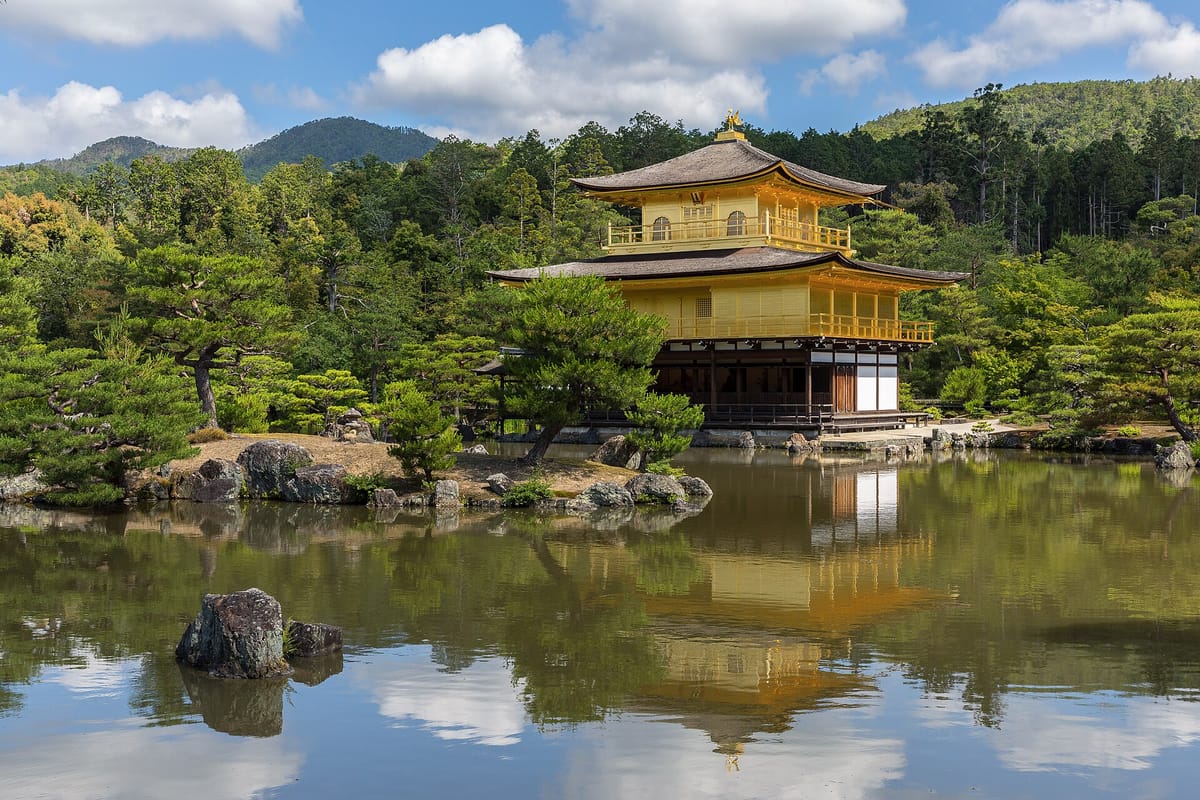
Getting there: bus 205 and the Kinkakuji-michi stop
No train station is close, so most visitors come by city bus. From Kyoto Station, bus 205 runs directly to the Kinkakuji-michi stop in about forty minutes, longer in traffic; the temple gate is a few minutes' walk up the road. Buses 101 and 102 also stop at Kinkakuji-michi, and buses 12 and 59 stop at Kinkakuji-mae, closer to the gate. Kyoto city buses are boarded at the back or middle and paid when you leave, by IC card or cash.
A faster option at busy times is the Karasuma subway line from Kyoto Station to Kitaōji, then bus 204 or 205 from the bus terminal above the station, or a taxi, which takes about ten minutes. Bus 59 links Kinkaku-ji to Ryōan-ji in a few minutes, and many visitors walk the road between them, the Kinukake-no-michi, in around twenty minutes.
| Japanese | Romaji | Meaning |
|---|---|---|
| 金閣寺道に行くバスはどれですか。 | Kinkakuji-michi ni iku basu wa dore desu ka. | Which bus goes to Kinkakuji-michi? |
| このバスは金閣寺に止まりますか。 | Kono basu wa Kinkaku-ji ni tomarimasu ka. | Does this bus stop at Kinkaku-ji? |
| 次は金閣寺道ですか。 | Tsugi wa Kinkakuji-michi desu ka. | Is the next stop Kinkakuji-michi? |
| 金閣寺の入口はどちらですか。 | Kinkaku-ji no iriguchi wa dochira desu ka. | Which way is the entrance to Kinkaku-ji? |
| 龍安寺まで歩いて行けますか。 | Ryōan-ji made aruite ikemasu ka. | Can I walk to Ryōan-ji? |
The garden route: from the pond to the Fudō-dō
Look closely at the pavilion and you will see three different buildings stacked on top of each other. The ground floor, the Hōsui-in, is in the plain palace style of the Heian nobility, with natural wood and white walls. The second floor, the Chōondō, is in the style of a samurai house, and the top floor, the Kukkyōchō, is a Zen Buddhist hall; both upper floors are covered in gold leaf, and a gilt phoenix stands on the roof.
The path is one-way. After the ticket gate you come straight to the rail with the classic view across the pond, then walk along the side of the water past the pavilion, round behind it and up through the wooded garden. You finish at a small shrine hall and the souvenir stalls before the exit, so take your photos at the start; you cannot go back against the flow.
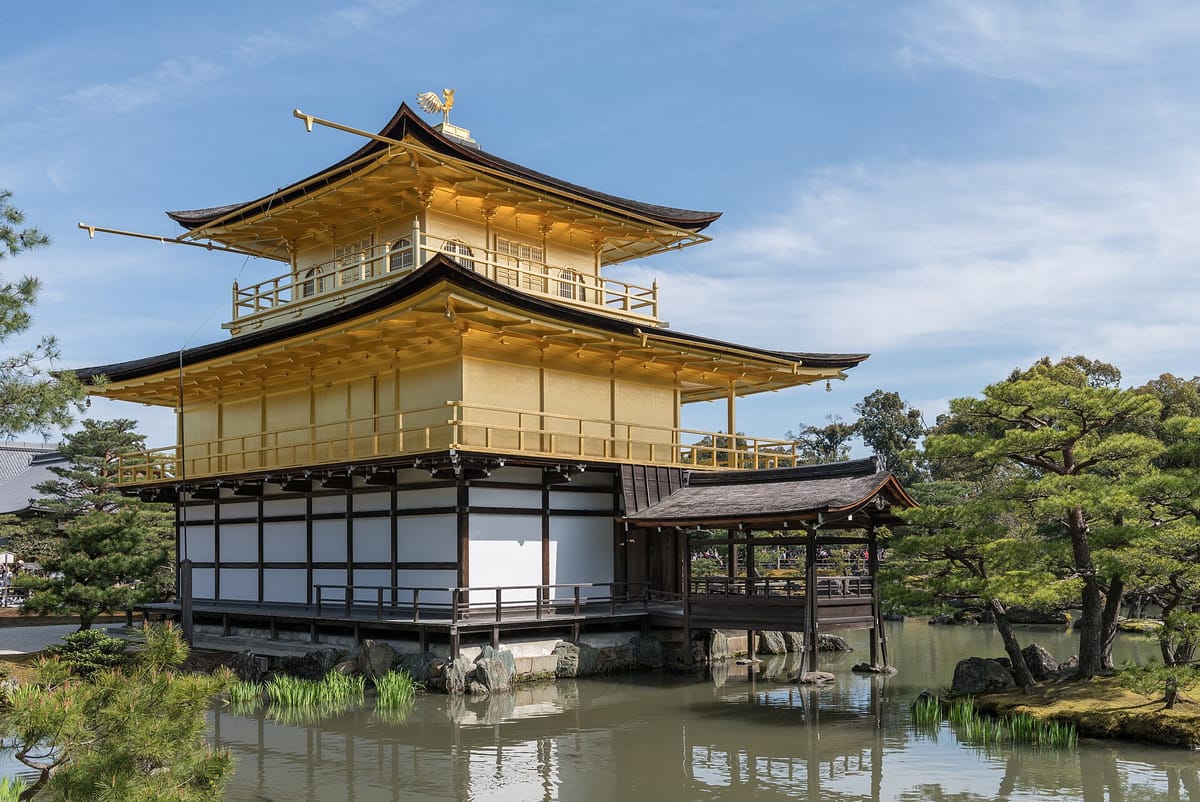
- Kyōkochi: the mirror pond in front of the pavilion, with pine-covered islets and rocks donated by feudal lords.
- Shariden: the Golden Pavilion itself, a relic hall, viewed from outside only.
- Rikushū no matsu: a pine trained into the shape of a boat, said to have been grown by Yoshimitsu, beside the abbot's quarters.
- Ryūmon-daki: a small waterfall with a carp stone, a reminder of the legend of the carp that climbs a waterfall and becomes a dragon.
- Anmintaku: a small, shaded pond higher up the hill, said never to dry up even in drought.
- Sekkatei: a thatched teahouse from the Edo period, seen from the path.
- Fudō-dō: a hall to Fudō Myōō near the exit, where you can pray and buy charms.
The words on the signs, and the talisman ticket
The first sign you meet is 拝観受付, haikan uketsuke, the reception for viewing. Temples say haikan, to view respectfully, rather than nyūjō, admission, and the ticket is a haikanken. At Kinkaku-ji the ticket is unusual: a long slip of paper printed as an o-fuda, a talisman, wishing good fortune and safety to your household. Many visitors take it home and put it up rather than throwing it away.
Once inside, follow 順路, junro, the set route, marked with arrows. The name plates along the water give the pond, 鏡湖池, and the pavilion's formal name, 舎利殿. The table below covers the words you will see from the gate to the exit.
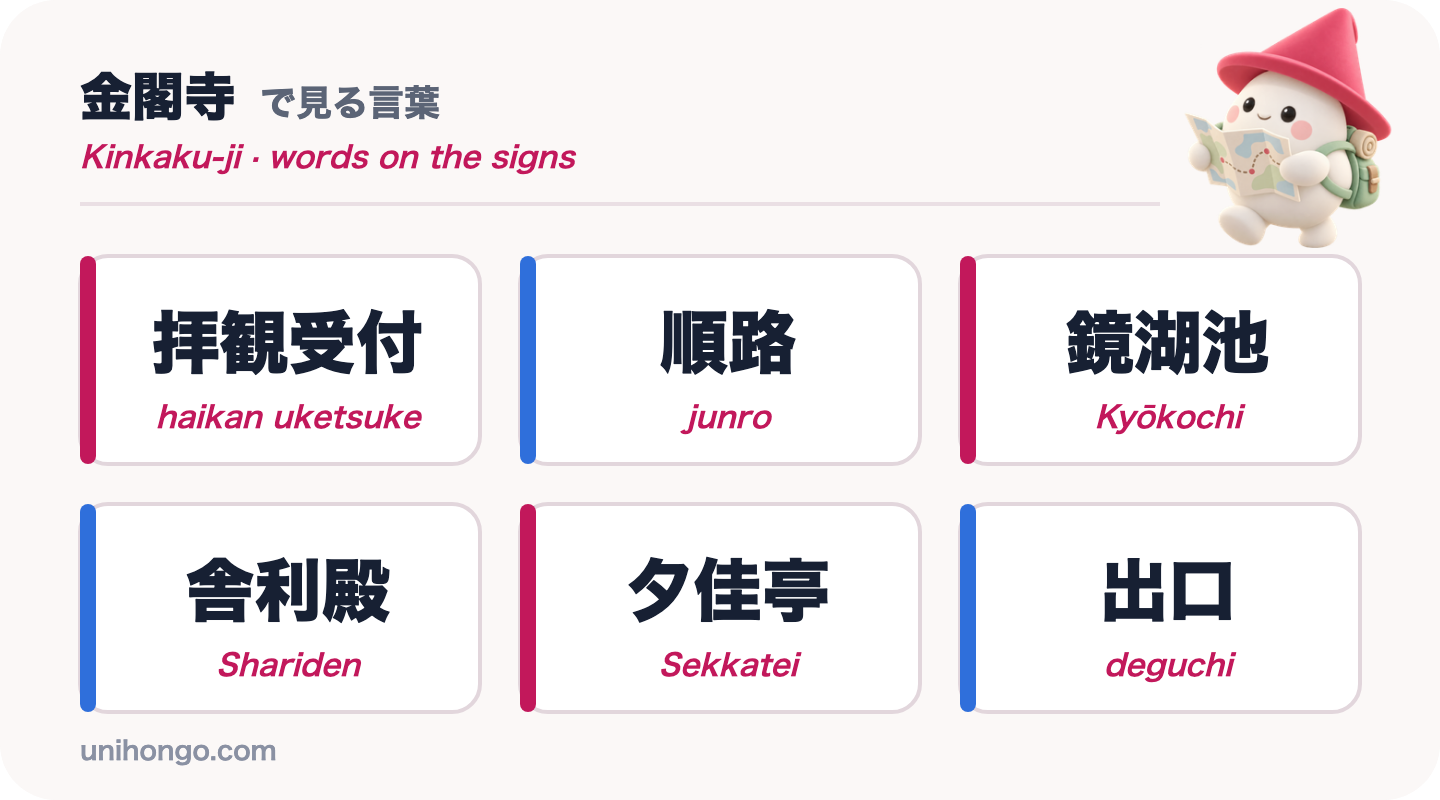
| Word | Reading | Meaning |
|---|---|---|
| 拝観受付 | haikan uketsuke | Ticket window for visitors |
| 拝観券 | haikanken | Entry ticket to a temple |
| 順路 | junro | The set route; follow the arrows |
| 鏡湖池 | Kyōkochi | The mirror pond in front of the pavilion |
| 舎利殿 | Shariden | Relic hall, the formal name of the Golden Pavilion |
| 夕佳亭 | Sekkatei | The thatched teahouse in the garden |
| 不動堂 | Fudō-dō | Hall to Fudō Myōō near the exit |
| 出口 | deguchi | Exit |
| 鹿苑寺 | Rokuon-ji | The temple's formal name |
Japanese at the gate: tickets, photos and matcha
The ticket window is quick, and pointing works, but a sentence of Japanese is noticed and appreciated. Staff are used to questions about photos and the route, and the most common answer you will hear is about keeping the line moving along the rail. Photography is fine in the garden; the unwritten rule at the famous viewpoint is to take your picture and step back so the next person can.
Near the end of the route there is usually a place to sit down for matcha with a sweet, and there are stalls selling omamori and gold-leaf souvenirs. The phrases below cover the whole visit, from the window to the tea.
| Japanese | Romaji | Meaning |
|---|---|---|
| 大人二枚お願いします。 | Otona nimai onegai shimasu. | Two adult tickets, please. |
| このお札は持って帰ってもいいですか。 | Kono o-fuda wa motte kaette mo ii desu ka. | May I take this talisman home? |
| ここで写真を撮ってもいいですか。 | Koko de shashin o totte mo ii desu ka. | May I take photos here? |
| 順路はこちらですか。 | Junro wa kochira desu ka. | Is this the way to go? |
| 抹茶とお菓子のセットをお願いします。 | Matcha to o-kashi no setto o onegai shimasu. | The matcha and sweet set, please. |
| 金箔のお守りはありますか。 | Kinpaku no o-mamori wa arimasu ka. | Do you have a gold-leaf charm? |
Etiquette, crowds and timing
Kinkaku-ji is one of the busiest sights in Kyoto, and the garden path is narrow, so a few habits make the visit easier for everyone.
- Arrive at opening time or late in the afternoon; late morning brings the school groups and tour buses.
- Take your photo at the first viewpoint, then move along the rail. The route is one-way and you cannot return to it.
- Keep to the path and do not step onto the moss or lean over the pond fences.
- Selfie sticks and tripods get in the way on the narrow path; hold the camera close.
- Kyoto buses fill up at peak times. If the 205 is packed, take the subway to Kitaōji and a taxi or bus from there.
- Combine the visit with Ryōan-ji and Ninna-ji along the Kinukake-no-michi for a half day in north-west Kyoto.
Practise the visit before you go
Two questions come up again and again at the gate, and knowing the answers in Japanese helps you understand the reply rather than just nod. Practise the four lines below until you can say them without looking, and listen for the key words in the answers: hairemasen, you cannot enter, and ike, the pond.
Then practise with a partner who answers back. In Unihongo, choose the Sightseeing topic and ask your AI Sensei to play the attendant at Kinkaku-ji, or choose Directions to rehearse the bus ride there and back. Saying the lines once before you arrive is what makes them come out at the window.
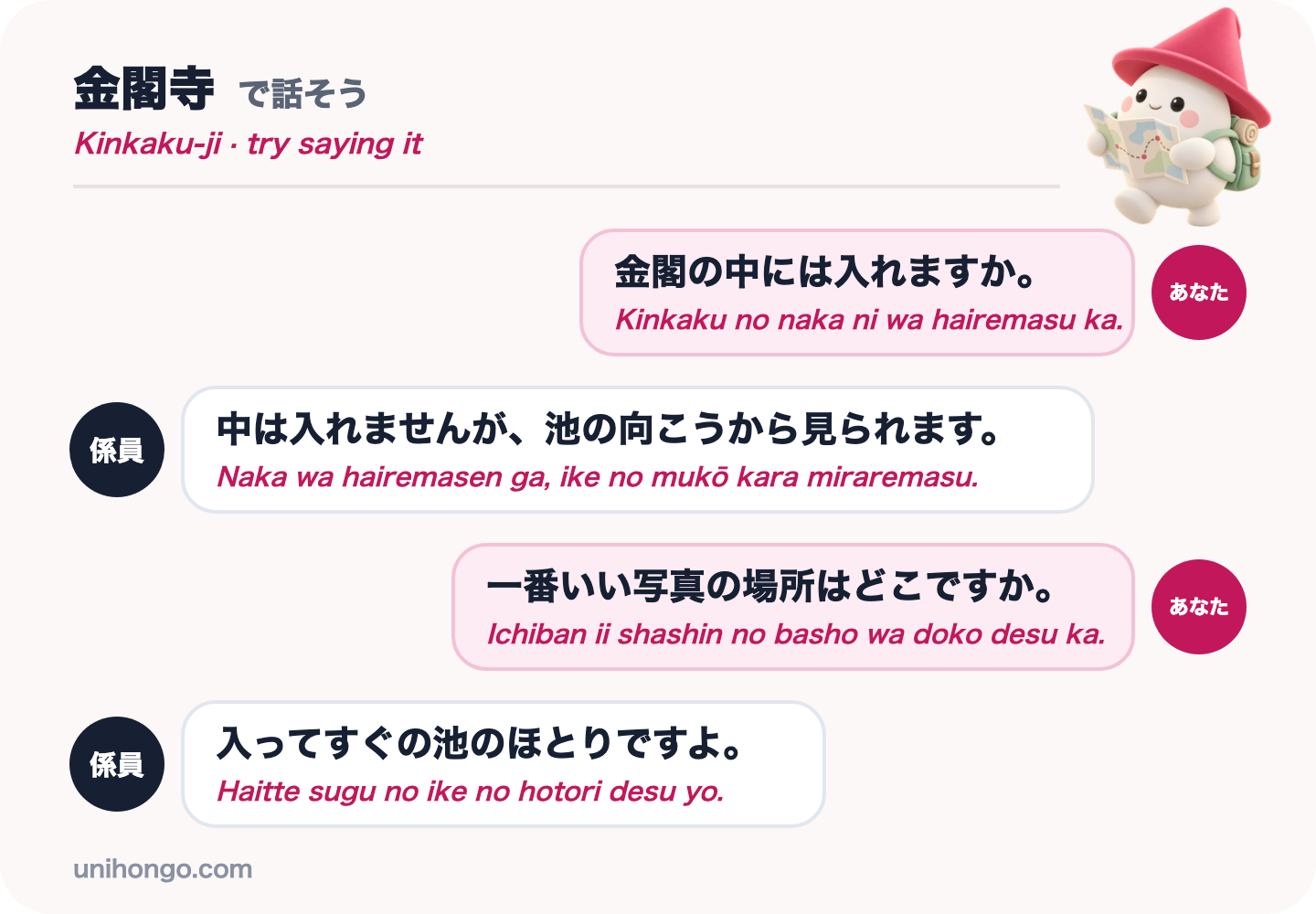
| Japanese | Romaji | Meaning |
|---|---|---|
| 金閣の中には入れますか。 | Kinkaku no naka ni wa hairemasu ka. | Can I go inside the Golden Pavilion? |
| 中は入れませんが、池の向こうから見られます。 | Naka wa hairemasen ga, ike no mukō kara miraremasu. | You cannot go inside, but you can see it from across the pond. |
| 一番いい写真の場所はどこですか。 | Ichiban ii shashin no basho wa doko desu ka. | Where is the best place for a photo? |
| 入ってすぐの池のほとりですよ。 | Haitte sugu no ike no hotori desu yo. | By the pond, just after you come in. |
Official information
Kinkaku-ji's hours, the current fee and any notices are published by Shōkoku-ji, the head temple, on its English site, which also carries a live camera of the pavilion. Check it before you go.