

Why Matsumoto Castle is worth the trip
Most Japanese castles you can visit today are twentieth-century concrete reconstructions with a museum inside. Matsumoto-jō is different. Its main keep, the tenshu, was built by the Ishikawa family in the 1590s and has survived earthquakes, the Meiji government's orders to pull down castles and centuries of snowy winters. It is the oldest surviving five-tier keep in Japan and is one of five National Treasure castles.
It also stands on flat land, not a hill, so you see it at eye level across the moat, with the black lacquered walls, white plaster and layered roofs reflected in the water and the Northern Alps behind. The dark colouring earned it the nickname karasu-jō, crow castle.
For a Japanese learner the visit is a chance to read the kanji of castle architecture, 天守, 櫓, 門, which you will see again at every castle in Japan, and to handle the very Japanese routine of taking off your shoes and carrying them with you.
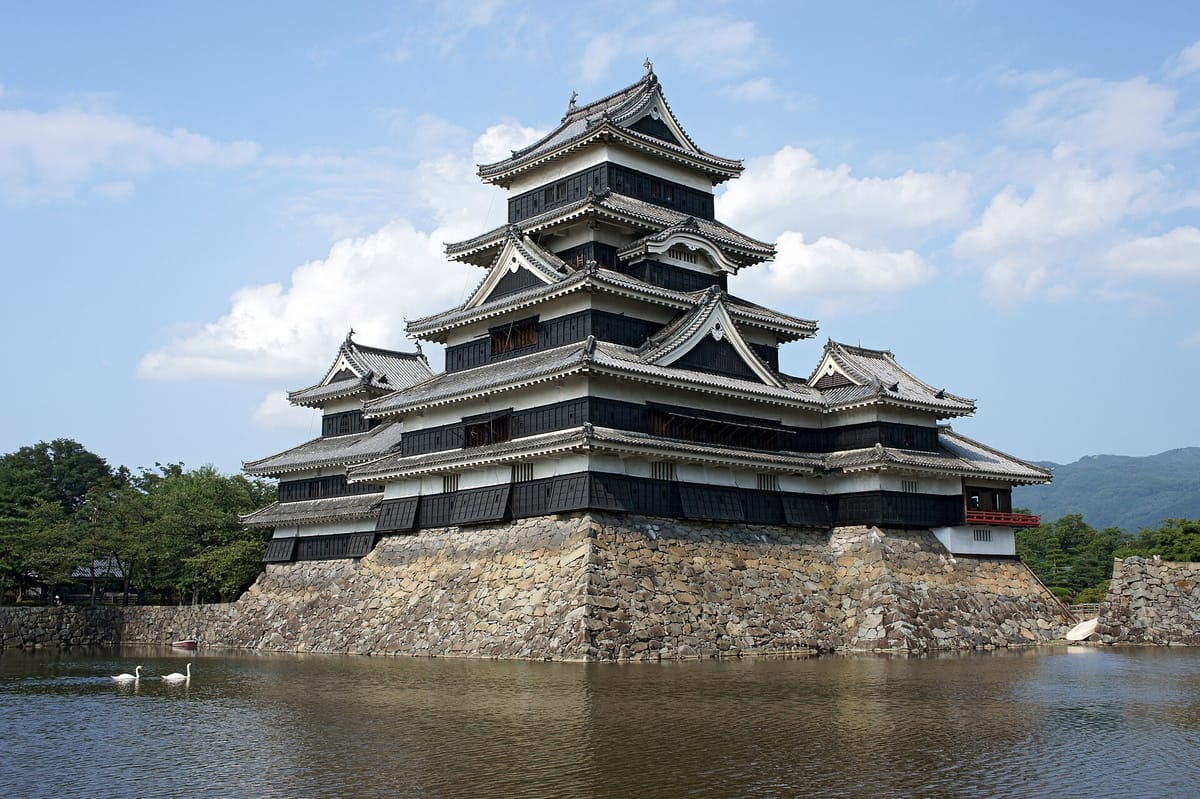
Getting there: Matsumoto Station to the castle
Matsumoto Station is on the JR Chūō Line. From Shinjuku the Azusa limited express takes roughly two and a half to three hours; from Nagoya the Shinano limited express takes about two. The station is also the gateway to Kamikōchi and the Northern Alps, so many travellers combine the two.
Leave by the castle exit, Oshiro-guchi, on the east side of the station. The castle is about fifteen minutes on foot, straight up through the city centre, crossing the Nakamachi and Nawate streets on the way. The Town Sneaker loop bus, northern course, also stops near the castle if it is raining or you are tired.
| Japanese | Romaji | Meaning |
|---|---|---|
| 松本まで、あずさの指定席を一枚お願いします。 | Matsumoto made, Azusa no shiteiseki o ichimai onegai shimasu. | One reserved seat on the Azusa to Matsumoto, please. |
| お城口はどちらですか。 | Oshiro-guchi wa dochira desu ka. | Which way is the castle exit? |
| 松本城まで歩いて何分くらいですか。 | Matsumoto-jō made aruite nanpun kurai desu ka. | About how many minutes on foot to Matsumoto Castle? |
| タウンスニーカーのバス停はどこですか。 | Taun Sunīkā no basutei wa doko desu ka. | Where is the Town Sneaker bus stop? |
| コインロッカーはありますか。 | Koin rokkā wa arimasu ka. | Are there coin lockers? |
From the Kuromon gate to the sixth floor
You enter the inner compound through the Kuromon, the black gate, where the ticket office is, and cross the Honmaru garden, the lawn where the lord's palace once stood. The keep is a group of five connected buildings, and the route takes you through them in a fixed order, up one set of stairs and down another.
Inside, the floors are dark wood, the windows are small and the stairs get steeper and narrower as you climb. There are holes in the floor for dropping stones, slits for archers and gunners, and a third floor with no windows at all that was hidden from the outside. The top floor opens on to views of the city and, on clear days, the mountains.
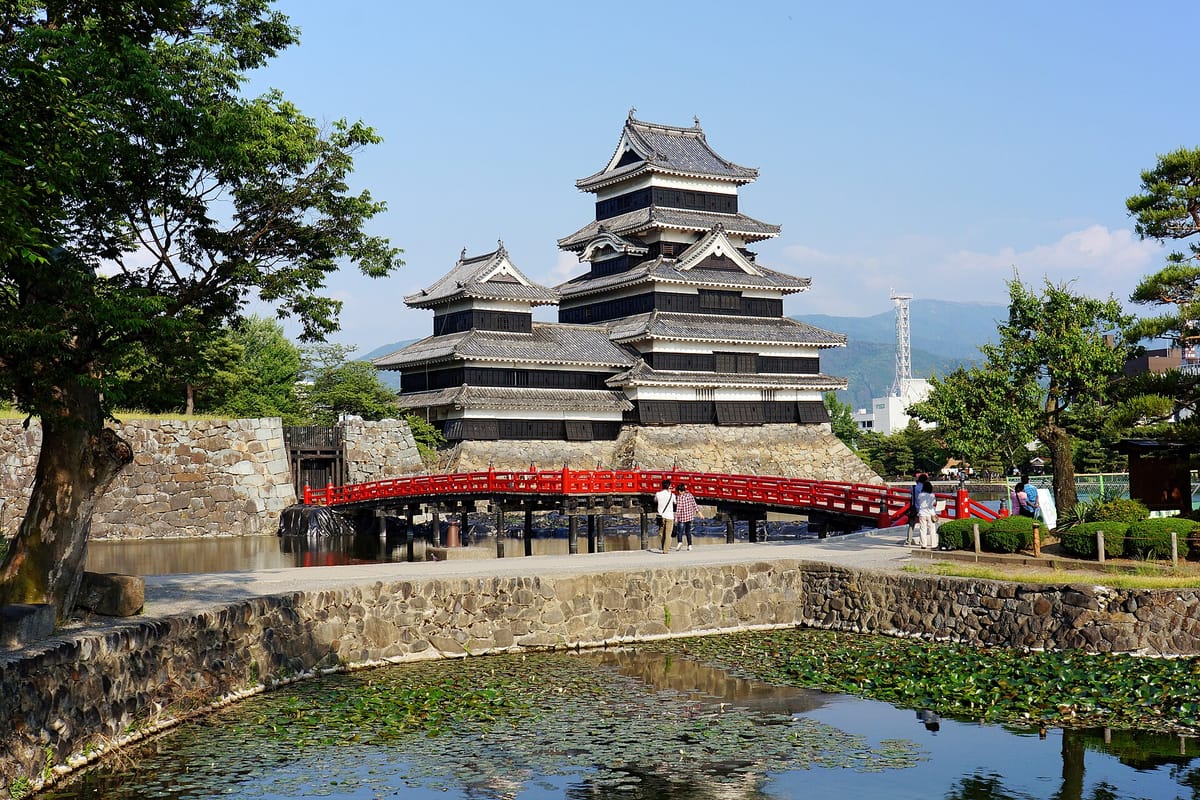
- Kuromon (黒門): the black gate to the inner compound, with the ticket office.
- Honmaru teien (本丸庭園): the garden on the site of the main palace, the best place for photos of the keep.
- Daitenshu (大天守): the main keep, five tiers outside and six floors inside.
- Inui kotenshu (乾小天守): the smaller keep to the north, linked by a covered passage.
- Tsukimi Yagura (月見櫓): a red-railed moon-viewing pavilion added in peacetime, open on three sides.
- Firearms display: a collection of old matchlock guns and armour on one of the lower floors.
- Top floor: a small shrine in the rafters and views in four directions.
Words on the castle signs
Two warnings appear again and again inside the keep. 頭上注意, zujō chūi, means mind your head, and it hangs by every low beam. 急な階段, kyū na kaidan, steep stairs, or simply 階段注意, careful on the stairs, marks each flight. Take them seriously: the steepest stairs are closer to a ladder than a staircase.
Castle vocabulary is compact and reusable. 天守 is the keep, 櫓 is a turret or tower and 門 is a gate. Put a direction or a colour in front and you have the names of most castle buildings in Japan.
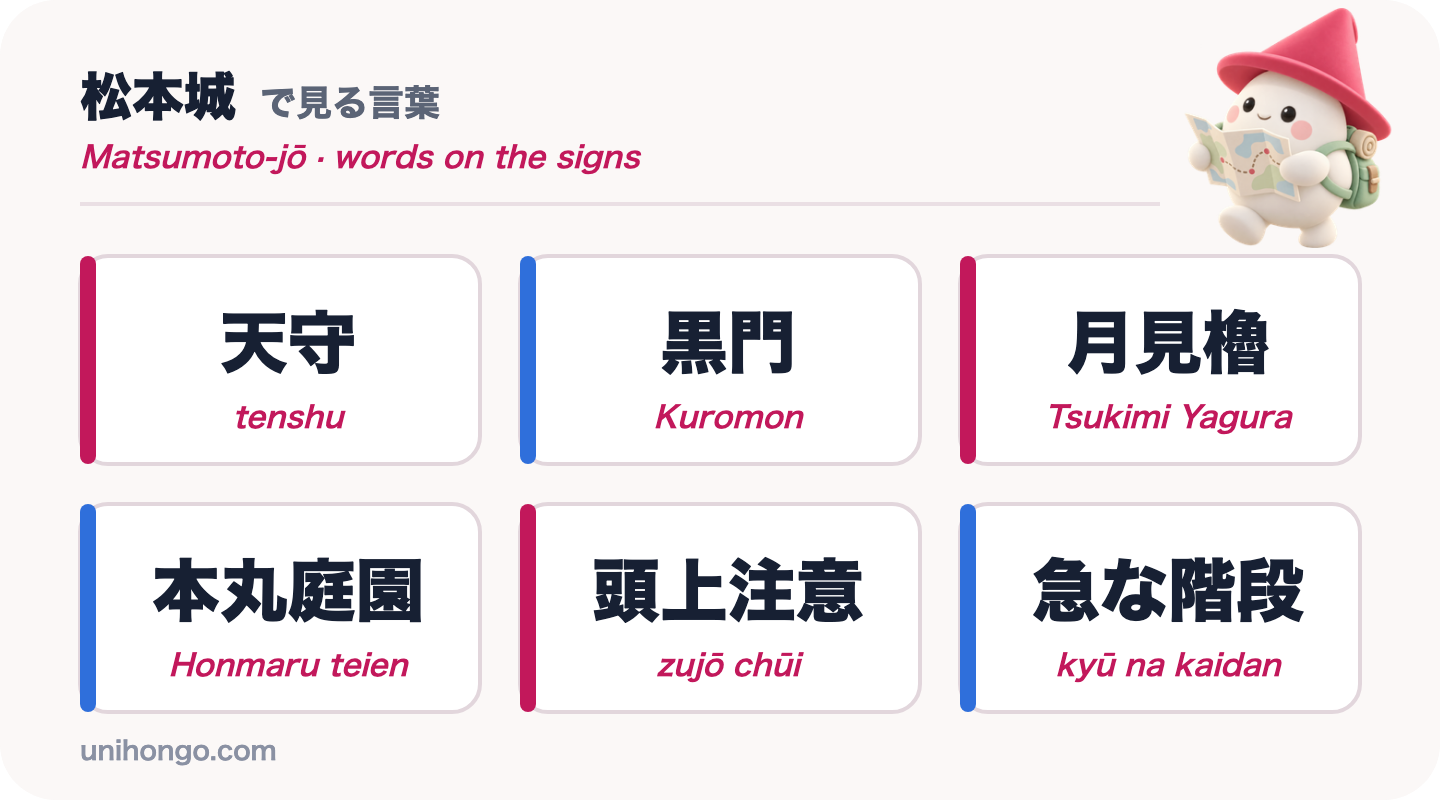
| Word | Reading | Meaning |
|---|---|---|
| 天守 | tenshu | Castle keep, the main tower |
| 黒門 | Kuromon | The black gate, entrance to the inner compound |
| 月見櫓 | Tsukimi Yagura | Moon-viewing pavilion |
| 本丸庭園 | Honmaru teien | Garden on the site of the main palace |
| 頭上注意 | zujō chūi | Mind your head |
| 急な階段 | kyū na kaidan | Steep stairs |
| 国宝 | kokuhō | National Treasure |
| 入場券 | nyūjōken | Admission ticket |
| 撮影禁止 | satsuei kinshi | No photography |
Japanese at the ticket office and the keep entrance
At the Kuromon ticket office you either buy a ticket or show your e-ticket QR code. At the door of the keep, staff ask you to take off your shoes and hand you a plastic bag to carry them in. You walk through the building in socks, so wear a pair without holes and bring something warm for your feet in winter, when the wooden floors are cold.
Staff here speak in polite service Japanese, keigo. You do not need to answer in the same register; plain polite sentences with desu and masu are perfect.
| Japanese | Romaji | Meaning |
|---|---|---|
| 大人二枚お願いします。 | Otona nimai onegai shimasu. | Two adults, please. |
| 電子チケットを買いました。QRコードはこれです。 | Denshi chiketto o kaimashita. QR kōdo wa kore desu. | I bought an e-ticket. Here is the QR code. |
| 靴はこの袋に入れればいいですか。 | Kutsu wa kono fukuro ni irereba ii desu ka. | Should I put my shoes in this bag? |
| 中で写真を撮ってもいいですか。 | Naka de shashin o totte mo ii desu ka. | May I take photos inside? |
| 英語のパンフレットはありますか。 | Eigo no panfuretto wa arimasu ka. | Do you have an English leaflet? |
| 出口はどちらですか。 | Deguchi wa dochira desu ka. | Which way is the exit? |
Etiquette, timing and the streets nearby
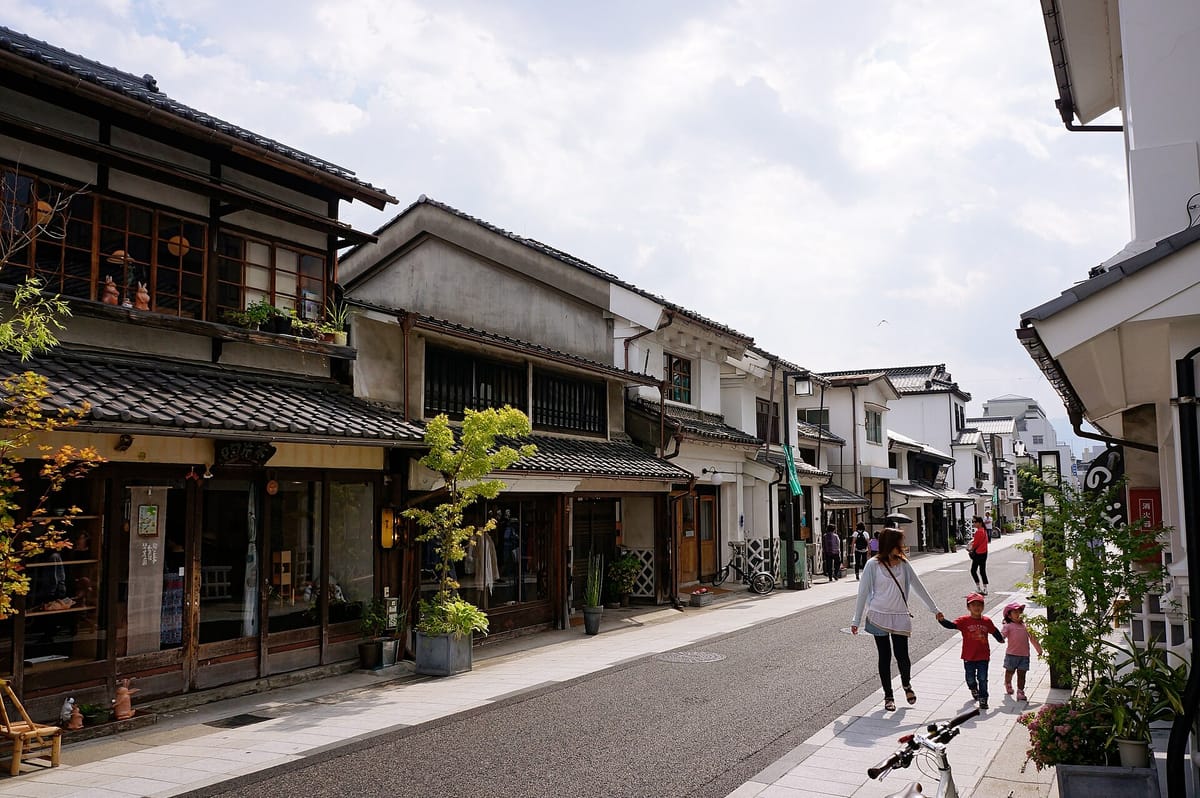
Matsumoto rewards a slow day. After the castle, walk south to the old merchant streets, eat Shinshū soba made from Nagano buckwheat, and come back to see the keep lit up in the evening.
- Arrive soon after opening, especially in cherry blossom season in April, Golden Week in early May and summer weekends.
- Go up and down the stairs slowly, hold the rail, and let people coming the other way pass at landings.
- Leave big bags at a station locker; you need your hands for the stairs and your shoe bag.
- Do not fly drones anywhere over the castle or its grounds; it is strictly forbidden.
- Nakamachi-dōri (中町通り): a street of white-walled storehouses, now craft shops and cafés.
- Nawate-dōri (縄手通り): a narrow riverside shopping street with a frog theme, near the Yohashira shrine.
- Former Kaichi School (旧開智学校): a Meiji-era school building a short walk north of the castle, now a National Treasure.
Practise the keep entrance before you go
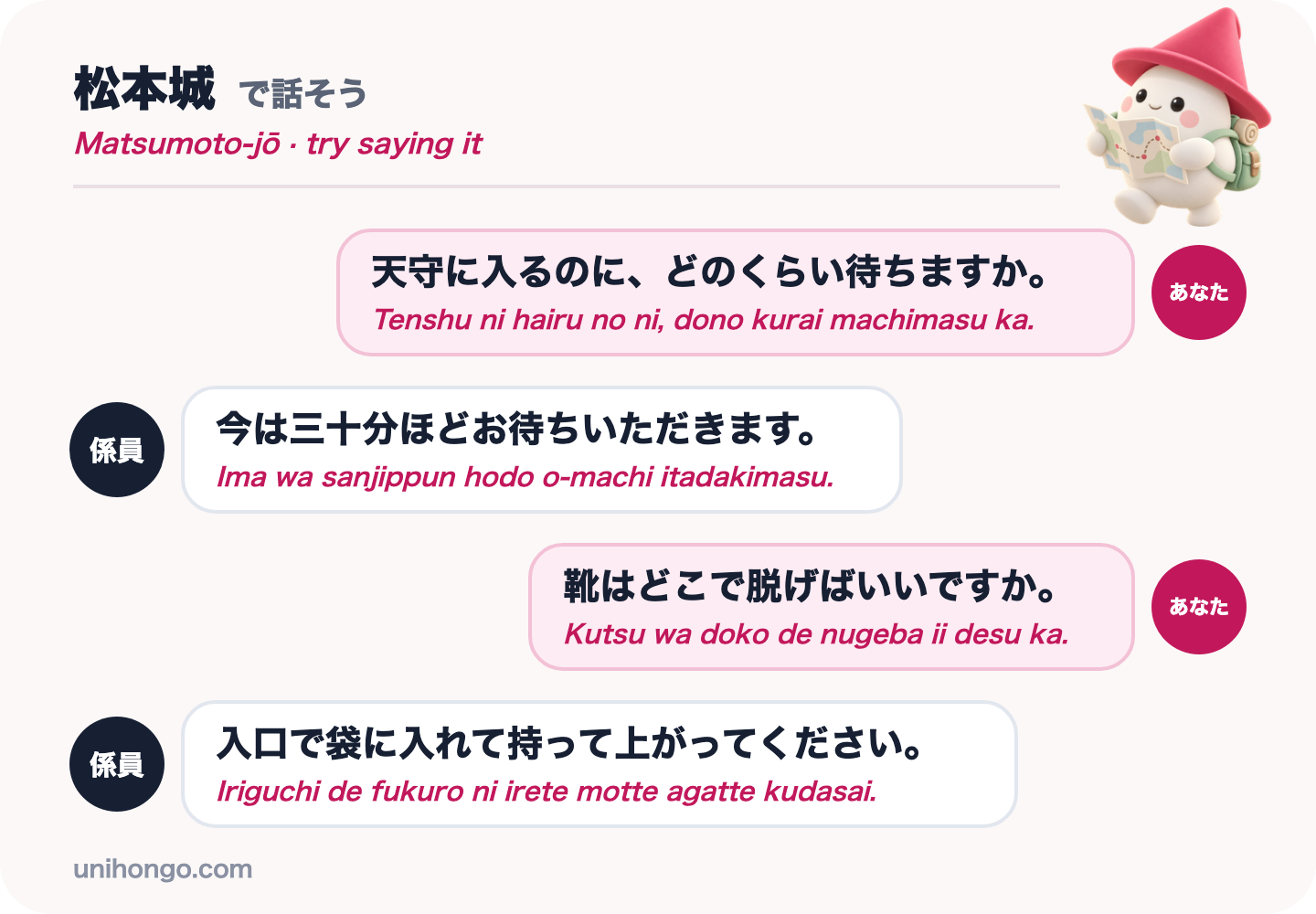
The two questions you are most likely to ask at the castle are about the queue and your shoes. Staff answer with polite forms such as o-machi itadakimasu, literally we will have you wait, which sounds complicated but only means the wait is about this long.
Practise the four lines below until you can say them without reading. Then practise with a partner who answers back: in Unihongo, choose the Sightseeing topic and ask your AI Sensei to play the castle staff, and ask them to use keigo so your ear gets used to it.
| Japanese | Romaji | Meaning |
|---|---|---|
| 天守に入るのに、どのくらい待ちますか。 | Tenshu ni hairu no ni, dono kurai machimasu ka. | How long is the wait to go into the keep? |
| 今は三十分ほどお待ちいただきます。 | Ima wa sanjippun hodo o-machi itadakimasu. | At the moment it is about a thirty-minute wait. |
| 靴はどこで脱げばいいですか。 | Kutsu wa doko de nugeba ii desu ka. | Where should I take off my shoes? |
| 入口で袋に入れて持って上がってください。 | Iriguchi de fukuro ni irete motte agatte kudasai. | Put them in a bag at the entrance and carry them up with you. |
Official information
Hours, fees, e-ticket details, waiting times and seasonal events are published by the castle and by Matsumoto's official tourism site. Check both before you go, especially in holiday periods.